


Brepols Online Books Other Monographs Collection 2013 - bob2013moot

Collection Contents
3 results
-
-
Rationale IV
show More to view fulltext, buy and share links for:Rationale IV show Less to hide fulltext, buy and share links for: Rationale IVWilliam Durand (c. 1230-Nov. 1, 1296), Bishop of Mende, France, was unquestionably the most renowned liturgical scholar of the later Middle Ages. His encyclopedic allegorical exposition of the rites and worship services of the Latin Church, the Rationale divinorum officiorum, or "Rationale for the divine offices," is the best known medieval work in its genre. Divided into eight books of varying length, the Rationale is exhaustive in its treatment of a wide variety of subjects: the church building and liturgical art; the ministers of the church and their functions; liturgical vestments; the Mass and the Divine Office; the Church's calendar and its feast days.
Modern scholarship has clearly shown that Durand's Rationale superseded all previous liturgical commentaries within only a few years of its publication (c. 1292-1296). By the end of the fifteenth century, it had become one of the most widely disseminated treatises of its kind in western Europe.
Book 4, Durand’s lengthy and detailed commentary on the Mass, has never been translated into English. The present volume makes this important text available for modern students of liturgy, musicology, theology, and art history for whom the original Latin text is not accessible. The present translation also provides extensive annotation and explanation of Durand’s sometimes cryptic etymologies, while bringing to light important source material embedded within his commentary.
The source text of this volume appeared in Corpus Christianorum Continuatio Mediaeualis as Guillelmus Durantus - Rationale divinorum officiorum IV (CCCM 140). References to the corresponding pages of the Corpus Christianorum edition are provided in the margins of this translation.
-
-
-
Removing Masculine Layers to Reveal a Holy Womanhood: The Female Transvestite Monks of Late Antique Eastern Christianity
show More to view fulltext, buy and share links for:Removing Masculine Layers to Reveal a Holy Womanhood: The Female Transvestite Monks of Late Antique Eastern Christianity show Less to hide fulltext, buy and share links for: Removing Masculine Layers to Reveal a Holy Womanhood: The Female Transvestite Monks of Late Antique Eastern ChristianityFemale monks have been discussed within the spheres of socio-history, theology, and literary analysis, but no comprehensive study has focused on their historical and gendered context until now. This book reexamines their hagiographies to reveal that female protagonists possess a holy womanhood regardless of having layers of masculinity applied to their characters. Each masculine layer is scrutinized to explore its purpose in the plots and the plausible motivations for the utilization of transvestite figures in religious literature. Hagiographers had no intention of transforming their religious protagonists into anything but determined, holy women who are forced to act drastically in order to sustain ascetic dreams begun while mothers, wives, daughters, and sisters. Through an intertextual method, masculinity and literary themes work to contextualize praise for a holy womanhood within an acceptable gendered language, which seems to support a belief in the spiritual potential of women. This book highlights the potential for complex irony to develop around a female transvestite, which supplies religious tales with intrigue and interest, an ability to instruct/chastise mixed audiences, and a potential to portray the reversal inherent in the human drama of salvation.
Dr. Crystal Lynn Lubinsky received her PhD from the University of Edinburgh in Ecclesiastical History and currently lectures on ancient history and religious studies for the History Department and Religious Studies Program at University of Massachusetts at Dartmouth in the United States. Her research interests and future projects include andromimesis, instances of Christian reversal and redemption, monasteries as refuge, and the Christian Desert Myth.
-
-
-
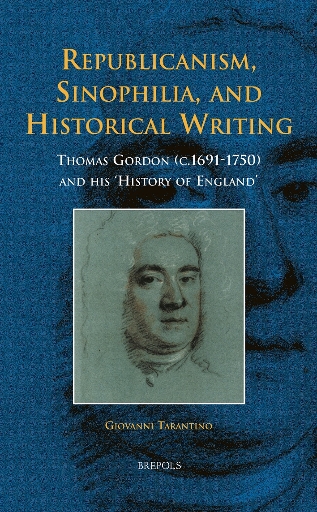
Republicanism, Sinophilia, and Historical Writing
show More to view fulltext, buy and share links for:Republicanism, Sinophilia, and Historical Writing show Less to hide fulltext, buy and share links for: Republicanism, Sinophilia, and Historical WritingThomas Gordon (c.1691-1750) was a prolific Scottish journalist and pamphleteer working in eighteenth-century London. His works circulated in a variety of forms and for many years in Europe and the British North American colonies. Gordon’s conception of ‘republicanism’ was essentially that of a secular and tolerant society free from providential designs; his works reflected a lifelong commitment to defending the rule of law, the balance of powers, and the rotation of representative bodies.
This study sets out to produce a fuller profile of Gordon, to investigate his specific and controversial contribution as a political theorist, and finally to present for the first time an annotated edition of his unfinished and unpublished (mainlymedieval) History of England: a highly readable text whose main metanarrative theme is the struggle between ‘the Government of Will’ and ‘the Government of Laws’- with the struggle between ‘God’s Will’ and ‘the Will of the Clergy’ as an essential rhetorical subtheme.
The book also deals with a hitherto unexplored aspect of Gordon’s thinking, his Sinophilia. Gordon’s ‘sensible Chinese’ is drawn in as a rhetorical tool to voice bitter judgements on both Catholic and Protestant inconsistencies. By resorting to the utopian model of a distant Orient, Gordon aimed to expose the severe impact on Western societies of clerical interference in State affairs, concluding that ‘men who are oppressed, or who foresee inevitable oppression, will be naturally thinking of the means of security and escape’, or possibly dreaming about distant civilizations.
-