


Brepols Online Books Other Monographs Collection 2015 - bob2015moot

Collection Contents
2 results
-
-
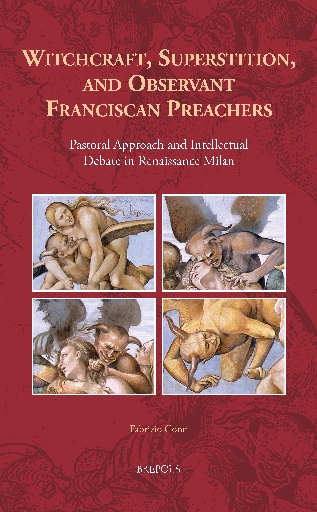
Witchcraft, Superstition, and Observant Franciscan Preachers
show More to view fulltext, buy and share links for:Witchcraft, Superstition, and Observant Franciscan Preachers show Less to hide fulltext, buy and share links for: Witchcraft, Superstition, and Observant Franciscan PreachersThis book offers a new and innovative approach to the study of magic and witchcraft in Italy between the late Middle Ages and the early modern period. Unusually, this subject is explored not through inquisitorial trial records or demonological literature, but through the sermons and confession manuals produced by Observant Franciscan friars, focusing on the so-called ‘pastoral’ approach to folklore, superstition, and witchcraft - an approach that appears to have been notably less harsh than that taken by inquisitors and dedicated demonologists.
Central to this research are the writings of a number of friars active at the friary of St Angelo’s in Milan. Among them were preachers and confessors such as Bernardino Busti, who treated superstition as part of a model that categorized the beliefs and behaviours of the faithful, as well as dedicated intellectuals such as Samuele Cassini, who took scepticism towards elements of belief in witchcraft still further, ultimately leading to a clash with groups such as the Dominicans.
By considering the writings of these men in their wider literary and pastoral context, and in the light of the broader reforming aims of the Franciscans, this unique study not only offers new insights into the late medieval understanding of superstition and witchcraft, but also makes an important contribution to the history of pastoral care.
-
-
-
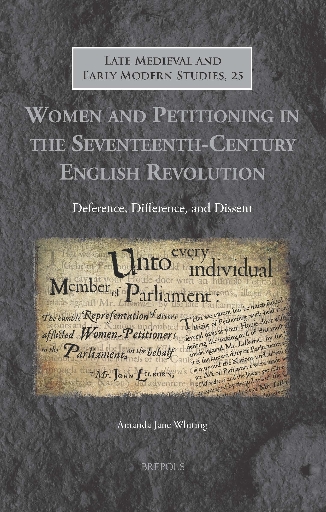
Women and Petitioning in the Seventeenth-Century English Revolution
show More to view fulltext, buy and share links for:Women and Petitioning in the Seventeenth-Century English Revolution show Less to hide fulltext, buy and share links for: Women and Petitioning in the Seventeenth-Century English RevolutionDuring the English Civil Wars and Revolution (1640-60), the affairs of Church and State came under a crucial new form of comment and critique, in the form of public petitions. Petitioning was a readily available mode of communication for women, and this study explores the ways in which petitioning in seventeenth-century England was adapted out of and differed from pre-Revolutionary modes, whilst also highlighting gendered conventions and innovations of petitioning in that period.
Male petitioning in the seventeenth century did not have to negotiate the cultural assumptions about intellectual inferiority and legal incapacity that constrained women. Yet just because women did not claim separate (and modern) women’s rights does not mean that they were passive, quiescent, or had no political agency. On the contrary, as this study shows, women in the Revolution could use petitioning as a powerful way to address those in power, precisely because it was done from an assumed position of weakness. The petition is not simply a text, authored by a single pen, but a series of social transactions, performed in multiple social and political settings, frequently involving people previously excluded from participation in political discussion or action. To the extent that women participated in collective petitioning, or turned their individual addresses into printed artefacts for public scrutiny, they also participated in the public sphere of political opinion and debate.
-