


BOB2020MOME

Collection Contents
4 results
-
-
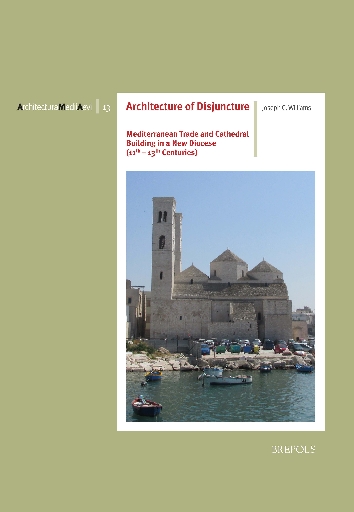
Architecture of Disjuncture
show More to view fulltext, buy and share links for:Architecture of Disjuncture show Less to hide fulltext, buy and share links for: Architecture of DisjunctureThrough careful analysis of the Romanesque cathedral of Molfetta (in Apulia, southern Italy), Williams demonstrates how the commercial boom of the medieval Mediterranean changed the way churches were funded, designed, and built. The young bishopric of Molfetta, emerging in an economy of long-distance trade, competed with much wealthier institutions in its own diocese. Funding for the cathedral was slow and unpredictable. To adapt, the builders designed toward versatility, embracing multi-functionalism, change over time, specialization, and a heterogeneous style.
-
-
-
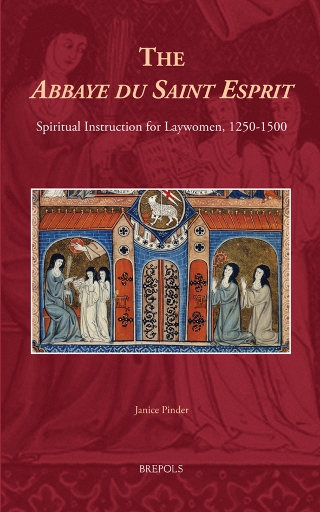
The Abbaye du Saint Esprit
show More to view fulltext, buy and share links for:The Abbaye du Saint Esprit show Less to hide fulltext, buy and share links for: The Abbaye du Saint EspritThe Abbaye du Saint Esprit was a successful work of vernacular spiritual advice for women, surviving in sixteen manuscripts and a widely copied Middle English translation. Unlike many other didactic religious texts, it offers few prescriptions for behaviour; rather, it instructs the reader to build a convent of virtues in her conscience and uses the allegorical structure of the building and its inhabitants to arrange brief teachings on prayer and virtuous practice. Between its genesis in the last quarter of the thirteenth century to its final development towards the end of the fifteenth, it was reworked several times for new audiences of women both lay and cloistered, bourgeois and aristocratic. The examination of these successive adaptations offers insights into the growth of lay religious culture, the participation of women in new religious movements, and the use and transformation of twelfth and early thirteenth-century monastic formation literature for new audiences.This book also offers, for the first time, editions of all the French versions of the Abbaye and a modern English translation of the earliest version.
-
-
-
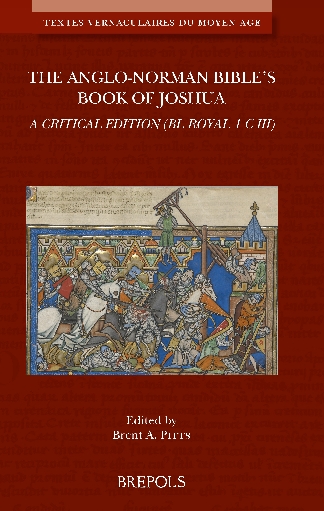
The Anglo-Norman Bible’s Book of Joshua, a Critical Edition
show More to view fulltext, buy and share links for:The Anglo-Norman Bible’s Book of Joshua, a Critical Edition show Less to hide fulltext, buy and share links for: The Anglo-Norman Bible’s Book of Joshua, a Critical EditionThe Anglo-Norman Bible’s Joshua includes tales of spies, giants, the prostitute Rahab, the punishment of Achan, oracles, and Joshua’s brilliant military victories. Joshua stops the sun. The first half of the book relates Joshua’s stunning conquests in Canaan. The second half, the apportionment of the land among the tribes, detailed geographical surveys of territorial boundaries, and the death of Joshua.
Skilful, well-paced story telling is a feature of the ANB’s Joshua. To the accounts of Rahab and Achan we may add the chronicle of Joshua’s successful, crushing campaign in the wake of the destruction of Makkedah. In rapid succession, and in an annalistic style involving staccato repetition of key phrases, the narrator relates the destruction of Libnah, Lachish, Eglon, Hebron, and Debir.
The text of the ANB’s Joshua is extant in British Library Royal 1 C III (base manuscript, L) and Paris, Bibliothèque nationale de France, MS français 1 (P), both c. 1350 and both the Bibles of kings. L belonged at some point in the fifteenth century to Reading’s Benedictine abbey, entering the royal library in 1530. Characteristic of L is its occasional insertion of short glosses in English or Latin to clarify or correct the Anglo-Norman text. An illustrated text, P was prepared by an English workshop for the fourth baron de Welles, John, and his wife, Maud, daughter of William, Lord Ros. This is clearly the Bible of a wealthy and well-connected English family. After the Welles family, the manuscript belonged to Louis de Bruges († 1492), then to King Louis XII of France.
-
-
-
The Anthropology of St Gregory Palamas
show More to view fulltext, buy and share links for:The Anthropology of St Gregory Palamas show Less to hide fulltext, buy and share links for: The Anthropology of St Gregory PalamasHow are we to regard our body? As a prison, an enemy, or, maybe, an ally? Is it something bad that needs to be humiliated and extinguished, or should one see it as a huge blessing, that deserves attention and care? Is the body an impediment to human experience of God? Or, rather, does the body have a crucial role in this very experience? Alexandros Chouliaras’ book The Anthropology of St Gregory Palamas: the Image of God, the Spiritual Senses, and the Human Body argues that the fourteenth-century monk, theologian, and bishop Gregory Palamas has interesting and persuasive answers to offer to all these questions, and that his anthropology has a great deal to offer to Christian life and theology today.
Amongst this book’s contributions are these: for Palamas, the human is superior to the angels concerning the image of God for specific reasons, all linked to his corporeality. Secondly, the spiritual senses refer not only to the soul, but also to the body. However, in Paradise the body will be absorbed by the spirit, and acquire a totally spiritual aspect. But this does not at all entail a devaluing of the body. On the contrary, St Gregory ascribes a high value to the human body. Finally, central to Palamas’ theology is a strong emphasis on the human potentiality for union with God, theosis: that is, the passage from image to likeness. And herein lies, perhaps, his most important gift to the anthropological concerns of our epoch.
-