


BOB2023MOME

Collection Contents
3 results
-
-
Commentary on Isaiah
show More to view fulltext, buy and share links for:Commentary on Isaiah show Less to hide fulltext, buy and share links for: Commentary on IsaiahAndrew of Saint Victor was one of the most prominent biblical scholars of the twelfth century. He was a regular canon of the Parisian abbey of St Victor, founded in 1108, which in the twelfth century had developed into a prestigious center of spiritual learning, closely connected to the nascent university in Paris. Because of his frequent use of Jewish exegetical materials, Andrew's commentaries are a rich source for the history both of biblical hermeneutics and of inter-religious dialogue during the Middle Ages. His Isaiah commentary caused outrage among medieval Christian scholars because it eschewed traditional christological interpretations, and instead offered a reading “according to the Hebrew.” This translation makes this work accessible in English for the first time.
The source text of this volume was published in 2021 by Frans van Liere (Corpus Christianorum, Continuatio Mediaeualis, 53C). References to the corresponding pages of the Corpus Christianorum edition are provided in the margins of this translation.
-
-
-
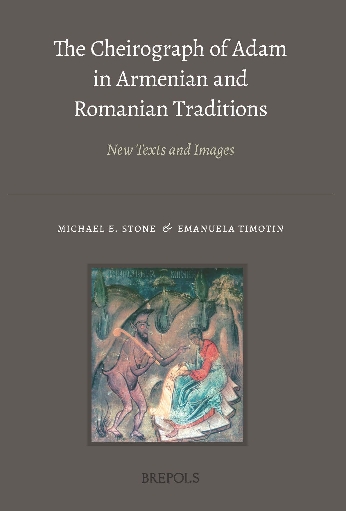
The Cheirograph of Adam in Armenian and Romanian Traditions
show More to view fulltext, buy and share links for:The Cheirograph of Adam in Armenian and Romanian Traditions show Less to hide fulltext, buy and share links for: The Cheirograph of Adam in Armenian and Romanian TraditionsThis book explores the legend of Adam’s Contract with Satan that was made after the expulsion from the Garden of Eden.This legend was current in the Eastern Orthodox churches of SE Europe as well as in the Caucasus. Unknown forms of the legend have been found in two traditions, the Romanian and the Armenian, and are investigated here. Notably this legend has found its way into folk stories and sometimes into folk music, showing how widely it was accepted and distributed. This legend also inspired images in both traditions. In Romania the most striking illustrations are to be found in Bukovina province, in frescos on the famous painted churches of that region, as well as in manuscripts. In Armenia features of this story are incorporated into the iconography of the Baptism of Christ in the River Jordan.
-
-
-
The Church and Cistercians in Medieval Poland
show More to view fulltext, buy and share links for:The Church and Cistercians in Medieval Poland show Less to hide fulltext, buy and share links for: The Church and Cistercians in Medieval PolandIn this volume, the research of Józef Dobosz, one of Poland’s leading historians of the Middle Ages, is made accessible in English for the first time. It brings together nineteen studies focused on the role of the Church, the Cistercian Order, and other religious institutions in the history of the Piast realm from which Poland emerged. The introduction offers a broad outline of the first two centuries of the rule of the Piast dynasty after the Baptism of Poland in 966 until the fragmentation of the Piast patrimony during the twelfth century. The subsequent essays examine the circumstances of the foundation of Poland’s leading Cistercian monasteries in Sulejów, Jędrzejów, Wąchock, Owińska, and Łekno. The author analyses the means of their establishment, evaluates the existing sources, and places these within the context of the Piast dynasty’s economic, political, and social policies.
The studies offer an in-depth analysis of the motivations of the leading dynasts, magnates, and prelates in supporting the mission of the Church in Poland and enabling further embedding of Christianity across all strata of the society. The author examines the oldest Polish documents related to Cistercian monasteries and canons regular (in particular foundation charters) including early medieval charter forgeries. The volume’s key conclusions about the impact of Christianity on nascent Poland are based on a detailed examination of medieval charters, the role of scriptoria, identities of significant people of the Church, and the wider historical record.
-