


BOB2023MOME

Collection Contents
4 results
-
-
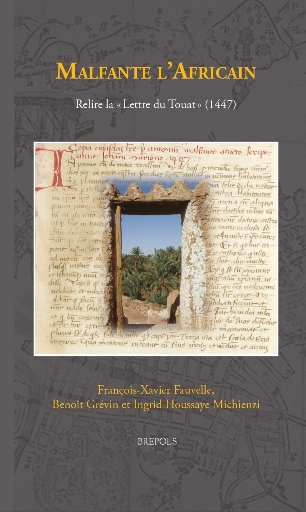
Malfante l’Africain
show More to view fulltext, buy and share links for:Malfante l’Africain show Less to hide fulltext, buy and share links for: Malfante l’AfricainEn 1447, Antonio Malfante, un marchand génois, adresse une lettre en latin depuis Tamentit dans l’oasis saharienne du Touat (actuelle Algérie). Il y décrit la région et livre des informations sur le Sahara et l’Afrique subsaharienne. Dans une perspective d’histoire globale, ce livre explore tous les aspects d’une source exceptionnelle qui relie trois mondes interconnectés : celui des marchands italiens rayonnant en Méditerranée occidentale ; celui des routes sahariennes, du Maghreb à Tombouctou ; celui des royaumes, sociétés et cités de l’Afrique subsaharienne. Une approche interdisciplinaire revisite ce texte fameux. L’analyse philologique corrige nombre d’erreurs présentes depuis la première édition-traduction (La Roncière, 1919), et présente les interactions linguistiques (latin, italien, arabe…). La contextualisation dans l’histoire du commerce transcontinental du xve siècle renouvelle la compréhension de la démarche de Malfante et de ses relais africains. L’analyse africaniste de sa description du Sahara et de l’Afrique subsaharienne lève un voile sur le Nord-Ouest de l’Afrique à une époque de raréfaction des sources écrites. Enfin, une lecture historiographique du texte met en relief les présupposés colonialistes qui ont accompagné sa découverte. Combinant histoire textuelle, commerciale et africaine, cette relecture du « voyage de Malfante » présente une histoire globale euro-africaine, entre christianisme, islam et animisme, entre recherche de profit, description anthropologique et construction d’une image de l’autre.
-
-
-
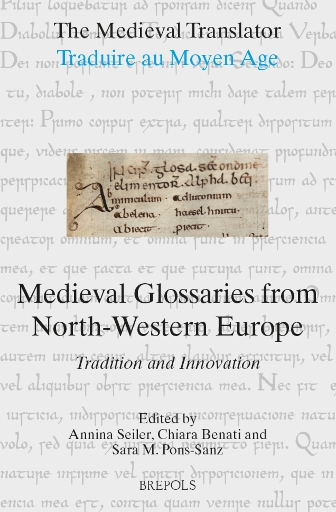
Medieval Glossaries from North-Western Europe
show More to view fulltext, buy and share links for:Medieval Glossaries from North-Western Europe show Less to hide fulltext, buy and share links for: Medieval Glossaries from North-Western EuropeGlossaries are the dictionaries of the medieval period. They were created at a time when no comprehensive dictionary of the Latin language existed, but lexicographical resources were urgently needed to engage with the writings of Classical and Late Antiquity as well as near-contemporary texts. In the non-Romance speaking areas in north-western Europe, the compilers of glossaries were quick to have recourse to their vernacular languages. Glossaries are often the places in which these languages were put into writing for the first time. Hence, the effort to explain Latin vocabulary resulted in bilingual lexicography and in the establishment of the vernaculars as written languages in their own right. The negotiation of linguistic and cultural barriers lies at the centre of the glossaries. Consequently, medieval traditions of glossography are highly interconnected.
This volume represents the first reference work dedicated to medieval glossaries in English and related traditions, including other languages spoken in the British Isles (Celtic languages, Anglo-Norman) and the Germanic languages (High and Low German, Dutch, Scandinavian, Gothic). As such, it is intended as a vademecum for researchers in order to facilitate modern approaches to medieval glossography, lexicology and lexicography, which often require some familiarity with different traditions. Written by experts in the field, the fifty chapters of this volume highlight important characteristics and themes of medieval glossaries and outline different glossographic traditions; they facilitate access to individual glossaries, or groups of related glossaries, by providing detailed discussions of the texts, their sources, relationships and transmission; they also give an account of the current state of research and highlight important resources.
-
-
-
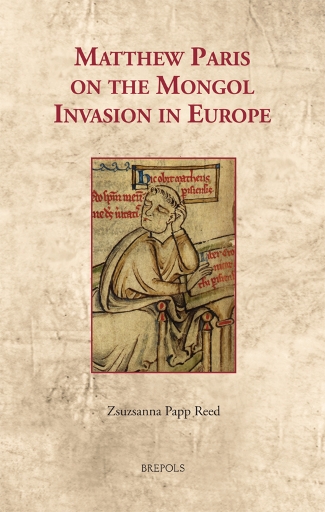
Matthew Paris on the Mongol Invasion in Europe
show More to view fulltext, buy and share links for:Matthew Paris on the Mongol Invasion in Europe show Less to hide fulltext, buy and share links for: Matthew Paris on the Mongol Invasion in EuropeThis is a novel, interdisciplinary study of the Mongol military campaign in Eastern Europe (1241–1242) — the North, as thirteenth-century Europeans saw the region — in the works of contemporary English chronicler, Matthew Paris of St Albans Monastery. Tracing the journey of his sources, the volume explores thirteenth-century information networks against the backdrop of the struggle between Emperor Frederick II and Pope Innocent IV.
Parallel to the history of information, the subject of the study is the Chronica majora and its afterlife, Matthew’s chronicle world where the sometimes fictitious (and often very real) episodes of the Mongol story unfold. Tracing major landmarks in the meta-history of the Chronica majora, the author wishes to emancipate Matthew Paris as a historian — one in the series of a multitude of others who continue to write and rewrite the history of the Mongol invasion across centuries of historiography.
The volume is a handy companion both to scholars of English historiography and those who want to read critically the oft-cited primary sources of the history of the Mongol military operations in Europe.
-
-
-
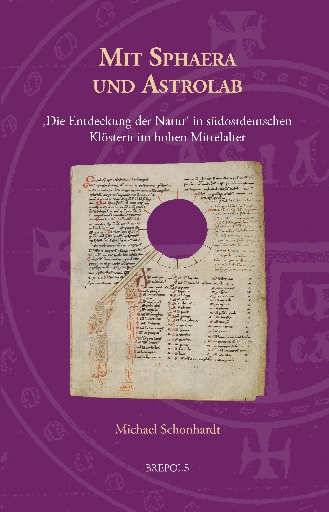
Mit Sphaera und Astrolab
show More to view fulltext, buy and share links for:Mit Sphaera und Astrolab show Less to hide fulltext, buy and share links for: Mit Sphaera und AstrolabThis book offers a study of the scientific landscape of medieval Bavaria during the higher Middle Ages. Based on manuscripts as well as medieval library catalogues, it tries to quantify the so-called ‘Discovery of Nature’ and tries to analyse it from the perspective of a monastic landscape in which the arrival of the astrolab in the 11th century marked a significant turning point. By introducing new methods and questions into the traditional body of Carolingian astronomy, monastic scholars of this area played a decisive, albeit neglected, role in the development of medieval astronomy.
The book reconstructs the studies of the monk Wilhelm von Hirsau who tackled some of the most urgent problems of astronomy of his time: correcting the dates of the solstices and finding latitude. These studies are then placed in the broader development of medieval science, particularly focusing on his sphaera, an instrument that has often been wrongly understood as a teaching device. In contrast, the present study argues that this instrument is not only William’s lost astronomical clock, but also the first example for stationary observational astronomy in medieval Europe as well as an important milestone towards the empirical astronomy of future centuries.
-