


EMISCS13

Collection Contents
41 - 43 of 43 results
-
-
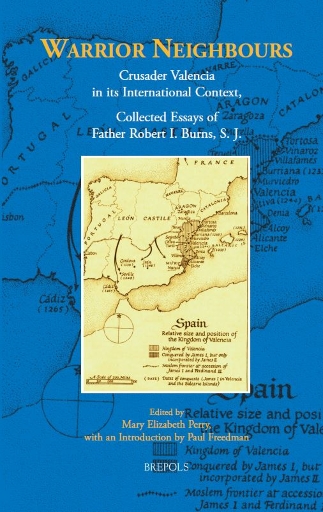
Warrior Neighbours
show More to view fulltext, buy and share links for:Warrior Neighbours show Less to hide fulltext, buy and share links for: Warrior NeighboursThis volume presents the impressive corpus of studies by Robert I. Burns, SJ, on the topic that he has spent a half-century exploring in meticulous detail: the Crusader Kingdom of Valencia. These studies focus on one of Europe’s greatest medieval monarchs, James the Conqueror of Aragon-Catalonia, who made an enduring contribution to Western civilization.
James I ‘the Conqueror’ conquered Mediterranean Spain from Islam during fifty crusading years (1225-1276). Not only did he contend with ‘infidel’ powers around him, he frequently vied with warring Christian neighbours. This book presents a rich depiction of King James’s warrior neighbours, Muslim and Christian, from the king who was his greatest ally and greatest rival, Alfonso X the Learned (1212-1284), to the redoubtable and resourceful al-Azraq, a Muslim adventurer, rebel, and leader of one of the most formidable Islamic countercrusades in Spain. These studies illuminate such themes as cultural conflict and interchange, border tensions and frontier relations, medieval warfare and crusading, piracy, brigandage and reprisals, grievance management, medieval queenship and papal relations, the role of Jews in a pluri-ethnic kingdom, Mudejars and Moriscos, and the warrior heroes of Islam. King James presided over a society more complex than any in Christendom, and these studies unlock the details of this stunning achievement.
Robert I. Burns, SJ, Ph.D. (Johns Hopkins University), Doc. es Sc. Hist. (Fribourg University, Switzerland), was Professor Emeritus of History at UCLA and Director of the Institute of Medieval Mediterranean Spain. He was an elected Fellow of the Medieval Academy of America, and of the Hispanic Society of America, and a Guggenheim Fellow. His distinctions include the Haskins gold medal of the Medieval Academy of America, seven national book awards, eight honorary doctorates, and the Order of the Cross of St George.
-
-
-
The Medieval Paradigm
show More to view fulltext, buy and share links for:The Medieval Paradigm show Less to hide fulltext, buy and share links for: The Medieval ParadigmMedieval culture is marked by a general acceptance of the mental attitude which both recognized and accepted the truths of the dominant religion. This is, then, the ‘general paradigm’ that programmatically directs the paths and results of intellectual activity in the Middle Ages. In the various fields of scientific research, in the different epochs and in the manifold social and institutional situations, there are also produced - based on the ‘general paradigm’ - many ‘particular paradigms’, which carry out some specified and graduated effects of the general one.
The idea pursued during the Congress is an attempt to determine, describe and evaluate the general and particular results the ‘paradigm’ had on the maturation of medieval philosophical and scientific thought with regard to the relationship - that was a dynamic and reciprocal one, and was not necessarily reduced to a theological understanding -between rational inquiry and religious belief.
List of Contributors: G. Alliney, M. Bartoli, A. Bisogno, A. Cacciotti, S. Carletto, C. Casagrande, A. Conti, G. d’Onofrio, P.F. De Feo, C. Erismann, G. Fioravanti, F. Fiorentino, A. Galonnier, R. Gatti, J. Gavin, M. Geoffroy, A. Guidi, M. Laffranchi, R. Lambertini, M. Lenzi, E. Mainoldi, C. Martello, C. Mews, A. Morelli, P. Müller, F. Paparella, M. Parodi, G. Perillo, I. Peta, A. Petagine, P. Porro, F. Seller, K. Tachau, Ch. Trottmann, S. Vecchio, M. Vittorini, J. Ziegler
-
-
-
Writing Down the Myths
show More to view fulltext, buy and share links for:Writing Down the Myths show Less to hide fulltext, buy and share links for: Writing Down the MythsWhat are myths? Are there ‘correct’ and ‘incorrect’ versions? And where do they come from? These and many other related questions are addressed in Writing Down the Myths, a collection of critical studies of the contents of some of the most famous mythographic works from ancient, classical, medieval, and modern times, and of the methods, motivations, and ideological implications underlying these literary records of myth.
While there are many works on myth and mythology, and on the study of this genre of traditional narrative, there is little scholarship to date on the venerable activity of actually writing down the myths (mythography), attested throughout history, from the cultures of the ancient Middle East and the Mediterranean to those of the modern world. By assembling studies of the major literary traditions and texts through a variety of critical approaches, this collection poses - and seeks to answer - key questions such as these: how do the composers of mythographic texts choose their material and present them; what are the diverse reasons for preserving stories of mythological import and creating these mythographic vessels; how do the agenda and criteria of pre-modern writers still affect our popular and scholarly understanding of myth; and do mythographic texts (in which myths are, so to speak, captured by being written down) signal the rebirth, or the death, of mythology?
-