


Antiquité Tardive - Late Antiquity - Spätantike - Tarda Antichità
Revue Internationale d'Histoire et d'Archéologie (IVe-VIIIe siècle)
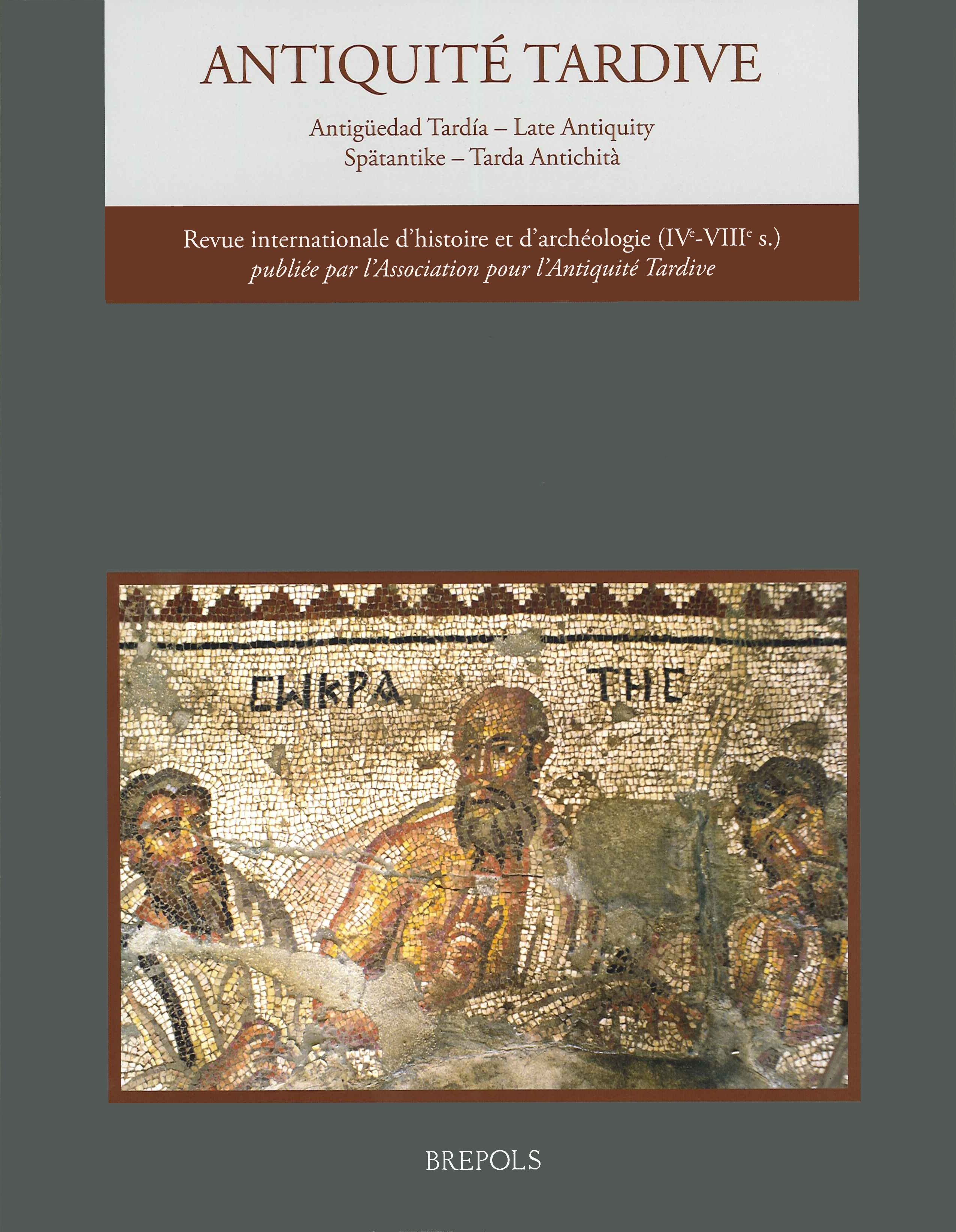
Volume 17, Issue 1, 2010
-
-
El Dies Solis en la legislación constantiniana
show More to view fulltext, buy and share links for:El Dies Solis en la legislación constantiniana show Less to hide fulltext, buy and share links for: El Dies Solis en la legislación constantinianaBy: E. Moreno ResanoAbstractConstantine provided two measures on Sunday’s observance. The first one was the institution of a weekly market (nundinae) every Sunday in the district of Aquae Iasae (Pannonia Superior), dated between the years 316 and 321. The second one is the enactment of a general law, directed to the vicar of the pretorian praefect in the City of Rome, Helpidius, that stablished the Sunday as dies festus, and, consequently, an official and private rest day, with some exceptions.
The terms of the Constantinian dispositions on Sunday were not relative to Christianity. Namely, Constantine legislated on Sunday under the heathen denomination of Dies Solis (“the Day of the Sun”), and never as the Christian Dies Dominicus (“the Day of the Lord”). In fact, the Constantinian dispositions on Sunday indicated the Dies Solis as a day of weekly rest in order to furnish the Roman citizens a weekly space of time dedicated to the observance of vows to the Roman gods.
According to the text of the laws, the first aim of the Constantinian dispositions was the emperor’s achievement of heathen piety (pietas), following the Roman consuetudines. Taking into account that these dispositions were enacted during 323-324, the critical period previous to the second civil war between Constantine and Licinius, they could be considered as a form of Constantinian adhesion to Roman customary religious forms, in opposition with the syncretistical religious cults developed by his reival Licinius in the Eastern provinces of the Empire.
Nevertheless, the Constantinian measures on Sunday were also meant to the Christian citizens, who recognized the Sunday as the “Holy Day of the Lord” after 324. Later, in 335-336, Eusebius of Caesarea developed this identification in De laudibus Constantini, with the emperor’s approvement, but it was not until 386 that the Sunday received a legal sanction as the “Day of the Lord”.
-
-
-
Si fama non fallit fidem: les druides dans la littérature latine de l’Antiquité tardive
show More to view fulltext, buy and share links for:Si fama non fallit fidem: les druides dans la littérature latine de l’Antiquité tardive show Less to hide fulltext, buy and share links for: Si fama non fallit fidem: les druides dans la littérature latine de l’Antiquité tardiveBy: R. WiśniewskiAbstractThis paper deals with the reasons of intense, though short-lived, interest that a few Latin writers of the late 4th century, namely Ammianus, Ausonius and the author of the Historia Augusta, had in the druids. In older scholarship it was commonly believed that the druidic passages in these authors testified to the revival of indigenous Gallic priesthood in the 3rd century, and its survival in the 4th century. Nowadays scholars are more cautious about the actual renaissance of the druidism. However, even if this revival was only a literary phenomenon, the question rises about its sources.
I suggest that there were three reasons of the popularity of the druids. The first was the interest of the late ancient intelligentsia in one’s own people and family history: the druids were attractive both as a subject of research and as forefathers. The second was their philosophical profession, they were viewed as Gallic representatives of Pythagoreanism. The third was the fact that they were teachers, and so proper role models for Ausonius and his fellow-professors. The re-disappearance of the druids from the literature should be linked to the disappearance of Gallic pagan intellectuals.
-
-
-
Silver belt garniture from the tomb outside Romuliana walls
show More to view fulltext, buy and share links for:Silver belt garniture from the tomb outside Romuliana walls show Less to hide fulltext, buy and share links for: Silver belt garniture from the tomb outside Romuliana wallsBy: I. PopovićAbstractLes investigations archéologiques menées hors les murs à Romuliana en 2005 ont été l’occasion d’étudier un tombeau de la nécropole romaine tardive située au sud des remparts du palais. L’utilisation de ce tombeau remonte à la première phase de la nécropole et a été datée de la fin du iiie-début du ive siècle à la fin du vie siècle. La première sépulture est une crémation, confirmée par la présence, à proximité immédiate du mur nord-est du tombeau, de charbons, de bois et d’ossements brûlés. Dans ce dépôt, ont été trouvés un fragment de bord de coupe en argent et deux segments de ceinturon en argent travaillé, extrêmement abîmés par le feu du bûcher. Le décor du ceinturon est composé d’ornements floraux géométriques incrustés d’argent, similaires à ceux trouvés sur les sites de Sackrau Aquincum et Durostorum. Le contexte de cette inhumation, datée de l’extrême fin du iiie siècle, trouve des parallèles dans les sépultures du mémorial 1 dressé sur la colline de Magura, près de Romuliana: on y reconnaît en effet des similarités aussi bien morphologiques que décoratives dans la vaisselle d’argent et le décor du ceinturon.
-
-
-
Jean d’Antioche et ses sources latines
show More to view fulltext, buy and share links for:Jean d’Antioche et ses sources latines show Less to hide fulltext, buy and share links for: Jean d’Antioche et ses sources latinesBy: St. RattiAbstractWe are here investigating about the latin sources of John of Antioch for the imperial period. While John’s chronicle offers doubtless connexions with the Eutropius’ Breviarium, it seems unacceptable to regard the abbreviator’s latin text as John’s basic source for the reigns of Augustus to Jovian, even if we are lead to suppose that John may have enriched his research by consulting ponctually a latine source close to Eutrope. The idea that the Peanios’s Greek translation of Eutropius’ Breviarium could have been used as a source by John has also to be dropped, whereas the assumption that John could have consulted an other Greek translation should not be rejected. Thus Eutropius’ Breviarium is not a basic source to which John could have been continuoulsy enslaved. The chronicler seems more, on the contrary, to have improved an Eutropian Latin and Greek translation from other sources, especially from Dexippus.
Then we are lead to wonder whether John of Antioch could be Leo Grammaticus’ source and thus deserve to be called Leoquelle. Between John of Antioch and Zonaras — perhaps even before John —, there has existed a greek source wich Zonaras used. This source was partly reproducing informations known by latin historiographs from the last thirty years of the fourth century and which can read in quite a developped forme from Eutropius to Ammianus Marcellinus. Finally, it seems that the attribution of the Excerpta Salmasiana to John of Antioch should be refused.
-
-
-
Traduire Lydos. Notes en marge de la nouvelle édition de Jean le Lydien, Des magistratures de l’État romain …
show More to view fulltext, buy and share links for:Traduire Lydos. Notes en marge de la nouvelle édition de Jean le Lydien, Des magistratures de l’État romain … show Less to hide fulltext, buy and share links for: Traduire Lydos. Notes en marge de la nouvelle édition de Jean le Lydien, Des magistratures de l’État romain …By: D. FeisselAbstractThe new edition of ‘On the Magistracies’, published by Budé in 2006, does not offer a profoundly altered text from earlier versions (Wünsch, 1903; Bandy, 1987). But it is the first to provide a systematic commentary on the work, running to more than 1000 pages, together with a French translation which is more readable than the two earlier English translations. That translation does however still call for a series of corrections, particularly in connection with the difficulties of Late Antique administrative vocabulary. The resolutions offered below are supported by brief explanatory notes. In some cases our translation will lead to a modification of the Greek text.
-
-
-
Review of R. Bagnall (ed.), Egypt in the Byzantine World, 300-700 (Cambridge, 2007)
show More to view fulltext, buy and share links for:Review of R. Bagnall (ed.), Egypt in the Byzantine World, 300-700 (Cambridge, 2007) show Less to hide fulltext, buy and share links for: Review of R. Bagnall (ed.), Egypt in the Byzantine World, 300-700 (Cambridge, 2007)By: A. LópezAbstractCes lignes proposent le compte rendu d’un ouvrage collectif issu du Dumbarton Oaks Spring Symposium in Byzantine Studies tenu en 2004 et consacré à «l’Égypte dans le monde byzantin, 450-700». Deux principaux thèmes régissent l’ensemble du volume: l’un concerne les effets des changements et/ou des permanences qu’a manifestement connus le ve siècle mais qui n’ont laissé que très peu de témoignages; l’autre le potentiel qu’offre une histoire comparative qui inscrit l’Égypte dans contexte élargi du Proche-Orient romain tardif.
-
-
-
CIL VI, 1783,16-17: plerique meministis (e considerazioni sparse sull’impiego di plerique)
show More to view fulltext, buy and share links for:CIL VI, 1783,16-17: plerique meministis (e considerazioni sparse sull’impiego di plerique) show Less to hide fulltext, buy and share links for: CIL VI, 1783,16-17: plerique meministis (e considerazioni sparse sull’impiego di plerique)By: A. BaldiniAbstractThe pressing problem is if Theodosius I really went to Rome after the Frigidus. CIL VI, 1783 is an epigraphical statement about a Theodosian speech as soon as Nicomachus Flavianus senior was dead, that is after the battle. Scholars have different ideas: one is that Theodosius I really went to Rome, the second is that in the inscription the reference is at a senatorial delegation in Milan. My suggestion starts from the deliberation that Nicomachus Flavianus junior was the redactor of the letter in CIL VI, 1783; the HA, if it was not written by Nicomachus Flavianus junior, may be is the product of similar circles. Here, I consider some literary uses of plerique, in particular in the HA. I add also some notices on oratio (principis) in the HA, and my proposal is that Theodosian words in the tradition were not from him directely, but from an oratio principis, according to a widespread routine in Late Antiquity.
-
-
-
La subversion du genre romanesque dans le De nuptiis Philologiae et Mercurii de Martianus Capella
show More to view fulltext, buy and share links for:La subversion du genre romanesque dans le De nuptiis Philologiae et Mercurii de Martianus Capella show Less to hide fulltext, buy and share links for: La subversion du genre romanesque dans le De nuptiis Philologiae et Mercurii de Martianus CapellaBy: B. BakhoucheAbstractIn Martianus Capella’s Wedding of Philologia and Mercury, using novel as a ‘genre’ is the pretext for a work which focuses on the academic disciplines. Novel is subverted and used as an attractive package for a common handbook. I will intend to study all transgressions committed by the author: the frontiers are blurred between humanity and divinity, between microcosm and macrocosm, within the framework of a very cryptic construction. The result is polyphony within a work which intends to reflect an entirety. I will try to show that the novel intends to reflect a whole — be it cosmic, academic or literary.
-
-
-
Les monuments à auges en Cyrénaïque (Ptolémaïs et Cyrène)
show More to view fulltext, buy and share links for:Les monuments à auges en Cyrénaïque (Ptolémaïs et Cyrène) show Less to hide fulltext, buy and share links for: Les monuments à auges en Cyrénaïque (Ptolémaïs et Cyrène)By: E. JastrzębowskaAbstractStone installations referred to as “troughs” can be found in four Late Antique houses at Ptolemais and Cyrene. These large blocks of stone with a hollow carved in one of the longer sides, which is facing up, find numerous parallels in buildings of public, sacral and private character, both pagan and Christian, known from North Africa. Despite a rich topic literature, the function of these blocks remains mostly unexplained. At Ptolemais “troughs” have been recorded in the so-called House of Paulos, at Cyrene in the anonymous house by the Central Basilica, in the House of Hesychius and the so-called House of the Doric Peristyle. In all cases, the small size of the rooms or the presence of steps in the entrance preclude their use as actual horse troughs. Four such “troughs” standing in a small unit by the courtyard of the Asclepios cult complex at El-Bayda (ancient Balagrae), still active in the second half of the 4th century, are helpful in assigning a function to these installations. It is commonly known that those arriving in the sanctuary in search of a cure for their ailments were obliged to make offerings in kind to the deity they were imploring. Therefore, the “troughs” in the house of Paulos, who was a high-ranking imperial official, at Ptolemais and in the three houses at Cyrene, including that of the Libyarch Hesychius, could have served a similar purpose, as collecting points for “taxes in kind”, which would subsequently be transferred to Constantinople.
-
-
-
Comptes rendus
show More to view fulltext, buy and share links for:Comptes rendus show Less to hide fulltext, buy and share links for: Comptes rendusAbstractHistoire et archéologie de l’Antiquité tardive.
H. Amirav, B. ter Haar Romeny (eds), From Rome to Constantinople: Studies in Honour of Averil Cameron (N. Lenski); P. Blaudeau (éd.), Exil et relégation. Les tribulations du sage et du saint durant l’Antiquité romaine et chrétienne (ier-vie s. ap. J.-C.) (P. Maraval); L. Bouras, M. Parani,Lighting in Early Byzantium (J.-Ph. Carrié); A. Cutler, A. Papaconstantinou (eds.), The Material and the Ideal. Essays in Medieval Art and Archaeology in Honour of Jean-Michel Spieser (E. Zanini); K.-P. Johne, T. Gerhardt, U. Hartmann (ed.), Deleto paene imperio Romano. Transformationsprozesse des Römischen Reiches im 3. Jahrhundert und ihre Rezeption in der Neuzeit (A. Hostein); K.-P. Johne, U. Hartmann, T. Gerhardt (ed.), Die Zeit der Soldatenkaiser. Krise und Transformation des römischen Reiches im 3. Jahrhundert n. Chr. (235-284) (Fr. Paschoud); C. Kelly,Ruling the Later Roman Empire (S. Destephen); R. Marino, C. Molè, A. Pinzone (ed.), Poveri ammalati e ammalati poveri. Dinamiche socio-economiche, trasformazioni culturali e misure assistenziali nell’Occidente Romano in età tardoantica (M. Diliberto Paulsen); R. Price, M. Whitby (eds.), Chalcedon in Context. Church Councils 400-700 (S. Destephen); P. Sauzeau, T. van Compernolle (éd.), Les armes dans l’Antiquité. De la technique à l’imaginaire (E. L. Wheeler); E. Soler, F. Thelamon (dir.), Les jeux et les spectacles dans l’Empire romain tardif et dans les royaumes barbares (L. Lugaresi); C. Sotinel, M. Sartre (éd.), L’usage du passé entre Antiquité tardive et haut Moyen Âge. Hommage à Brigitte Beaujard (St. Ratti); V. Zalesskaya,Monuments of Byzantine Applied Arts. 4th-7th Centuries. Catalogue of the Hermitage Collection (L. Khrushkova).
Régions.
S. Acerbi,Entre Roma y Byzancio: la Italia de Gregorio Magno a través de su Registrum Epistularum (S. Destephen); L. Caballero Zoreda (dir.), La iglesia de San Pedro de la Nave (J.-P. Caillet); S. Destephen,Prosopographie chrétienne du Bas-Empire, 3. Le diocèse d’Asie (325-641) (Cl. Lepelley); C. Garcia MacGaw,Le problème du baptême dans le schisme donatiste (M. A. Tilley); J. Henning (éd.), Post-Roman Towns, Trade and Settlement in Europe and Byzantium. Vol. 1. The Heirs of the Roman West; Vol. 2. Byzantium, Pliska, and the Balkans (N. Christie); E. Hermanowicz,Possidius of Calama: A Study of the North African Episcopate at the Time of Augustine (N. McLynn); G. Vergone,Le epigrafi lapidarie del museo paleocristiano di Monastero (J.-P. Caillet).
Philologie et sources.
R. Delmaire, T. Mommsen, F. Richard, J. Rougé,Les lois religieuses des empereurs romains de Constantin à Théodose II (312-438). Vol. 1: Code Théodosien. Livre XVI (St. Ratti); J.-N. Guinot, F. Richard (eds), Empire chrétien et Église aux ive et ve siècles. Intégration ou “concordat”? Le témoignage du Code Théodosien (P. Van Nuffelen); A. P. Johnson,Ethnicity and Argument in Eusebius’ Praeparatio Evangelica (S. Morlet); B. Pouderon (dir.), Histoire de la littérature grecque chrétienne, 1. Introduction sous la responsabilité de Enrico Norelli et Bernard Pouderon (S. Destephen); S. Ratti,Ecrire l’histoire à Rome (H. Inglebert); S. Sconocchia, F. Cavalli, M. Baldin (ed.), Testi medici latini antichi. Le parole della medicina: Lessico e storia (J. Chandelier); Sozomène,Histoire ecclésiastique. Livres VII-IX (P. Van Nuffelen).
-
-
-
Back Matter (“Publications reçues en 2009”, “Recommendations to authors”, “Instructions aux auteurs”)
show More to view fulltext, buy and share links for:Back Matter (“Publications reçues en 2009”, “Recommendations to authors”, “Instructions aux auteurs”) show Less to hide fulltext, buy and share links for: Back Matter (“Publications reçues en 2009”, “Recommendations to authors”, “Instructions aux auteurs”)
-
Volumes & issues
-
Volume 32 (2024)
-
Volume 31 (2024)
-
Volume 30 (2022)
-
Volume 29 (2022)
-
Volume 28 (2021)
-
Volume 27 (2020)
-
Volume 26 (2019)
-
Volume 25 (2018)
-
Volume 24 (2017)
-
Volume 23 (2016)
-
Volume 22 (2015)
-
Volume 21 (2013)
-
Volume 20 (2013)
-
Volume 19 (2012)
-
Volume 18 (2011)
-
Volume 17 (2010)
-
Volume 16 (2009)
-
Volume 15 (2008)
-
Volume 14 (2007)
-
Volume 13 (2006)
-
Volume 12 (2005)
-
Volume 11 (2004)
-
Volume 10 (2003)
-
Volume 9 (2002)
-
Volume 8 (2001)
-
Volume 7 (2000)
-
Volume 6 (1999)
-
Volume 5 (1998)
-
Volume 4 (1997)
-
Volume 3 (1995)
-
Volume 2 (1994)
-
Volume 1 (1993)
Most Read This Month
