


Antiquité Tardive - Late Antiquity - Spätantike - Tarda Antichità
Revue Internationale d'Histoire et d'Archéologie (IVe-VIIIe siècle)
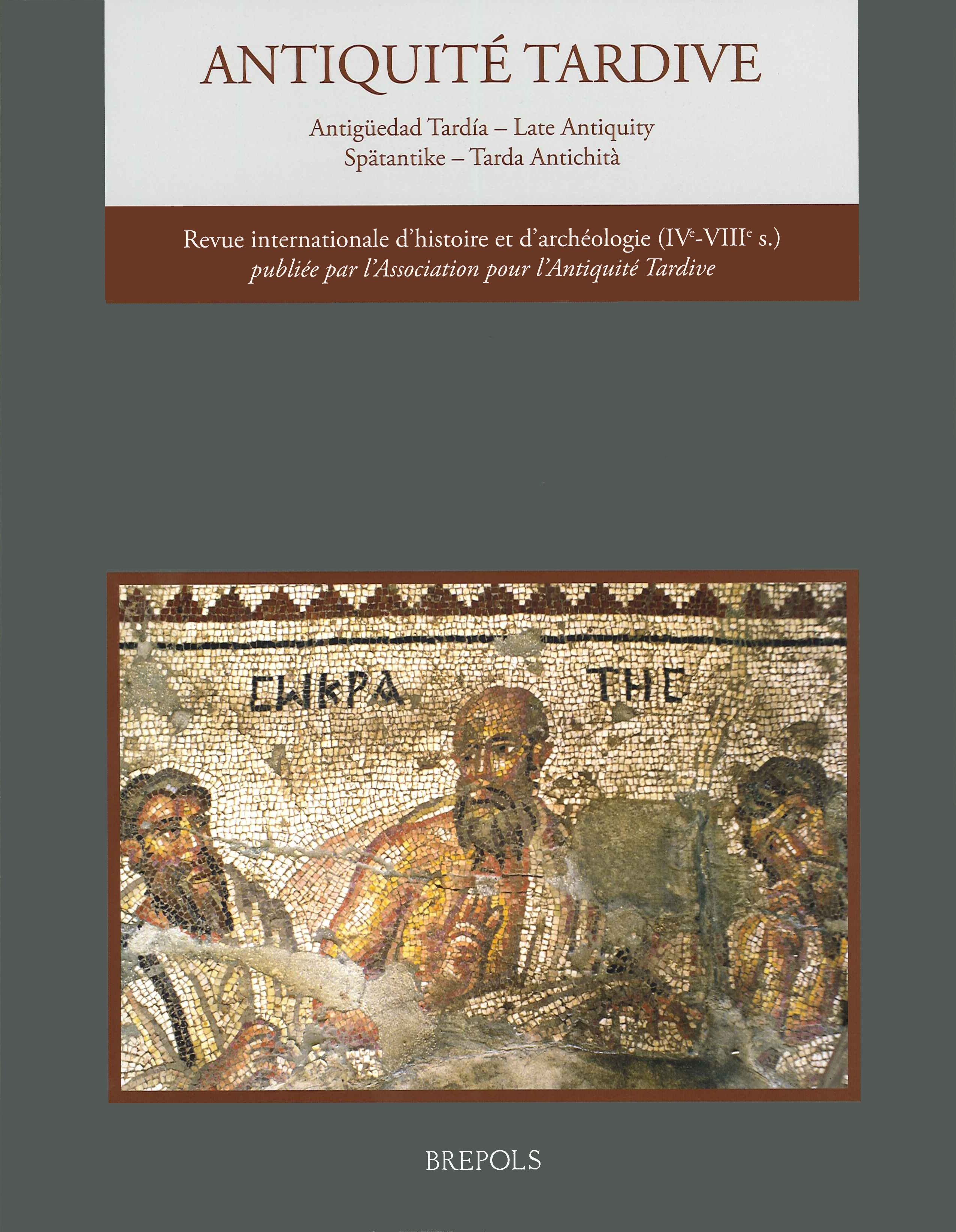
Volume 32, Issue 1, 2024
-
-
Front Matter (“Principales abréviations”, “Éditorial (Hervé Inglebert)”)
show More to view fulltext, buy and share links for:Front Matter (“Principales abréviations”, “Éditorial (Hervé Inglebert)”) show Less to hide fulltext, buy and share links for: Front Matter (“Principales abréviations”, “Éditorial (Hervé Inglebert)”)
-
-
-
Présentation du dossier : faire parler l’Antiquité tardive
show More to view fulltext, buy and share links for:Présentation du dossier : faire parler l’Antiquité tardive show Less to hide fulltext, buy and share links for: Présentation du dossier : faire parler l’Antiquité tardiveAbstractAn Overview of the Dossier
Changes in the linguistic situation have been a major element in the complex and fascinating process of transition from the ancient to the medieval world, but for too long they had to wait to receive the attention they deserve. The last fifty years have done much to make up for this delay, taking the full measure of the intensity of the phenomena of linguistic renewal and diversification, in particular an increase in multilingualism encouraged by the break-up of the Empire, amplified and diversified by ‘barbarisation’ and Christianisation.
These scientific advances were made possible by a methodological revolution that drew on contemporary research in linguistics, sociolinguistics and communication sciences. The linguistic map of this world in transition has been largely redrawn, and several previously dominant theories have been refuted or even reversed. Without aiming to be exhaustive, this thematic dossier of Antiquité Tardive sets out to make a provisional assessment of this research.
-
-
-
Échanges croisés entre le grec et le latin dans l’Antiquité tardive
show More to view fulltext, buy and share links for:Échanges croisés entre le grec et le latin dans l’Antiquité tardive show Less to hide fulltext, buy and share links for: Échanges croisés entre le grec et le latin dans l’Antiquité tardiveAbstractCross-exchanges between Greek and Latin in Late Antiquity
The administrative division of the Roman Empire in the 4th century accentuated the language distribution between a Latin-speaking West and an East dominated by Greek, where the language of power was officially Latin. But until the 6th century, imperial ideology sought to reduce duality to unity (ad unum, adunatio), by integrating Hellenism into Romanity. The intensity of exchanges, and their bilateral nature, may have created identity ambiguities, as evidenced by the name of Constantinople and that of the Romans (Romanus, Ῥωμαῖος), and established in usage a linguistic in-between space, at the crossroads of the two languages. Furthermore, the translation of biblical texts from their Hebrew sources, the spread of the Christian message, as well as the confrontation with the languages of the ‘barbarian’ invaders, broadened the issue of Greek- Latin bilingualism, placing it within a multilingualism, indeed within the universalism of a ‘mental pre-language’, from which linguistic reflection has benefited.
-
-
-
Late Antique Egypt as an Observatory of Multilinguism and Empire : An Overview
show More to view fulltext, buy and share links for:Late Antique Egypt as an Observatory of Multilinguism and Empire : An Overview show Less to hide fulltext, buy and share links for: Late Antique Egypt as an Observatory of Multilinguism and Empire : An OverviewAbstractThis article offers a broad overview of research on multilingualism in Egypt, focusing more specifically on the languages that have interacted with Egyptian in its late antique form, known as Coptic. These interactions took place in an imperial framework that changed over time, both in the empire it was based on (Roman, east Roman, Caliphate) and in its internal linguistic make-up (the eastern Roman empire, for instance, being less and less Latin-centred). That changing landscape had repercussions on the indigenous language, a phenomenon for which Egypt is an excellent observatory because of its invaluable papyri, a source capturing a much larger range of linguistic registers than any other for the period.
-
-
-
The Linguistic Landscape of Late Antique North Africa
show More to view fulltext, buy and share links for:The Linguistic Landscape of Late Antique North Africa show Less to hide fulltext, buy and share links for: The Linguistic Landscape of Late Antique North AfricaBy: Andrew WilsonAbstractThis article examines the complex multilingualism of North Africa in antiquity and the early middle ages, using inscriptions, ancient literary sources, and linguistic analysis to reconstruct the shifting linguistic landscape. Before the Roman conquest, the main languages spoken in North Africa were Afro-Asiatic proto-Amazigh Berber languages, as well as Punic (a western branch of Semitic Phoenician) in the coastal regions where Phoenician colonists had established cities from the twelfth century BC. Rome’s conquest of the region had a profound linguistic impact: as Rome absorbed the former Carthaginian territories, and then the Numidian and Mauretanian kingdoms, Latin became the dominant language, both spoken and written. Latin inscriptions eventually replaced Punic and Libyco-Berber scripts in areas under Roman rule. However, this did not mean a complete linguistic shift. Bilingualism and even multilingualism were widespread. Greek, which in North Africa was primarily a language of elite education, was also spoken in many coastal cities as a language of trade. Punic remained the first language for many people until at least the fifth century AD, and in some areas even until four hundred years after the Arab conquest; it continued to be written, primarily in the Latin script, until the third century AD. Texts in the proto-Amazigh Berber languages were still inscribed on funerary stelae in the third century AD, and these languages were doubtless spoken too. After the third century, direct evidence of the use of Berber languages within the Roman-controlled areas of the Maghreb disappears. They may have died out in Roman North Africa, except in the Kabylia region in modern Algeria; if they did survive, they were nevetheless profoundly modified in the fifth century AD by a process of linguistic levelling when tribal incursions and migrations from the Sahara introduced a different Berber language. With the Arab conquest in the seventh century, Latin lost its status as a language of administration, governance, and power, but it persisted in some regions as a spoken language until as late as the fifteenth century.
-
-
-
Apprendre le latin dans l’Égypte de l’Antiquité tardive : le rôle de la littérature latine
show More to view fulltext, buy and share links for:Apprendre le latin dans l’Égypte de l’Antiquité tardive : le rôle de la littérature latine show Less to hide fulltext, buy and share links for: Apprendre le latin dans l’Égypte de l’Antiquité tardive : le rôle de la littérature latineAbstractLearning Latin in Late Antique Egypt: What Role Did Latin Literature Play?
This paper offers an overview on how the Western educational model reached the Late Antique Eastern empire, and specifically Egypt, contributing to shape a renewed cultural identity where the literature from Rome had to find its place. With the benefit of an updated census and edition of a Corpus of Latin Texts on Papyrus (CLTP) (forthcoming with CUP), we’ll seek to explore both the technical literature and paraliterature of a grammatical and educational kind, as well as proper literary works by the scholastic canonic authors of the quadriga Messii (Terence and Virgil, Sallust and Cicero) but also works by authors who reputedly enjoyed a renewed appreciation in Late Antiquity (e.g. Livy, Juvenal). Our main focus here is the role Latin literature played in teaching/learning Latin as a foreign language in such a multilingual and multicultural context as Late Antique Egypt.
-
-
-
Bilinguisme et traduction dans le monde antique tardif
show More to view fulltext, buy and share links for:Bilinguisme et traduction dans le monde antique tardif show Less to hide fulltext, buy and share links for: Bilinguisme et traduction dans le monde antique tardifBy: Bruno RochetteAbstractBilingualism and Translation in the Late Roman World
Greek Latin bilingualism is a feature characteristic of the Roman Republic and Empire until a significant upheaval occurs at the end of the Empire which leads to the progressive forgetting of Greek in the West. While the eastern part of the Empire remains Greek-speaking and is little influenced by Latin, the Western world goes from a bilingual world to a monolingual Latin-speaking environment. This article aims to provide, from a diachronic point of view, an overview about this slow evolution, which will lead to the complete disappearance of Greek in the West and the need to translate many pagan and Christian Greek texts into Latin.
-
-
-
Latino volgare, latino tardo: un bilancio delle definizioni alla luce di incontri teorici (pragmatica e sociolinguistica) e dibattiti scientifici
show More to view fulltext, buy and share links for:Latino volgare, latino tardo: un bilancio delle definizioni alla luce di incontri teorici (pragmatica e sociolinguistica) e dibattiti scientifici show Less to hide fulltext, buy and share links for: Latino volgare, latino tardo: un bilancio delle definizioni alla luce di incontri teorici (pragmatica e sociolinguistica) e dibattiti scientificiBy: Piera MolinelliAbstractVulgar and Late Latin: A Review of Definitions in the Light of (Pragmatic and Sociolinguistic) Theory and Scientific Debates
Nowadays, the traditional notion of Latin as a monolithic language has been abandoned in favor of a multilayered view that recognizes the existence of different varieties within the same language. Two fundamental varieties that have long captured the attention of scholars are ‘Vulgar Latin’ and ‘Late Latin’. The past few decades have witnessed significant advancements in research on these two topics due to the adoption of both new theoretical frameworks and new research methodologies. Nonetheless, within the scholarly community, there still exists a certain inconsistency and vagueness in the way the concepts of ‘Late Latin’ or ‘Vulgar Latin’ are defined, as well as in the way these labels are used. This work, therefore, seeks to provide an overview of the various ways in which linguists have recently elaborated and defined these notions, highlighting their limitations and critical aspects. Inspiration is drawn from the results of sociolinguistic and sociopragmatic research on contemporary languages.
-
-
-
À propos de l’édition italienne (2020) de Viva Voce : une Retractatio et ses échos
show More to view fulltext, buy and share links for:À propos de l’édition italienne (2020) de Viva Voce : une Retractatio et ses échos show Less to hide fulltext, buy and share links for: À propos de l’édition italienne (2020) de Viva Voce : une Retractatio et ses échosBy: Michel BanniardAbstractAround the Italian Edition (2020) of Viva Voce : A Retractatio and its Resound
After the deep epistemological change impelled by the 1992 edition of the book Viva Voce, its new Italian edition was published (2020), carefully translated, improved and extended with a supplementary chapter X, Retractatio, mainly thanks to the accurate collaboration of a brilliant Italian team of scholars. Its main target was to create an up-to-date work, to make it more easily available, and last but not least to check the global results about our way of thinking and sketching the newly created historical period usually designated as Late Antiquity, mainly under the main topics of culture, literacy, oral and written communication, gathering innovative datas about language evolution from Latin to Romance languages.
-
-
-
Vies, naissances et morts des langues de l’Antiquité tardive
show More to view fulltext, buy and share links for:Vies, naissances et morts des langues de l’Antiquité tardive show Less to hide fulltext, buy and share links for: Vies, naissances et morts des langues de l’Antiquité tardiveAbstractLate Antique Languages: Life, Birth and Death
Of all the periods in history, the end of Antiquity may well have been the one that saw the most changes in the field of languages. The spread of a new type of religion, Christianity, a religion of the book and the spoken word, gave a new dimension to multilingualism. It led to the transition of previously exclusively oral languages to written form, through the adoption of their own or borrowed alphabets, and their access to a higher cultural register. Three widely spoken languages, born before their religious role was fully developed, have found in this role their main driving force for dissemination and vitality: Syriac, Coptic and Koranic Arabic. Persian, on the other hand, had no connection with Christianity when it introduced pelhevi writing in the third century. Some ethnic, almost exclusively oral languages (Gaulish, Punic), ceased to be spoken; others only had a relatively brief existence in written form (Gotic and, less briefly, Coptic). Nabataean eventually disappeared, to be replaced by the Arabic language and script. At the same time, the languages of communication disseminated by the globalisation of the ancient world – Latin and Greek – saw their geographical area of use reduced, in the case of Latin by competition from new Romance languages derived from it. Conversely, Syriac, an Edessenian dialect of Aramaic, is not a case of a newly created alphabet, but of a language and script that enjoyed cosmopolitan success from the third century onwards, linked to the spread of Christianity. In a limited number of cases, the new powers that emerged from the migratory movements imposed their language and mode of writing: for example, ‘English’ pushed the use of ‘Britton’ to the territorial peripheries. On the other hand, the establishment of the Germanic kingdoms had little linguistic impact on the Western Roman provinces, where the evolution from provincial Latin to the Romance languages was already irreversible. Another factor in the proliferation of written languages was the general political and economic fragmentation of the ancient world, the opposite of the globalisation previously effected by the two great empires, Roman and Persian.
-
- Varia
-
-
-
Une nouvelle dédicace de fondation de Justinien et de Théodora à Iustiniana secunda (Ulpiana, Gračanica, Kosovo)
show More to view fulltext, buy and share links for:Une nouvelle dédicace de fondation de Justinien et de Théodora à Iustiniana secunda (Ulpiana, Gračanica, Kosovo) show Less to hide fulltext, buy and share links for: Une nouvelle dédicace de fondation de Justinien et de Théodora à Iustiniana secunda (Ulpiana, Gračanica, Kosovo)Authors: Arben Hajdari, Christophe J. Goddard and Milot BerishaAbstractA New Dedication of the Foundation of Iustiniana Secunda by Justinian and Theodora (Ulpiana, Gracanica, Kosovo)
The discovery of a dedication by Justinian and Theodora in the main Christian basilica of the the new city they founded in Iustiniana Secunda, in present-day Gračanica in Kosovo (fig. 1), 8 km south-east of the capital of Kosovo, Prishtina, is exceptional. It confirms the emperor’s attachment to his home province, Dardania, as reported by Procopius and Justinian himself in his Novellae. Written as an elegant epigram in Latin, its elegiac dystichs, inspired by Virgil, show the vivacy of Latin culture at the imperial court in the middle of the sixth century AD. They also illustrate the changing relationship between cities, the church and the imperial power.
-
-
-
-
Un archivio in frammenti. Ripensare i “papiri di Ravenna” (secoli v-ix)
show More to view fulltext, buy and share links for:Un archivio in frammenti. Ripensare i “papiri di Ravenna” (secoli v-ix) show Less to hide fulltext, buy and share links for: Un archivio in frammenti. Ripensare i “papiri di Ravenna” (secoli v-ix)By: Dario InternulloAbstractAn Archive in Fragments: Rethinking the ‘Ravenna papyri’
The main purpose of this essay is to describe and present an up-to-date picture of the current state of knowledge concerning the ‘Ravenna papyri’. This corpus, well known to many historians of Late Antiquity, runs by several interpretations between studies regarding its precise numerical, chronological, and typological definition. With the intention of recalibrating and thus consolidating this definition, the perspective adopted here is an archival one: the survey and analysis have included all the documents, written mainly (but not exclusively) on papyrus between the 5th and the mid-9th centuries, which have reached us through the archives of the archbishops of Ravenna. The work takes into account not only the original papyrus documents, but also those that have come down to us through later parchment copies. It also includes the numerous documents that have been transcribed, summarized, or simply mentioned in two sources that have hitherto been little used in discussions of the ‘Ravenna papyri’: Agnellus’ Liber Pontificalis (9th century) and the Breviarium Ecclesiae Ravennatis (10th century). Reconstructed in this way, the corpus, consisting of 133 items and enclosing what we know of a large late antique and early medieval archive, offers new research insights and reveals itself as a historical source worthy of investigation. In this regard, the last part of the work also investigates the possible moments that led to the creation and changes of this archive, distinguishing between a slower ‘time of pious donations’ and a more accelerated ‘time of imperial privileges’, the latter being responsible for a real change of course in the history of the archive in the late 6th century. Finally, the discourse is completed by an appendix with a descriptive list of all the items that make up the corpus.
-
-
-
... citius quam credere fas est. Eine metrische Votivinschrift eines römischen Kommandeurs aus Mogontiacum
show More to view fulltext, buy and share links for:... citius quam credere fas est. Eine metrische Votivinschrift eines römischen Kommandeurs aus Mogontiacum show Less to hide fulltext, buy and share links for: ... citius quam credere fas est. Eine metrische Votivinschrift eines römischen Kommandeurs aus MogontiacumAuthors: Ulrike Ehmig and Rudolph HaenschAbstractCitius quam credere fas est … A Metrical Votive Inscription of a Roman Officer Found at Mogontiacum
In November 2019, excavations carried out along the Roman wall of Mogontiacum - Mainz unearthed a monumental block with a metrical votive inscription, presented here for the first time. The text, written in hexameters, relates a combat in which the donor, whose name is not mentioned, found himself trapped. He made a vow to Phoebus Apollo to erect templa if he would help him. No sooner had he confirmed his vow than the enraged adversaries retreated to their woods and he fulfilled his vow faster than credible. In addition to its text, the inscription is also remarkable for its form, decoration and ordination. It dates from the end of the 2nd or the first half of the 3rd century AD, perhaps the time of the expedition planned by Severus Alexander and led by Maximinus Thrax. However, the inscription may also bear witness to a skirmish with no emperor on the Rhine front. The design of the inscription is appropriate for someone who grew up under the Severans, but at the same time is too unspecific to identify a specific person or event.
-
-
-
« l’Empire du Couchant » par « l’alliance avec les barbares ». Foedera et foederati au temps d’Aetius (425-454) : pour une lecture renouvelée de la diplomatie et de la stratégie du patrice Aetius en Occident. Deuxième partie : Considérations stratégiques
show More to view fulltext, buy and share links for:« l’Empire du Couchant » par « l’alliance avec les barbares ». Foedera et foederati au temps d’Aetius (425-454) : pour une lecture renouvelée de la diplomatie et de la stratégie du patrice Aetius en Occident. Deuxième partie : Considérations stratégiques show Less to hide fulltext, buy and share links for: « l’Empire du Couchant » par « l’alliance avec les barbares ». Foedera et foederati au temps d’Aetius (425-454) : pour une lecture renouvelée de la diplomatie et de la stratégie du patrice Aetius en Occident. Deuxième partie : Considérations stratégiquesBy: Guillaume SartorAbstractDefend “The Empire of the West” by an Alliance with the Barbarians. Foedera and Foederati in the Time of Aetius (425-454): For a Re-reading of Aetius’ Diplomacy and Strategy in the West. Part Two: Strategic Considerations
The present study continues the analysis of the diplomacy deployed by general Aetius from 425 to 454. It is devoted to the strategic aspects of the diplomacy and the policy of the patrice. After abandoning his Hunnic alliance, Aetius benefited, from the 430s, with the Franks and then, after 439, with the Goths of Aquitaine, two gentes foederatae who became his main allies in the defense of the Pars Occidentis. These gentes, reinforced by other Germanic gentes established in the Empire (Burgundians) or maintained on the imperial margins (Alamanni, etc.) participated in the protection of the patrician and offered him foederati to accompany him on his expeditions and serve in his mobile army of intervention. Integrated – with other gentes – into a strategic defense system for the Western Empire centered on Gaul, theses gentes defend the imperial order against its internal enemies (rebellious gentes, bagaudae, etc.) and its external enemies (Attila). In an Empire lacking resources and weakened by the loss of Africa conquered by the Vandals, Aetius chose to defend, with his gentes foederatae, Gaul as a central piece in maintaining the territorial unity of Pars Occidentis and suffering from Hunnic pressure from 440, he refused to multiply the fronts by engaging in Africa because the Western strategic dilemma prevented him from dispersing his forces by taking the risk of a maritime expedition towards Africa while the Huns threatened the continental provinces. If the strategic system founded by Aetius on his alliance with – in particular – the Franks and the Goths, was able to be maintained, it nonetheless contained weaknesses linked to the personalization of political and diplomatic relations between the gentes and the person of the patrice as the events of 454-455 revealed. The gentes, Goths and Franks, whose roles had continued to grow during the time of Aetius and thanks to their alliance with the latter, were to become major in the destinies of Pars Occidentis in these last years.
-
-
-
Mauretania. Zum Griff einer spätrömischen Bronzelampe aus Marseille
show More to view fulltext, buy and share links for:Mauretania. Zum Griff einer spätrömischen Bronzelampe aus Marseille show Less to hide fulltext, buy and share links for: Mauretania. Zum Griff einer spätrömischen Bronzelampe aus MarseilleBy: Norbert FrankenAbstractMauretania. The Handle of the Late Roman Bronze Lamp from Marseille
The subject of this study is a handle of a late Roman bronze lamp from the late 3rd or early 4th century AD, which came to light under unknown circumstances in Marseille-Le Canet sometime before 1761 and has been kept in the Musée Calvet in Avignon since 1810. Following earlier suggestions to name the figure depicted as the goddess Isis, the goddess Cybele or as Bacchus in the role of a theatrical actor, the author now argues in favor of naming her as the personification of the continent of "Libya" or one of the Roman provinces of North Africa, such as "Africa" or "Mauretania". Even without an exact parallel, the newly interpreted lamp handle fits perfectly into the imagery shaped by the ideas and tastes of a wealthy elite, which we encounter not only on the mosaic floors of rich late antique villa complexes such as in Piazza Armerina and Caddeddi near Noto in Sicily, but also - as shown here - on late Roman bronze lamps and other bronze utensils.
-
- Chronique et historiographie
-
-
-
Un hommage à Claudia Barsanti : récentes avancées en archéologie byzantine
show More to view fulltext, buy and share links for:Un hommage à Claudia Barsanti : récentes avancées en archéologie byzantine show Less to hide fulltext, buy and share links for: Un hommage à Claudia Barsanti : récentes avancées en archéologie byzantineAbstractA Tribute to Claudia Barsanti: Recent Advances in Byzantine Archaeology
The 23rd International Congress of Byzantine Studies was held in Belgrade in August 2016. The present volume brings together under the title Archaeology of a World of Changes. Late Roman and Early Byzantine Architecture, Sculpture and Landscapes a selection of 29 papers in memory of Claudia Barsanti, an eminent specialist in architectural decoration, around her favourite research themes. Research has obviously continued over the past 7 years, but this publication provides a welcome and convenient update on a number of issues, sites, monuments and objects in the Byzantine East.
-
-
-
-
Relire Procope : deux ouvrages récents sur une oeuvre-monde
show More to view fulltext, buy and share links for:Relire Procope : deux ouvrages récents sur une oeuvre-monde show Less to hide fulltext, buy and share links for: Relire Procope : deux ouvrages récents sur une oeuvre-mondeBy: Maxime EmionAbstractRe-reading Procopius: Two Recent Books about an “oeuvre-monde”
The simultaneous publication of the Companion to Procopius of Caesarea, edited by M. Meier and F. Montinaro, and of G. Greatrex’s Historical Commentary to the Persian Wars, represents a milestone for Procopian studies, which have been heavily renewed in the last two decades. While the Companion gives a synthetic view on a variety of topics regarding Procopius and his three works (Wars, Secret History, Buildings), the Commentary offers a detailed linear reading of the first two books of the Wars. Far from exhausting the subject, both volumes call for further research on a set of problems, old and new. Against the methodologically traditional views according to which one could retrieve the author’s opinions in spite of, or thanks to, the apparent contradictions between his texts, a recent critical trend deems the “real Procopius” to be ultimately unknowable, and tries to explain away the discrepancies of tone between his works by the diversity of literary genres. Although this paradigmatic shift aims to disarm the subjectivity trap in the interpretation of Procopius, its focus on genre and narratological processes runs the risk of forgetting the author. Another point of contention resides in the dates of the Secret History and the Buildings. This old debate has seen few progresses until recently, with Battistella’s suggested date of 553/554 for the Secret History, and Montinaro’s ongoing work on the two recensions of the Buildings. Deeply linked with these chronological problems, strong arguments have also been made regarding the unicity of Procopius’ works. In three interconnected texts, belonging to three different genres, the author may have ambitioned to describe the world in its totality, although one may doubt whether this resulted from a preexisting plan or appeared during the writing process. The inclination towards literary analyses does not eclipse the need for a historical reading of Procopius’ works. Recent research on the reign of Justinian and its wider background have thus shed light on the world depicted by the author of Caesarea. In this point of view, the classicism of Procopius should be seen as a tool rather than an end in itself, and the historical reality be studied alongside its representation. Though the threat of a split between literary and historical analyses may loom over Procopian studies, the two volumes under review will undoubtedly promote dialogue between the various lines of interpretation.
-
-
-
Le premier cycle historiographique de la New Late Antiquity (1968-1999)
show More to view fulltext, buy and share links for:Le premier cycle historiographique de la New Late Antiquity (1968-1999) show Less to hide fulltext, buy and share links for: Le premier cycle historiographique de la New Late Antiquity (1968-1999)By: Hervé InglebertAbstractRéflexions sur Andrea Giardina, « ‘Tutto il vigore è negli occhi.’ Peter Brown e la nascita della New Late Antiquity », dans Clifford Ando et Marco Formisano (éd.), The New Late Antiquity. A Gallery of Intellectual Portraits, Heidelberg, 2021, p. 183-235, et sur Peter Brown, Journeys of the Mind. A Life in History, Princeton, 2023.
-
-
-
Bulletin critique
show More to view fulltext, buy and share links for:Bulletin critique show Less to hide fulltext, buy and share links for: Bulletin critiqueAbstractArchéologie et histoire de l’art de l’Antiquité tardive
A. Berger, The Statues of Constantinople (G. de Bruyn) ; E. N. Boeck, The Bronze Horseman of Justinian in Constantinople. The Cross-Cultural Biography of a Mediterranean Monument (G. de Bruyn) ; G. Brands, H. Rupprecht Goette (Hrsg.), Spätantike Ideal- und Portraitplastik: Stilkritik, Kontexte, naturwissenschaftliche Untersuchungen. Beiträge eines Workshops an der Martin-Luther-Universität Halle-Wittenberg 13.-16. Juni 2018 (T. M. Kristensen) ; R. Fleming, The Material Fall of Roman Britain, 300-525 CE (D. Roberts) ; E. Laflı (ed.), Greek, Roman, and Byzantine Bronzes from Anatolia and Neighbouring Regions (A. M. Pülz) ; A. Lichtenberger, R. Raja (eds.), Architectural Elements, Wall Paintings, and Mosaics. Final Publications from the Danish-German Jerash Northwest Quarter Project IV, vol. 1: Architecture and Building Ceramics (L. Blanke) ; A. Palladino, Inventing Late Antique Reliquaries. Reception, Material History, and Dynamics of Interaction (4th-6th centuries CE) (L. M. Orlandi) ; A. Villa del Castillo, Talleres de escultura cristiana en la Península Ibérica (siglos VI-X). Análisis arqueológico (B. Torre Miguel)
Histoire de l’Antiquité tardive
N. Baker-Brian, The Reign of Constantius II (B. Bleckmann) ; N. Baker-Brian, The Reign of Constantius II (R. Viccione) ; C. Brélaz, E. Rose (eds), Civic Identity and Civic Participation in Late Antiquity and the Early Middle Ages ; N. Belayche, A.-V. Pont (éd.), Participations civiques des juifs et des chrétiens dans l’Orient romain (ier-ive siècles) (L. Guichard) ; A. Cameron, From the Later Roman Empire to Late Antiquity and Beyond (H. Inglebert) ; J. W. Drijvers, The Forgotten Reign of the Emperor Jovian (363-364). History and Fiction (S. Destephen) ; V. Egetenmeyr, Die Konstruktion der ,Anderen’. Barbarenbilder in den Briefen des Sidonius Apollinaris (A. Chauvot) ; Generaldirektion Kulturelles Erbe Rheinland-Pfalz (Hrsg.), Der Untergang des Römischen Reiches (S. Destephen) ; M. Hanaghan, David Woods (éd.), Ammianus Marcellinus From Soldier to Author (G. Sartor) ; M. Hebblewhite, C. Whately (éd.), Brill’s Companion to Bodyguards in the Ancien Mediterranean (P. Faure) ; D. Labadie, L’invention du protomartyr Étienne. Sainteté, pouvoir et controverse dans l’Antiquité (ier-vie s.) (E. Cronnier) ; M. Lamy et S. Shimahara (éd.), Le pouvoir au féminin. Modèles et anti-modèles bibliques du ive au xviie siècle (M. C. Chiriatti) ; W. Pohl, R. Kramer (éd.), Empires and Communities in the Post-Roman and Islamic World, c. 400-1000 CE (E. Baptiste) ; V. Puech, Les élites de cour de Constantinople (450-610). Une approche prosopographique des relations de pouvoir (C. Begass) ; S. Rendina, La prefettura di Antemio e l’Oriente romano (A. Lanadio) ; G. Sanz Casasnovas, Rabies indómita. Representación del bárbaro y violencia contra los no romanos en las Res gestae de Amiano Marcelino (E. Moreno Resano) ; B. Waldron, Dynastic Politics in the Age of Diocletian, AD 284-311 (M. Christol) ; A. Zeini, Zoroastrian Scholasticism in Late Antiquity. The Pahlavi version of the Yasna Haptaƞhāiti (S. Azarnouche)
Régions
S. Acerbi, R. Teja (eds), El primado del obispo de Roma. Orígenes históricos y consolidación siglos IV-VI (G. D. Dunn) ; T. Amraoui, Alejandro Quevedo (ed.), D’une rive à l’autre. Circulations et échanges entre la Maurétanie césarienne et le sud-est de l’Hispanie (Antiquité-Moyen Âge) (A. Álvarez Melero) ; K. Belke, Bithynien und Hellespont. Mit 325 Abbildungen auf Tafeln, einer Karte im Text, zwei Karten auf Tafeln und zwei Faltkarten (S. Destephen) ; M. Benabbès, L’Afrique byzantine et berbère face à la conquête arabe (M.-A. Nsiri) ; G. Bernard, Aurélien Montel (dir.), Le détroit de Gibraltar (Antiquité - Moyen Âge), II. Espaces et figures de pouvoir (L.-G. Pérez-Aguilar) ; G. Deligiannakis, A Cultural History of Late Roman Cyprus (L. Zavagno) ; S. Gross, Babylonian Jews and Sasanian Imperialism in Late Antiquity (N. Preud’homme) ; G. Kalas, Ann van Dijk (eds), Urban Developments in Late Antique and Medieval Rome. Revising the Narrative of Renewal (A. C. Arnau) ; A. Myers Achi (dir.), Africa and Byzantium (S. Destephen) ; F. Oppedisano (éd.), Between Ostrogothic and Carolingian Italy: Survivals, revivals, ruptures (V. Mayo) ; M. Pozo Flores, Vasconia tardoantigua. Entre la evolución sociopolítica y la construcción intelectual (400-711) (F. Gallon) ; R. Schär, Auf der Suche nach dem vollkommenen Leben. Die frühen Juramönche und Juranonnen zwischen Rückzug und Interaktion (L. Ripart) ; C. Tonghini, From Edessa to Urfa: The Fortification of the Citadel (N. Asutay-Effenberger)
Philologie et sources
Ambroise de Milan, Sur la mort de Théodose, introduction, traduction et notes Yves-Marie Duval (†) et Benoît Gain (C.-A. Cvetkovic) ; Ambroise de Milan, Sur la mort de Valentinien II, introduction Guy Sabbah, traduction Guy Sabbah et Jean-François Berthet, annotation Laurent Angliviel de la Beaumelle (†), Guy Sabbah et Jean-François Berthet (M. V. Escribano Paño) ; R. Ampio, Vittricio de Rouen. De laude sanctorum. Introduzione, testo, traduzione e note (A. Encuentra) ; S. Ardeleanu, J. C. Cubas Díaz (eds.), Funerary Landscapes of the Late Antique oecumene. Contextualizing Epigraphic and Archeological Evidence of Mortuary Practices (A. Blanco-Pérez) ; S. Brentjes (ed.), in cooperation with J. Høyrup and B. O’Brien, Narratives on Translation across Eurasia and Africa. From Babylonia to Colonial India (P. M. Forness) ; A. Bruzzone, A. Fo, L. Piacente (éd.), Metamorfosi del classico in età romanobarbarica (E. Wolff) ; V. Calzolari (dir.), Les arts libéraux et les sciences dans l’Arménie ancienne et médiévale (J. Siragan Arlen) ; K. De Temmerman, J. Van Pelt, K. Staat (éd.), Constructing Saints in Greek and Latin Hagiography. Heroes and Heroines in Late Antique and Medieval Narrative (A. Busine) ; P. F. Sacchi, M. Formisano (dir.), Epitomic Writing in Late Antiquity and Beyond. Forms of Unabridged Writing (F. Mottais) ; A. Gangloff (ed.), The Emperor’s Qualities and Virtues in the Inscriptions from Augustus to the Beginning of Constantine’s Reign: “Mirrors for prince”? Qualités et vertus de l’empereur dans les inscriptions d’Auguste au début du règne de Constantin : « Miroirs au prince » ? (A. Blanco-Pérez) ; O. Gengler, M. Meier (éd.), Johannes Malalas: Der Chronist als Zeithistoriker (A. Busine) ; F. Jullien, A. H. Becker, The Martyrdom of Mar Grigor Piran-Gušnasp and The Martyrdom of Mar Yazd-panah (V. Berti) ; L. Parker, Symeon Stylites the Younger and Late Antique Antioch. From Hagiography to History (V. Déroche)
-
-
-
Back Matter (“Publications reçues en 2024”, “Instructions aux auteurs”, “Recommendations to authors”)
show More to view fulltext, buy and share links for:Back Matter (“Publications reçues en 2024”, “Instructions aux auteurs”, “Recommendations to authors”) show Less to hide fulltext, buy and share links for: Back Matter (“Publications reçues en 2024”, “Instructions aux auteurs”, “Recommendations to authors”)
-
Volumes & issues
-
Volume 32 (2024)
-
Volume 31 (2024)
-
Volume 30 (2022)
-
Volume 29 (2022)
-
Volume 28 (2021)
-
Volume 27 (2020)
-
Volume 26 (2019)
-
Volume 25 (2018)
-
Volume 24 (2017)
-
Volume 23 (2016)
-
Volume 22 (2015)
-
Volume 21 (2013)
-
Volume 20 (2013)
-
Volume 19 (2012)
-
Volume 18 (2011)
-
Volume 17 (2010)
-
Volume 16 (2009)
-
Volume 15 (2008)
-
Volume 14 (2007)
-
Volume 13 (2006)
-
Volume 12 (2005)
-
Volume 11 (2004)
-
Volume 10 (2003)
-
Volume 9 (2002)
-
Volume 8 (2001)
-
Volume 7 (2000)
-
Volume 6 (1999)
-
Volume 5 (1998)
-
Volume 4 (1997)
-
Volume 3 (1995)
-
Volume 2 (1994)
-
Volume 1 (1993)
Most Read This Month Most Read RSS feed
