


Liber Annuus
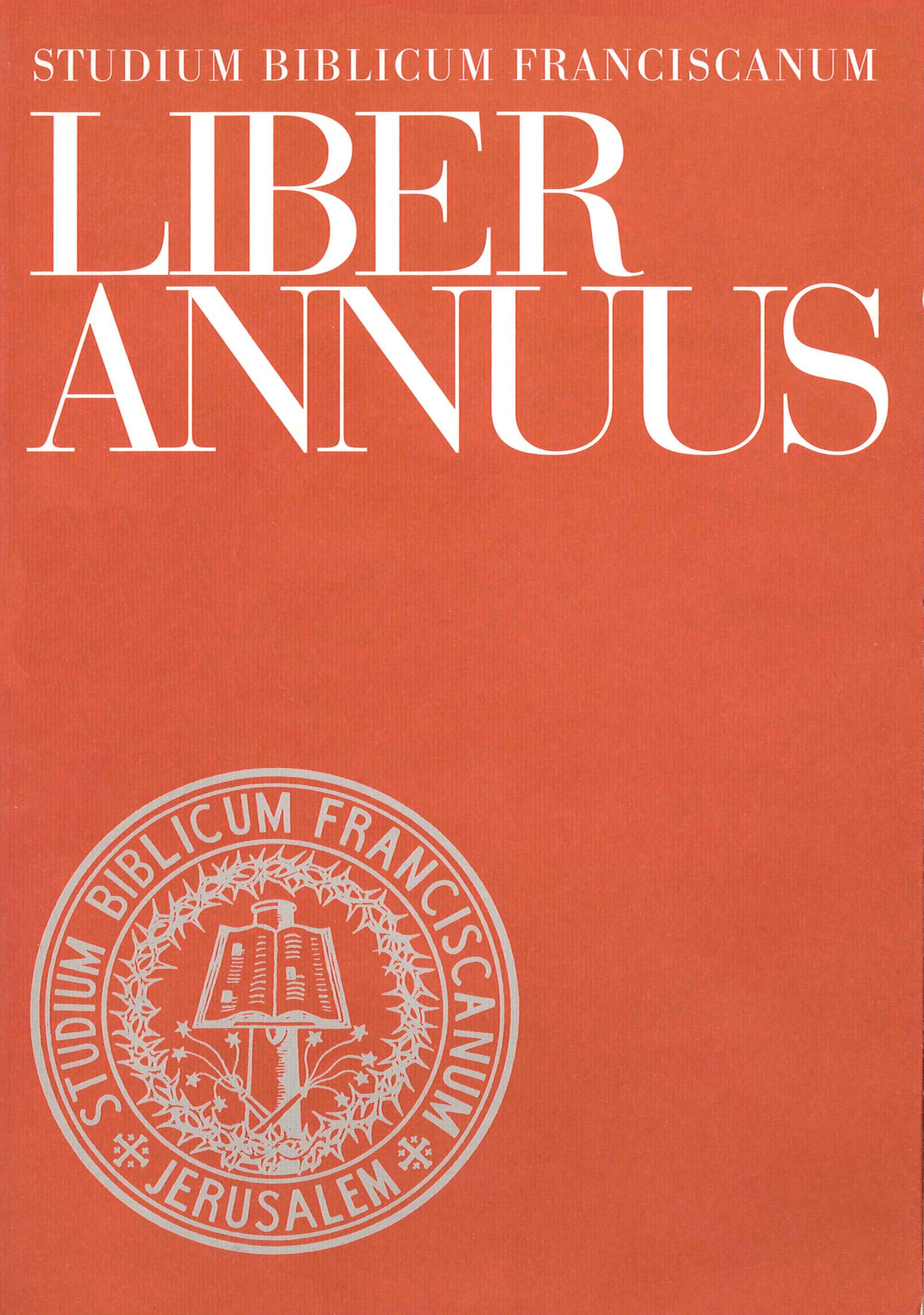
Volume 63, Issue 1, 2013
-
-
Front Matter ("Title Page", "Copyright Page", "Editorial Board", "Table of Contents")
show More to view fulltext, buy and share links for:Front Matter ("Title Page", "Copyright Page", "Editorial Board", "Table of Contents") show Less to hide fulltext, buy and share links for: Front Matter ("Title Page", "Copyright Page", "Editorial Board", "Table of Contents")
-
-
-
La linguistica testuale applicata alla Vulgata: le parti narrative di Gn 37-50
show More to view fulltext, buy and share links for:La linguistica testuale applicata alla Vulgata: le parti narrative di Gn 37-50 show Less to hide fulltext, buy and share links for: La linguistica testuale applicata alla Vulgata: le parti narrative di Gn 37-50By: Valerio BarbieriAbstractText linguistics according to the model of H. Weinrich has been applied to Biblical Hebrew by A. Niccacci. The present article, a summary of a broader work, aims to apply this theory to the Latin tense system of the Vulgate. As a sample text, the narrative sections of Gen 37-50 are studied. The comparison with the Masoretic Text shows a wide text-linguistic correspondence regarding the main line of the narration. A certain correspondence is found as well for the background. For the antecedent/prelude constructions, however, the Vulgate corresponds to a minor degree. This is caused by the fact that Latin does not exhibit verbal tenses, which are text-linguistically equivalent to some constructions peculiar to Biblical Hebrew.
-
-
-
L’amico-nemico: il Sal 55 nel suo contesto canonico
show More to view fulltext, buy and share links for:L’amico-nemico: il Sal 55 nel suo contesto canonico show Less to hide fulltext, buy and share links for: L’amico-nemico: il Sal 55 nel suo contesto canonicoBy: Alberto MelloAbstractA recurring theme in the Psalter is that of the enemy, usually in the singular: “my enemy”, such that the psalmic triangle generally consists of God - the psalmist - the enemy. But a truly serious case is that when a friend becomes an enemy, because he is very difficult to defend (cf. Ps 41; 101). Here one takes into consideration Ps 55, which bears the most poignant psalmic attestation of this grave situation, and whose contextual reading (Ps 51-55) sheds light from the canonical point of view.
-
-
-
La facture syntaxico-poétique du Ps 86
show More to view fulltext, buy and share links for:La facture syntaxico-poétique du Ps 86 show Less to hide fulltext, buy and share links for: La facture syntaxico-poétique du Ps 86AbstractThe present article aims to highlight the syntax and poetic beauty of Ps 86. This psalm is not sufficiently studied and is often judged by scholars as an anthological composition without literary and poetic originality. Through the study of particular syntax forms of Ps 86, its poetic composition and structure, I want to demonstrate the opposite view. Ps 86 is a beautiful poetic work that reflects the state of mind of a true believer whose God is the unique savior. The imperatives that are found along the psalm are a description of the confident cry that comes from the heart of the worshiper. Ps 86 is very neat and its unit is unquestionable. Its concentric structure places the praise of God at the center of the supplication. God is worthy to be praised because he gives salvation.
-
-
-
La traiettoria della Sapienza dall’AT a Giovanni, al NT e sviluppi ulteriori
show More to view fulltext, buy and share links for:La traiettoria della Sapienza dall’AT a Giovanni, al NT e sviluppi ulteriori show Less to hide fulltext, buy and share links for: La traiettoria della Sapienza dall’AT a Giovanni, al NT e sviluppi ulterioriBy: Alviero NiccacciAbstractThis paper presents firstly a synthesis of several preceding studies of the author on the trajectory of Wisdom in the OT; from Prov 8 to Job 28, Sir 1, 24 and 51, Bar 3:9-4:4 and to Wis 9 (§ 1). Then it considers apocryphal texts regarding God appearing as a man (§ 2) and the gnostic myth of Wisdom who comes among men but is not accepted and goes back to heaven (§ 3); Jesus as Teacher of wisdom and personified Wisdom in the NT (§ 4), paying special attention to the Gospel of John on Jesus as the incarnate Word become flesh, dwelling among men and revealing the Father (§ 5), and also to the Letters of Paul and the rest of the NT (§ 6); and theological developments in the theme of Wisdom in the Church Fathers, medieval writers and modern authors (§ 7). Finally, the paper provides some concluding remarks by outlining three forms of God’s incarnation given to men, i.e., Creation, Holy Scripture and Eucharist.
-
-
-
Ebed-Melec nella letteratura biblica e giudaica
show More to view fulltext, buy and share links for:Ebed-Melec nella letteratura biblica e giudaica show Less to hide fulltext, buy and share links for: Ebed-Melec nella letteratura biblica e giudaicaBy: Vincenzo LopassoAbstractIn this study, Lopasso puts together the biblical and rabbinic data regarding Ebed Melech, the cushite officier at the court of king Zedekiah, who drew the prophet Jeremiah up from the pit (Jer 38:7-13). For this reason and for his religious attitude, he was promised salvation during the general overthrow of the holy city (Jer 39:15-18). Unlike the TM, the Lxx presents him as an antagonist of the king with a polemic function more appropriate to a prophet. Beginning with the Targum, neither his name nor his origin are clear. His person begins to become legendary and represents those who will be rewarded with immortality by God for their good works. In this trek, it is interesting to follow all the steps and look for possible links between the different texts and biblical passages which have had an influence in the formation of the tradition.
-
-
-
‘The tabernacle of David that is fallen’ (Am 9:11): An Exegetical Study of a Moot Expression
show More to view fulltext, buy and share links for:‘The tabernacle of David that is fallen’ (Am 9:11): An Exegetical Study of a Moot Expression show Less to hide fulltext, buy and share links for: ‘The tabernacle of David that is fallen’ (Am 9:11): An Exegetical Study of a Moot ExpressionAbstractAm 9:11-15 is an oracle of consolation. It is often regarded as an addition to the original prophecies because it speaks about a messianic hope of Davidic restoration in a book which is centered on the Northern Kingdom of Israel. This study will be limited to the first expression of the oracle, in particular to the mention of the “Fallen Tabernacle of David”. It is my opinion that the Sukkat David should be read in the context of the rich imagery of buildings in the book of Amos. Thus it appears clear that it is not important to identify what is meant by the prophet (either Jerusalem, or the Temple, or the Davidic Dynasty, etc.). Rather it is more important to understand the metaphor of the temporary and frail structure (a booth) of David in opposition to the stable and firm buildings of the countries around Judah (the pagan nations of Amos 1, together with Samaria throughout the Book): fortresses, temples, houses, and so on.
-
-
-
Imperative and waw-Imperative: A Text-Linguistic Description of the Distribution
show More to view fulltext, buy and share links for:Imperative and waw-Imperative: A Text-Linguistic Description of the Distribution show Less to hide fulltext, buy and share links for: Imperative and waw-Imperative: A Text-Linguistic Description of the DistributionBy: Gregor GeigerAbstractThe paper aims at describing the distribution of clause initial imperatives with and without waw, applying the text-linguistic model of Weinrich and Niccacci. Imperative clauses without waw are found in the following text-linguistic environments: At the very beginning of a new text, i.e., of a new direct speech; after other prelude constructions; at the beginning of a new text segment; as a foreground construction, connected semantically and syntactically closely to a preceding imperative. On the other hand, waw-imperative clauses are foreground constructions.
-
-
-
Codex B e Nestle-Aland XXVIII a confronto. Il Vangelo di Marco
show More to view fulltext, buy and share links for:Codex B e Nestle-Aland XXVIII a confronto. Il Vangelo di Marco show Less to hide fulltext, buy and share links for: Codex B e Nestle-Aland XXVIII a confronto. Il Vangelo di MarcoBy: Rosario PierriAbstractThis article follows the recent publication of the 28th critical edition of the New Testament by Nestle-Aland (NA). Observations and interpretations are provided regarding how NA uses the text of Mark from Codex B in its evaluation and choice of some of the readings while at the same time indicating if they are lectiones singulares. On the basis of gathered data, the article includes cases of: Substitution; Substitution and transposition; Omission; Addition; Transposition; Concordance. Not all cases of discordance are mentioned and those of concordance are limited to examples where, for reasons of external and internal critique, offer elements for discussion. This comparison has made it possible to highlight a series of readings that are not noted in the NA critical apparatus, and others that are found in Codex B. In some cases, the criteria chosen for a reading in NA do not seem clear and sometimes are not altogether coherent. It is especially important to point out that for three readings present in the NA text, alternatives have been proposed.
-
-
-
Mark, John, and Answerability: Interfluentiality and Dialectic between the Second and Fourth Gospels
show More to view fulltext, buy and share links for:Mark, John, and Answerability: Interfluentiality and Dialectic between the Second and Fourth Gospels show Less to hide fulltext, buy and share links for: Mark, John, and Answerability: Interfluentiality and Dialectic between the Second and Fourth GospelsBy: Paul N. AndersonAbstractThe relation between Mark and John, the Bi-Optic Gospels, is one of the most difficult and most important subjects in biblical studies. Upon correct inferences of this set of intratraditional and intertraditional relationships many other judgments falter or stand. Seeking to make an advance over monodimensional source- and redaction-critical theories, an overall theory of Markan-Johannine interfluentiality identifies at least six stages in the developments within and between these two traditions, seeking to make the best sense of their textual similarities and differences. Along the way, several advances are argued over prevalent critical approaches, leading to an assessment of John’s relation to Mark as being interfluential in the oral stages of their traditions, augmentive and corrective to Mark in John’s first edition as “the second gospel”, and harmonizing - in that the final edition of John tends to reconcile itself with the other Markan Gospels. As the final Markan interpolation includes Johannine content, interfluentiality indeed continues. In service to an overall theory of interfluentiality stands Mikhail Bakhtin’s theory of polyvalent dialogism, applicable to historical narratives as well as fictive ones, wherein answerability within the cognitive experience of authors seeks to reconcile disparities between life and art. In that sense, an ongoing history of dialectical engagement between these bi-optic renderings of Jesus’ ministry inform also a broader understanding of John’s distinctive relations to the Lukan, Q, and Matthean traditions, and most importantly to their common subject: Jesus.
-
-
-
E il Signore si voltò. Un tratto lucano dell’agire itinerante di Gesù
show More to view fulltext, buy and share links for:E il Signore si voltò. Un tratto lucano dell’agire itinerante di Gesù show Less to hide fulltext, buy and share links for: E il Signore si voltò. Un tratto lucano dell’agire itinerante di GesùAbstractThe article explores the meaning of a gesture of Jesus mentioned many times in Luke’s gospel: the act of “turning” of the Lord toward various persons who accompany him in the journey. It is mentioned seven times (Luke 7:9, 44; 9:55; 10:23; 14:25; 22:61; 23:28) and is always in the same verbal form (the aorist participle στραφείς). On the level of composition, the term is inserted in short introductory narratives and generally has the aim of emphasizing a saying or instruction of Jesus. Apparently of little relevance, such a gesture renders lively the description. But it is not a simple literary device. Evidently if the author wanted to include (redaction) or preserve (tradition) this detail in his account, he did it for introspective reasons. The gesture of Jesus is an element of his itinerant lifestyle and as such is linked to the Lukan theme of discipleship. The third evangelist, by portraying Jesus in that action, seems to want to fix as a model the relationship between him and his followers: the effort required in discipleship and the care of the teacher for them. Jesus is the guide of the disciples, he opens the way forward in the right direction but sometimes he turns toward his followers who need to be encouraged, sustained and corrected in their journey of faith.
-
-
-
The Parable of the Pounds or Talents: One Story in Two Different Contexts
show More to view fulltext, buy and share links for:The Parable of the Pounds or Talents: One Story in Two Different Contexts show Less to hide fulltext, buy and share links for: The Parable of the Pounds or Talents: One Story in Two Different ContextsBy: Piotr BlajerAbstractLuke 19:11-27, known as the parable of the pounds or minas resembles the Matthean parable of the talents (25:14-30). Both parables share the same general structure, and yet there are several differences that set them apart. Scholars have tried to establish a link between these two parables. Various solutions have been proposed, but none of them seems to solve the problem. This paper attempts to establish a link between the two parables and answer the question as to what caused the main differences between the Matthean and Lukan version. A closer analysis of the parables and their context suggests that both parables go back to the same parable proclaimed by Jesus whereas the differences between the two parables can be traced back to different contexts, either immediate or broader. The presence of the nobleman who goes to a distant country in the Lukan parable links the parable of the coins to Jesus’ triumphal entry and to the crowds who proclaim Jesus as king (19:38). The delegation of those who oppose the nobleman’s kingship echoes Jesus’ conflict with Israel that has been steadily growing during the journey section (9:51-19:28).
-
-
-
Il participio nell’argumentatio di Col 1,24–4,1: valore sintattico e funzione retorica
show More to view fulltext, buy and share links for:Il participio nell’argumentatio di Col 1,24–4,1: valore sintattico e funzione retorica show Less to hide fulltext, buy and share links for: Il participio nell’argumentatio di Col 1,24–4,1: valore sintattico e funzione retoricaAbstractThis article continues the analysis of the participle in the Letter to the Colossians (see LA 62 [2012] 153-172). In particular, we focus on the presence and on the syntactic semantic value of the participle, and on its rhetorical function in the argumentatio/probatio (Col 1:24-4:1). The multiplicity/richness of this verbal mood is always at the service of the narrative: it binds the different parts of the propositions and brings forward the rhetorical argumenta. Its function, therefore, is not at all obvious or purely pleonastic. It contributes to better define and describe the work of reconciliation of God in Christ and makes it actual for the Colossians. This event, which is the content of the Gospel, is the source of holiness/blamelessness of the Colossians. By using the participle, Paul continually reminds them, “what seems appropriate, good, convenient” (εἰκός) to the faith; and at the same time, he explains the modus of the new life of believers. They now participate in the mystery of Christ’s death and resurrection, and they are called to give witness to it in their life and in every situation (family and society).
-
-
-
‘Si vanti il fratello umile’. E il ricco? Uno zeugma in Gc 1,9-10a
show More to view fulltext, buy and share links for:‘Si vanti il fratello umile’. E il ricco? Uno zeugma in Gc 1,9-10a show Less to hide fulltext, buy and share links for: ‘Si vanti il fratello umile’. E il ricco? Uno zeugma in Gc 1,9-10aBy: Elisa ChiorriniAbstractThroughout the history of the exegesis of James 1:9-10a, the imperative καυχάσθω has raised more than a few discussions. What is the relationship of the verb to “the rich man”? Some scholars believe that the imperative is used in a literal sense, whereas others believe καυχάσθω is applied to the rich man ironically. This choice has significant implications for the interpretation of the entire exhortation: what is the intent of the Epistle, to invite the rich man to conversion, or to foretell his impending and unavoidable doom? The zeugma, identified in the two propositions governed by καυχάσθω, argues in favour of an ironic or antithetical interpretation of the imperative. This reading is confirmed by the verses that follow (10b-11) and it is part of a coherent approach to the themes of wealth and boast in the Epistle, which, regarding these topics, shows affinity with its cultural environment. The article proposes to consider the figures of the humble man and the rich one as literary types.
-
-
-
Une stèle funéraire araméenne de Tayma’
show More to view fulltext, buy and share links for:Une stèle funéraire araméenne de Tayma’ show Less to hide fulltext, buy and share links for: Une stèle funéraire araméenne de Tayma’By: Émile PuechAbstractAn Aramaic inscription is engraved below a stylized human face on a funerary stela from Tayma’. It mentions the name of the dead, his father’s name, and it specifies that it is his own image. But contrary to the reading of the edition, there are no secondary additions and erasures in favor of a damnatio memoriæ.
-
-
-
A Wall Painting in Herod’s Theatre at Herodion: An Image of Elysium?
show More to view fulltext, buy and share links for:A Wall Painting in Herod’s Theatre at Herodion: An Image of Elysium? show Less to hide fulltext, buy and share links for: A Wall Painting in Herod’s Theatre at Herodion: An Image of Elysium?Authors: Asher Ovadiah and Yehudit TurnheimAbstractIt seems that Herod’s theatre at Herodion is part of the monumental burial complex (the mausoleum) and its related ceremonies. This proposal is reinforced by literary sources and similar Roman-period theatres related to burial complexes and the cult of the dead.
Of the four wall-paintings discovered in the royal box of the theatre, only one has survived in its entirety. The mural depicts a scene with a building and trees, next to which is a rocky hill with deer (or gazelles) climbing it. Either next to or opposite the deer stands a hunting-dog (hound), watching them and/or ready for pursuit. Does this wall-painting depict the deer and the hound merely incidentally, or does their appearance have an allegorical meaning?
-
-
-
A Fragmentary Wall Painting in Herod’s Theatre at Herodion: The Drinking Contest between Dionysos and Herakles
show More to view fulltext, buy and share links for:A Fragmentary Wall Painting in Herod’s Theatre at Herodion: The Drinking Contest between Dionysos and Herakles show Less to hide fulltext, buy and share links for: A Fragmentary Wall Painting in Herod’s Theatre at Herodion: The Drinking Contest between Dionysos and HeraklesBy: Asher OvadiahAbstractThe fragmentary wall painting in question, found loose in the debris in the theatre’s royal room at Herodion, depicts two male figures. It was painted between 15 and 10 BCE, at the time of the theatre’s construction. The excavators believe that it belongs to one of the pinakes (“windows”) of the wall paintings, found in the royal room. Its high artistic quality indicates that the artist must in all probability have been trained in one of the main centres of Hellenistic art, as for example Alexandria. It seems that the depiction presents a banquet (symposium).
The key of its interpretation and significance lies most probably on a mythological narrative that is to be found (or can be found) in later visual works of art: the drinking contest between Dionysos and Herakles. If the suggested reconstruction of the scene is correct, although only half of it exists (or part of it exists) while the other with the drunken Herakles is missing, it can be said that the present drinking contest is the earliest known visual artistic example to date.
-
-
-
The Olive Oil Economy of Byzantine and Early Islamic Palestine: Some Critical Notes
show More to view fulltext, buy and share links for:The Olive Oil Economy of Byzantine and Early Islamic Palestine: Some Critical Notes show Less to hide fulltext, buy and share links for: The Olive Oil Economy of Byzantine and Early Islamic Palestine: Some Critical NotesBy: Itamar TaxelAbstractA recent theory, which deals with various aspects of olive oil production in late antique Palestine, claims in favour of an Early Islamic date for the introduction of two of the most common local oil pressing techniques - the lever and screw and the direct screw press with grooved stone piers frame, and also diminishes the role of churches and monasteries in the Palestinian olive oil economy. The present article reassesses these and other related issues, and provides clear archaeological and historical evidence which shows that the discussed oil production methods were in use already in the Byzantine period, and that the contemporaneous Palestinian Church and many of the country’s agricultural monasteries were deeply involved in the olive oil economy.
-
-
-
Toward a Code of Ethics for Archaeological Practice in the Palestinian National Territories
show More to view fulltext, buy and share links for:Toward a Code of Ethics for Archaeological Practice in the Palestinian National Territories show Less to hide fulltext, buy and share links for: Toward a Code of Ethics for Archaeological Practice in the Palestinian National TerritoriesAbstractDue to the political changes in modern Palestine, especially with the establishment of the Palestinian Authority in 1994 under the Oslo Accords, it has become necessary to engage as many Palestinian archaeologists as possible in cultural heritage. In this atmosphere, the focal point of archaeological activity has dramatically shifted beyond a purely academic setting to encompass a wide range of critical involvements, areas in which the Palestinian archaeologists have been faced with numerous ethical challenges.
-
-
-
The Hellenistic Period at Tall Safut
show More to view fulltext, buy and share links for:The Hellenistic Period at Tall Safut show Less to hide fulltext, buy and share links for: The Hellenistic Period at Tall SafutBy: Owen ChesnutAbstractThe site of Tall Safut is located 12 km north of Amman in Jordan. It was excavated over 10 seasons between 1982 and 2001. During those seasons significant remains from the Bronze and Iron Ages were found. No material from the Hellenistic Period had previously been identified at the site. This paper will examine the sparse, yet important material remains from the Hellenistic Period. The pottery and its context will be examined as will the numismatic finds.
-
Volumes & issues
-
Volume 74 (2024)
-
Volume 73 (2023)
-
Volume 72 (2022)
-
Volume 71 (2021)
-
Volume 70 (2020)
-
Volume 69 (2019)
-
Volume 68 (2018)
-
Volume 67 (2017)
-
Volume 66 (2016)
-
Volume 65 (2015)
-
Volume 64 (2014)
-
Volume 63 (2013)
-
Volume 62 (2012)
-
Volume 61 (2011)
-
Volume 60 (2010)
-
Volume 59 (2009)
-
Volume 58 (2008)
-
Volume 57 (2007)
-
Volume 56 (2006)
-
Volume 55 (2005)
-
Volume 54 (2004)
-
Volume 53 (2003)
-
Volume 52 (2002)
-
Volume 51 (2001)
-
Volume 50 (2000)
Most Read This Month
