


The Medieval Translator
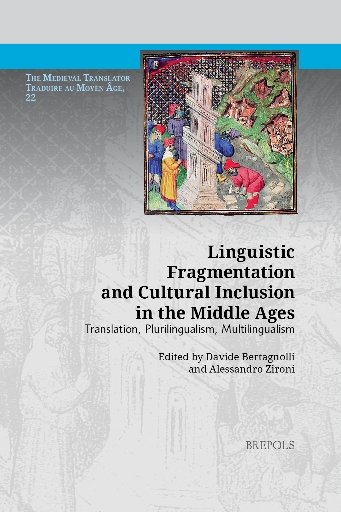
Linguistic Fragmentation and Cultural Inclusion in the Middle Ages
Translation, Plurilingualism, Multilingualism
Linguistic fragmentation contains the risk of cultural separation while the concept of inclusion implies the recognition of the difference of the Other which must be recognised in its specificity to develop a process of inclusion. One of the main means of overcoming the dangers hidden in linguistic fragmentation is unquestionably plurilingualism and relatedly translation. Translation enables the transmission of content from one linguistic-cultural system to another. Multilingualism is not just a peculiarity of the contemporary age it is a fundamental phenomenon of the Middle Ages. The conceptual relationship between linguistic fragmentation and cultural inclusion and the inter-relationships of these two apparently opposing poles with the communicative tool of translation requires some reflection within the broader framework of translation studies in the Middle Ages. This collection of essays examines the seemingly paradoxical concept of linguistic fragmentation as an instrument of cultural inclusion thanks to the practice of translation.
The essays explain the relationship through translations between many medieval languages and texts from Icelandic to Italian from English to French and more. They examine vernacular circulation of religious texts (translation of the Bible of hagiographic or homiletic texts etc.); circulation thanks to translation of literary texts (e.g. the translation of epic-chivalric cycles); translation from a koine language to another language and vice versa; and the relationship between the choice of the target language and the socio-cultural context.
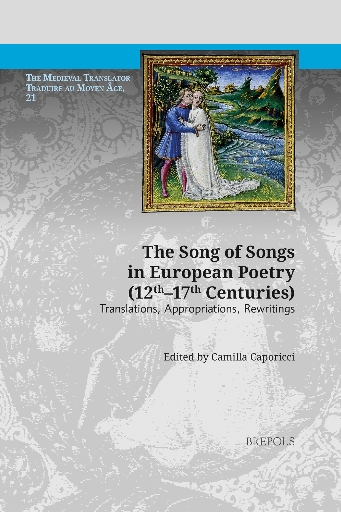
The Song of Songs in European Poetry<br/> (Twelfth to Seventeenth Centuries)
Translations, Appropriations, Rewritings
Traditionally attributed to King Solomon and defined by Rabbi Aqiva as the Holy of Holies among the sacred Scriptures the Song of Songs is one of the most fascinating and controversial biblical books. Celebrated as a key to the supreme mystery of the union between God and the faithful this ambivalent book which combined a sensual celebration of love with a well-established tradition of allegorical interpretation was a text crucial to both the Middle Ages and the Renaissance and held a particular appeal for poets. Indeed the Song of Songs played a significant role in the development of European poetry from its very beginning creating an exceptional convergence of sacred and secular languages and horizons of meaning.
Written by a group of distinguished international scholars this volume explores the complex and multifaceted processes through which the Song of Songs entered influenced and interacted with medieval and Renaissance European poetry (twelfth to seventeenth centuries). Focusing on both individual authors – including Peter Riga Dante Alighieri Richard Rolle and George Herbert – and particularly relevant poetic traditions – including Hebrew liturgical poetry and the Tristan and Ysolt tradition Middle English and Petrarchan lyric Renaissance verse versions and seventeenth-century musical compositions dissident and prophetic texts – the volume unveils the relevant role played by the biblical book in the development of European poetry thought and spirituality highlighting its ability to contribute to different poetic genres and give voice to a variety of religious political philosophical and artistic intentions.
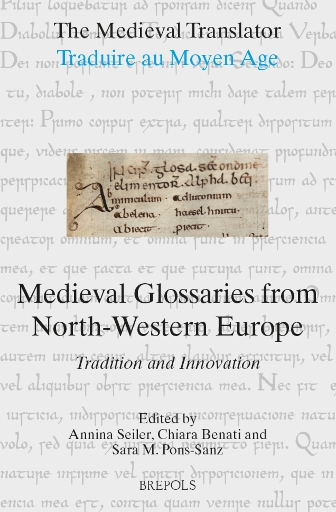
Medieval Glossaries from North-Western Europe
Tradition and Innovation
Glossaries are the dictionaries of the medieval period. They were created at a time when no comprehensive dictionary of the Latin language existed but lexicographical resources were urgently needed to engage with the writings of Classical and Late Antiquity as well as near-contemporary texts. In the non-Romance speaking areas in north-western Europe the compilers of glossaries were quick to have recourse to their vernacular languages. Glossaries are often the places in which these languages were put into writing for the first time. Hence the effort to explain Latin vocabulary resulted in bilingual lexicography and in the establishment of the vernaculars as written languages in their own right. The negotiation of linguistic and cultural barriers lies at the centre of the glossaries. Consequently medieval traditions of glossography are highly interconnected.
This volume represents the first reference work dedicated to medieval glossaries in English and related traditions including other languages spoken in the British Isles (Celtic languages Anglo-Norman) and the Germanic languages (High and Low German Dutch Scandinavian Gothic). As such it is intended as a vademecum for researchers in order to facilitate modern approaches to medieval glossography lexicology and lexicography which often require some familiarity with different traditions. Written by experts in the field the fifty chapters of this volume highlight important characteristics and themes of medieval glossaries and outline different glossographic traditions; they facilitate access to individual glossaries or groups of related glossaries by providing detailed discussions of the texts their sources relationships and transmission; they also give an account of the current state of research and highlight important resources.
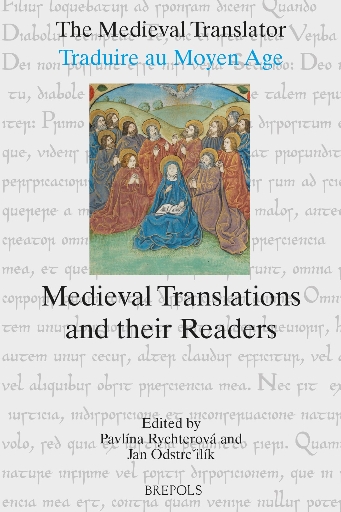
Medieval Translations and their Readers
The papers gathered in this volume focus on ‘Medieval Translations and their Readership’ the special strand of the 11th Cardiff Conference on the Theory and Practice of Translation in the Middle Ages. The volume discusses the role of the reader in the process of translation communities of readers and their active participation in translators’ choices and the translation as a result of a dialogue between author text and its reader.
Translations of works of theology and religious education the focus of most of the contributions to this volume constitute excellent material for research into medieval lay audiences. Vernacular religious educational texts from the thirteenth to the sixteenth century show a great deal of conformity. Individual authors resorted to similar strategies and techniques to meet any translation challenges to fulfil educational aims or to relate to their readers and to accommodate their expectations. Simultaneously the readers played a crucial role as they shaped the production of texts in many ways.
Research into Middle English pastoral and devotional literature and the conditions of its production still dominates scholarly work in the field. Religious texts in vernaculars other than Middle English have so far received little attention. This volume tries to tackle this lacuna by offering a careful comparative analysis of relevant vernacular texts across Europe including Slavonic works using historiographical philological and linguistic methods as well as literary scholarly approaches.
The sixteen chapters are organized in three sections. The first one ‘Authors and Readers’ brings together articles examining the idea of a model reader as expressed in translations of biblical texts and texts of religious instruction. The contributions in the second section on the ‘Dissimination of Knowledge’ focus on how translators addressed readers how people read and how they used the manuscripts and printed books made for them. The target audience or model reader of the first section is here put into perspective with the help of discussions of reading practices. The last section ‘Religious Education in Transition’ comprises contributions which focus on textual material from the period when printed books gradually changed the relationship between languages texts authors and readers.
Acquisition through Translation
Towards a Definition of Renaissance Translation
The definition of translation in Renaissance Europe is here proposed as a process of acquisition: the book studies how a number of European languages finding their identification in the newly evolving concept of nation shape their countries’ vernacular libraries by appropriating ancient and contemporary classics.
The emergence of standard modern languages in early modern Europa entailed a competition with the dominant Latin culture which remained the prevalent medium for the language of science philosophy theology and philology until at least the eighteenth century. In this process translation played a very special role: in a number of significant instances we can identify in the undertaking of a specific translation a policy of acquisition of classical - and by definition authoritative - texts that contributed to the building of an intellectual library for the emerging nation. At the same time the transmission of ideas and texts across Europe constructed a diasporic and transnational culture: the emerging vernacular cultures acquired not only the classical Latin models incorporating them in their own intellectual libraries but turned their attention also to contemporary or near-contemporary vernacular texts conferring on them through the act of translation the status of classics. Through the examination of case studies that take into account both literary and scientific texts this volume offers an overview of how early modern Europe developed its vernacular national literatures following the model suggested in the late Middle Ages through a process of acquisition and translation.
Pursuing a New Order II.
Late Medieval Vernacularization and the Bohemian Reformation
In the first two decades of the fifteenth century the Hussite religious reform movement emerged in Bohemia; it used one of the realm's vernacular languages Czech both to disseminate its reform ideas and to establish strong foundations for the reform. The vernacular became a significant strategy for identification capable of binding together disconnected religious ethnic political and regional identities and generating a very potent aggregate of identifications. This volume considers material from the second half of the fourteenth century to the first half of the sixteenth beginning with the so-called Hussite ‘forerunners’ and ending with the early German reformation. Individual essays discuss the various functions of the vernaculars in different text types social situations and religious and political contexts. Together they correct former assumptions about the topic and provide a basis for further study of Hussite vernacular theology and contribute to the transformation of scholarly narratives about the Hussite movement by including works of vernacular religious education among the most important source material. It offers a basis for the comparative research on the role of the vernaculars in late medieval European religious reform movements.
Booldly bot meekly
Essays on the Theory and Practice of Translation in the Middle Ages in honour of Roger Ellis
When back in the 1980s Roger Ellis first sounded out academic colleagues in British universities and beyond about their possible interest and participation in a conference on medieval translation theory and practice he perhaps did not envisage that the resulting gathering - intellectually curious animated convivial - at Gregynog Hall in Wales (1987) would be the first of a series of international conferences with a strong continental European base which now provides a regular forum in which one can initiate and engage with research questions about this near all-encompassing aspect of medieval culture. Since that first meeting the Cardiff Conferences on the Theory and Practice of Translation in the Middle Ages have charted and drawn anew the parameters of scholarly debate on the topic while their Proceedings hosted since 1996 by Brepols’ Medieval Translator series cumulatively present a body of work valuable to anyone interested in translation in its medieval broadly European manifestations.
The contributors of this volume’s essays assembled in tribute to Roger Ellis on the occasion of his seventieth birthday have profited from the intellectual opportunities the Medieval Translator conferences foster and in particular from Roger’s friendship and academic acumen. The essays draw in many cases on Roger’s work to inform a collective project that reflects on his specific interests in translation including latemedieval piety and Birgittine texts scholarly editions and studies of genre considering literary and linguistic relations within and across languages registers national boundaries time and space refining even re-defining our understanding of translation. We offer these essays with warm thanks to and appreciation of Roger Ellis for his work in this field not least for establishing with this conference series a means to demonstrate that translation and translation studies is above all a question of different voices speaking productively in dialogue.
Pursuing a New Order I.
Religious Education in Late Medieval Central and Eastern Central Europe
Concentrating on the period of the emergence of the vernaculars in the context of religious text production in Central and Eastern Central Europe from the fourteenth to the sixteenth centuries the individual studies in this volume present material so far neglected by nationally defined historiographies and literary studies. The process of vernacularization created a new sociolinguistic field for the negotiation of social order through the choice of texts and topics. This volume seeks to answer the questions of whether why and how distinctive new communicative literary and political cultures developed after the vernacular languages had acquired ever higher levels of literacy and education. The volume fills a gap in contemporary scholarship on the role of the vernaculars and vernacular literatures in European medieval societies and with the focus on Eastern European regions it breaks new ground in regard to questions that have so far only been explored on the basis of material from Europe’s ‘West’.
Translation and Authority - Authorities in Translation
The question about the relation between medieval translation practices and authority is a complex and multifaceted one. Depending on one’s decision to focus on the authority of the source-text or of the translated text itself on the author of the original text on the translator or on the user of the translation it falls apart in several topics to be tackled such as just to name a few: To what extent does the authority of the text to be translated affect translational choices? How do translators impose authority on their text? By lending their name to a translation do they contribute to its authoritative status?
After two introductory essays that set the scene for the volume addressing the above questions from the perspective of translations of authoritative texts into Dutch and French the focus of the volume shifts to the translators themselves as authorities. A next section deals with the choices of texts to be translated and the impact these choices have on the translation method. A third part is dedicated to papers that examine the role of the users of the translations.
The selection of papers in the present volume gives a good indication of the issues mentioned above embedded in a field of tension between translations made from a learned language to a vernacular language translations from one vernacular to another or even from a vernacular to the Latin language.
The Medieval Translator. Traduire au Moyen Age
In principio fuit interpres
Translation studies centering on medieval texts have prompted new ways to look at the texts themselves but also at the exchange and transmission of culture in the European Middle Ages inside and outside Europe. The present volume reflects in the range and scope of its essays the itinerant nature of the Medieval Translator Conference at the same time inviting readers to reflect on the geography of medieval translation. By dividing the essays presented here into four groups the volume highlights lines of communication and shifts in areas of interest connecting the migrating nature of the translated texts to the cultural political and linguistic factors underlying the translation process. Translation was in each case under discussion the result or the by-product of a transnational movement that prompted the circulation of ideas and texts within religious and/or political discussion and exchange.
Thus the volume opens with a group of contributions discussing the cultural exchange between Western Europe and the Middle East identifying the pivotal role of Church councils aristocratic courts and monasteries in the production of translation. The following section concentrates on the literary exchanges between three close geographical and cultural areas today identifiable with France Italy and England allowing us to re-think traditional hypotheses on sites of literary production and to reflect on the triangulation of language and manuscript exchange. From this triangulation the book moves into a closer discussion of translations produced in England showing in the variety and chronological span covered by the contributions the development of a rich cultural tradition in constant dialogue with Latin as well as contemporary vernaculars. The final essays offer a liminal view considering texts translated into non-literary forms or the role played by the onset of printing in the dissemination of translation thus highlighting the continuity and closeness of medieval translation with the Renaissance.
Alessandra Petrina is Associate Professor of English Literature at the Università degli Studi di Padova Italy. She has published extensively on late-medieval and Renaissance literature and intellectual history as well as on modern children’s literature and edited a number of volumes on early modern English culture.
La version latine et l'adaptation française de l'Historia rerum in partibus transmarinis gestarum de Guillaume de Tyr
Étude comparative fondée sur le Recueil des historiens des croisades - historiens occidentaux
A comparison of the twelfth-century Latin chronicle of the Crusades by William of Tyre the Historia rerum in partibus transmarinis gestarum with its anonymous thirteenth-century French version the Estoire de Eracles reveals a number of major differences between the two. These operating at every level of the translation - of syntax lexis or theme - show the difficulties the translator faced in adapting to his own and his first readers’ interests the complex historiography of William of Tyre. The conclusions which they allow us to draw confirm an understanding of translation closer to the idea of adaptation than to any conventional modern understanding of the term.
Lost in Translation?
The contributions to this volume are organised in a way that bear out the vitality of translation activity in the medieval period and the resourcefulness of modern scholarship in addressing the phenomenon of translation at large. No other period relies so heavily on this literary process to construct its cultural identity. Translations from Latin into the vernacular or from one vernacular into another or even from a vernacular into the Latin language are just a few of the many forms medieval translation can take. The codification of the translation process as appropriation transformation or accommodation does not sufficiently emphasize the overarching curiosity and interest that motivates any translation activity. Rather preceding the stages of appropriation and re-interpretation it is positive inquisitiveness and openness towards linguistic and cultural difference that generate the production of a new text and the transference of culture from one sphere to another. It is that positive inquisitiveness which this volume emphasizes.
The volume initially addresses the way in which translators dealt with texts from the early medieval period. It then considers the phenomenon of bilingualism and the privileged relationship that England held with the continent especially the Italian and French literary traditions. The third part of this volume tackles the problem of fifteenth-century religious translation in England and to a lesser extent France and complicates it by showing its inevitable political implications. Understood more particularly as an act of cultural transfer translation activity can also be considered beyond the linguistic process. The fourth part of the volume deals with several instances of translations from one genre into another and from one media into another. The contributions also point to new ways of considering the literary process of translation and by praising diversity and difference they suggest a less traumatic way of reading Babel than is usually implied.
La traduction vers le moyen français
Actes du IIe colloque de l’AIEMF, Poitiers, 27-29 avril 2006
Les médiévistes connaissent bien les sens que les Arts poétiques latins du Moyen Âge attribuent au mot translatio : transfert de langues et de cultures mais aussi transplantation de lettres d’un monde à un autre monde greffe vitale du passé sur le présent donation de sens du présent au passé. Environ deux tiers des traductions médiévales sont faites entre le xiv e et le xv e siècle. Bien avant que la Renaissance ne revendique son ouverture sur le monde de l’Antiquité le Moyen Âge et en particulier les clercs de ses deux derniers siècles ont greffé sur la langue et la civilisation françaises tout un pan de la culture et de la littérature du passé jusqu’en à en modifier pour toujours le code génétique. Réfléchir sur la traduction vers le moyen français y compris celle del’oc vers l’oïl comme nous avons voulu le faire lors du II e colloque de l’AIEMF (Association Internationale d’Études sur le Moyen Français) c’est être au cœur de la genèse de ce moyen français de sa double proximité : avec l’ancien français et avec le français moderne. Le rôle joué par la traduction en moyen français apparaîtra encore plus clairement lorsque les médiévistes disposeront d’un répertoire global des traductions médiévales. Ce volume s’inscrit ainsi dans un projet plus vaste : Translations médiévales : cinq siècles de traductions en français xi e-xve siècles (Brepols 2010) qui recensera et interprétera les informations bibliographiques sur l’ensemble des textes traduits enfrançais entre le xi e et le x e siècle offrant ainsi un répertoire exhaustif des textes translatés de leurs traducteurs de leurs commanditaires et de leurs horizons de réception.
The Medieval Translator. Traduire au Moyen Age
Au cœur de toute activité de traduction le concept de déplacement permet de rendre compte des multiples états successifs d’un même texte et d’en interpréter les variations. Toute traduction est en effet une translation c’est-à-dire un changement d’environnement que ce dernier soit national social politique historique linguistique ou ecclésial. Les textes examinés ici témoignent chacun à sa manière des transformations qu’ils ont subies lorsque changeant de langue de style ou d’époque ils ont changé de destinataires. La dynamique qui les traverse se nourrit de subtils côtoiements: un désir légitime de divertir peut fort bien s’accommoder d’une intention didactique; un recueil de miracles locaux peut attirer des pèlerins contribuant ainsi à la vie économique d’un monastère; un texte et ses traductions peuvent devenir l’objet d’utilisations polémiques; se constituer en humaniste une bibliothèque de traductions peut aussi servir un dessein politique.
Par ailleurs les transpositions successives et leurs gloses comme en musique entraînent des changements de tonalité. Ce ‘surplus’ de sens qu’encourage Marie de France pourra cependant se heurter à des résistances: comment par exemple préserver d’une langue à l’autre toutes les harmoniques que libère un enchaînement de jeux de mots mystiques? Ainsi l’inévitable compromis qui s’imposera au traducteur sera souvent le choix d’un enrichissement doublé d’une déperdition.
Ce volume présente une sélection des communications entendues lors du septième colloque international consacré à la théorie et la pratique de la traduction des textes au Moyen Age qui s’est tenu à l’Université de Paris III — Sorbonne Nouvelle en juillet 2004. La période couverte par ces textes et leurs traductions s’étend de l’Antiquité jusqu’à nos jours. Ce sont au total vingt-huit études qui sont ici proposées. La richesse des domaines abordés la haute technicité des analyses de même que la place faite aux questionnements de la traductologie moderne illustrent la remarquable vitalité des études actuelles relatives aux multiples aspects de la traduction des textes médiévaux.
Vernacular Mysticism in the Charterhouse
A Study of London, British Library, MS Additional 37790
The first monograph to appear in The Medieval Translator series Vernacular Mysticism in the Charterhouse presents a study of London British Library MS Additional 37790 (Amherst) a purpose-built anthology of major mystical texts by Richard Rolle Julian of Norwich Jan van Ruusbroec and Marguerite Porète interspersed with shorter texts and compilations. Though the manuscript is famous mainly because it contains the only extant copy of Julian of Norwich's short text it is an intriguing witness to the fifteenth-century spread of the vernacular into traditionally Latinate environments in this case the Carthusian Order in England. In this process of transmission translation plays a central part. Most of the texts in the anthology are translations from Latin or French into Middle English. In addition the anthologist's selection and ordering of texts within the volume intended to further the readers' spiritual lives translates them anew for his intended audience. This study provides finely detailed analyses of the texts in the textual and material context of the Amherst anthology as well as in their religious and historical contexts. It also offers a first-time edition of Quedam introductiua extracta a Latin compilation contained in the manuscript and a discussion and listing of verbal marginal annotations reflecting early readers' reactions to the texts. By reading the texts in (one of) their medieval manuscript context(s) this book gives students and scholars of (translated) medieval religious texts a fresh view of the classics of mystical writing contained in the remarkable literary document that is the Amherst anthology.
The Theory and Practice of Translation in the Middle Ages
Complexité et fascination: deux mots qui reviennent souvent à l’esprit au contact des textes médiévaux au point qu’ils pourraient servir à caractériser la nature des rapports qui unissent ces textes à leurs traducteurs. Dans leur diversité les communications entendues à Saint-Jacques-de-Compostelle illustrent chacune à sa manière de nombreux aspects de cette complexité qu’il s’agisse des sujets traités ou des problèmes techniques soulevés. Le rapport au temps qu’impose le texte médiéval se double d’un rapport à la distance car la différence culturelle se présente au traducteur comme un éloignement ce qui dans le travail de rapprochement que constitue alors la traduction introduit la notion d’interprétation. A son tour cette interprétation avec ses degrés est étroitement dépendante des objectifs pédagogiques culturels politiques ou religieux que s’est fixés le traducteur comme cela apparaîtra clairement à la lecture d’un certain nombre de ces communications. Plusieurs études de ce recueil confirment également que la traduction loin d’être un travail de solitaire est avant tout un acte social une activité de mise en relations. C’est cette patiente recherche d’adaptation à des publics différents en fonction d’époques et de goûts différents accompagnée de choix tour à tour réjouissants et frustrants qui constitue le travail de tout traducteur qu’il appartienne au Moyen Âge ou au monde moderne. C’est aussi cette richesse venue du passé mais toujours actuelle et cette recherche sans cesse reprise d’un équilibre toujours instable qui font que la traduction dans sa pratique comme dans sa théorie exerce sur tant d’esprits une réelle fascination.
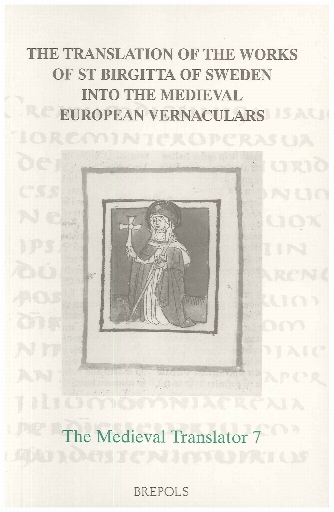
The Translation of the Works of St Birgitta of Sweden into the Medieval European Vernacular
This volume of papers from an international Conference held in Beverley in 1997 on the translation into the medieval European vernaculars of the works of St Birgitta of Sweden forms volume 7 in the series The Medieval Translator. Previous volumes in the series have been based on papers heard at the Cardiff Conferences on the Theory and Practice of Translation in the Middle Ages (1987- ). While future volumes in the series will continue to provide a record of the Cardiff Conference (the next is planned for Compostella in 2001) the present volume provides a welcome development for the series and paves the way for scholarly monographs on individual works and writers — including editions of medieval translations — and other publications more narrowly angled at the different questions raised by the study of medieval translation.
The Medieval Translator. Traduire au Moyen Age
Proceedings of the International Conference of Göttingen (22-25 July 1996). Actes du Colloque international de Göttingen (22-25 juillet 1996)
Most of the papers in this volume consider translation in medieval England (in both Old and Middle English and Anglo-Norman) though translations into other medieval vernaculars are also represented (Icelandic Dutch German) as is translation of classical Greek into Latin. Most of the translations are anonymous though major translators are also included: Cicero King Alfred Robert Grosseteste Jean de Meun Chaucer. Several papers consider the troubled times during the late fourteenth and early fifteenth centuries in England when a number of major translation projects were undertaken; others explore the place of translation in daily life (pro forma letters gynaecological treatises forged documents in support of a local shrine texts rewritten so as to update legal references in them); another considers the importance of paper for the rapid dissemination of translated texts. Also featured prominently is the translation of different sorts of religious texts originally variously in monastic eremitical and mendicant milieux and including the 'translations' for their readers of divine messages received by female visionaries. The more generous understanding of the term indicated by the use of quotation marks for these latter is also reflected in a paper considering representations of heaven and hell in visual arts. All the contributions share an awareness of translation as culturally specific - as originating in and addressing specific contexts: of; for example; nationality politics class and gender. Above all translation as a new thing; with a life of its own may provide a fuller as well as a different realisation of what was only partly present in its original.
The Medieval Translator. Traduire au Moyen Age
Le premier volume de cette collection chez Brepols est le cinquième d'une série du même nom éditée par Roger Ellis et publiée précédemment chez d'autres éditeurs. Comme ses prédécesseurs il présente les communications faites lors de colloques internationaux et traitant de la théorie et de la pratique de la traduction au moyen âge. Les articles figurant au sommaire de ce volume ont été présentés lors du colloque de Conques les 26-29 juillet 1993. Les articles sont rédigés dans une des langues internationales et sont accompagnés de résumés en anglais. Le fil conducteur est le phénomène de la traduction au moyen âge et la série contient tant les études spécialisées que les approches plus générales. L'article phare du volume 5 (K. Ashley & P. Sheingorn The translations of Sainte Foy: bodies textes and places) par exemple traite de l'interaction entre la transmission littéraire et la translation de reliques en partant du cas de sainte Foy. D'autre part la question des traductions post-médiévales ou contemporaines de textes mediévaux est également abordée.