


Antiquité Tardive - Late Antiquity - Spätantike - Tarda Antichità
Revue Internationale d'Histoire et d'Archéologie (IVe-VIIIe siècle)
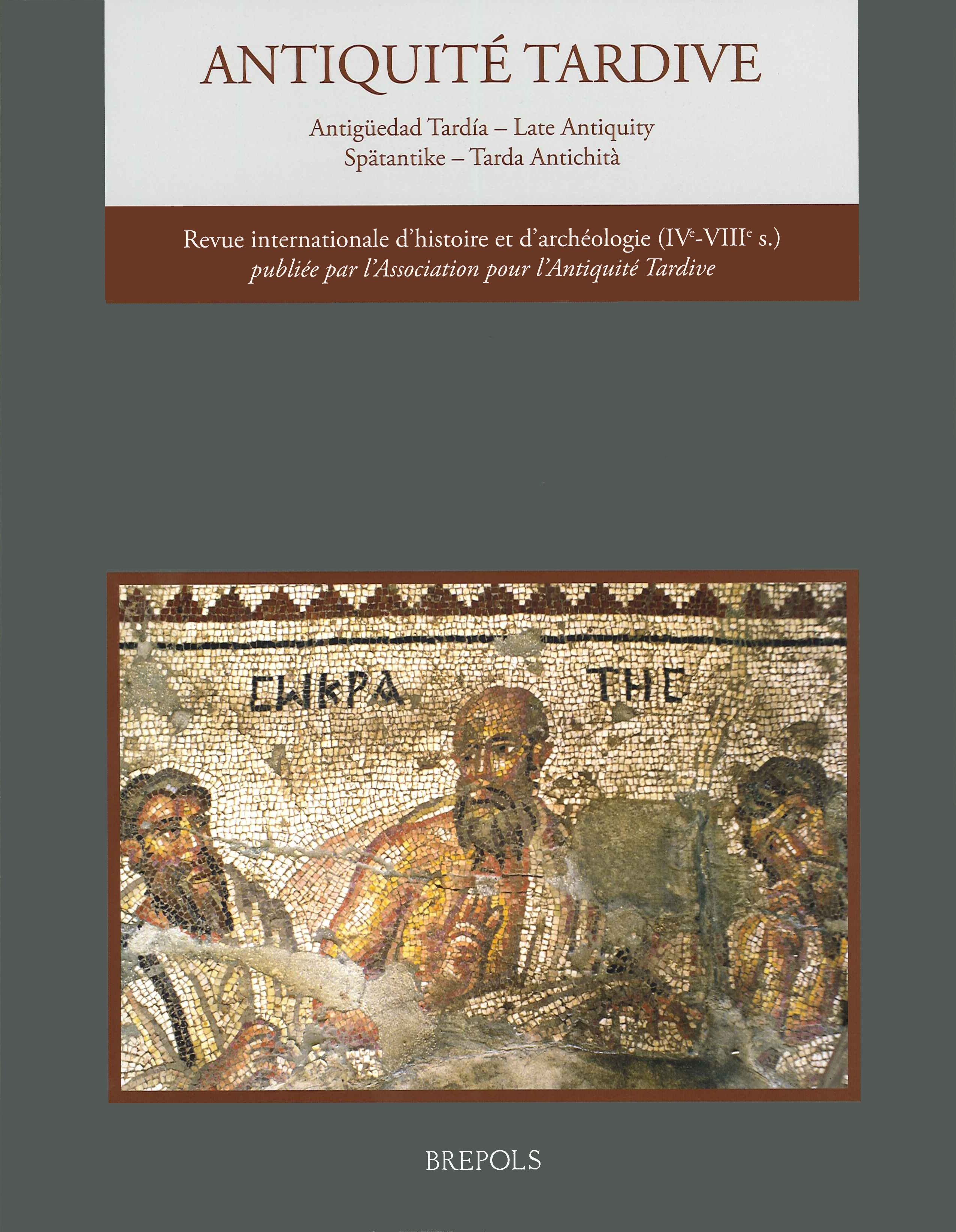
Volume 29, Issue 1, 2021
-
-
Front Matter ("Principales abréviations", "Table des matières", "Éditorial", "In memoriam: Lellia Cracco Ruggini, Pierre Maraval, Roland Delmaire")
show More to view fulltext, buy and share links for:Front Matter ("Principales abréviations", "Table des matières", "Éditorial", "In memoriam: Lellia Cracco Ruggini, Pierre Maraval, Roland Delmaire") show Less to hide fulltext, buy and share links for: Front Matter ("Principales abréviations", "Table des matières", "Éditorial", "In memoriam: Lellia Cracco Ruggini, Pierre Maraval, Roland Delmaire")
-
-
-
Introduction - Historiographie et méthodologie
show More to view fulltext, buy and share links for:Introduction - Historiographie et méthodologie show Less to hide fulltext, buy and share links for: Introduction - Historiographie et méthodologieAuthors: François Baratte, Gisella Cantino Wataghin and Eleonora Destefanis
-
-
-
Uomo e «natura» nella tarda antichità: rappresentazione e percezione
show More to view fulltext, buy and share links for:Uomo e «natura» nella tarda antichità: rappresentazione e percezione show Less to hide fulltext, buy and share links for: Uomo e «natura» nella tarda antichità: rappresentazione e percezioneAbstractMen and “Nature” in Late Antiquity: representation and perception
The aim of this paper is to inquire into one specific aspect of the relationship between man and nature in Late Antiquity, namely how man observes, perceives, contemplates, eventually appreciates the physical realities of the world, that is the “nature”, in one of the main meanings of this word. Literary and figurative texts from the 4th through the 6th century are considered: among the first Ausonius, Ennodius, Claudianus, Ambrose of Milan, and for the others mosaics (rural, hunting, marine scenes). The analysis points out that if natural elements are a wide and constant presence in the late antique imagery, their representation is normally filtered through rhetorical canons and traditional iconographic formulae, that exclude any immediate representation in words as much as in images. The only exception to this pattern is the Itinerarium Egeriae, where the pilgrim expresses in short but lively sentences her own reaction to the landscapes she is encountering in her trip; this unusual liberty from traditional models accords with the uniqueness of the text, that does not fit in any specific literary genre. Exceptional as it is from this point of view, the Itinerarium is however an important witness of an attention to the physical world and of a sensitivity to its suggestions that were likely widespread, even if they did not have space in the formal culture. [Author]
-
-
-
Archeologia del paesaggio e relazioni uomo-ambiente: risorse, natura e luoghi in Italia settentrionale tra V e X secolo d.C.
show More to view fulltext, buy and share links for:Archeologia del paesaggio e relazioni uomo-ambiente: risorse, natura e luoghi in Italia settentrionale tra V e X secolo d.C. show Less to hide fulltext, buy and share links for: Archeologia del paesaggio e relazioni uomo-ambiente: risorse, natura e luoghi in Italia settentrionale tra V e X secolo d.C.By: Fabio SaggioroAbstractLanscape archaeology and human-environment relationship: resources, nature and settlements in northen Italy between 5th and 10th century
The role that the environment has played in human past has taken on an ever greater presence in archaeology literature, following the progressive abandonment of the idea that the times of change of environmental ecosystems were necessarily of a very long period. The reconstruction of the topographical structures of forest spaces has in some researches assumed a decisive role to understanding the rhythms of life of the communities. The possibility of making different types of data converge: from archival to topographical ones (from the document to the ground, we could say) undoubtedly opens up roads in this direction. The paper addresses the man-environment relationship in the Middle Ages through recent different case studies of the Po area, starting with sites such as the plain village of Nogara, or the Benedictine monastery of Leno or the alpine village of Piuro. The basic problem remains that of relating the archaeological settlements with the paleoenvironmental elements in a systematic and ever more precise way. In the long phase between the 5th and 10th centuries, the paleoenvironmental data that seem to emerge in northern Italy would show a progressive consolidation of a man-environment relationship mainly centered on the management of natural resources, such as the forest. The changes in residential construction, towards almost exclusively wooden building, seem to involve the management of these collective, public or private assets. The changes, however, which seem to occur mostly within the 5th-7th century AD, should be evaluated with greater precision: processes of erosion, denudation of slopes in mountain areas, rather than the development of swampy or wooded areas in lowland areas underline a diversification of environmental transformations, which perhaps could translate, on a local scale, more general climatic dynamics. Regarding 9th-10th century, the study, not only of some sites, but of the surrounding landscape, has shown how the correlations with human activities are never completely absent and there is to changes in the shape of resource management, rather than to real abandonment of spaces. From this perspective, it is evident, on a methodological level, the need to systemically use paleo-environmental investigations/ multidisciplinary approaches, within the more ‘traditional’ archaeological research, in order to restore the complexity of environmental changes and the characteristics of different landscapes. [Author]
-
-
-
L’homme et son environnement. L’approche interdisciplinaire sur l’évolution des territoires insulaires de l’archipel du Kvarner (Croatie)
show More to view fulltext, buy and share links for:L’homme et son environnement. L’approche interdisciplinaire sur l’évolution des territoires insulaires de l’archipel du Kvarner (Croatie) show Less to hide fulltext, buy and share links for: L’homme et son environnement. L’approche interdisciplinaire sur l’évolution des territoires insulaires de l’archipel du Kvarner (Croatie)Authors: Morana Čaušević-Bully, Charly Massa, Marine Rousseau, Vincent Bichet, Hervé Richard and Mario NovakAbstractMankind and its environment: an interdisciplinary approach on the development of the insulare territories of Kvarner archipelago (Croatia)
The present article aims to introduce the IATEKA programme “Interdisciplinary Approach to the Territorial Evolution of the Kvarner Archipelago” and its first results, started in 2018 and focused on examining the long-term relationship between humans and their environment, with a particular focus on the construction, management and transformation of the island territories and landscapes of the Kvarner Archipelago, as well as the fluctuation of the different populations and their impact and/or adjustment to the particular environment. As an interdisciplinary programme, methods and results obtained in the field of sedimentary and landscape archaeology, physical anthropology or bioarchaeology, specific analyses such as stable isotopes, ancient DNA, paleobiology and sedimentology are brought to a new level of inter-examination. Although this programme aims to approach the questions of human-environment interactions over a long, or even very long period in as comprehensive a manner as possible and through an interdisciplinary approach, the article focuses only on the results of the palynological studies, relating to the period between Antiquity and the Early Middle Ages. Indeed, the results obtained on the lake sediments allow us to better understand the evolution of the environment of one of the islands of the archipelago, the island of Cres. It also seemed impossible to approach the changes observed for the period of Late Antiquity stricto sensu without addressing, even if only briefly, the character traits of the region that were established from the beginning of Antiquity and the effective presence of Roman power in the region. [Authors]
-
-
-
Late antique “natural” disasters: de te fabula narratur?
show More to view fulltext, buy and share links for:Late antique “natural” disasters: de te fabula narratur? show Less to hide fulltext, buy and share links for: Late antique “natural” disasters: de te fabula narratur?Authors: Hendrick Dey and Paolo SquatritiAbstractLes catastrophes « naturelles » dans l’Antiquité tardive : de te fabula narratur ?
Notre article se divise en deux parties. Dans la première, nous analysons le concept de catastrophe naturelle (tremblements de terre, inondations et autres événements climatiques, épidémies des hommes et des bêtes domestiques) dans le cadre de l’Antiquité tardive. Nous mettons le grand nombre de désastres « naturels » attestés par les sources du VIe-VIIIe siècles en rapport avec la culture littéraire de la période et nous examinons la vulnerabilité autant que la résistance (« resilience ») des sociétés tardoromaines. La seconde partie de l’article s’intéresse à Césarée Maritime, ville frappée en 551 et en 749 par des tsunamis, et toutefois capable de surmonter sa vulnerabilité écologique et sociale et de montrer sa resilience, que ce soit sous l’administration byzantine, comme sous celle des califes. [Auteurs]
-
-
-
Le climat et l’Antiquité Tardive : ses restitutions par les Modernes et sa perception par les Anciens
show More to view fulltext, buy and share links for:Le climat et l’Antiquité Tardive : ses restitutions par les Modernes et sa perception par les Anciens show Less to hide fulltext, buy and share links for: Le climat et l’Antiquité Tardive : ses restitutions par les Modernes et sa perception par les AnciensBy: Philippe LeveauAbstractClimate and Late Antiquity: modern restitution and ancient perception
This article draws on proxy data that paleoclimatologists have used to reconstruct the climate in Late Antiquity. The cooling that characterized the Mediterranean and circum-Mediterranean regions at this time appears less pronounced than indicated by its classification as a Little Ice Age. Analysis of the perception that the Ancients had of the climate makes it possible to rule out the hypothesis of a direct relationship between the climate of this period and the crisis of the Roman Empire in the West. The term “Little Ice Age” and even more “Little Ice Age of Late Antiquity” in the environmental geosciences creates a regrettable confusion between climatic oscillations and a breakdown in the climatic system which has occurred frequently throughout the Earth’s history. Historians have been wrong to adopt this terminology and to assume that it defines a relationship in the past between the radiance of the sun, its activity and the history of a historical society. Interdisciplinarity should not result in the merging of disciplines. The approach taken here is multidisciplinary, which is better suited to the identification of a number of factors. [Author]
-
-
-
Climate and the end of Antiquity: an answer from western-central Anatolia
show More to view fulltext, buy and share links for:Climate and the end of Antiquity: an answer from western-central Anatolia show Less to hide fulltext, buy and share links for: Climate and the end of Antiquity: an answer from western-central AnatoliaBy: Paolo MaranzanaAbstractLe climat et la fin de l’Antiquité tardive : une réponse depuis le centre-ouest de l’Anatolie
Cet article traite du rapport entre le développement des communautés rurales de Galatie (centre-ouest de l’Anatolie) durant la période romaine tardive (IVe-VIIe siècle) et les changements environnementaux. Le plateau de l’Anatolie centrale est une région sèche située à près de 1 000 m d’altitude, où les différences de précipitations ont pu avoir un impact significatif sur l’accès à l’eau, et donc sur l’agriculture. Ces dernières décennies, les études environnementales en Anatolie ont permis de recueillir une importante documentation concernant les tendances climatiques, les espèces cultivées (céréales, arboriculture, mauvaises herbes et graminées pour les pâturages) ainsi que la productivité agricole au fil du temps. L’article compare ces témoins aux données de l’archéologie collectées lors de différents projets de prospection menés dans la région (le Konya Plain Survey, l’Archaeological General Survey in Central Anatolia, l’Isparta Archaeological Survey, et les prospections dans les territoires d’Aizanoi et Germia). Les résultats montrent que la production agricole et l’occupation rurale se sont développées indépendamment des conditions climatiques. Le nombre de sites et la productivité agricole ont en effet augmenté durant la période sèche (IVe-Ve siècle) et ont continué de se développer durant la période froide et humide (VIe-VIIe siècle) pour diminuer de manière significative à la fin du VIIe siècle (période encore froide et humide). Cette tendance paraît moins liée aux changements climatiques qu’à des événements socio-économiques, politiques et militaires à une échelle plus globale, comme la fondation de Constantinople (IVe siècle), la perte des provinces occidentales (Ve siècle) et les raids arabes (VIIe siècle). La réponse aux changements environnementaux est toutefois visible dans les travaux d’aménagement menés par les communautés rurales, qui n’ont pu continuer leurs activités agricoles qu’à l’aide d’opérations extensives de fumage et de drainage, révélées par les prospections. [Trad. de la Rédaction]
-
-
-
Il controllo delle acque fluviali nell’Italia settentrionale (IV-VIII secolo). Spunti di riflessione, tra fonti scritte e documentazione archeological
show More to view fulltext, buy and share links for:Il controllo delle acque fluviali nell’Italia settentrionale (IV-VIII secolo). Spunti di riflessione, tra fonti scritte e documentazione archeological show Less to hide fulltext, buy and share links for: Il controllo delle acque fluviali nell’Italia settentrionale (IV-VIII secolo). Spunti di riflessione, tra fonti scritte e documentazione archeologicalAbstractControl of the fluvial waters in Northern Italy (4th-8th c.). Some insights, from written sources to archaeological documentation
One of the most recurrent topics in historiography regarding landscape transformations in Late Antiquity is related to flooding and loss of control over rivers, essentially attributed to two factors: 1/ the increase in rainfall and decrease in temperature, as part of the so-called Late Antique Little Ice Age (LALIA), on which paleoclimatological studies have focused in particular; 2/ the loss of control over water courses, that took place in the Roman period, mainly related to depopulation that would have prevented the extensive maintenance works on the banks and canalisations. In this context, particularly with regard to northern Italy, which is the subject of this contribution, some passages of the Dialogi of Gregory the Great and Paul the Deacon (notably the famous mention of the diluvium in 589) are often evoked, recalling miraculous interventions of saints who stopped floods or diverted the rivers, thus saving cities and countryside. The paper aims to discuss and argue these perspectives, examining the context and the purposes of the cited texts, actually written with a moralistic-eschatological intention, but also widening the glance to other types of sources, literary, juridical as well as the Corpus agrimensorum, from which it clearly appears that the theme of floods was already well present in the imperial age. The archaeological record is also examined, providing useful information to more precisely discuss the chronology and the real extent of the floods, showing a very diverse and complex reality. [Author]
-
-
-
Représenter le nature : l’exemple des manuscrits
show More to view fulltext, buy and share links for:Représenter le nature : l’exemple des manuscrits show Less to hide fulltext, buy and share links for: Représenter le nature : l’exemple des manuscritsBy: François BaratteAbstractRepresenting Nature in manuscripts
Representing Nature is hardly ever the way it really is, but the way one imagines it. Painters and mosaicists of Late Antiquity have thus brought to life creatures that naturalists of course described, but that no one had ever seen, like unicorn, phoenix or griffin. They placed them in perfectly realistic scenes, like hunts, so that their picture made it possible to push back the boundaries of the World. In general, and despite some remarkable exceptions, at that time the scientific sensitivity to nature is decreasing, and if it is still present in some writers, it seems even weaker in the figurative arts: there are no representation, for example, of winter or desert, which are yet well described in literary texts. We examine here some significant examples borrowed from manuscripts which highlight the poor quality of the representations of Nature in the late illustrated works of Virgil, or which on the contrary introduce to a few artists with a more acute sensitivity. The representations of the Flood perfectly reflect these differences in temperament. [Author]
-
-
-
Imago naturae. Cristiani e pagani a confronto nello specchio della natura (IV-V secolo)
show More to view fulltext, buy and share links for:Imago naturae. Cristiani e pagani a confronto nello specchio della natura (IV-V secolo) show Less to hide fulltext, buy and share links for: Imago naturae. Cristiani e pagani a confronto nello specchio della natura (IV-V secolo)AbstractImago naturae. Christians and pagans face to face in the miror of nature (4th-5th c.)
The contribution examines the way in which, between the 4th and 5th centuries, Christian thinkers confronted themselves with the way in which, in their ‘natural philosophy’, the pagan thinkers of the time faced various aspects of the problem of the nature. After briefly recalling the main themes of the confrontation in the pre-Constantinian period, the contribution examines some continuities such as the apologetic line and the Christian attempt, in particular by Augustin, within the nascent theology of creation, to secularize the divine dimension of nature. In the last part the paper examines some innovations, starting with Basil’s preaching on Hexameron, focusing in conclusion on the way in which the contemplation of nature has become an important monastic theme, in particular through the reflection of Evagrius. [Author]
-
-
-
Le désert des moines latins
show More to view fulltext, buy and share links for:Le désert des moines latins show Less to hide fulltext, buy and share links for: Le désert des moines latinsBy: Laurent RipartAbstractThe desert of Latin monks
The Latin literature of early Christianity approached the desert according to the description given by the Scriptures and the Lives of the Eastern fathers, who had perceived it less as a particular landscape than as a supernatural space, inhabited by both demons and angels. The Latin monks thus appropriated the Oriental concept of (h)eremus, to designate first of all the islands colonised by the western anchorites, and then the forests and all the rural spaces in which they settled. By describing their monastic places as desert, the Latin monks were led to think of them as a demonic world transformed into a Garden of Eden, according to a stereotyped model that allowed them to affirm the separation and therefore the sacredness of the spaces they had appropriated. [Author]
-
-
-
“Mikra theatra”. Criteri esegetici per l’identificazione dei luoghi dell’insegnamento domestico tra il II e il VI sec. d.C.
show More to view fulltext, buy and share links for:“Mikra theatra”. Criteri esegetici per l’identificazione dei luoghi dell’insegnamento domestico tra il II e il VI sec. d.C. show Less to hide fulltext, buy and share links for: “Mikra theatra”. Criteri esegetici per l’identificazione dei luoghi dell’insegnamento domestico tra il II e il VI sec. d.C.By: Ada CarusoAbstract“Mikra theatra”. Exegetical criteria for identifying household school between the 2d and the 6th century
Teaching inside private houses was very common during Late Antiquity among rhetoricians, philosophers and Christians. Despite the great quantity of literary sources that attest to household lessons, the identification of domus used for this purpose is not easy. Archaeological evidence is scanty, as the furniture was often of perishable material. Furthermore, sources, although abundant, do not lead to any secure identification. My aim is to establish some useful criteria to concretely assume the teaching activity inside private houses. To this purpose, I will first examine the archaeological material detecting domestic teaching or the holding of intellectual activities; then I will examine those houses wherein a teaching activity can be retained as sure (or very likely), starting from Late Hellenism (Pompei, Velia) to Late Antiquity (Aphrodisias; Rome, house of Agapitus; Egypt, Trimithis). Additionally, I will discuss why houses that have been considered to be seats of Late Antique schools (Apamea, maison de la Cathédrale de l’Est; Baalbeck, Soueidié villa), must be regarded, instead, as incerta exempla. In particular, it will be pointed out how the apsidal hall, which has been often regarded as indicative of domestic teaching (Athens, houses on the Areopagus), is not decisive to this regard, whereas the decoration instead appears to be functional to such kind of activity. In most cases, in fact, the interpretation as house/school is mainly based on decorative elements (sculptures or paintings) or inscriptions on the walls, whereas the planimetric features are quite unspecific. Nevertheless, the decoration alone is not a definitive argument, but requires the support of other elements. Based on features common to certain cases, a preliminary list of criteria is provided. Despite the partiality of the results, the intend of this study is to provide a first step towards the identification of places which were fundamental in the transmission of socio-cultural contents to the arising Medieval world. [Author]
-
-
-
Il ne faut pas mettre toutes les eulogies dans le même panier ! Eulogies de saint Mênas et céramiques découvertes à Taposiris Magna (Égypte)
show More to view fulltext, buy and share links for:Il ne faut pas mettre toutes les eulogies dans le même panier ! Eulogies de saint Mênas et céramiques découvertes à Taposiris Magna (Égypte) show Less to hide fulltext, buy and share links for: Il ne faut pas mettre toutes les eulogies dans le même panier ! Eulogies de saint Mênas et céramiques découvertes à Taposiris Magna (Égypte)By: Julie MarchandAbstractWe should not put all eulogia in the same basket! Ceramics and eulogia of Saint Menas discovered at Taposiris Magna (Egypt)
In May 2018, during its field season, the French archaeological mission at Taposiris Magna and Plinthine (MFTMP) discovered a large assemblage of ceramics including a series of handled bowls, that is to say baskets (56 individuals out of the total number of 272) in a backfill contemporary with the occupation of the Byzantine baths. Since the handles bear Menas’ name, they are interpreted as eulogia. After a first part devoted to the study of the ceramic assemblage, this article presents the baskets-eulogia, their iconography and undoubtedly ritual use, and their mainly regional distribution. In a third final part, the networks of circulation and exchange between Taposiris Magna and Abu Mina are developed. [Author]
-
-
-
Patrones de relación entre los reyes merovingios y el episcopado galo (511-561)
show More to view fulltext, buy and share links for:Patrones de relación entre los reyes merovingios y el episcopado galo (511-561) show Less to hide fulltext, buy and share links for: Patrones de relación entre los reyes merovingios y el episcopado galo (511-561)AbstractPatterns of relations between the Merovingian kings and the Gallic episcopate (511-561)
The reign of Clovis (481/2-511) brought with it the imposition of secular power over the Gallic episcopate and the ecclesiastical structures it controlled. Far from maintaining the same degree of control as him, his successors made unequal use of the legacy received in ecclesiastical matters. In this way, each king gave his own characteristics to his ecclesiastical policy and his relations with the bishops of his respective kingdom, depending on various factors. Throughout this study we intend to highlight the different attitudes shown by the Merovingian kings towards the episcopate from the distribution of the regnum Francorum in 511 until the death of Clotarius I in 561. To this end, we propose an individualized study of each kingdom and its ecclesiastical policy. [Author]
-
-
-
Der heilige Medard und seine Verehrer. Zur königlichen Patronage von Heiligenkulten im Merowingerreich
show More to view fulltext, buy and share links for:Der heilige Medard und seine Verehrer. Zur königlichen Patronage von Heiligenkulten im Merowingerreich show Less to hide fulltext, buy and share links for: Der heilige Medard und seine Verehrer. Zur königlichen Patronage von Heiligenkulten im MerowingerreichBy: Till StüberAbstractSaint Medardus and his devotees. On royal patronage of saints’ cults in the Merovingian kingdoms
This paper discusses the origins of the cult of Medardus, a Merovingian saint who was to become fairly popular within and without the Frankish realms. Medardus was one of the numerous bishop-saints whose cults were typical for post-Roman Gaul. However, his case is a rather curious one: his cult was, at least in the beginning, almost exclusively sponsored by royal patronage. After having transferred Medardus’s body from his episcopal see of Noyon to the royal town of Soissons, the contemporary king Chlothar I commissioned a basilica to be built over the saint’s tomb. Serving as a burial place for at least two Merovingian kings - Chlothar himself (d. 561) and his son Sigibert (d. 575) -, the basilica continuously benefited from royal patronage during the Merovingian and Carolingian periods. The newly established cult quickly gained popularity and the Medardus basilica subsequently figured among the most prominent sanctuaries of Frankish Gaul. Even though Medardus’s posthumous ‘career’ is far from being commonplace, up to now very little attention has been paid to the origins of the cult and Chlothar’s reasons for linking this contemporary bishop closely to the reigning dynasty. An overall look at the scattered evidence will suggest that Chlothar consciously chose Medardus to become a particularly ‘royal saint’, i.e. a saint whose cult - unlike many others - was not linked to the tradition of a certain bishopric or to the authority of a living bishop. By actively supporting this new saint’s cult, Chlothar and his successors apparently adopted integral features of episcopal authority. As a comparison with royally sponsored saints’ cults in other royal cities will show, this approach was adopted by other kings as well. [Author]
-
-
-
Le destin d’une grande demeure d’Aphrodisias : la maison au triconque (À propos du livre de Michelle L. Berenfeld, The Triconch House, Wiesbaden, Reichert (Aphrodisias, IX), 2019)
show More to view fulltext, buy and share links for:Le destin d’une grande demeure d’Aphrodisias : la maison au triconque (À propos du livre de Michelle L. Berenfeld, The Triconch House, Wiesbaden, Reichert (Aphrodisias, IX), 2019) show Less to hide fulltext, buy and share links for: Le destin d’une grande demeure d’Aphrodisias : la maison au triconque (À propos du livre de Michelle L. Berenfeld, The Triconch House, Wiesbaden, Reichert (Aphrodisias, IX), 2019)By: Eric MorvillezAbstractDestiny of a large house at Aphrodisias: the Triconch House
Michelle L. Berenfeld presents the eleventh volume of the Aphrodisias Papers series devoted to the Triconch House. She provides the scientific community with a long-awaited publication on this domus, regarded by some scholars to be a governor’s palace, by others an episcopal residence. I entend to come back to the main conclusions on the architecture and decoration of this peristyle house, in the light of the typical reception rooms of the late residences. One of the main contributions of the publication is to provide us with a diachronic perspective of the history of the building, implemented from the outset in the urban fabric. The building was reorganized and decorated throughout Late Antiquity and, after a abandonment phase in the 7th century, regained its function as the bishop’s residence in the Medieval-Byzantine period. [Author]
-
-
-
Zu einem vermeintlichen Historikerfragment in Geoponika 1,14,3
show More to view fulltext, buy and share links for:Zu einem vermeintlichen Historikerfragment in Geoponika 1,14,3 show Less to hide fulltext, buy and share links for: Zu einem vermeintlichen Historikerfragment in Geoponika 1,14,3By: Carlo ScardinoAbstractOn a supposed historian fragment in Geoponika 1,14,3
In his review of Historiker der Reichskrise des 3. Jahrhunderts (KFHist A 1-4, A 6-8), published in AnTard 27 (2019), pp. 395-397, Aleksander Paradzinski points out that the editors have overlooked a fragment of the historian Philostratus in Geoponica 1.14.3. A new investigation of the text of the Geoponica, however, indicates that this agricultural fragment derives most likely from the Heroicus of the sophist Philostratus. [Author]
-
-
-
Bulletin critique
show More to view fulltext, buy and share links for:Bulletin critique show Less to hide fulltext, buy and share links for: Bulletin critiqueAbstractArchéologie et histoire de l’art de l’Antiquité tardive
C. CABRERA TEJEDOR, From Hispalis to Ishbiliyya: The Ancient Port of Seville, from the Roman Empire to the End of the Islamic Period (45 BC-AD 1248), Oxford (P. Terrado Ortuño) ; N. DUVAL, V. Popović (dir.), Caričin Grad III, L’acropole et ses monuments (cathédrale, baptistère et bâtiments annexes), Rome (P. Chevalier) ; V. FIOCCHI NICOLAI, P. FILIPPO, M. LOVISON (dir.), Umberto M. Fasola nel centenario della nascita (1917-2017). L’archeologo e il Barnabita, Vatican (M.-Y. Perrin) ; N. HANNESTAD, What did the Sarcophagus of Symmachus look like? Late Antique Pagan Sarcophagi, Aarhus (P. Russenberger) ; C. HOF, Die Stadtmauer, Wiesbaden (J.-C. Balty) ; E. KITZINGER, Le culte des images avant l’iconoclasme (IVe-VIIe siècles), Paris (I. Rapti) ; N. LAMARE, Les fontaines monumentales en Afrique romaine, Rome (P. Aupert) ; A. LICHTENBERGER, R. RAJA (dir.), Byzantine and Umayyad Jerash Reconsidered. Transitions, Transformations, Continuities, Turnhout (A. Walmsley) ; M.MACKENSEN, Relief- und stempelverzierte nordafrikanische Sigillata des späten 2. bis 6.. Jahrhunderts. Römisches Tafelgeschirr der Sammlung K. Wilhelm, Wiesbaden (M. Gazenbeek) ; G.MARSILI, Archeologia del cantiere protobizantino. Cave, maestranze e committenti attraverso i marchi dei marmorari, Bologne (F. Berti, D. Peirano) ; P. REYNOLDS, Butrint 6: Excavations on the Vrina Plain, vol. 3. The Roman and Late Antique Pottery from the Vrina Plain Excavations, Oxford (E. Metalla) ; D. UNDERWOOD, Re(using) Ruins: Public Buildings in the Cities of the Late Antique West, A.D.. 300-600, Leiden/ Boston (J.A. Domingo) ; D. BAYARD et J.-P. FOURDRIN (DIR.), Villes et fortifications de l’Antiquité tardive dans le nord de la Gaule, Lille (A. Bayard) ; N.WESTBROOK, The Great Palace in Constantinople: An Architectural Interpretation, Turnhout (S. Malmberg)
Histoire de l’Antiquité tardive
G. AGOSTI, D. BIANCONI (dir.), Pratiche didattiche tra centro e periferia nel Mediterraneo tardoantico, Spoleto (C. Laes) ; A. BETTENWORTH, D. BOSCHUNG, M. FORMISANO (dir.), For Example. Martyrdom and Imitation in Early Christian Texts and Art, Paderborn (S. Destephen) ; P. BRIMIOULLE, Das Konzil von Konstantinopel 536, Stuttgart (M. Gratsianskiy) ; D. BRIQUEL, Romulus vu de Constantinople. La réécriture de la légende dans le monde byzantin : Jean Malalas et ses successeurs, Paris (E.N. Boeck) ; D. BRODKA, Narses. Politik, Krieg und Historiographie, Berlin (A. Laniado) ; M. CHAIEB (dir.), Les Pères de l’Église et les barbares. Comment penser, accueillir et contrôler l’irruption des « autres », Plans-sur-Bex (B. Näf) ; J. CHAMEROY, P.-M. GUIHARD (dir.), Argentum Romanorum sive Barbarorum. Tradition und Entwicklung im Gebrauch des Silbergeldes im römischen Westen (4.-6. Jahrhundert), Mainz (B. Callegher) ; F. CHAPOT (dir.), Les récits de la destruction de Jérusalem (70 ap. J.-C.). Contextes, représentations et enjeux, entre Antiquité et Moyen Âge, Turnhout (M. Hadas-Lebel) ; C. CORBO, Diritto e decoro urbano in Roma antica, Naples (C. Davoine) ; S. DESTEPHEN, Le Voyage impérial dans l’Antiquité tardive. Des Balkans au Proche-Orient, Paris (J.-M. Carrié) ; S. ESDERS, Y. FOX, Y. HEN, L. SARTI (dir.), East and West in the Early Middle Ages. The Merovingian Kingdoms in Mediterranean Perspective, Cambridge (M. Coumert) ; I. GARIPZANOV, Graphic Signs of Authority in Late Antiquity and the Early Middle Ages, 300-900, Oxford (Y. Hen) ; R. GYSELEN, La géographie administrative de l’empire sassanide. Les témoignages épigraphiques en moyen-perse, Bures-sur-Yvette (S. Azarnouche) ; G. HEYDEMANN, H. REIMITZ (dir.), Historiography and Identity, II. Post-Roman Multiplicity and New Political Identities, Turnhout (M. Coumert) ; P. HOFFMANN, A. TIMOTIN (dir.), Théories et pratiques de la prière à la fin de l’Antiquité, Turnhout (C. O. Tommasi) ; A. IZDEBSKI, M.MULRYAN (dir.), Environment and Society in the Long Late Antiquity, Leiden/Boston (C. Petit) ; A. LIUJENDEJK, W. E. KLINGSHIRN (dir.), My Lots are in Thy Hands: Sortilege and its Practitioners in Late Antiquity, Leiden/Boston (R. Wiśniewski) ; E.MANDERS, D. SLOOTJES (dir.), Leadership, Ideology and Crowds in the Roman Empire of the Fourth Century AD, Stuttgart (C. Machado) ; M.MEIER, Geschichte der Völkerwanderung. Europa, Asien und Afrika vom 3. bis zum 8. Jahrhundert n. Chr., Munich (B. Dumézil) ; T. L.MEURER, Vergangenes Verhandeln. Spätantike Statusdiskurse senatorischer Eliten in Gallien und Italien, Berlin/Boston (M. Moser) ; F.MORELLI, I prezzi dei materiali e prodotti artigianali nei documenti tardoantichi e del primo periodo arabo (IV ex.-VIII d.C.), Berlin/Boston (C. Freu) ; F. OPPEDISANO (dir.), Procopio Antemio imperatore di Roma, Bari (J.W.P. Wijnendaele) ; J.M. PIGOTT, New Rome Wasn’t Built in a Day: Rethinking Councils and Controversy at Early Constantinople 381-451, Turnhout (T. Graumann) ; S. REBENICH, H.-U.WIEMER (dir.), A Companion to Julian the Apostate, Leiden/Boston (K. Rosen) ; I. SCHAAF (dir.), Animal Kingdom of Heaven. Anthropozoological Aspects in the Late Antique World, Berlin/Boston (S. Destephen) ; H. SCHMALZGRUBER (dir.), Speaking Animals in Ancient Literature, Heidelberg (S. Destephen) ; R. H. STECKEL, C. S. LARSEN, C. A. ROBERTS, J. BATEN (dir.), The Backbone of Europe: Health, Diet, Work and Violence over Two Millennia, Cambridge (C. Petit) ; L. E. TACOMA, Roman Political Culture. Seven Studies of the Senate and City Councils of Italy from the First to the Sixth Century AD, Cambridge (G. A. Cecconi) ; A. TEICHGRÄBER, Was ist also unser Lohn? Die Finanzen der nordafrikanischen Kirchen im 4. und frühen 5. Jahrhundert, Münster (S. Günther) ; J. VILELLAMASANA, Biografía de Osio de Córdoba, Barcelona (E. Moreno Resano)
Régions
R. BOCKMANN, A. LEONE, P. VON RUMMEL (dir.), Africa - Ifrīqiya. Continuity and Change in North Africa from the Byzantine to the Early Islamic Age, Wiesbaden (M. Benabbes) ; E. BOUBE, A. CORROCHANO, J. HERNANDEZ (dir.), Du royaume goth au Midi mérovingien, Bordeaux (M.- C. Truc) ; A. FILIPOVÁ, Milan sans frontières. Le culte et la circulation des reliques ambrosiennes, l’art et l’architecture (IVe-VIe siècle), Rome (V. Sala) ; Z. FRANTOVÁ, Ravenna: Sedes Imperii. Artistic Trajectories in the Late Antique Mediterranean, Rome (M.C. Carile) ; A. LANGLANDS, R. LAVELLE (dir.), The Land of the English Kin. Studies in Wessex and Anglo-Saxon England, Leiden/Boston (A. Gautier) ; M. MACKENSEN, Das severische Vexillationskastell Myd(---) / Gheriat el-Garbia am limes Tripolitanus (Libyen), I. Forschungsgeschichte, Vermessung, Prospektionen und Funde 2009-2010, Wiesbaden (Y. Le Bohec) ; F. MITTHOF, P. SCHREINER, O. JENS SCHMITT (dir.), Handbuch zur Geschichte Südosteuropas, 1. Herrschaft und Politik in Südosteuropa von der römischen Antike bis 1300, 2 vol., Berlin (R. Boiadzhiev) ; J. MORALEE, Rome’s Holy Mountain. The Capitoline Hill in Late Antiquity, Oxford (U. Roberto) ; M. SOMMER (dir.), Inter duo Imperia. Palmyra between East and West, Stuttgart (M. Gawlikowski) ; R. H.WILKINSON, The Last Horizons of Roman Gaul: Communication, Coin Circulation, and the Limits of the Second Burgundian Kingdom. A prosopographical, numismatic, and ceramic synthesis (ca. 395-550 CE), Oxford (I. Wood) ; L. ZAVAGNO, Cyprus between Late Antiquity and the Early Middle Ages (ca. 600-800). An island in transition, London/New York (G. Deligiannakis)
Philologie et sources
AUGUSTINUS, Späte Schriften zur Gnadenlehre. De gratia et libero arbitrio. De praedestinatione sanctorum libri duo (olim : De praedestinatione sanctorum, De dono perseuerantiae), éd. V.H. DREKOLL, C. SCHEERER, Berlin/Boston (M. Dulaey) ; ANICIUSMANLIUS SEVERINUS BOETHIUS, Philosophiae Consolatio - Trost der Philosophie. Lateinisch/Deutsch, Stuttgart (J.-B. Guillaumin) ; B. CABOURET, A. PETERS-CUSTOT, C. ROUXPETEL (dir.), La réception des Pères grecs et orientaux en Italie au Moyen Âge (Ve-XVe siècle), Paris (M. Rizzi) ; CONSTANTIN VII PORPHYROGÉNÈTE, Le Livre des cérémonies, éd. G. Dagron et B. Flusin, Paris (P. Magdalino) ; J. CORKE-WEBSTER, Eusebius and Empire. Constructing Church and Rome in the Ecclesiastical History, Cambridge (C. Zamagni) ; IUVENCUS, Evangeliorum Liber Quartus, éd. D. DE GIANNI, Stuttgart (E. Colombi) ; La Vie de saint Didier évêque de Cahors (630-655), éd. K. BATE, E. CARPENTIER et G. PON, Turnhout (J. C. Martín-Iglesias) ; The Coptic Life of Aaron, éd. J.H.F. DIJKSTRA, J. VAN DERVLIET, Leiden/Boston (G. Schenke) ; M. L. FELE, Le fonti dei Romana di Iordanes, 1. Dalle origini del mondo ad Augusto (Rom. 1-257), Florence (A. Chauvot) ; P. HARDIE, Classicism and Christianity in Late Antique Latin Poetry, Oakland (G. Scafoglio) ; MARCUS AMBROSIUS THEODOSIUS, Kommentar zum Somnium Scipionis, lateinisch/deutsch, éd. F. HEBERLEIN, Stuttgart (M. Armisen-Marchetti) ; JEAN CHRYSOSTOME, Panégyriques de martyrs, tome 1, éd. N. RAMBAULT, Paris (A. Busine) ; G. KELLY, J. VANWAARDEN (dir.), The Edinburgh Companion to Sidonius Apollinaris, Edinburgh (C. Urlacher-Becht) ; M.D. LAUXTERMANN, I. TOTH (dir.), Inscribing Texts in Byzantium. Continuities and Transformations, Londron/New York (S. Mitchell) ; J.C.MARTÍN-IGLESIAS, P.C. DÍAZ, M. VALLEJO GIRVÉS, La Hispania tardoantigua y visigoda en las fuentes epistolares. Antología y comentario, Madrid (R. Collins) ; S.MORAW, Die Odyssee in der Spätantike. Bildliche und literariche Rezeption, Turnhout (F. Pontani) ; A. OMISSI, A.J. ROSS (dir.), Imperial Panegyric from Diocletian to Honorius, Liverpool (V. Neri) ; S. PABST, Das theologische Profil des Julian von Toledo. Das Leben und Wirken eines westgotischen Bischofs des siebten Jahrhunderts, Leiden/Boston (P. Henriet) ; M. PALONE, Le Etiopiche di Eliodoro. Approcci narratologici e nuove prospettive, Stuttgart (A. Billault) ; A. SARTRE-FAURIAT, M. SARTRE, Inscriptions grecques et latines de la Syrie, t. XVI : L’Auranitide, vol. 1 : Qanawāt et la bordure nord du Jebel al-‘Arab, & vol. 2 : Suwaydā et la bordure ouest du Jebel al-‘Arab, Beyrouth (C. Crowther) ; TERTULLIEN, De l’âme, éd. J. LEAL, trad. P. MATTEI, Paris (A. Capone) ; TIMOTHÉE, Sur la Pâque, éd. P. CHAMBERT-PROTAT et C. GERZAGUET, Paris (P. Mattei) ; P. VAN NUFFELEN, L. VAN HOOF (dir.), Clavis Historicorum Antiquitatis Posterioris. An Inventory of Late Antique Historiography (A.D. 300-800), Turnhout (B. Gain)
-
Volumes & issues
-
Volume 32 (2024)
-
Volume 31 (2023)
-
Volume 30 (2022)
-
Volume 29 (2021)
-
Volume 28 (2020)
-
Volume 27 (2019)
-
Volume 26 (2018)
-
Volume 25 (2017)
-
Volume 24 (2016)
-
Volume 23 (2015)
-
Volume 22 (2014)
-
Volume 21 (2013)
-
Volume 20 (2012)
-
Volume 19 (2011)
-
Volume 18 (2010)
-
Volume 17 (2009)
-
Volume 16 (2008)
-
Volume 15 (2007)
-
Volume 14 (2006)
-
Volume 13 (2005)
-
Volume 12 (2004)
-
Volume 11 (2003)
-
Volume 10 (2002)
-
Volume 9 (2001)
-
Volume 8 (2000)
-
Volume 7 (1999)
-
Volume 6 (1998)
-
Volume 5 (1997)
-
Volume 4 (1996)
-
Volume 3 (1995)
-
Volume 2 (1994)
-
Volume 1 (1993)
Most Read This Month
