


The Controversy over Integralism in Germany, Italy and France during the Pontificate of Pius X (1903-1914)
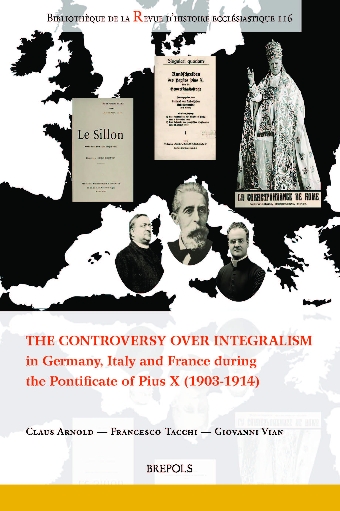
Abstract
In the years after 1900 the autonomous activity of the Catholic laity in politics, culture and society was opposed by ‘integralists’ in theological circles, in the laity as well as in the clergy, and last but not least in the Roman Curia. The integralists favoured a strict confessionalism and hierarchical control over all fields of Catholic life. Pope Pius X enforced this position in Italy and in France by solemnly condemning the autonomist Christian Democracy of Romolo Murri and the ‘Sillon’ movement of Marc Sangnier. In Germany, however, compromises with the Roman authorities were possible on all fields of contention: concerning the interdenominational character of the Christian trade unions, the independence of the Centre Party from the hierarchy and also during the controversy over the ‘Catholic belles-lettres’. Finally, in the papal encyclical ‘Singulari quadam’ (1912) the interconfessional Christian trade unions were at least ‘tolerated’. The present volume analyses these struggles in a comparative perspective and, by evaluating the entire accessible archival documentation, it reconstructs for the first time the respective internal decision-making processes of the Roman Curia. The result of this entire research is a profiling of three important European Catholicisms in the controversy over integralism. This conflict had a decisive bearing on the long-term positioning of French, German and Italian Catholicism within their respective national societies.
