


Brepols
Brepols is an international academic publisher of works in the humanities, with a particular focus in history, archaeology, history of the arts, language and literature, and critical editions of source works.3021 - 3040 of 3194 results
-
-
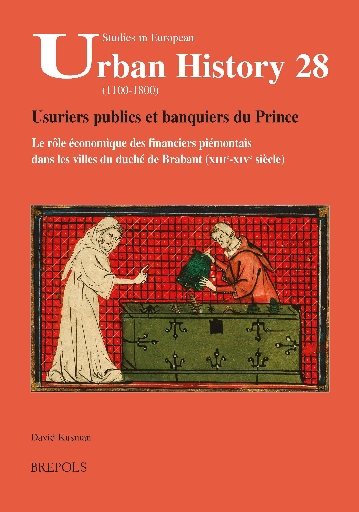
Usuriers publics et banquiers du Prince
Le rôle économique des financiers piémontais dans les villes du duché de Brabant (XIIIe-XIVe siècle)
show More to view fulltext, buy and share links for:Usuriers publics et banquiers du Prince show Less to hide fulltext, buy and share links for: Usuriers publics et banquiers du PrinceEntre le dernier quart du XIIIe siècle et le premier tiers du XIVe siècle, les banquiers piémontais installés dans le duché de Brabant constituèrent la communauté la plus importante des Lombards actifs dans les anciens Pays-Bas. Banquiers du Prince, ils prêtaient également aux élites urbaines et à la noblesse. Cette étude s’attache à reconstituer les stratégies commerciales et les réseaux sociaux des financiers piémontais grâce auxquels ceux-ci jouèrent un rôle de premier plan dans l’économie et la politique du duché de Brabant. En s’interrogeant sur les modalités d’intégration des Piémontais dans les villes brabançonnes, l’étude a finalement pour ambition de dépasser l’image caricaturale du Lombard, souvent identifié à un usurier public.
David Kusman , docteur en histoire médiévale de l’Université Libre de Bruxelles, est chercheur associé à l’Unité de Recherche en histoire rurale et urbaine (U.L.B.) et au PAI VII/26 "City and Society in the Low Countries (1200-1850)
-
-
-
Uygur Buddhist Literature
show More to view fulltext, buy and share links for:Uygur Buddhist Literature show Less to hide fulltext, buy and share links for: Uygur Buddhist LiteratureThis first volume of the Silk Roads Studies is a reference manual of the published Uygur Buddhist literature. Uygur Buddhist Literature creates a complete inventory of the published Uygur Buddhist texts along with a bibliography of the pertinent scholarlyliterature. The work includes an introduction that outlines the history of the discovery of the Uygur Buddhist Literature and a short history of the Buddhist Uygurs and their translation activities. The survey of the literature itself is divided into six sections: (1) Non-Mahayana Texts, including Sutra, Vinaya, Abhidarma, Biographies of the Buddha (including Jatakas) and Avadana; (2) Mahayana Sutras; (3) Commentaries; (4) Chinese Apocrypha; (5) Tantric Texts (6) Other Buddhist Works. Included under each title of a text is a brief synopsis of the text and an explanation of the Uygur manuscript, including where known: origin of translation, the translator and the place of translation, the place it was found, and any other interesting points. After this brief survey of the manuscript, the signature of the manuscript with references to the editions of the text is provided as well as additional references to the secondary literature. The survey concludes with an index to titles, translators, scribes and sponsors. This manual is an essential tool not only for specialists in the field of Altaic, especially Turcological or Monogolian, Iranological, Sinological or Buddhological Studies, but is also written for a larger public of students interested in Asian religions and cultural history in general. This book provides in a systematic and exhaustive way the most recent information on the places where the documents are kept, a synopsis of the text, editions and secondary literature.
-
-
-
Varietate delectamur: Multifarious Approaches to Synchronic and Diachronic Variation in Latin
Selected Papers from the 14th International Colloquium on Late and Vulgar Latin (Ghent, 2022)
show More to view fulltext, buy and share links for:Varietate delectamur: Multifarious Approaches to Synchronic and Diachronic Variation in Latin show Less to hide fulltext, buy and share links for: Varietate delectamur: Multifarious Approaches to Synchronic and Diachronic Variation in LatinThe focus of the Latin Vulgaire – Latin Tardif book series lies on the complex and multifaceted problem of late and so-called vulgar Latin. Specifically, starting out from a wide range of methodological approaches involving all levels of language, the series’ main purpose is to investigate how Classical Latin (i.e. the language used in the period from ca. 100 BC to AD 100 by authors such as Cicero, Horace and Vergil) underwent the changes during the late period (i.e. mainly between the 3rd and the 7th century AD) that resulted in (the early stages of) the Romance languages. To this purpose, three main types of linguistic sources are taken into consideration. First, direct Latin sources, which include for instance texts written by people with a lesser level of literacy (e.g. inscriptions, soldiers’ letters), or by fully literate authors reproducing colloquial language deliberately (e.g. Petronius, Apuleius). Second, indirect Latin sources, which consist of metalinguistic testimonies of ancient authors (mainly, but not exclusively, grammarians) dealing with the language variation typical of their time and region. And third, the Romance idioms themselves: by comparing sources in at least two Romance varieties, one may reconstruct Latin words or forms which were used widely in spoken usage but, for different reasons, are not attested in any extant source.
-
-
-
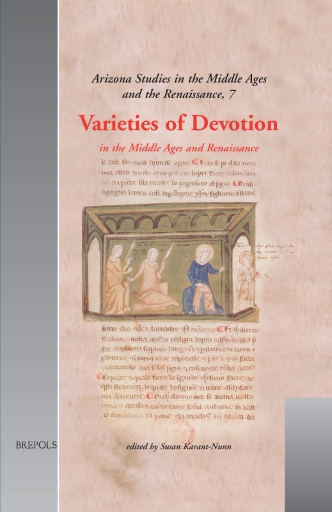
Varieties of Devotion in the Middle Ages and Renaissance
show More to view fulltext, buy and share links for:Varieties of Devotion in the Middle Ages and Renaissance show Less to hide fulltext, buy and share links for: Varieties of Devotion in the Middle Ages and RenaissanceIn the modern world, interest in religious devotion is as great as ever. This volume brings together the research of ten scholars into the diverse ways that Europeans expressed their quest for God over more than a millennium, from the formative centuries of Christianity up to the seventeenth century. Topics include women transvestite saints, Monophysite wall-paintings, Anglo-Saxon sainthood and painful martyrdom, Carmelite self-redefinition, the confident authorship of Gautier de Coinci and Matfre Ermengaud, competition between the bishop and a wandering preacher for popular favor in Le Mans, the contemplative philanthropies of the Poor Clares, Chester Nativity-cycle actors’ masculinity, Jean Gerson’s warm relations with his siblings, and George Herbert’s Eucharistic feeling. The authors’ profound familiarity with primary sources as well as the influence of current theory makes these essays vibrant and timely.
-
-
-
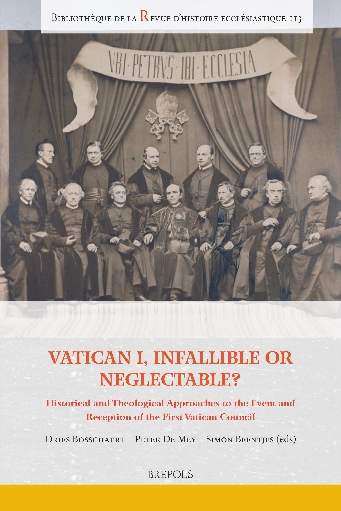
Vatican I, Infallible or Neglectable?
Historical and Theological Approaches to the Event and Reception of the First Vatican Council
show More to view fulltext, buy and share links for:Vatican I, Infallible or Neglectable? show Less to hide fulltext, buy and share links for: Vatican I, Infallible or Neglectable?On 20 October 1870 pope Pius IX adjourned the First Vatican Council, because of the Italian Rissorgimento troops approaching the city of Rome. Given that the Council had only opened less than a year prior, on 8 December 1869, the act was emblematic. The council, as the Catholic Church’s protective response against all things new – rationalism, liberalism, naturalism, materialism, and pantheism – was overtaken by history. Given its premature end not all documents prepared were completed and those that were promulgated, became among the most controversial documents in the nineteenth and twentieth-century Catholic Church, strongly defining its relations to other Christian confessions and modernity. Similarly, around one hundred years after the suspension of the First Vatican Council its historical and theological study was overtaken by the event of the Second Vatican Council, known for its rapprochement to the modern world. The history and results of the First Vatican Council were either forgotten or reinterpreted in light of this subsequent council’s decisions. In light of the 150th anniversary of this council, the editors and authors of this volume set themselves the goal of re-examining this tradition of historical and theological reception (and forgetting) of the First Vatican Council.
-
-
-
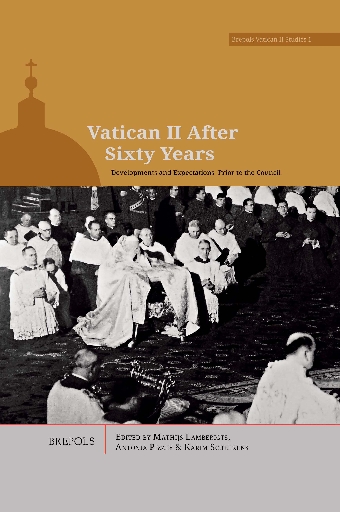
Vatican II After Sixty Years
Developments and Expectations Prior to the Council
show More to view fulltext, buy and share links for:Vatican II After Sixty Years show Less to hide fulltext, buy and share links for: Vatican II After Sixty YearsThis volume is the result of a workshop organized in Leuven within the context of the Australian Catholic University-KU Leuven-Tilburg University project on Vatican II (1962-1965). This volume focuses on the preparatory period of the Council and its broader context, for many renewal movements were underway decades before the Council's opening. The preparation of the Council was also a period of intense consultation of bishops and male superiors of religious orders and congregations. Indeed, John XXIII aimed at introducing an aggiornamento in the Roman Catholic Church, taking into account the wishes and the needs of bishops and superiors. The volume presented here offers new insights about this period on the basis of archives and other materials insufficiently consulted to date. The papers presented are the result of research by both senior scholars and junior researchers. They focus on the following issues: revelation, ecclesiology, ecumenism, and education.
-
-
-
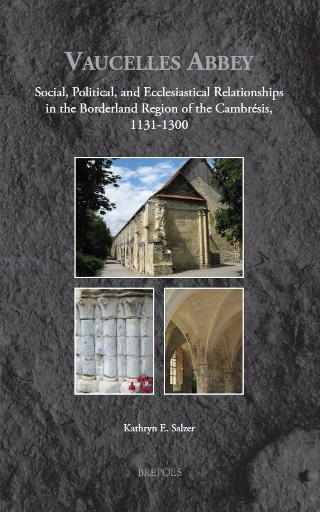
Vaucelles Abbey
Social, Political, and Ecclesiastical Relationships in the Borderland Region of the Cambrésis, 1131-1300
show More to view fulltext, buy and share links for:Vaucelles Abbey show Less to hide fulltext, buy and share links for: Vaucelles AbbeyFounded in 1131 by the castellan of Cambrai, Vaucelles Abbey thrived in a borderland region, where German emperors, French kings, Flemish counts, bishops of Cambrai, and the Cistercian Order all had active interests. To understand how Vaucelles flourished, we must look at the relationships that the house created and fostered with various international, regional, and local individuals and institutions. Vaucelles used these connections to protect the vast patrimony that the monks created in the two centuries after its foundation.
This study asserts that three principal factors influenced the foundation and development of Vaucelles. First, the abbey was fortunate in its local support, beginning with the castellan family and expanding to include numerous regional families and the bishops of Cambrai. Second, the abbey was established in a political borderland, a geo-political situation that Vaucelles survived and actually turned into a positive feature of its development. And finally, Vaucelles was a Cistercian monastery, a direct daughter house of Clairvaux. Vaucelles’ Cistercian observance fostered relationships that were particularly significant to the abbey’s development from the late twelfth century onward. These factors offer exceptional tools for demonstrating many features of Vaucelles’ political, social, and economic life during the twelfth and thirteenth centuries.
-
-
-

Vehicles of Transmission, Translation, and Transformation in Medieval Textual Culture
show More to view fulltext, buy and share links for:Vehicles of Transmission, Translation, and Transformation in Medieval Textual Culture show Less to hide fulltext, buy and share links for: Vehicles of Transmission, Translation, and Transformation in Medieval Textual CultureIn this volume the McGill University Research Group on Transmission, Translation, and Transformation in Medieval Cultures and their collaborators initiate a new reflection on the dynamics involved in receiving texts and ideas from the antiquity or from other contemporary cultures. For all their historic specificity, the western European, Arab/Islamic and Jewish civilizations of the Middle Ages were nonetheless co-participants in a complex web of cultural transmission that operated via translation and inevitably involved the transformation of what had been received. This threefold process is what defines medieval intellectual history. Every act of transmission presumes the existence of some ‘efficient cause’ – a translation, a commentary, a book, a library etc. Such vehicles of transmission, however, are not passive containers in which cultural products are transported. On the contrary: the vehicles themselves select, shape, and transform the material transmitted, making ancient or alien cultural products usable and attractive in another milieu. The case studies contained in this volume attempt to bring these larger processes into the foreground. They lay the groundwork for a new intellectual history of medieval civilizations in all their variety, based on the core premise that these shared not only a cultural heritage from antiquity but, more importantly, a broadly comparable ‘operating system’ for engaging with that heritage. Each was a culture of transmission, claiming ownership over the prestigious knowledge inherited from the past. Each depended on translation. Finally, each transformed what it appropriated.
-
-
-
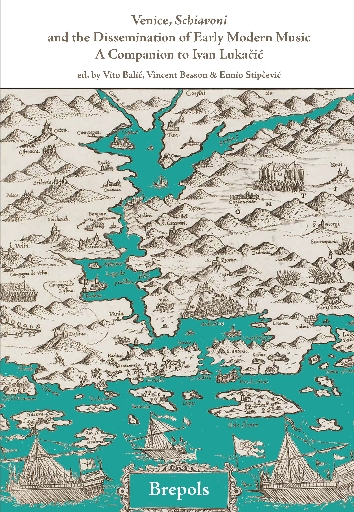
Venice, Schiavoni and the Dissemination of Early Modern Music: A Companion to Ivan Lukačić
show More to view fulltext, buy and share links for:Venice, Schiavoni and the Dissemination of Early Modern Music: A Companion to Ivan Lukačić show Less to hide fulltext, buy and share links for: Venice, Schiavoni and the Dissemination of Early Modern Music: A Companion to Ivan LukačićIvan Lukačić (born around 1585, died in 1648), composer, Conventual Franciscan, long-time “maestro di cappella” of the cathedral in Split, is a typical “hero” of local historiography. As early as 1935, the Croatian-American musicologist Dragan Plamenac (real name Karl Siebenschein) prepared a selection from the only known collection of Lukačić’s compositions, the Sacrae cantiones (Venice, 1620). In the same year, Plamenac introduced Croatian Renaissance and Baroque music to the local audience for the first time at a concert held at the Croatian Music Institute. In the aftermath of Plamenac’s emigration to the USA in 1939, it took several decades for new archival, stylistic, interdisciplinary, and international research in Croatian musicology to take place. Despite the availability of earlier material as well as contemporary musical publications of Lukačić’s work (J. Andreis, Zagreb, 1970; E. Stipčević, Padua, 1986), it is not an exaggeration to say that Lukačić still remains unknown internationally. For many years, a number of studies of Lukačić and the music of his contemporaries from the “other, eastern coast of the Adriatic” published almost exclusively in Croatian and thus the international professional public had very limited access to them. This collection of studies dedicated to Lukačić and to the musical and cultural contacts between the two Adriatic coasts is the first volume to be published in both English and Italian. The echoes of the contacts between Italy and Croatia reached the Royal Palace in Portugal, shops selling printed music in Denmark and church archives in Slovenia and Poland. The aim of this book is to follow the traces of that cultural dissemination.
-
-
-
Vera philosophia
Studies in Late Antique medieval and Renaissance Christian Thought
show More to view fulltext, buy and share links for:Vera philosophia show Less to hide fulltext, buy and share links for: Vera philosophiaThis volume includes a collection of reworked articles which the author, during the last twenty years, dedicated to the origins and conditions constitutive of Christian philosophical-theological thought. From the earliest centuries of the Christian era, human reason was submitted to a particular formal conditioning, in so far as it was necessarily obliged to confront the contents of a divine revelation recognized as necessarily ‘true’. The medieval Latin scholar was induced by the social and cultural peculiarities of his time to confront a model of thought which imposes a decisive subordination of natural knowledge - demonstrated to be imperfect and inconclusive - to the certainties assured by the faith. The production of this model of philosophia, significantly different from the dominant paradigms in the classical period, rooted itself in the critical redimensioning of reason which Cicerointroduced into the West. Departing from the observation of the failure of the philosophical aspirations of antiquity, the Christian intellectuals effected an operative ‘overturning’ of the conditions of veridical knowledge.
The new wisdom was not entirely the result of religion interfering in the field of rational science, but it was shaped by a conscious ‘conversion’ of the philosophers and reached fulfillment under two principles: faith, which requires earthly knowledge in order to defend itself from misunderstandings and heresies; and reason, which allows itself to draw upon supernatural revelation for the possession of regulatory principles which guide it in the study of natural things.
This book investigates the development of this approach during the course of the centuries which in the West precede the rediscovery of Aristotelian epistemology: from Augustine to Boethius, from John Scottus Eriugena to Anselm of Aosta. It concludes by describing the return of this methodological approach, at the end of the Medieval Scholastic period, in the results of the anti-Aristotelian critique carried out by the men of the Renaissance through the recovery of a model of thought which had dominated in the Patristic and Early Medieval periods.
-
-
-
Verbal and Visual Communication in Early English Texts
show More to view fulltext, buy and share links for:Verbal and Visual Communication in Early English Texts show Less to hide fulltext, buy and share links for: Verbal and Visual Communication in Early English TextsWhen reading a text our understanding of its meaning is influenced by the visual form and material features of the page. The chapters in this volume investigate how visual and material features of early English books, documents, and other artefacts support - or potentially contradict - the linguistic features in communicating the message. In addition to investigating how such communication varies between different media and genres, our contributors propose novel methods for analysing these features, including new digital applications. They map the use of visual and material features - such as layout design or choice of script/typeface - against linguistic features - such as code-switching, lexical variation, or textual labels - to consider how these choices reflect the communicative purposes of the text, for example guiding readers to navigate the text in a certain way or persuading them to arrive at a certain interpretation. The chapters explore texts from the medieval and the early modern periods, including saints’ lives, medical treatises, dictionaries, personal letters, and inscriptions on objects. The thematic threads running through the volume serve to integrate book studies with discourse linguistics, the medieval with the early modern, manuscript with print, and the verbal with the visual.
-
-
-
Vergilius orator
Lire et commenter les discours de l’Énéide dans l’Antiquité tardive
show More to view fulltext, buy and share links for:Vergilius orator show Less to hide fulltext, buy and share links for: Vergilius oratorEn devenant le principal support pédagogique des grammatici, l’œuvre de Virgile a joué un rôle central dans la formation intellectuelle de la jeunesse lors de l’Antiquité romaine tardive, y compris dans la formation rhétorique : les discours - principalement ceux de l’Énéide - ont fourni aux commentateurs du grand poète l’occasion d’expliquer des notions rhétoriques et d’analyser des exemples précis de situations oratoires. Les contributions du présent volume explorent les différentes facettes de cet art virgilien de la parole, tel qu’il a été compris par les professionnels de la littérature et de l’éducation de l’Antiquité tardive.
-
-
-
Vernacular Mysticism in the Charterhouse
A Study of London, British Library, MS Additional 37790
show More to view fulltext, buy and share links for:Vernacular Mysticism in the Charterhouse show Less to hide fulltext, buy and share links for: Vernacular Mysticism in the CharterhouseThe first monograph to appear in The Medieval Translator series, Vernacular Mysticism in the Charterhouse presents a study of London, British Library, MS Additional 37790 (Amherst), a purpose-built anthology of major mystical texts by Richard Rolle, Julian of Norwich, Jan van Ruusbroec and Marguerite Porète, interspersed with shorter texts and compilations. Though the manuscript is famous mainly because it contains the only extant copy of Julian of Norwich's short text, it is an intriguing witness to the fifteenth-century spread of the vernacular into traditionally Latinate environments, in this case the Carthusian Order in England. In this process of transmission, translation plays a central part. Most of the texts in the anthology are translations from Latin or French into Middle English. In addition, the anthologist's selection and ordering of texts within the volume, intended to further the readers' spiritual lives, translates them anew for his intended audience. This study provides finely detailed analyses of the texts in the textual and material context of the Amherst anthology as well as in their religious and historical contexts. It also offers a first-time edition of Quedam introductiua extracta, a Latin compilation contained in the manuscript, and a discussion and listing of verbal marginal annotations reflecting early readers' reactions to the texts. By reading the texts in (one of) their medieval manuscript context(s), this book gives students and scholars of (translated) medieval religious texts a fresh view of the classics of mystical writing contained in the remarkable literary document that is the Amherst anthology.
-
-
-
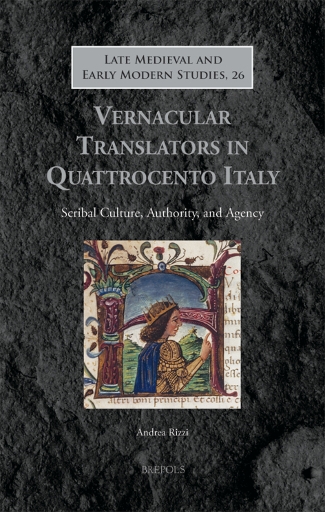
Vernacular Translators in Quattrocento Italy
Scribal Culture, Authority, and Agency
show More to view fulltext, buy and share links for:Vernacular Translators in Quattrocento Italy show Less to hide fulltext, buy and share links for: Vernacular Translators in Quattrocento ItalyThis book provides a richly documented study of vernacular translators as agents within the literary culture of Italy during the fifteenth century. Through a fresh and careful examination of these early modern translators, Rizzi shows how humanist translators went about convincing readers of the value of their work in disseminating knowledge that would otherwise be inaccessible to many. The translators studied in this book include not only the well-known ‘superstars’ such as Leonardo Bruni, but also little-known and indeed obscure writers from throughout the Italian peninsula.
Rizzi demonstrates that vernacular translation did not cease with the rise of ‘humanism’. Translations from Greek into Latin spurred the concurrent production of ‘new’ vernacular versions. Humanists challenged themselves to produce creative and authoritative translations both from Greek and occasionally from the vernacular into Latin, and from Latin into the vernacular. Translators grew increasingly self-assertive when taking on these tasks.
The findings of this study have wide implications: they trace a novel history of the use of the Italian language alongside Latin in a period when high culture was bilingual. They also shed further light on the topic of Renaissance self-fashioning, and on the workings of the patronage system, which has been studied far less in literary history than in art history. Finally, the book gives welcome emphasis to the concept that the creation and the circulation of translations (along with other literary activities) were collaborative activities, involving dedicatees, friends, and scribes, among others.
-
-
-

Vernacularity in England and Wales, c. 1300-1550
show More to view fulltext, buy and share links for:Vernacularity in England and Wales, c. 1300-1550 show Less to hide fulltext, buy and share links for: Vernacularity in England and Wales, c. 1300-1550Studies of the vernacular in the period 1300-1550 have tended to focus exclusively upon language, to the exception of the wider vernacular culture within which this was located. In a period when the status of English and ideas of Englishness were transforming in response to a variety of social, political, cultural and economic factors, the changing nature and perception of the vernacular deserves to be explored comprehensively and in detail. Vernacularity in England and Wales examines the vernacular in and across literature, art, and architecture to reach a more inclusive understanding of the nature of late medieval vernacularity.
The essays in this collection draw upon a wide range of source material, including buildings, devotional and educational literature, and parliamentary and civic records, in order to expand and elaborate our idea of the vernacular. Each contributor addresses central ideas about the nature and identity of the vernacular and how we appraise it, involving questions about nationhood, popularity, the commonalty, and the conflict and conjunction of the vernacular with the non-vernacular. These notions of vernacularity are situated within studies of reading practices, heresy, translation, gentry identity, seditious speech, and language politics. By considering the nature of vernacularity, these essays explore whether it is possible to perceive a common theory of vernacular use and practice at this time.
-
-
-
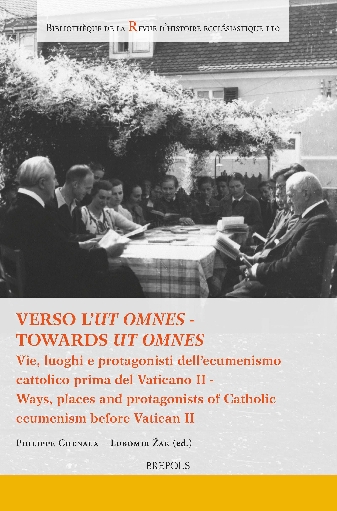
Verso l' Ut Omnes - Towards Ut Omnes
Vie, luoghi e protagonisti dell’ecumenismo cattolico prima del Vaticano II - Ways, places and protagonists of Catholic ecumenism before Vatican II
show More to view fulltext, buy and share links for:Verso l' Ut Omnes - Towards Ut Omnes show Less to hide fulltext, buy and share links for: Verso l' Ut Omnes - Towards Ut OmnesThe studies collected in this volume highlight the rising of an ecumenical consciousness within the Catholic Church in the early twentieth century. The Catholic paths, suggested in view of the hoped-for Christian unity before the Second Vatican Council, were different but complementary: the path of prayer and liturgy, that of theological refl ection, that of fraternal witness and that of martyrdom. The text offers valuable contributions on all these paths, written by specialists in the history of ecumenism.
-
-
-
Viator
Medieval and Renaissance Studies
show More to view fulltext, buy and share links for:Viator show Less to hide fulltext, buy and share links for: ViatorViator offers a space for renewed attention to transcultural studies from Late Antiquity into Early Modernity, while continuing its long-standing tradition of publishing articles of distinction in the established fields of medieval and Renaissance studies. In keeping with its title, “traveler,” the journal gives special consideration to articles that cross frontiers, focus on meetings between cultures, pursue an idea through the centuries, or employ methods of different disciplines simultaneously, while remaining accessible to the non-specialist reader. Viator particularly welcomes articles that look beyond Western Eurasia and North Africa and considers the history, literature, art, and thought of the eras of early global interconnection from broader perspectives.
More information about this journal on Brepols.net
-
-
-
Viator (English and Multilingual Edition)
show More to view fulltext, buy and share links for:Viator (English and Multilingual Edition) show Less to hide fulltext, buy and share links for: Viator (English and Multilingual Edition)Viator offers a space for renewed attention to transcultural studies from Late Antiquity into Early Modernity, while continuing its long-standing tradition of publishing articles of distinction in the established fields of medieval and Renaissance studies. In keeping with its title, “traveler,” the journal gives special consideration to articles that cross frontiers, focus on meetings between cultures, pursue an idea through the centuries, or employ methods of different disciplines simultaneously, while remaining accessible to the non-specialist reader. Viator particularly welcomes articles that look beyond Western Eurasia and North Africa and considers the history, literature, art, and thought of the eras of early global interconnection from broader perspectives.
-
-
-
Victorine Christology
show More to view fulltext, buy and share links for:Victorine Christology show Less to hide fulltext, buy and share links for: Victorine ChristologyThe Canons following the Rule of St Augustine at St Victor in Paris were some of the most influential religious writers of the Middle Ages. They combined exegesis and spiritual teaching in a theology that was deeply rooted in tradition but also attuned to current developments in the schools of Paris. The importance of Victorine Christology in this great age of theological speculation is unquestionable. The writings translated in this volume cover the foundational and maturing periods of Victorine Christology during the 1130s to the 1150s when Hugh of St Victor championed the paradigm of the “assumed man” (homo assumptus) and Robert of Melun advanced his Christology into the most comprehensive treatment in the twelfth century.
-
