


BOB2022MOOT

Collection Contents
3 results
-
-
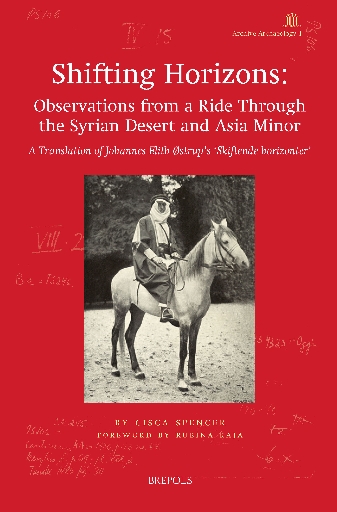
Shifting Horizons
show More to view fulltext, buy and share links for:Shifting Horizons show Less to hide fulltext, buy and share links for: Shifting HorizonsJohannes Elith Østrup (1867-1938), son of a Danish farmer, philologist of Turkish and Semitic languages, and later Vice Chancellor of Copenhagen University, spent 1891-1893 travelling by horse around Syria, Lebanon, and Anatolia. Unlike most European travellers, his language skills allowed him to chat with locals in cafés, stay in people’s homes, and travel with the Bedouin. A curious young man, Østrup travelled with eyes, ears, and mind open to the unknown, and recorded his journey in this lively travelogue, Skiftende horizonter (1894). His writing offers a vivid account of his time in the region, and dwells with equal interest on both the region’s broader political, ethnic, and religious struggles, and the day-to-day concerns of those who lived there.
Now, for the first time, this text is available to English-speaking readers thanks to this translation by Cisca Spencer, Østrup’s great granddaughter and a former Australian diplomat. With a foreword by Rubina Raja, Professor of Classical Archaeology at Aarhus University, together with Østrup’s own photographs and new maps, this volume captures all the charm and enthusiasm of the original in bringing this nineteenth-century travelogue to a modern readership.
-
-
-
Solus homo nudus, solum animal sapiens
show More to view fulltext, buy and share links for:Solus homo nudus, solum animal sapiens show Less to hide fulltext, buy and share links for: Solus homo nudus, solum animal sapiensLa définition du nu comme genre artistique pose problème depuis qu’a été critiquée la distinction posée par Kenneth Clark entre Nu et nudité (The Nude , 1956). Si les Anciens n’ont pas laissé de théorie du nu, les humanistes ont fourni une abondance de préceptes lui reconnaissant la validité d’un concept esthétique. Cet ouvrage présente une première synthèse des théories du nu dans les traités d’art de la Renaissance et montre comment artistes et théoriciens ont inventé le nu à partir de trois sciences - les mathématiques, la médecine et la philosophie morale - en renouvelant les doctrines antiques de la symétrie, de l’anatomie et de la physiognomonie.
-
-
-
The Spirit, the World and the Trinity
show More to view fulltext, buy and share links for:The Spirit, the World and the Trinity show Less to hide fulltext, buy and share links for: The Spirit, the World and the TrinityIn a renowned and controversial passage Origen writes: “Of the subsistence of the Holy Spirit, no-one could have even a suspicion, except those who profess a belief in Christ” (De Principiis, 1,3). But how come that ancient Christian authors elaborated a theology of the Holy Spirit? This innovative study tackles this question by analysing how the exegesis of the Gospel of John shaped the trinitarian and soteriological agency of the Holy Spirit in the theologies of two of the most important Christian authors of all times: Origen and Augustine. In particular, the Johannine Father-Son-Spirit relation and the dichotomy between God and the world represent the foundation on which Origen and Augustine built their pneumatologies. At a closer look, one even realises that they both conceived the God-human relationship through a Johannine lens.
The heuristic comparison proposed in this book is focused on the three large themes, towards which Origen and Augustine represent opposite approaches: the understanding of the immanent Trinity, the dualism between God and the world and the proper role of the Holy Spirit. On the one hand, Origen put forward a paradigm of participation to explain the oneness and threeness of God. On the other, Augustine understands God’s self-relation through a paradigm of identity. These two trinitarian constructions are shaped by a different understanding of the Gospel of John: while Origen’s theology mostly smooths the gospel’s dualism by interpreting God’s salvific act as a gradual spiritualisation of the world, Augustine tends to accentuate the Gospel’s dichotomies by radicalising the Johannine dualism. This study will therefore clarify the two specific paradigms in the two authors’ theologies: participation/transformation in Origen and identity/separation in Augustine, showing also how these paradigms are patterned after their different understanding of the fourth Gospel.
-