


BOB2025MOME

Collection Contents
3 results
-
-
Nichil Melius, Nichil Perfectius Caritate
show More to view fulltext, buy and share links for:Nichil Melius, Nichil Perfectius Caritate show Less to hide fulltext, buy and share links for: Nichil Melius, Nichil Perfectius CaritateIn his magnum opus De Trinitate, the twelfth-century canon Richard of St. Victor offers sustained reflection on core dogmatic claims from the Athanasian creed. At the heart of the treatise is Richard’s argument for exactly three divine persons. Starting with the necessity of a single, maximally perfect divine substance, Richard reasons along four steps: (i) God must have maximal charity, or other-love; (ii) to be perfectly good, delightful, and glorious, God’s other-love must be shared among at least two, and (iii) among at least three, divine persons; (iv) the metaphysics of divine processions and love each ensure the impossibility of four divine persons. For Richard, Scripture and trustworthy church authorities already provide certainty in these truths of faith. Even so, as an act of ardent love, Richard contemplates the Trinity as reflected in creation. From this epistemic point of departure, he supports his conclusions from common human experience alone.
Recently, philosophers of religion have employed Richard’s trinitarian reflection as a springboard for constructive work in apologetics and ramified natural theology. His unique and meticulous approach to the Trinity has garnered attention from scholars of medieval and Victorine studies, recognizing the novelty and rigour of his philosophical theology.
This volume presents the first focused exploration of Richard’s central thesis in De Trinitate, combining historical context with philosophical scrutiny. It confronts the most challenging aspects of his argument, presenting Richard’s insights as not merely intriguing but also profoundly compelling. His thesis, if validated, promises to significantly enrich modern dialogues on the philosophical and theological dimensions of the Trinity.
-
-
-
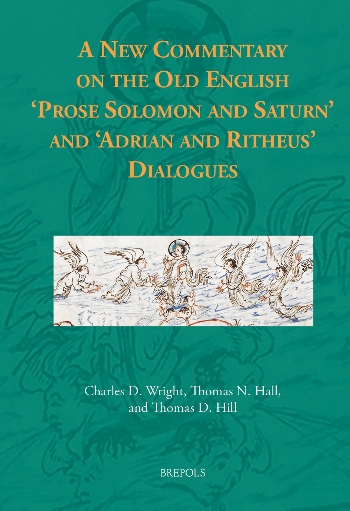
A New Commentary on the Old English ‘Prose Solomon and Saturn’ and ‘Adrian and Ritheus’ Dialogues
show More to view fulltext, buy and share links for:A New Commentary on the Old English ‘Prose Solomon and Saturn’ and ‘Adrian and Ritheus’ Dialogues show Less to hide fulltext, buy and share links for: A New Commentary on the Old English ‘Prose Solomon and Saturn’ and ‘Adrian and Ritheus’ DialoguesWho was not born, was buried in his mother’s womb, and was baptized after death? Who first spoke with a dog? Why don’t stones bear fruit? Who first said the word ‘God’? Why is the sea salty? Who built the first monastery? Who was the first doctor? How many species of fish are there? What is the heaviest thing to bear on earth? What creatures are sometimes male and sometimes female? The Old English dialogues The Prose Solomon and Saturn and Adrian and Ritheus, critically edited in 1982 by J. E. Cross and Thomas D. Hill, provide the answers to a trove of curious medieval ‘wisdom questions’ such as these, drawing on a remarkable range of biblical, apocryphal, patristic, and encyclopaedic lore.
This volume (which reprints the texts and translations of the two dialogues from Cross and Hill’s edition) both updates and massively supplements the commentary by Cross and Hill, contributing extensive new sources and analogues (many from unpublished medieval Latin question-and-answer texts) and comprehensively reviews the secondary scholarship on the ancient and medieval texts and traditions that inform these Old English sapiential dialogues. It also provides an extended survey of the late antique and early medieval genres of ‘curiosity’ and ‘wisdom’ dialogues and florilegia, including their dissemination and influence as well as their social and educational functions.
-
-
-
Nicolaus Viti Gozzius, Breve compendium in duo prima capita tertii De anima Aristotelis
show More to view fulltext, buy and share links for:Nicolaus Viti Gozzius, Breve compendium in duo prima capita tertii De anima Aristotelis show Less to hide fulltext, buy and share links for: Nicolaus Viti Gozzius, Breve compendium in duo prima capita tertii De anima AristotelisThis is the first edition of Nikola Vitov Gučetić’s (1549–1610) compendium of philosophical and theological problems arising from Aristotle’s De anima Book 3, Chapter 4, where he begins his discussion of the thinking part of the soul, that is, the intellect (nous). With the interpretation of Averroes (1126–1198), this text has structured much of the debate on the immortality of the soul in the Middle Ages and the Renaissance. Gučetić’s Breve compendium is a testament to these debates, interesting for its selection of issues for discussion in connection with Aristotle’s text, and for its open defence of the Averroist position in the late decades of the sixteenth century. Although Gučetić had a preliminary arrangement with Aldo Manuzio the Younger to print this text around 1590, at some point he abandoned the plan to publish it.
The main purpose of this book is to provide a critical edition of the Latin text for scholars in the humanities, especially historians of late Medieval and Renaissance philosophy. The edition is accompanied by an introductory study that places the author and his work in the historical and intellectual context, describes the manuscript, and gives a detailed synopsis of the work. This will make the book useful also to students of the humanities and those interested in the history and culture of Dubrovnik.
-