Brepols Online Books Medieval Miscellanea Original Archive v2016 - bobar16mimeo

Collection Contents
201 - 220 of 254 results
-
-
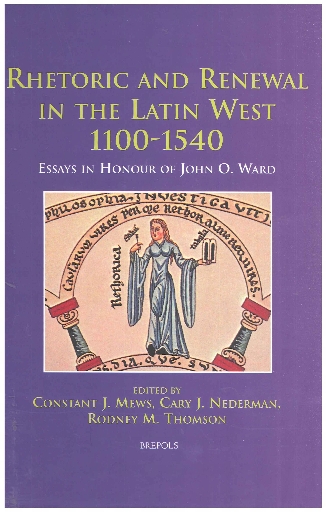
Rhetoric and Renewal in the Latin West 1100-1540
show More to view fulltext, buy and share links for:Rhetoric and Renewal in the Latin West 1100-1540 show Less to hide fulltext, buy and share links for: Rhetoric and Renewal in the Latin West 1100-1540The essays in this volume, presented in honour of John O. Ward, explore the role of rhetoric in promoting reform and renewal in the Latin West from Peter Abelard (1079-1142) to Juan Luis Vives (1492-1540). Ward, who has taught for many years at the University of Sydney, has been an influential and creative force in medieval and renaissance studies both in Australia and internationally. This volume opens with a personal memoir and bibliography of Ward’s publications, as well as an overview of the study of medieval rhetoric. The first of the three sections, ‘Abelard and Rhetoric’, relates Abelard’s rhetoric to his logic, his theology, and his relationship to Heloise. A second section, ‘Voices of Reform’, considers various writers (William of Malmesbury, John of Salisbury, Richard FitzNigel, and William of Ockham) who bring rhetorical techniques to bear upon analysis of social conditions. A third section, ‘Rhetoric in Transition’, deals with the evolution of rhetorical theory between the late fourteenth and early sixteenth centuries. The volume will be of interest not just to specialists in rhetoric, but to all concerned with issues of reform and renewal in European culture during the period 1100-1540.
-
-
-
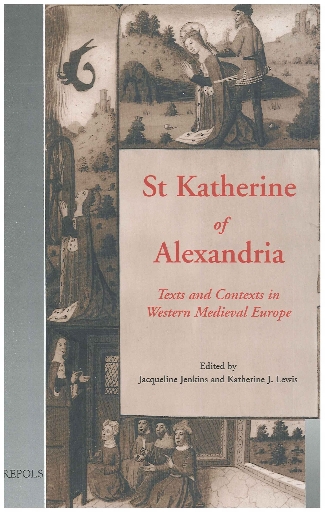
St Katherine of Alexandria
show More to view fulltext, buy and share links for:St Katherine of Alexandria show Less to hide fulltext, buy and share links for: St Katherine of AlexandriaSt Katherine of Alexandria was one of the most popular saints in medieval Europe. This book constitutes the first interdisciplinary collection of essays to explore her cult and the range of meanings which St Katherine embodied for her devotees. The essays between them consider a wide range of evidence, from visual representations (wall paintings, manuscript illuminations, stained glass, and seals), to literary texts (lives of the saint, prayers, hymns, devotional manuscripts, and breviaries) as well as documentary evidence (wills, chronicles, ecclesiastical records and antiquarian writings) and the physical remains of churches and chapels dedicated to St Katherine. These sources are interpreted as part of wider manifestations of devotion to the saint in England, France, Italy, Spain, Sweden, and Wales. The authors approach the cult from varying disciplinary and methodological perspectives, but all seek to uncover the various religious, social and cultural messages contained within the different versions of St Katherine which these particular texts and contexts offer. The volume as a whole therefore sheds light not only on devotion to St Katherine, but also on a much wider range of issues and ideologies governing the lives of her devotees and the societies in which they lived.
-
-
-
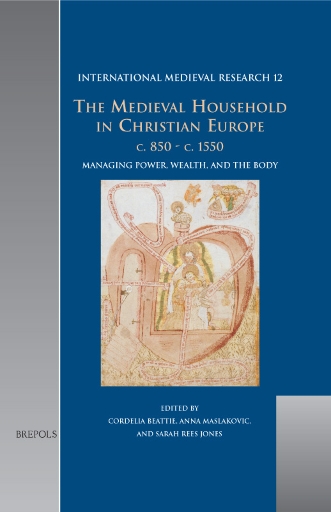
The Medieval Household in Christian Europe, c. 850-c. 1550
show More to view fulltext, buy and share links for:The Medieval Household in Christian Europe, c. 850-c. 1550 show Less to hide fulltext, buy and share links for: The Medieval Household in Christian Europe, c. 850-c. 1550This volume asks whether there was a common structure, ideology, and image of the household in the medieval Christian West. In the period under examination, noble households often exercised great power in their own right, while even quite humble households were defined as agents of government in the administration of local communities. Many of the papers therefore address the public functions and perceptions of the household, and argue that the formulation of domestic (or family) values was of essential importance in the growth and development of the medieval Christian state.
Contributors to this volume of collected essays write from a number of disciplinary perspectives (archaeological, art-historical, historical and literary). They examine socially diverse households (from peasants to kings) and use case studies from different regions across Europe in different periods within the medieval epoch from c. 850 to c. 1550. The volume both includes studies from archives and collections not often covered in English-language publications, and offers new approaches to more familiar material. It is divided into thematic sections exploring the role of households in the exercise of power, in controlling the body, in the distribution of wealth and within a wider economy of possessions.
-
-
-
The Study of the Bible in the Carolingian Era
show More to view fulltext, buy and share links for:The Study of the Bible in the Carolingian Era show Less to hide fulltext, buy and share links for: The Study of the Bible in the Carolingian EraFrom the last quarter of the eighth until the beginning of the tenth century, Carolingian monasteries, cathedrals, and courts were the sites of a vigorous scholarship grounded in the study of sacred Scripture. The significance of Bible studies in this epoch is evident from the many extant Carolingian commentaries on virtually every book of the Old and New Testaments. More works of this kind survive from the period, often in multiple copies, than is true for any other genre of literature. Although scholars used to dismiss the Carolingian Bible commentaries as uncreative compilations of material borrowed from the Church Fathers, in recent years appreciation of these tracts’ essential creativity has grown significantly. In addition, there is now increased recognition of the degree to which the ‘exegetical’ culture nurtured within the Carolingian schools fertilized other aspects of contemporary intellectual and cultural endeavour.
The essays in this collection offer a fresh look at the range of biblical studies and their impact on diverse domains of Carolingian culture and learning. The bibliography provides a record of critical editions of Carolingian-era Bible commentaries and secondary scholarship in the field published within the last twelve years.
-
-
-
The Theory and Practice of Translation in the Middle Ages
show More to view fulltext, buy and share links for:The Theory and Practice of Translation in the Middle Ages show Less to hide fulltext, buy and share links for: The Theory and Practice of Translation in the Middle Ages[El interés que los autores de estos trabajos demuestran por las complejidades y consecuencias de la traducción en la Edad Media, o de la traducción de textos medievales en el período moderno, ha dado como resultado un volumen diverso y estimulante intelectualmente. Los trabajos del presente volumen, escritos en inglés, francés y español, se centran en el tema de la traducción desde muchas perspectivas, ofreciendo una amplia gama de interpretaciones del concepto de traducción. El volumen contiene trabajos que abarcan en el tiempo desde el período Anglo-Sajón hasta el presente, y en temática desde libros de recetas medievales hasta argumentos a favor de que las mujeres administren la Eucaristía. Las lenguas que se estudian incluyen no sólo lenguas no europeas sino también el Latín y numerosas vernáculas europeas, ya sean como lengua origen o lengua meta. Como cualquier traductor o estudioso de la traducción puede rápidamente constatar, es imposible separar lengua de cultura. Todos los autores de este volumen han analizado en profundidad las complejidades de la traducción como hecho cultural, aún cuando el foco de atención pareciera ser específicamente lingüístico. Son estas complejidades las que dotan al estudio de la teoría y práctica de la traducción en la Edad Media de su perdurable fascinación.
,The interest of the writers of these essays in the intricacies and implications of translation in the Middle Ages, or of the translation of medieval texts in the modern period, has resulted in a diverse and intellectually stimulating volume. The papers in this volume, written in either English, French, or Spanish, approach translation from a wide variety of perspectives and offer a range of interpretations of the concept of translation. The volume contains essays ranging in time from the Anglo Saxon period to the present, and in topic from medieval recipe books to arguments in favour of women administering the sacrament. Languages studied include non-European languages as well as Latin and numerous European vernaculars as both source and target languages. As any translator or student of translation quickly becomes aware, it is impossible to divorce language from culture. All the contributors to this volume struggle with the complexities of translation as a cultural act, even when the focus would seem to be specifically linguistic. It is these complexities which lend the study of the theory and practice of translation in the Middle Ages its enduring fascination.
,Complexité et fascination: deux mots qui reviennent souvent à l’esprit au contact des textes médiévaux, au point qu’ils pourraient servir à caractériser la nature des rapports qui unissent ces textes à leurs traducteurs. Dans leur diversité, les communications entendues à Saint-Jacques-de-Compostelle illustrent, chacune à sa manière, de nombreux aspects de cette complexité, qu’il s’agisse des sujets traités ou des problèmes techniques soulevés. Le rapport au temps qu’impose le texte médiéval se double d’un rapport à la distance, car la différence culturelle se présente au traducteur comme un éloignement, ce qui, dans le travail de rapprochement que constitue alors la traduction, introduit la notion d’interprétation. A son tour cette interprétation, avec ses degrés, est étroitement dépendante des objectifs pédagogiques, culturels, politiques ou religieux que s’est fixés le traducteur, comme cela apparaîtra clairement à la lecture d’un certain nombre de ces communications. Plusieurs études de ce recueil confirment également que la traduction, loin d’être un travail de solitaire, est avant tout un acte social, une activité de mise en relations. C’est cette patiente recherche d’adaptation à des publics différents, en fonction d’époques et de goûts différents, accompagnée de choix tour à tour réjouissants et frustrants, qui constitue le travail de tout traducteur, qu’il appartienne au Moyen Âge ou au monde moderne. C’est aussi cette richesse, venue du passé mais toujours actuelle, et cette recherche sans cesse reprise d’un équilibre toujours instable, qui font que la traduction, dans sa pratique comme dans sa théorie, exerce sur tant d’esprits une réelle fascination.
]
-
-
-
The White Mantle of Churches
show More to view fulltext, buy and share links for:The White Mantle of Churches show Less to hide fulltext, buy and share links for: The White Mantle of ChurchesWhen a monk living at the beginning of the last millennium described Europe ‘cladding itself everywhere in a white mantle of churches’, he precipitated several questions for historians to answer. Was there a surge in church-building at the time? If so, what were the causes of this, and what were the purposes? Does it help to explain our understanding of Romanesque architecture and art? Was there a connection between the ‘white mantle of churches’ and the millennium? Did people believe the world was coming to an end?
The supposition of apocalyptic expectations at the time was until recently dismissed as romantic myth, but the arrival of our new millennium has brought a revival in interest in the dawn of the second millennium, and new evidence of millennial fears. Yet millennial studies and architectural history largely continue to follow separate, parallel paths. This book therefore aims to add the architectural evidence to the millennial debate, and to examine this formative period in relation to the evolution of Romanesque architecture and art. As our own millennium gets under way with continuing hesitancy between European aspiration and national identity, it is also of interest to compare our time with the Europe of a thousand years ago.
-
-
-
Time and Eternity
show More to view fulltext, buy and share links for:Time and Eternity show Less to hide fulltext, buy and share links for: Time and EternityThis volume is composed of selected papers from the main strand ‘Time and Eternity’ at the seventh International Medieval Congress held in July 2000. It attests to the fact that the medieval experience of time and eternity was rich and complex, and that its investigation is open to various approaches and methods. Time and (the possibility or impossibility of) its beginning and its end were frontiers to be explored and to be understood.
To make the reader more familiar with the field of study, the volume begins with Wesley Stevens’s plenary address ‘A Present Sense of Things Past: Quid est enim tempus?’, a stimulating introduction not only with regard to some of the basic problems in conceptualizing the nature of time but also to the dating of historical events and the use of calendars for that purpose.
Following Stevens’s essay, the volume is organised into seven broader themes covering a variety of questions and trying to offer new insights into the medieval perception and constructions of time. They deal with the computation of time and the use of calendars; Jewish concepts of time and redemption; Christian philosophies of eternity and time; monastic and clerical conceptions; literary representations; time and art; and apocalyptic expectations. The volume’s selection of authors is international in scope and represents some of the leading current scholarship in the field. It proves that we still ‘thirst to know the power and the nature of time’ (St Augustine).
-
-
-
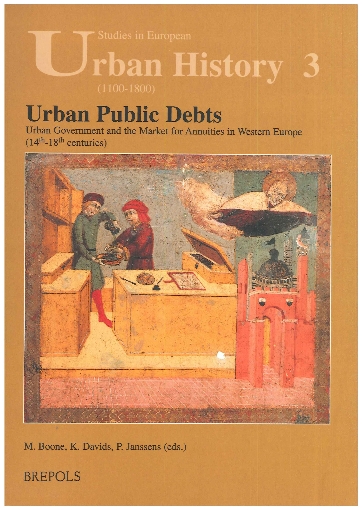
Urban public debts, urban government and the market for annuities in Western Europe (14th-18th centuries)
show More to view fulltext, buy and share links for:Urban public debts, urban government and the market for annuities in Western Europe (14th-18th centuries) show Less to hide fulltext, buy and share links for: Urban public debts, urban government and the market for annuities in Western Europe (14th-18th centuries)The essays in this volume offer a state-of-the-art analysis of a heretofore somewhat neglected part of financial history: the way in which urban governments in Western Europe during the Late Middle Ages and Early Modern Times handled the public debts their cities were confronted with. The technical aspects of the sale of annuities (renten, rentes) may have already been abundantly studied, but the links with social and political history still needed to be tackled. Who bought these annuities and thus participated in sharing the burden and profits which were likely to arise from them? What were their motives? How did the obvious links with urban elites work? And, perhaps most significantly, how did these occasional sales evolve into a structural way of linking financially important private persons with public finances, in the context both of cities and of growing states, since often the cities needed the money on a short-term basis in order to accomplish their own financial obligations toward ‘the state’. Participants in the colloquium where a large number of the essays were first presented represent in the first place the urban strongholds of Europe in the period under scrutiny: the Low Countries and Northern and Central Italy, but the Swiss cities, the cities of Aragon, London and papal Rome are also considered.
-
-
-
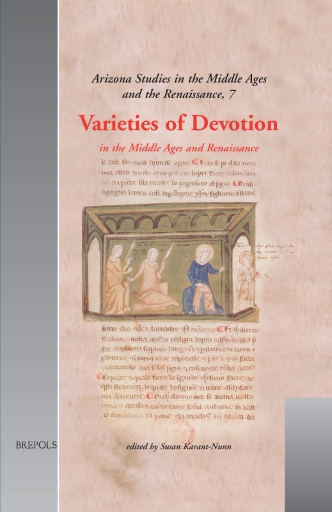
Varieties of Devotion in the Middle Ages and Renaissance
show More to view fulltext, buy and share links for:Varieties of Devotion in the Middle Ages and Renaissance show Less to hide fulltext, buy and share links for: Varieties of Devotion in the Middle Ages and RenaissanceIn the modern world, interest in religious devotion is as great as ever. This volume brings together the research of ten scholars into the diverse ways that Europeans expressed their quest for God over more than a millennium, from the formative centuries of Christianity up to the seventeenth century. Topics include women transvestite saints, Monophysite wall-paintings, Anglo-Saxon sainthood and painful martyrdom, Carmelite self-redefinition, the confident authorship of Gautier de Coinci and Matfre Ermengaud, competition between the bishop and a wandering preacher for popular favor in Le Mans, the contemplative philanthropies of the Poor Clares, Chester Nativity-cycle actors’ masculinity, Jean Gerson’s warm relations with his siblings, and George Herbert’s Eucharistic feeling. The authors’ profound familiarity with primary sources as well as the influence of current theory makes these essays vibrant and timely.
-
-
-
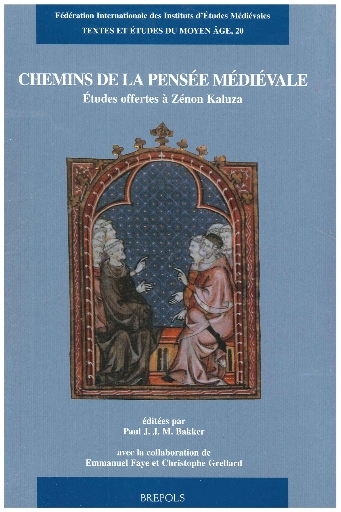
Chemins de la pensée médiévale
show More to view fulltext, buy and share links for:Chemins de la pensée médiévale show Less to hide fulltext, buy and share links for: Chemins de la pensée médiévaleHistorien de la philosophie et de la théologie du Moyen Âge tardif, spécialiste des xiv e et xv e siècles, Zénon Kaluza a profondément marqué les études médiévales des dernières décennies. Ses travaux portent sur plusieurs grands thèmes de l’histoire doctrinale du Moyen Âge, notamment le «platonisme» parisien et pragois, les méthodes et les langages de la philosophie et de la théologie, les contextes institutionnels du savoir et, enfin, la question du rapport entre l’Église et l’État. Pour rendre hommage à l’homme et à son œuvre, ses collègues et amis lui offrent ce recueil d’articles. Réunies sous le titre de Chemins de la pensée médiévale, ces études explorent différents aspects de l’histoire de la philosophie et de la théologie ainsi que, dans une perspective plus large, de l’histoire intellectuelle et sociale du Moyen Âge. Par l’ampleur de son orientation thématique, le présent volume offre une excellente présentation de l’état actuel de la recherche sur la pensée médiévale.
-
-
-
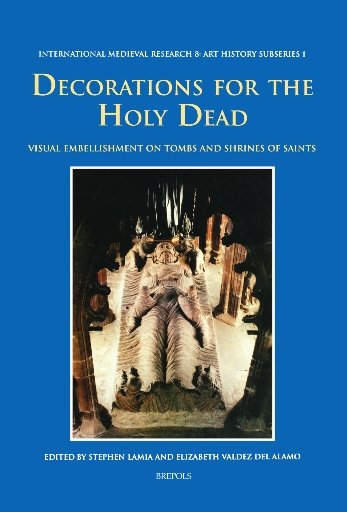
Decorations for the Holy Dead
show More to view fulltext, buy and share links for:Decorations for the Holy Dead show Less to hide fulltext, buy and share links for: Decorations for the Holy DeadDevotion to saints, their cult, and memory was enormously popular in medieval Europe. Factual evidence in the form of tombs, shrines, reliquaries, pilgrimages, vitae and souvenirs is legion and attests to the all-pervasive nature of the phenomenon. Despite the massive bibliography on hagiography, few if any books are devoted entirely to the study of saints’ burial places. The purpose of the papers gathered here, based on presentations sponsored by the International Center of Medieval Art at the International Medieval Congress in Leeds (1999), plus additional papers commissioned by the editors, is to examine the interaction between the visual arts at specific loci sancti and saints’ cults and, further, to enquire whether a corpus of more unusual motifs appeared at saintly sites, beyond the more predictable narrative, symbolic, and iconic representations of saints. The papers address the active role saints’ tombs and their embellishments assumed within the fabric of medieval society: rituals enacted at saints’ burial places, altarpieces, reliquaries, cloister as shrine, the aura of the venerable past, secular burial near saints’ tombs, and political and feminist elements in devotional practice. Monuments from Spain, France, Italy, Greece, Hungary, and England are examined and the volume incorporates 104 illustrations.
-
-
-
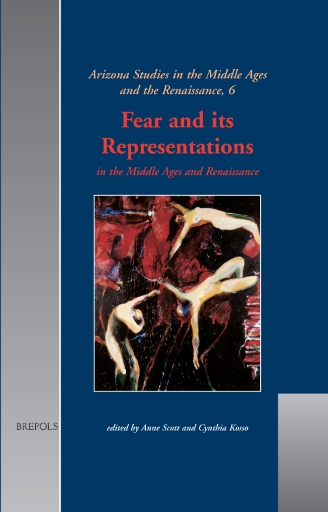
Fear and its Representations
show More to view fulltext, buy and share links for:Fear and its Representations show Less to hide fulltext, buy and share links for: Fear and its RepresentationsFear is a topic that appeals to a wide audience and is particularly of interest today. In the modern world, we fear war and terrorism, economic recession, and environmental degradation: these fears make up a great portion of the fabric of our daily lives. This is a volume of essays on fear and its representations in the Middle Ages and Renaissance. In it, the authors raise and try to answer questions about the ways in which individuals, families, and nations five-hundred, one-thousand, or even fifteen-hundred years ago approached the idea of fear.
The interdisciplinary nature of this volume and its editors (an historian of late antiquity and professor of literature of the Middle Ages) motivates an analysis of fear from a multitude of perspectives and within a host of secular and religious literature, historical treatises, scholastic works, art, and political accounts. The volume covers several main topics: Defining the Nature of Fear; Fear and Religion; Fear in Politics and Cultural Identity; Fear as a Literary and Dramatic Device; The Fears of Courtly Lovers, Knights, and Poets; Fear and the Mystic.
Through its breadth, depth, and interdisciplinary focus, the present volume makes a full contribution to the study of fear in medieval and Renaissance culture for historians, art historians, students of language and philosophy and anyone interested in how people in the past have experienced fear.
-
-
-
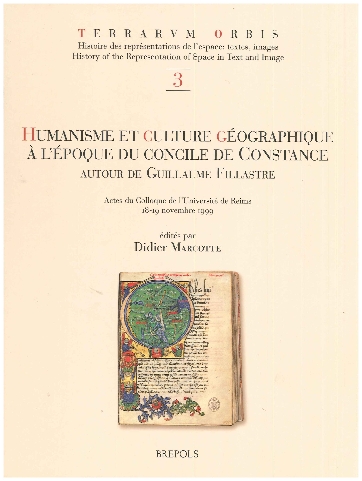
Humanisme et culture géographique à l’époque du concile de Constance. Autour de Guillaume Fillastre
show More to view fulltext, buy and share links for:Humanisme et culture géographique à l’époque du concile de Constance. Autour de Guillaume Fillastre show Less to hide fulltext, buy and share links for: Humanisme et culture géographique à l’époque du concile de Constance. Autour de Guillaume FillastreDoyen de Reims avant d’être cardinal, un des artisans, avec Pierre d’Ailly, de la résolution du Grand schisme d’Occident, Guillaume Fillastre a constitué, jusqu’à sa mort en 1428, une riche bibliothèque qui témoigne de sa formation d’humaniste et de son intérêt plus particulier pour la géographie de la tradition gréco-romaine. Son époque, qui est aussi celle du Pogge, voit le renouveau des études classiques s’imposer à toute l’Europe. À côté de la personnalité de l’érudit et de l’homme d’Église, on aborde ici les relations entre les premiers humanistes français et l’Italie, l’activité des philologues, les travaux des géographes et des cartographes dans les premières décennies du XVe siècle. Une place toute spéciale a été réservée à la Géographie de Ptolémée, dont la fortune, à la fin du moyen âge, a trouvé en Fillastre un de ses principaux vecteurs.
-
-
-
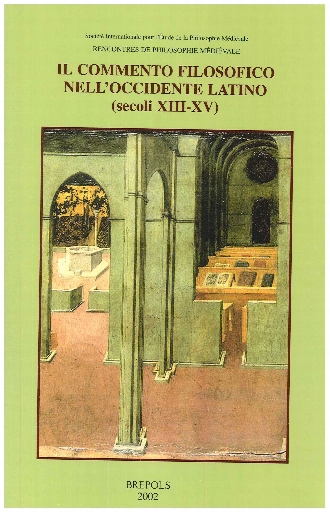
Il commento filosofico nell’occidente latino (secoli XIII-XV)
show More to view fulltext, buy and share links for:Il commento filosofico nell’occidente latino (secoli XIII-XV) show Less to hide fulltext, buy and share links for: Il commento filosofico nell’occidente latino (secoli XIII-XV)The practice of commentary upon authoritative texts is a prominent and fundamental feature of all teaching and learning during the Middle Ages. The roots of medieval commentaries made upon important philosophical texts lay in antiquity, but commentaries upon such texts — both ancient and more recent — flourished as never before during the late Middle Ages. Subsequently, beyond the end of the Middle Ages, the appeal and the habit of commentary declined, and to the point that today a considerable effort is required to understand medieval commentaries — their genres, their techniques, their evolution, their extraordinary persistence in use over many centuries — and perhaps too to understand the much diminished importance of the practice of commentary on select texts in current academic scholarship. The Philosophical Commentary in the Latin West (XIII-XV Centuries) proved to be a rich, varied and seemingly inexhaustible theme for the Colloquium of the International Society for the Study of Medieval Philosophy. The contributors who were invited discussed commentaries on texts of medicine, alchemy, biology, psychology, physics, ethics and politics as well as theology. The medieval commentators themselves were Arabs and Jews as well as Christians.
-
-
-
Latin Culture in the Eleventh Century
show More to view fulltext, buy and share links for:Latin Culture in the Eleventh Century show Less to hide fulltext, buy and share links for: Latin Culture in the Eleventh CenturyLatin Culture in the Eleventh Century is a collection of approximately sixty papers presented at the Third International Conference on Medieval Latin Studies held at the University of Cambridge in September 1998. The collection embraces a wide range of fields related to Medieval Latin, including poetry, hymnology, music, theology and philosophy, historiography, and inscriptions, in addition to Latin linguistics and metrics. Contributions are drawn from leading scholars from many European countries as well as from North America and Australia. The volume should prove invaluable to all students of this period.
-
-
-
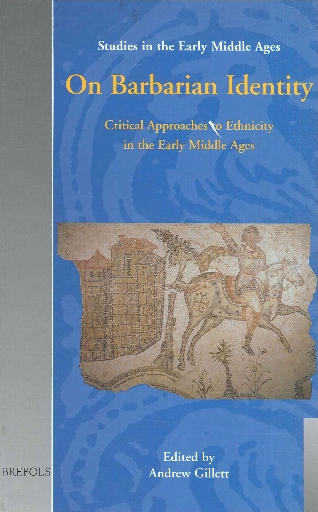
On Barbarian Identity
show More to view fulltext, buy and share links for:On Barbarian Identity show Less to hide fulltext, buy and share links for: On Barbarian IdentityEthnicity has been central to medieval studies since the Goths, Franks, Alamanni and other barbarian settlers of the former Roman empire were first seen as part of Germanic antiquity. Today, two paradigms dominate interpretation of barbarian Europe. In history, theories of how tribes formed (‘ethnogenesis’) assert the continuity of Germanic identities from prehistory through the Middle Ages, and see cultural rather than biological factors as the means of preserving these identities. In archaeology, the ‘culture history’ approach has long claimed to be able to trace movements of peoples not attested in the historical record, by identifying ethnically-specific material goods. The papers in this volume challenge the concepts and methodologies of these two models. The authors explore new ways to understand barbarians in the early Middle Ages, and to analyse the images of the period constructed by modern scholarship. Two responses to the papers, one by a leading exponent of the ‘ethnogenesis’ approach, the other by a leading critic, continue this important debate.
-
-
-
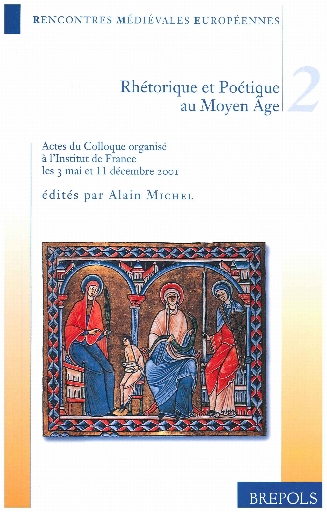
Rhétorique et poétique au Moyen Âge
show More to view fulltext, buy and share links for:Rhétorique et poétique au Moyen Âge show Less to hide fulltext, buy and share links for: Rhétorique et poétique au Moyen ÂgeLe présent Colloque, organisé par les Rencontres médiévales européennes, tend d’abord, ici comme dans d’autres recherches analogues qui ont déjà intéressé la même association, à mettre en lumière, par une démarche pluridisciplinaire, certains aspects de la culture médiévale qui manifestent à la fois sa complexité, sa profondeur et sa beauté. Il s’agit ici de la parole et de la beauté où s’accordent et s’unissent l’art littéraire et la sagesse, philosophique et même théologique.
Il est en effet possible de répondre aujourd’hui à certaines objections qui s’adressent communément au Moyen Âge lui-même et plus largement aux formes d’expression qu’il met en lumière. On lui reproche à la fois d’avoir abusé de la rhétorique et de l’avoir méconnue. Mais les chercheurs savent depuis quelques années que la rhétorique ne se réduit ni à l’abstraction scolastique ni à la sophistique. Dans la forme qu’elle prend jusqu’au xiv e siècle, en se référant à l’Antiquité et en préparant plus qu’on ne croit la Renaissance, elle suscite et reconnaît le progrès du langage, de sa justesse et de ses grâces. Pour cela, elle s’appuie à la fois sur la beauté de l’idéal et sur la rigueur de la pensée, sur la transcendance platonicienne et sur le bon-sens aristotélicien combiné avec l’étendue du savoir. Elle s’accorde aussi avec la poétique, latine ou profane, simplement lyrique, ou tournée vers la liturgie. Nous savons encore aujourd’hui que l’usage positif de l’intelligence peut s’associer avec la naïveté mystique dans un divino-humanisme.
Nous avons voulu montrer dans la tradition qui mène jusqu’à la modernité cette présence constante du coeur: dans la parole la plus fine chacun peut trouver l’amour le plus pur.
-
-
-
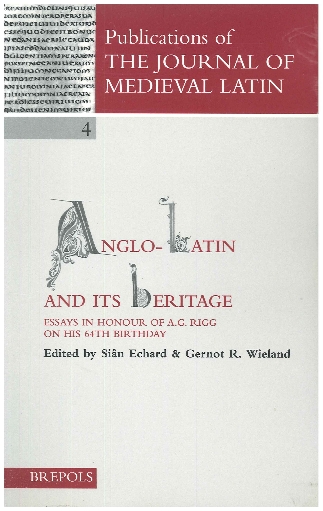
Anglo-Latin and its Heritage
show More to view fulltext, buy and share links for:Anglo-Latin and its Heritage show Less to hide fulltext, buy and share links for: Anglo-Latin and its HeritageFor some 40 years, A.G. Rigg has been defining the field of later Anglo-Latin literary scholarship, a task culminating in his History of Anglo-Latin Literature 1066-1422. Anglo-Latin and its Heritage is a collection of thirteen essays by his colleagues and students, past and present, which pays tribute to him both by exploring the field he has defined, and by making forays into its antecedents and descendants. The first section, “Roots and Debts,” includes essays on the migration of classical and late antique motifs and patterns of thought into early medieval Latin, and concludes with an essay which shows how a 12th-century writer reached back into that earlier period for stylistic models. The central section of the book, “Anglo-Latin Literature 1066-1422,” concentrates on Anglo-Latin writers of the period most studied by Rigg himself, and the seven essays in this section include analyses of poetic style and borrowing; discussions of patterns of reading; and essays which read Anglo-Latin works through their specific historical and cultural contexts. Two of the essays are elegant translations of significant Anglo-Latin poetic works. The final section of the book, “Influence and Survival,” offers three essays which consider Anglo-Latin literature in the late medieval and post-medieval world, from an edition of a Latin source for a late Middle English saint’s life; through an account of the migration of Latin texts into the royal libraries of Henry VIII; to the concluding essay, which explores a “mechanical” means of producing perfect Latin hexameter. A complete bibliography of Rigg’s works closes the volume. The chronological and methodological range of the essays in this collection is offered as a fitting tribute to one of Anglo-Latin’s most learned and indefatigable scholars.
-
-
-

De Sion exibit lex et verbum domini de Hierusalem
show More to view fulltext, buy and share links for:De Sion exibit lex et verbum domini de Hierusalem show Less to hide fulltext, buy and share links for: De Sion exibit lex et verbum domini de HierusalemAmnon Linder, professor of medieval history at the Hebrew University of Jerusalem has published seminal studies in the history of the Christian Holy Land and in Jewish-Christian relations in Late Antiquity and the Middle Ages. In recent years he has dedicated himself to the study of medieval liturgy, particularly Crusader liturgy of the liberation and destruction of Jerusalem (forthcoming as the next volume in this series).
The essays gathered here from friends, colleagues and students of Prof. Linder pick up the themes of his publications — medieval law, liturgy and literature. The papers deal with a variety of sources, encompass the fourth to fifteenth centuries, and span from the Holy Land to the British Isles.
-