Brepols Online Books Medieval Miscellanea Original Archive v2016 - bobar16mimeo

Collection Contents
1 - 20 of 254 results
-
-
A Late Medieval Songbook and its Context: New Perspectives on the Chantilly Codex (Bibliothèque du Château de Chantilly, Ms. 564)
show More to view fulltext, buy and share links for:A Late Medieval Songbook and its Context: New Perspectives on the Chantilly Codex (Bibliothèque du Château de Chantilly, Ms. 564) show Less to hide fulltext, buy and share links for: A Late Medieval Songbook and its Context: New Perspectives on the Chantilly Codex (Bibliothèque du Château de Chantilly, Ms. 564)
-
-
-
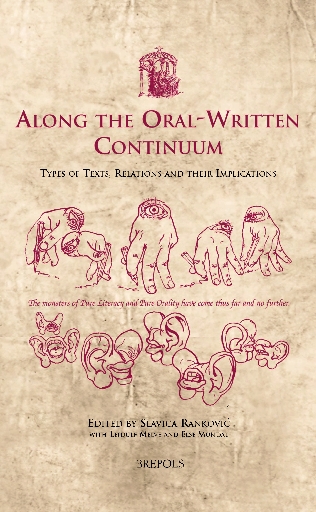
Along the Oral-Written Continuum
show More to view fulltext, buy and share links for:Along the Oral-Written Continuum show Less to hide fulltext, buy and share links for: Along the Oral-Written ContinuumEver since its introduction in the 1970s, Ruth Finnegan’s notion of the oral-written, or the oral-literate, continuum has served as one of the most effective means of dispelling the dichotomous understanding of the two principal media of communication in the Middle Ages. However, while often casually invoked, the concept has never been made a focus of study in its own right. The present volume is an attempt to place the oral-written continuum at the heart of discussion as an object of a head-on theoretical investigation, as a backdrop to distinct processes of acquisition of literacy in different European regions, and, indeed, as a tool for navigating the rugged landscape of verbal forms, exploring the complexity of oral-literary interrelationships that they manifest. The articles probe the concept with a variety of theoretical and methodological approaches, span diverse texts and genres, and involve a range of European cultural contexts, with special emphasis on Scandinavia and Northern Europe, but also reaching out to various other corners of the continent: from France, the Netherlands and England in the West, over Germany, Bohemia and Poland in the central region, to Serbia and Bosnia in the Southeast.
-
-
-
Approches du bilinguisme latin-français au Moyen Âge: linguistique, codicologie, esthétique
show More to view fulltext, buy and share links for:Approches du bilinguisme latin-français au Moyen Âge: linguistique, codicologie, esthétique show Less to hide fulltext, buy and share links for: Approches du bilinguisme latin-français au Moyen Âge: linguistique, codicologie, esthétiqueLe Moyen Âge a vu naître les langues romanes. L’émergence progressive de ces nouveaux systèmes linguistiques, puis leur accession à l’écrit et à la littérature, n’a pourtant pas rendu caduc l’usage du latin. Témoignent de cette résistance du latin la diglossie de nombreux locuteurs, auteurs ou copistes médiévaux, ainsi que le bilinguisme courant de leurs énoncés et de leurs productions textuelles. Ces phénomènes ont été éclairés et illustrés par d’abondants travaux dont l’apport est régulièrement signalé par les auteurs de ce volume.
L’originalité du présent recueil tient au fait qu’y sont analysées les modalités de cohabitation du latin et de la langue d’oïl dans les textes du Moyen Âge central et tardif. Cette réflexion collective, adossée à un souci permanent de définition théorique, se montre attentive à l’évolution chronologique, depuis les Psautiers bilingues du xii e siècle jusqu’aux imprimés du xvi e siècle. Elle est sensible aussi à des enjeux variables, depuis l’enseignement élémentaire de la grammaire ou du vocabulaire jusqu’à la mise en œuvre de dispositifs esthétiques complexes. En s’appuyant sur les témoins — pour la plupart manuscrits — qu’a pu susciter la double compétence linguistique médiévale, les auteurs du volume interrogent la conception des textes bilingues, leurs conditions d’élaboration, leur transmission, leur réception. L’insertion souvent discrète de fragments latins au sein de textes français, tout comme la présence plus rare de la langue d’oïl au sein de manuscrits latins, se lit alors comme un mode d’expression aussi raffiné que spontané, susceptible d’enrichir les usages prévus pour le texte enchâssant. Au-delà, l’ensemble de ces études permet d’entrevoir la conscience linguistique des locuteurs du Moyen Âge.
-
-
-
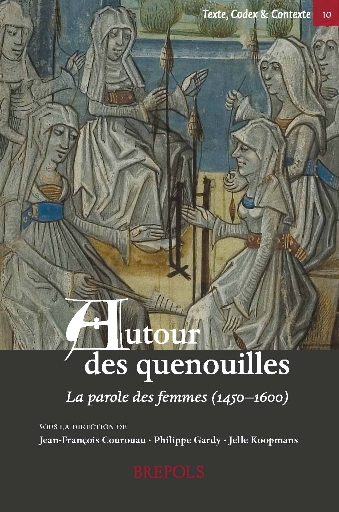
Autour des quenouilles: la parole des femmes (1450-1600)
show More to view fulltext, buy and share links for:Autour des quenouilles: la parole des femmes (1450-1600) show Less to hide fulltext, buy and share links for: Autour des quenouilles: la parole des femmes (1450-1600)Dans l’Europe de la fin du xv e siècle et du xvi e siècle, nombreux sont les textes qui font état d’un savoir spécifiquement détenu par les femmes, transmis entre elles de façon orale et constitué par un corps de croyances et de «recettes». L’émergence d’un tel «genre», au seuil des temps dits modernes, n’a jamais été analysée en tant que telle et l’objet de ce volume est de combler ce manque à travers l’étude d’œuvres produites dans différentes littératures d’Europe, des Flandres et d’Angleterre jusqu’à Valence et la Castille en passant par l’Occitanie.
-
-
-
Avicenna and his Legacy
show More to view fulltext, buy and share links for:Avicenna and his Legacy show Less to hide fulltext, buy and share links for: Avicenna and his LegacyThe centuries immediately following upon the monumental achievements of Avicenna (d. 1036) have been rightly characterized as a golden age of science and philosophy. Generation after generation scrutinized the Avicennan legacy, explicating and expanding upon the wealth of writings left by the master. Critical thinking in logic and astronomy, medicine and metaphysics spurred many new developments. This volume presents seventeen essays on Avicenna, his followers and his critics, many of whom are just now being introduced to western scholarship. The contributors to Avicenna and his Legacy include both established scholars as well as some of the best of the new generation.
-
-
-
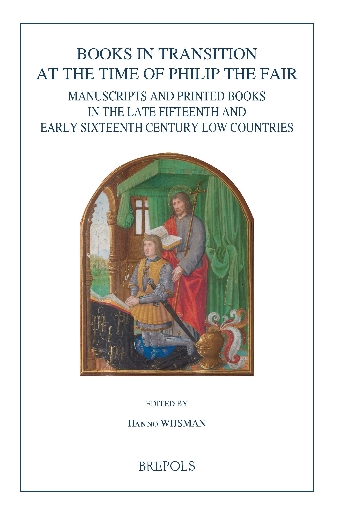
Books in Transition at the Time of Philip the Fair
show More to view fulltext, buy and share links for:Books in Transition at the Time of Philip the Fair show Less to hide fulltext, buy and share links for: Books in Transition at the Time of Philip the FairIn 2006, 500 years after his death, the Royal Library of Belgium organised an exhibition (curated by Bernard Bousmanne and Hanno Wijsman) revealing treasures from the era of Philip the Fair (1478-1506), last duke of Burgundy. This volume reunites most of the papers delivered at a conference held during the exhibition, increased with four new chapters. Ten specialists from Belgium, the Netherlands and the United States discuss the book market and its place in society in this transitional period when manuscripts and printed books were produced and used next to one another. The various chapters are illustrated with more than 70 reproductions, most of which formerly unpublished. The contributions are organised around five topics: Philip the Fair and his books, art in books, music in books, politics in books, the book market.
-
-
-
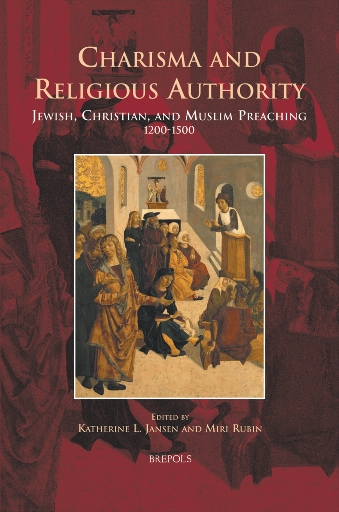
Charisma and Religious Authority
show More to view fulltext, buy and share links for:Charisma and Religious Authority show Less to hide fulltext, buy and share links for: Charisma and Religious AuthorityThis volume of essays concentrates on the effects of preaching in late medieval and early modern Europe, particularly through the concept of charisma, a term introduced into the discussion of religion and politics by Max Weber. Used by Weber, the term indicates the power of a person to move others to action, to animate and mobilize them. The late medieval and early modern periods witnessed the emergence of preachers who became powerful public figures central to the mobilization of populations towards religious reform or crusades. Such preachers were also enmeshed in civic life and the life of courts. Super-preachers like Bernardino of Siena and John of Capestrano shaped opinion on a wide range of issues: the ethics of business, marriage and gender relations, attitudes towards minorities, the poor and social responsibility, as well as the role of kings and other rulers in society. Preaching events were the mass media of the day, and in their wake could follow pogrom, lay revival, crusade, peace movement, or reconciliation within a faction-riven city. The power of these events was great and not merely confined to the Christian community. This volume introduces for the first time a comparative dimension which looks at the theme of charisma and religious authority in the Jewish, Christian, and Muslim preaching traditions.
-
-
-
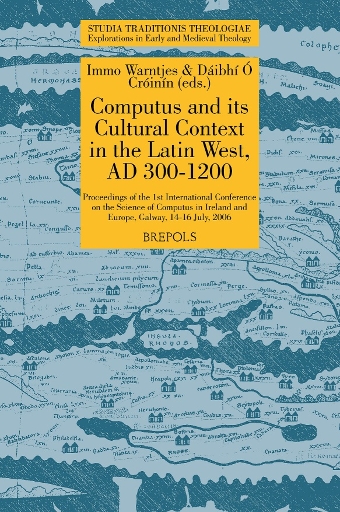
Computus and its Cultural Context in the Latin West, AD 300-1200
show More to view fulltext, buy and share links for:Computus and its Cultural Context in the Latin West, AD 300-1200 show Less to hide fulltext, buy and share links for: Computus and its Cultural Context in the Latin West, AD 300-1200The scientific knowledge that Irish, English, and continental European scholars nurtured and developed during the years c. AD 500 to c. AD 1200 was assimilated, in the first place, from the wider Roman world of Late Antiquity. Time-reckoning, calendars, and the minute reckonings required to compute the date of Easter, all involved the minutiae of mathematics (incl. the original concept of ‘digital calculation’) and astronomical observation in a truly scientific fashion. In fact, the ‘Dark Ages’ were anything but dark in the fields of mathematics and astronomy.
The first Science of Computus conference in Galway in 2006 highlighted the transmission of Late Antique Mathematical Knowledge in Ireland & Europe, the development of astronomy in Early Medieval Ireland & Europe and the role of the Irish in the development of computistical mathematics. The proceedings of that conference should, therefore, appeal equally to those interested in the history of science in Ireland and Europe, and in the origins of present-day mathematical and astronomical ideas.
-
-
-

De Bono Communi. The Discourse and Practice of the Common Good in the European City (13th-16th c.)
show More to view fulltext, buy and share links for:De Bono Communi. The Discourse and Practice of the Common Good in the European City (13th-16th c.) show Less to hide fulltext, buy and share links for: De Bono Communi. The Discourse and Practice of the Common Good in the European City (13th-16th c.)Traditionally confined to the sphere of the State and of auctoritas, the phrase the “Common Good” is set to conquer the cities in the late Middle Ages and at the beginning of the Early Modern period. But can we compare a kingdom like France where the cities defend their “Common Good” by making reference to the interest and benefit of the Kingdom with principalities like Flanders where, despite their fierce desire for autonomy, the cities use the notion with much greater reservation than their Italian counterparts? This volume traces the intellectual and theoretical roots that have led to the emergence of the notion of the “Common Good” in the urban world of Western Europe by analysing the practical forms of its manifestations.
-
-
-
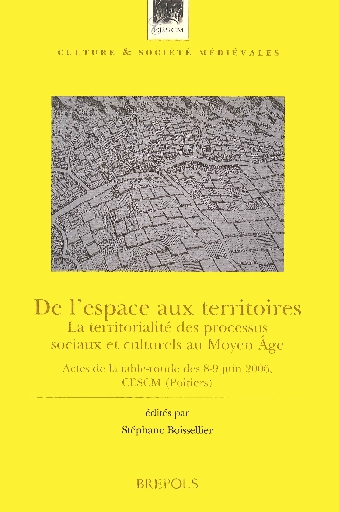
De l’espace aux territoires
show More to view fulltext, buy and share links for:De l’espace aux territoires show Less to hide fulltext, buy and share links for: De l’espace aux territoiresAu lieu d’une publication de plus sur l’espace — notion qui est un fourre-tout conceptuel —, une journée d’étude a été réunie à Poitiers les 8-9 juin 2006 sur le thème de la territorialité. Rassemblant, dans un cadre d’étude méditerranéen, des contributions qui abordent aussi bien le monde arabo-musulman que l’Occident méridional chrétien, cette rencontre visait à mieux cerner un phénomène essentiel dans l’histoire des sociétés complexes: les mécanismes de territorialisation, par lesquels les liens socio-politiques, les activités productives, les courants et les productions culturels et (plus classiquement) les constructions gouvernementales et administratives deviennent des systèmes spatiaux imbriqués, emboîtés et inter-connectés, avec une complexité qui constitue un défi à l’analyse historique.
Les auteurs des contributions rassemblées dans ce volume ont intégré l’analyse spatiale des géographes comme fondement de leur réflexion, dans une démarche transdisciplinaire, mais ils l’ont fait avec les moyens (limités par la nature des sources) des historiens. On trouvera ici des études, à différentes échelles, portant aussi bien sur les constructions idéelles de l’espace par les liturgistes ou les géographes médiévaux que sur les processus juridiques et matériels de la territorialisation, à partir de sources très variées requérant chacune une approche spécifique; mais toutes convergent pour une saisie globale de la territorialisation comme fondement des sociétés et des cultures médiévales — avec un espace conçu non pas comme un cadre, voire une simple toile de fond, mais comme un «ingrédient» majeur des processus.
Au moins pour l’Occident latin, la seconde moitié du Moyen Âge est privilégiée, pour des raisons historiques — la croissance démographique implique un poids croissant de l’homme et de ses activités dans l’espace matériel, notamment à l’échelle locale des communautés d’habitants — mais encore plus pour des raisons de sources; en effet, s’il est probable que les «topolignées» féodales sont plus fortement territorialisées que l’aristocratie impériale carolingienne, il reste à vérifier si l’agriculture, la centralité urbaine et l’encadrement des hommes ponctuaient moins fortement l’espace au haut Moyen Âge…
-
-
-
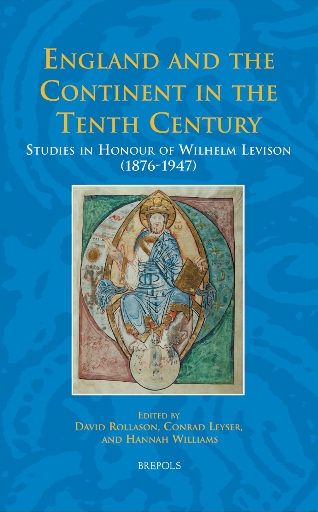
England and the Continent in the Tenth Century
show More to view fulltext, buy and share links for:England and the Continent in the Tenth Century show Less to hide fulltext, buy and share links for: England and the Continent in the Tenth CenturyDedicated as a memorial to the great historian of England and the Continent in the eighth century, Wilhelm Levison, this book provides the widest and most in-depth exploration to date of relations between England and the Continent during an equally crucial period, the tenth century. The volume, which comes out of a sustained collaboration between English and Continental universities, contains thematically arranged essays by established leading specialists and also by younger scholars. By building on the approaches used by Levison as well as other methods that have been developed in the decades since his death, these essays tackle a broad range of questions: What routeways and modes of contact linked England with the Continent? How similar were attitudes to rulership and dynastic strategies? How did the law, the working of government, and the organization and culture of the church differ between England and the Continent? How was the past seen and represented on the two sides of the English Channel? In answering these questions, this volume offers news ways of exploring the links and developing the comparison between England and the Continent in the century after the collapse of the Carolingian Empire, a formative period for the development of Europe.
-
-
-
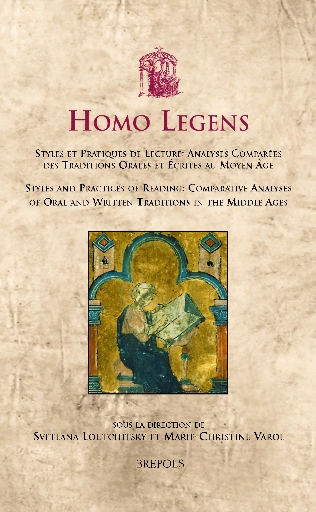
Homo Legens
show More to view fulltext, buy and share links for:Homo Legens show Less to hide fulltext, buy and share links for: Homo LegensHow can we uncover the traces of oral culture in medieval sources when the oral matter we possess survives only in written form? Is it the case that only the written persists while the oral is lost? What was the status of orality in medieval society? The studies in this volume (five chapters in French and two in English) examine the links between the oral and the written traditions in medieval literature. They do this by means of the analysis of literary sources from very diverse backgrounds, both geographically and linguistically speaking: the investigation ranges from medieval Spain, through the Byzantine Empire and the Crusader states, to late medieval and early modern Turkey. This interdisciplinary enquiry by an international group of scholars enables us to define the modes of transmission of medieval texts and how they were memorized as well as to decipher how they were read and appropriated. In addition, the book suggests a methodological basis for research into indices of orality and for analysis of the intertextual links between literary works. This enquiry, undertaken within the framework of the international Homo Legens project, provides an efficacious tool for the study of the practices of reading and writing.
-
-
-
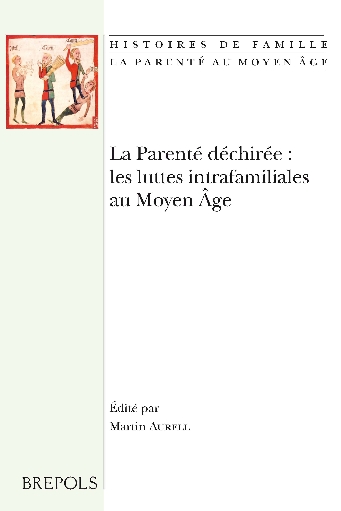
La Parenté déchirée: les luttes intrafamiliales au Moyen Âge
show More to view fulltext, buy and share links for:La Parenté déchirée: les luttes intrafamiliales au Moyen Âge show Less to hide fulltext, buy and share links for: La Parenté déchirée: les luttes intrafamiliales au Moyen ÂgeNous, médiévistes, insistons, trop souvent peut-être, sur la cohésion du groupe familial. Nous le percevons ainsi dans la force de sa solidarité, dans la rigidité de ses structures d’encadrement et dans la rigueur de l’obéissance à l’aîné. Son harmonie sortirait même renforcée de sa lutte contre des parentèles rivales. Une telle vision ne manque assurément pas de fondements. Pourtant, les sources révèlent aussi les conflits internes à une famille, qui interviennent, en premier lieu, dans l’axe de la filiation. Les tensions entre, d’une part, le père ou l’oncle paternel et, d’autre part, ses fils ou neveux sont souvent mentionnées par les sources. Elles répondent au conflit intergénérationnel, exacerbé dans l’aristocratie guerrière par l’adoption des valeurs du jeune (juvenis). À classe d’âge égale, les luttes entre frères ou entre cousins reproduisent souvent le même schéma juvénile, car elles opposent les cadets à l’aîné pour la conquête du pouvoir et du patrimoine. En second lieu, l’axe de l’alliance reproduit autant d’affrontements entre «belles-familles». Paradoxalement, l’élément religieux peut introduire le germe de la discorde. En prônant la conversion au détriment d’anciennes pratiques, la vocation religieuse ou le libre choix du conjoint, le christianisme est parfois à l’origine de tensions à l’intérieur de la famille. La charité qu’il préconise est supérieure au lien du sang. Elle valorise l’individu au détriment de structures d’encadrement, parmi lesquelles le cousinage et le lignage sont les premières touchées. Elle bouleverse, enfin, les pratiques de la parenté, l’exercice de la violence et leurs représentations littéraires ou iconographiques.
-
-
-

Laments for the Lost in Medieval Literature
show More to view fulltext, buy and share links for:Laments for the Lost in Medieval Literature show Less to hide fulltext, buy and share links for: Laments for the Lost in Medieval LiteratureThis is a collection of essays on the subject of lament in the medieval period, with a particular emphasis on parental grief. The analysis of texts about pain and grief is an increasingly important area in medieval studies, offering as it does a means of exploring the ways in which cultural meanings arise from loss and processes of mourning. The international scholars who come together to produce this volume discuss subjects as diverse as lament psalms in Old and Middle English, medieval Latin laments, mourning in Anglo-Saxon literature, mourning through objects, medieval art and archaeology, Old French poetic elegy, skaldic poetry, medieval women’s writing, Old Polish drama, English massacre plays, and Middle English nativity lyrics.
-
-
-
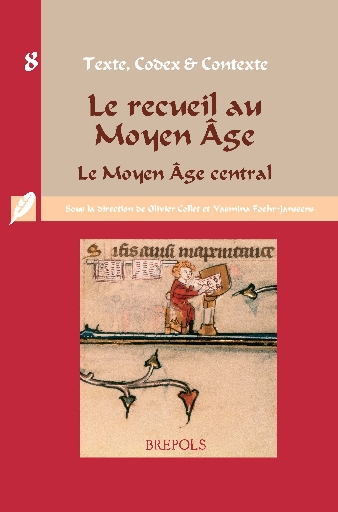
Le recueil au Moyen Âge
show More to view fulltext, buy and share links for:Le recueil au Moyen Âge show Less to hide fulltext, buy and share links for: Le recueil au Moyen ÂgeDe la redécouverte de notre ancienne littérature aux années 1990, peu de travaux systématiques ont été consacrés au phénomène de la mise en recueil durant le moyen âge central. Époque des premières collections livresques et surtout de la somme, le XIIIe siècle se caractérise toutefois par l’emprise d’un geste unificateur sur la production manuscrite. Une large part de la transmission écrite, littéraire et savante, est marquée par l’apparition de vastes corpus textuels répondant à un projet de regroupement ou de rassemblement plus ou moins raisonné.
Depuis une dizaine d’années, la communauté scientifique a marqué un regain d’intérêt pour ces questions qui figurent au cœur des préoccupations de la «nouvelle philologie». Axée sur une meilleure prise de conscience de la dimension matérielle des œuvres et des résonances directes de leur transcription, l’étude actuelle du fait littéraire ne manque pas en effet de s’interroger sur les implications et les conséquences de cette pratique, intimement liée aux traditions vernaculaires.
-
-
-
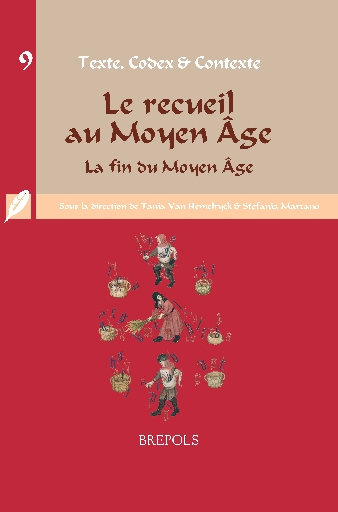
Le recueil au Moyen Âge
show More to view fulltext, buy and share links for:Le recueil au Moyen Âge show Less to hide fulltext, buy and share links for: Le recueil au Moyen ÂgeDans la lignée du volume sur L’écrit et le manuscrit (Texte, Codex & Contexte, 1) la question du recueil poursuit l’étude des interactions entre le codex, la conscience de l’auteur et le lecteur à la fin du Moyen Âge. Pourtant déterminant, l’espace matériel du recueil est souvent négligé par la critique qui se penche sur les éditions de pièces isolées de leur contexte.
Des manuscrits d’auteurs aux recueils d’œuvres diverses, les contributions rassemblées dans ce volume considèrent le geste d’ordonnancement qui préside à la genèse de ces nouvelles manifestations littéraires. Fruit du 3e colloque international du Groupe de recherche sur le moyen français de l’Université catholique de Louvain (10, 11 et 12 mai 2007), l’ouvrage offre une synthèse actuelle et des éclairages modernes sur le recueil à la fin du Moyen Âge par le biais d’études littéraires, linguistiques et codicologiques.
-
-
-
L’école de Saint-Victor de Paris
show More to view fulltext, buy and share links for:L’école de Saint-Victor de Paris show Less to hide fulltext, buy and share links for: L’école de Saint-Victor de ParisEn 1108, Guillaume de Champeaux, abandonne la direction de l’école cathédrale de Paris pour mener avec quelques étudiants une vie d’ermite sur les pentes alors désertes de la Montagne Sainte-Geneviève. En quelques dizaines d’années, le groupe de scholares devient une puissante abbaye de chanoines réguliers et l’une des écoles les plus remarquables de l’occident médiéval, par la stabilité d’une longue lignée de maîtres, la diversité des domaines où ils se sont illustrés et l’étendue de leur fécondité jusqu’à la fin du Moyen Âge. Neuf siècles après la fondation de Saint-Victor de Paris, cette fécondité multiforme continue d’étonner. Quel est donc le secret du rayonnement qu’à travers Hugues, Adam, André, Richard, Thomas Gallus et bien d’autres l’abbaye parisienne a exercée dans l’histoire des méthodes pédagogiques, des bibliothèques, des sciences et techniques, de la géographie, de l’historiographie, de l’exégèse biblique, de la systématisation théologique, de la réception du pseudo-Denys, de la spiritualité, de la poésie liturgique, de la pastorale et de la discipline du comportement? Quels sont les causes, les moyens et les relais de cette influence? Comment se décline-t-elle selon les siècles, les milieux touchés et les genres pratiqués? En décernant à Saint-Victor un rôle d’initiateur dans toutes ces régions de la vie intellectuelle ou religieuse, les historiens sont-ils prisonniers d’une erreur de perspective, cèdent-ils à un effet de mode, ou bien y eut-il réellement un «miracle victorin»?
-
-
-
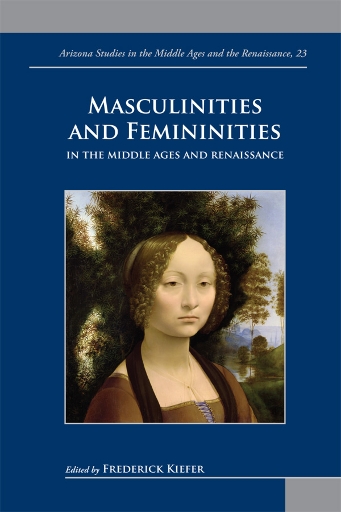
Masculinities and Femininities in the Middle Ages and Renaissance
show More to view fulltext, buy and share links for:Masculinities and Femininities in the Middle Ages and Renaissance show Less to hide fulltext, buy and share links for: Masculinities and Femininities in the Middle Ages and RenaissanceGender issues have been a persistent topic of investigation in European culture for more than a millennium. Today, perhaps no topic is of more immediate interest to students and scholars than sexual identity. If earlier eras imagined the categories of male and female as fixed, our own age has come to believe that notions of gender are, to a considerable extent, constructed by society and thus necessarily unstable. Using current understandings of sexuality, the contributors to this collection examine afresh such diverse works as Augustine’s Confessions, the Old English Beowulf, the French Richard Coer de Lyon, German mæren, Chrétien’s Yvain, writings by Wyclif and other Lollards, the poetry of Aemelia Lanyer, and an Italian portrait by Leonardo da Vinci. As the authors of this collection demonstrate, these thinkers persistently challenged the status quo, questioning assumptions felt as facts. In turn, they demonstrate how the medieval and Renaissance writers who are the subject of these essays helped prepare the way for understanding masculinity and femininity as masculinities and femininities.
-
-
-
Medieval Holy Women in the Christian Tradition c.1100-c.1500
show More to view fulltext, buy and share links for:Medieval Holy Women in the Christian Tradition c.1100-c.1500 show Less to hide fulltext, buy and share links for: Medieval Holy Women in the Christian Tradition c.1100-c.1500Medieval Holy Women in the Christian Tradition offers the first wide-ranging study of the remarkable women who contributed to the efflorescence of female piety and visionary experience in Europe between 1100 and 1500. This volume offers essays by prominent scholars in the field which extend the boundaries of our previous knowledge and understanding of medieval holy women. While some essays provide new perspectives on the familiar names of the unofficial canon of mulieres sanctae, many others bring into the spotlight women less familiar now, but influential in their own time and richly deserving of scholarly attention. The five general essays establish a context for understanding the issues affecting female religious witness in the later Middle Ages. The geographical arrangement of the volume allows the reader to develop an awareness of the particular cultural and religious forces in seven different regions and to recognize how these influenced the writing and reception of the holy women of that area. Seventeen major figures have essays devoted exclusively to each of them; in addition, the survey chapters on each region introduce the reader to many more. The extensive bibliographies which follow each chapter encourage further reading and study.
Alastair Minnis was Director of the Centre for Medieval Studies and Head of the Department of English at the University of York, and is currently Douglas Tracy Smith Professor of English at Yale University. A Fellow of the Medieval Academy of America and of the English Association, he is the author of six monographs and the editor or co-editor of fifteen further volumes.
Rosalynn Voaden (D.Phil., University of York, UK) is the author of God’s Words, Women’s Voices, and is the editor or co-editor of several volumes in the field. She was a Research Fellow at St Anne’s College, Oxford, and is currently Associate Professor of English at Arizona State University.
-