


Antiquité Tardive - Late Antiquity - Spätantike - Tarda Antichità
Revue Internationale d'Histoire et d'Archéologie (IVe-VIIIe siècle)
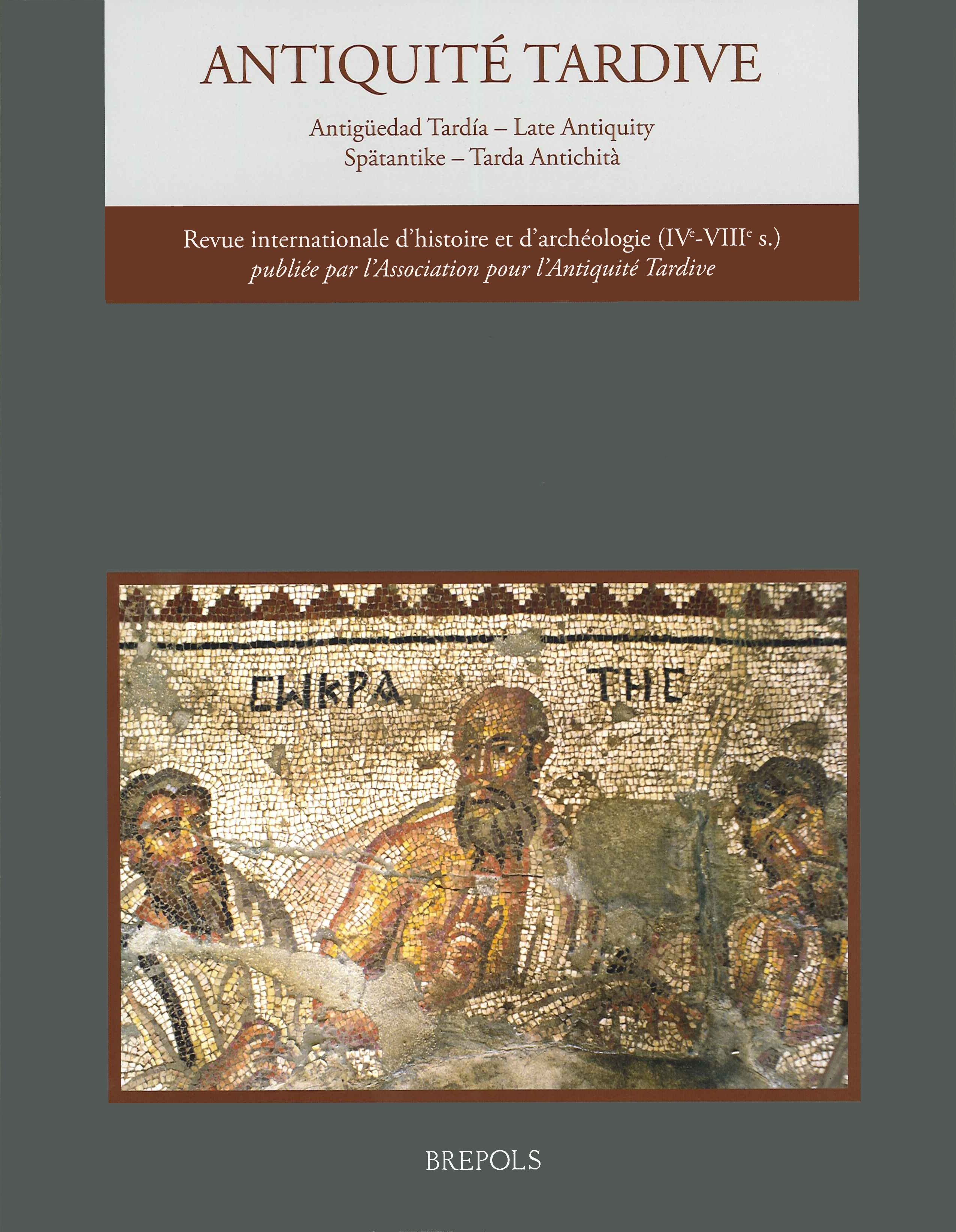
Volume 16, Issue 1, 2008
-
-
Last of the Catones. A profile of Symmachus the Younger
show More to view fulltext, buy and share links for:Last of the Catones. A profile of Symmachus the Younger show Less to hide fulltext, buy and share links for: Last of the Catones. A profile of Symmachus the YoungerBy: M. VitielloAbstractQuintus Aurelius Simmachus le jeune, membre de la famille des Anicii e beau-père de Boèce, est une des figures les plus illustres de son temps. En tant qu’homme de grande culture, mais aussi de par son rang de caput senatus, il eut un poids considérable au sein de la curie, représentant en outre une sorte de modèle pour l’élite italienne de cette génération. Le présent travail tente de reconstruire le profil culturel et politique du personnage, à travers l’analyse des témoignages de Cassiodore, d’Ennode et de Boèce. Le point de départ est celui de Cassiodore retransmis par l’Anecdoton Holderi, selon lequel Symmaque aurait été, de surcroît, imitator Catonis. Une telle définition, qui (au moins dans ce cas) va au delà de la rhétorique, renferme une série de valeurs clefs de la “Romanité” parmi lesquelles exempla, imitatio, mores, uirtutes, dont on trouve des confirmations précises dans les sources de la période en référence à Symmaque lui-même. À celles-ci s’ajoute la séculaire aspiration sénatoriale à la libertas, celle de l’époque républicaine que Caton d’Utique avait tenté de défendre jusqu’à la fin et qui ensuite, durant le Principat, avait entraîné la mort d’une série d’illustres membres du Sénat, souvent émules du Stoïcisme. C’est précisément dans le sillage de ces derniers que, des siècles plus tard, se placent les morts, successivement, de Boèce, dont le sacrifice est annoncé dans le De consolatione Philosophiae, et, tout de suite après, de Symmaque lui-même. La fin des derniers grands Anicii porta un coup mortel à ce Sénat vieux de mille ans, désormais irrémédiablement déchu et qui, quelques décades plus tard seulement, allait disparaître.
-
-
-
Iran e Mediterraneo nella Tarda Antichità (a proposito di un convegno recente)
show More to view fulltext, buy and share links for:Iran e Mediterraneo nella Tarda Antichità (a proposito di un convegno recente) show Less to hide fulltext, buy and share links for: Iran e Mediterraneo nella Tarda Antichità (a proposito di un convegno recente)By: T. GnoliAbstractWith the recent publication of the proceedings of an international conference held at Eutin (Germany) in 2000 (in collaboration with German, French and Italian students, and edited by Joseph Wiesehöfer et Philip Huyse), it is now possible to outline some of the characteristics of Late Antique Iran, under the Sassanians. While the chronological limits of this historical period in Iran correspond almost perfectly to those of Late Antique Greek and Roman world, several other similarities between these two perpetual enemies of Antiquity may also be highlighted. The perspective adopted in this excellent, highly interdisciplinary publication (though based essentially on approaches drawn from Iranian studies) constitutes a significant advance in the state of knowledge regarding relations between Ctesiphon and Rome/Constantinople.
-
-
-
Chronique d’historiographie tardive
show More to view fulltext, buy and share links for:Chronique d’historiographie tardive show Less to hide fulltext, buy and share links for: Chronique d’historiographie tardiveBy: Fr. PaschoudAbstractThis survey paper comments on three recent publications: an edition, German translation and monograph on Dexippus, a Greek historian of the 3rd century AD whose works survived only in fragments, a new volume of the full commentary of Ammianus by four dutch scholars on book 26, and a book on Ammianus as a elusive and allusive historian.
-
-
-
394: fin de la rédaction de l’Histoire Auguste?
show More to view fulltext, buy and share links for:394: fin de la rédaction de l’Histoire Auguste? show Less to hide fulltext, buy and share links for: 394: fin de la rédaction de l’Histoire Auguste?By: St. RattiAbstractThe author makes new points wich represent as many responses to possible objections to the thesis he exposed at the Historiae Augustae Colloquium Bambergense 2005, identifying the Historia Augusta with the Annales written by Nicomachus Flavianus senior.
1. Annales and imperial biographies: Actually, the difference between the two styles in Late Antiquity is groundless.
2. The seven books of the Historia Augusta and the Murbach catalogue: The text of the catalogue wich says that the Historia Augusta was written in seven books [Vita cesaru(m) u(e)l tira(n)noru(m) ab helio adriano us(que) ad Car(u)m carinu(m) libri VII] is reliable and does not need to be corrected.
3. The seven books: The structure of the Historia Augusta in seven books may have an ideologic and religious mean.
4. Chronological issues: a/ The composition’s date of the Historia Augusta: The Historia Augusta was composed between 392 and 394 in the form that we can read it. — b/ An allusion to the miraculous wind of the Frigidus’ battle? The theme of the storm (Gord. 16, 2) may be topical. It is not an allusion to the Frigidus but to a real storm that Zosimus knows. — c/ Probinus’ and Olybrius’ consulates: The Vita Probi probably contains a reference to the consuls of 395. As their nomination has been known in 394, that doesn’t provide any clue that the Historia Augusta is later than 394. — d/ Did the author of the Historia Augusta read Claudian? None of the presumed echoes of Claudian in the Historia Augusta is proved. — e/ The motif of the Kinderkaiser: Honorius became Augustus on january 23th, 393, whereas he was less than nine years old. Arcadius became Augustus on january 19th, 383, when he was six. This motif must have been developed by the Historia Augusta before 394. — f/ The religious atmosphere: The series of laws against pagans between 392 and 394 created a religious atmosphere wich perfectly fits with what we read in the Historia Augusta. — g/ Aurelianus, Stilicho and Eucherius in the Historia Augusta? References to the consuls of 400 in the Historia Augusta are not proved. Some allusions to Stilicho might be possible. But they don’t imply that the Historia Augusta was written later than 394. An allusion to Eucherius in the life of Maximinus Iunior is possible, but it doesn’t imply that the Historia Augusta was written later than 394. Reading the lives of the Maximini duo as a satirical tract against Stilicho is hard to admit. At any rate, it does not fit with the ascription of the Historia Augusta to Nicomachus Flavianus iunior.
-
-
-
A quarter century of Byzantine epigraphy: and where next?
show More to view fulltext, buy and share links for:A quarter century of Byzantine epigraphy: and where next? show Less to hide fulltext, buy and share links for: A quarter century of Byzantine epigraphy: and where next?By: F. MillarAbstractCet article rend compte de l’enregistrement des avancées de l’épigraphie byzantine que représentent les Chroniques d’épigraphie byzantine, 1987-2004 de Denis Feissel, publiées en 2006. Il analyse la nature de la contribution offerte par la redistribution des entrées byzantines du Bulletin épigraphique sous diverses catégories, essentiellement régionales, et se demande quels types d’utilisation pourraient et devraient maintenant être faites de la moisson d’inscriptions byzantines dans la recherche historique sur l’Antiquité tardive. La section finale s’intéresse principalement à l’Église dans le Moyen Orient ou, pour parler en termes romains de l’époque, dans le diocèse d’Orient.
-
-
-
Comptes rendus
show More to view fulltext, buy and share links for:Comptes rendus show Less to hide fulltext, buy and share links for: Comptes rendusAbstractHistoire et archéologie de l’Antiquité tardive.
C. Corbo,Paupertas. La legislazione tardoantica (IV-V sec. d.C.) (V. Toneatto et Cl. Lenoble); P.-G. Delage (éd.), Les Pères de l’Église et les ministères. Évolutions, idéal et réalités (P. Van Nuffelen); J. Fernández Ubiña, M. Marcos (eds.), Libertad e intolerancia religiosa en el Imperio romano (P. Van Nuffelen); C. Freu,Les figures du pauvre dans les sources italiennes de l’Antiquité tardive (V. Toneatto); M. Gaddis,There is no Crime for Those who have Christ. Religious Violence in the Christian Roman Empire (S. Destephen); M. Kahlos,Debate and Dialogue. Christian and Pagan Cultures c. 360-430 (S. Destephen); R. MacMullen,Voting About God in Early Church Councils (S. Destephen); P. norton,Episcopal Elections 250-600. Hierarchy and Popular Will in Late Antiquity (D. Moreau); S. Wood,The Proprietary Church in the Medieval West (D. Moreau).
Régions.
M. Buora, S. Seidel (dir.), Fibule antiche del Friuli (M. Vannesse); M. Buora, L. Villa (dir.), Goti nell’arco alpino orientale et M. Buora, L. Villa (dir.), Goti dall’Oriente alle Alpi (M. Vannesse); Le Martyre de Saint Aréthas et de ses compagnons (BHG 166), éd. et trad. M. Detoraki, J. Beaucamp (V. Christides); M. De Matteis, A. Trinchese (eds), Cimitile di Nola. Inizi dell’arte paleocristiana e tradizioni locali, et M. De Matteis, A. Trinchese (eds), Il complesso basilicale di Cimitile: patrimonio culturale dell’umanità? (M. Vannesse); S. Métivier,La Cappadoce (ive-vie siècle). Une histoire provinciale de l’Empire romain d’Orient (S. Destephen); A. Mosca, Ager Benacensis: carta archeologica di Riva del Garda e di Arco (IGM 35 I NE-I SE) (M. Vannesse); G. Pianu,La mansio di San Cromazio (M. Vannesse).
Philologie et sources.
S. Agusta-Boularot, J. Beaucamp, A.-M. Bernardi, E. Caire (eds), Recherches sur la Chronique de Jean Malalas II (S. Mariev); E. Amato (éd.), Approches de la Troisième Sophistique. Hommages à Jacques Schamp (A. Hostein); Ambrosiaster,Contre les païens (Question sur l’Ancien et le Nouveau Testament 114) et Sur le destin (Question sur l’Ancien et le Nouveau Testament 115) (L. Ciccolini); J.-P. Callu,Culture profane et critique des sources de l’Antiquité tardive. Trente et une études de 1974 à 2003 (St. Gioanni); M. Coumert,Origines des peuples. Les récits du Haut Moyen Âge occidental (550-850) (W. Goffart); Facundus d’Hermiane,Défense des trois chapitres (À Justinien). Tomes I-IV (P. Maraval); S. F. Johnson (éd.), Greek Literature in Late Antiquity. Dynamism, Didacticism, Classicism (P. Maraval); P. Molac,Douleur et transfiguration. Une lecture du cheminement spirituel de saint Grégoire de Nazianze (J. Prudhomme); F. Paschoud,Eunape, Olympiodore, Zosime. Scripta minora. Recueil d’articles, avec addenda, corrigenda, mise à jour et indices (St. Ratti).
Notes de lecture.
Les Apophtegmes des pères. Collection systématique, tome 3 (chapitres XVII-XXI) (St. Gioanni); A. Di Berardino (éd.), Patrology. The Eastern Fathers from the Council of Chalcedon (451) to John Damascus († 750) (S. Destephen); Commentaire sur la Paraphrase chrétienne du Manuel d’Épictète, intr., trad. et notes M. Spanneut (St. Gioanni); Évagre le Pontique,Chapitres des disciples d’Évagre, éd., intr., trad. et notes P. Géhin (S. Destephen); I. Gualandri, F. Conca, R. Passarella (eds), Nuovo e antico nella cultura greco-latina di IV-VI secolo (St. Ratti); Jérôme,Homélies sur Marc, intr., trad. et notes J.-L. Gourdain (St. Gioanni).
-
-
-
Back Matter (“Publications reçues en 2008”, “Recommendations to authors”, “Instructions aux auteurs”)
show More to view fulltext, buy and share links for:Back Matter (“Publications reçues en 2008”, “Recommendations to authors”, “Instructions aux auteurs”) show Less to hide fulltext, buy and share links for: Back Matter (“Publications reçues en 2008”, “Recommendations to authors”, “Instructions aux auteurs”)
-
Volumes & issues
-
Volume 32 (2024)
-
Volume 31 (2023)
-
Volume 30 (2022)
-
Volume 29 (2021)
-
Volume 28 (2020)
-
Volume 27 (2019)
-
Volume 26 (2018)
-
Volume 25 (2017)
-
Volume 24 (2016)
-
Volume 23 (2015)
-
Volume 22 (2014)
-
Volume 21 (2013)
-
Volume 20 (2012)
-
Volume 19 (2011)
-
Volume 18 (2010)
-
Volume 17 (2009)
-
Volume 16 (2008)
-
Volume 15 (2007)
-
Volume 14 (2006)
-
Volume 13 (2005)
-
Volume 12 (2004)
-
Volume 11 (2003)
-
Volume 10 (2002)
-
Volume 9 (2001)
-
Volume 8 (2000)
-
Volume 7 (1999)
-
Volume 6 (1998)
-
Volume 5 (1997)
-
Volume 4 (1996)
-
Volume 3 (1995)
-
Volume 2 (1994)
-
Volume 1 (1993)
Most Read This Month
