


Antiquité Tardive - Late Antiquity - Spätantike - Tarda Antichità
Revue Internationale d'Histoire et d'Archéologie (IVe-VIIIe siècle)
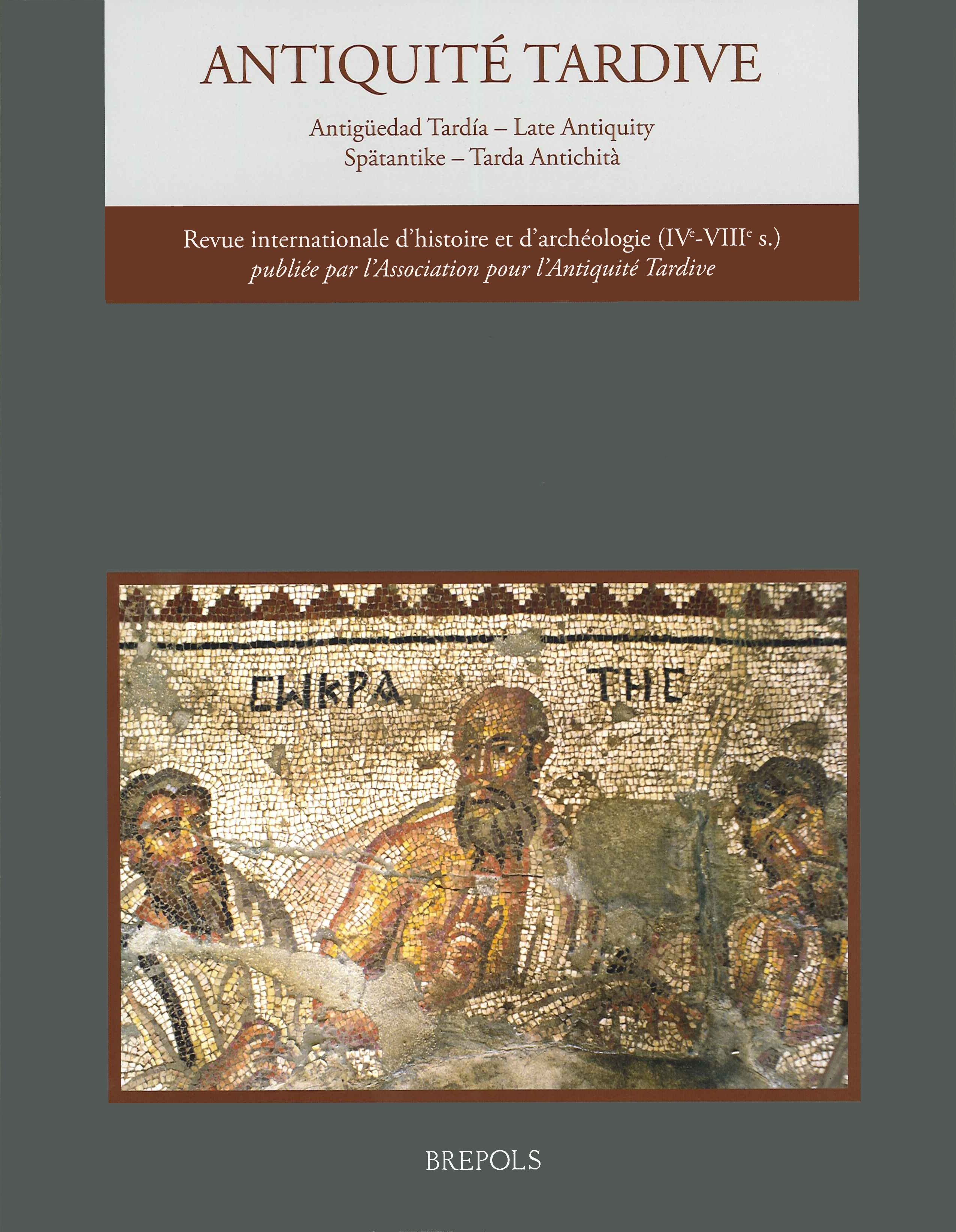
Volume 6, Issue 1, 1998
-
-
Note sur les relations de trois historiens des IVe et Ve siècles : Sulpicius Alexander, Renatus Profutus Frigeridus et Olympiodore
show More to view fulltext, buy and share links for:Note sur les relations de trois historiens des IVe et Ve siècles : Sulpicius Alexander, Renatus Profutus Frigeridus et Olympiodore show Less to hide fulltext, buy and share links for: Note sur les relations de trois historiens des IVe et Ve siècles : Sulpicius Alexander, Renatus Profutus Frigeridus et OlympiodoreAbstractIn the first part of this note, the author compares his point of view on Alexander and Frigeridus with G. Zecchini's. Their opinions differ on the following questions: the identification, classification, and localization of the historians' fragments ; the copiousness of their works ; and the periods of time they deal with, and especially the question of whether Alexander continues Ammianus Marcellinus and Frigeridus Alexander - a hypothesis that Zecchini excludes whereas the author thinks it likely. The second part of the note deals with the similarities one can perceive between Zosimus 6,4,1-5,2 and a fragment of Frigeridus. The author tries to show that Olympiodorus, Zosimus' source, owes his information to Frigeridus, especially for this passage. There are however in Olympiodorus-Zosimus passages with a pagan bias, which cannot come from the Christian Renatus Frigeridus. One has therefore to admit that Olympiodorus combined, for the year 408 and thereafter, a factual source (Frigeridus ?) with a source giving him an ideological framework.
-
-
-
Échos scientifiques de l'année ambrosienne ; G. Cantino Wataghin, Note di archeologia ambrosiana
show More to view fulltext, buy and share links for:Échos scientifiques de l'année ambrosienne ; G. Cantino Wataghin, Note di archeologia ambrosiana show Less to hide fulltext, buy and share links for: Échos scientifiques de l'année ambrosienne ; G. Cantino Wataghin, Note di archeologia ambrosianaBy: Jacques FontaineAbstractIt seems an opportune moment to pass on to the readers of Antiquite Tardive notice of the principal scientific celebration of the 16th centenary of Ambrose, and to add to it reviews of three important and recent works on the bishop of Milan. Appearing in English, Italian and French (to follow the chronological order of their publication), they offer by reason of their three points of view a portrait of the bishop multidimensional. Taken together, they also help us mark the distance travelled since the classic syntheses of Palanque and Paredi, and also since the Milan congress of 1974. One hopes that this short account will attract young "Ambrosians " for the 21st century. Our Milanese friends told us optimistically that they were expecting to see us at the 17th centenary of the Edict of Milan, in 2013.
-
-
-
Recherches sur la transition de Rome à Byzance dans la région du Bas-Danube
show More to view fulltext, buy and share links for:Recherches sur la transition de Rome à Byzance dans la région du Bas-Danube show Less to hide fulltext, buy and share links for: Recherches sur la transition de Rome à Byzance dans la région du Bas-DanubeBy: Andrew PoulterAbstractExtensive excavations carried out within the late Roman cites in the Balkans provide a substantial quantity of archaeological evidence which, suggests, as do epigraphic finds that most cities in the region were already in decline by the early 4th century. There were exceptions but, where cities do show signs of growth or prosperity, they appear to be only those which became centres of imperial administration and this does not prove any revival in the prosperity or civic functions by the urban Elite. Even so, this argument relies precariously on the attribution of functions to particular building types and generalisations based on often limited excavation and a sequence which invariably rests upon an insecure chronology. It is argued that it is more effective to develop regional programmes, involving the study of urban centres, based upon palaeoeconomic data, and to chart changes in the economic basis of urbanism form the Roman to early Byzantine periods. The results of the British excavations at Nicopolis ad Istrum in Bulgaria are used to illustrate the method. Here there would seem to have been a profound change in the agricultural economy during the early Byzantine period when the physical character and the function of the city changed no less dramatically: it became a strongly fortified military and ecclesiastical centre with apparently no civilian population permanently resident within its defences. Although the physical layout of an early Byzantine city was established for Nicopolis and work suggests that geophysical survey could produce similar results at such sites as Philippi, this brings us no nearer to providing an explanation for physical or economic changes. One possible solution is to extend the scope of research to the countryside and to apply new techniques of intensive survey which have proved successful in a pilot study in northern Greece at Louloudies, near the city of ancient Pydna. Now under way, a new research programme in northern Bulgaria is investigating village settlement and particularly the economic character of typesites (cf Gradishte) across a 2,0000 square kilometre region. The aim here is, by excavation and applying the intensive survey techniques (in combination with geophysics) developed in Greece, to ascertain whether the economic changes identified for the city were equally true of the countryside. It should be possible to determine whether the fate of early Byzantine Nicopolis was a product of economic changes in its hinterland or whether the character of urbanism was determined by factors unrelated to its regional context: an approach to the past which, in the future, should result in more fundamental advances in our understanding of Late antiquity than our present state of knowledge permits.
-
-
-
Le dossier du groupe épiscopal de Naples. État actuel des recherches
show More to view fulltext, buy and share links for:Le dossier du groupe épiscopal de Naples. État actuel des recherches show Less to hide fulltext, buy and share links for: Le dossier du groupe épiscopal de Naples. État actuel des recherchesAbstractIn 1996 we had requested for the dossier on double churches an up-to-date statement on the cathedral of Naples by J. Desmulliez, who was then preparing a thesis on Christian Campania. She here provides an account of research questions based both on locally published reports, notably those by R. Di Stefano and N. Ciavolino following recent excavations which have modified accepted theories, and on syntheses by R. Farioli andL. Pani Ermini, as presented in her thesis. The episcopal group consists of a Constantinian basilica mentioned in the Roman Liber Pontificalis and in Neopolitan tradition, but the Gesta of the bishops of Naples assigns it to a bishop of the 2nd half of the 4th century. It is the nucleus of the present cathedral at the south-west of the insula, dedicated to Sancta Restituta after the transfer of this saint's relics to Naples via Ischia. The S. Giovanni in Fonte baptistery is also attributed to Constantine in the saint's life but the Gesta notes it as a construction of Bishop Severus at the end of the 4th century or beginning of the 5th, which Soter {attested in 465) modified and restored. It is one of the oldest surviving baptisteries with a vault over a tambour, and it is decorated with famous mosaics, which pose problems of iconography and chronology, for one discerns differences in the decorative plan and in style: was one part by Soter, or did two different teams work at the same time ? A second church is due to Bishop Stephanus {attested between 495 and 502), who gave it his name (Stephania). It was believed to lie perpendicular to the first church, but the excavations have demonstrated that it was para llel. Late sources state that it was dedicated to the Saviour, but there also existed a basilica apostolorum, which some believe to be only a first phase of the future Stephania. It is necessary to add another 'minor' baptistery, as at Milan, which has been located and which was associated with an apsidal room with a synthronos: consignatorium or accubitum attributed to Bishop Vincentius actually mentioned in a votive inscription? The episcopal group thus displays the form of two churches with a baptistery between. Relying upon the traditional schema, the recent authors see in this an illustration of the ideal complex defined by Paulinus of Nola for Sulpicius Severus at Primuliacum, and they distinguish a room for catechumens and a congregational church. In any case, we are not concerned here with a single program from the beginning, and the traditional interpretation has been widely discussed in the section devoted to this theme in AnTard 4.
-
-
-
Nouvelle interprétation du complexe épiscopal "pré-euphrasien" de Poreč
show More to view fulltext, buy and share links for:Nouvelle interprétation du complexe épiscopal "pré-euphrasien" de Poreč show Less to hide fulltext, buy and share links for: Nouvelle interprétation du complexe épiscopal "pré-euphrasien" de PorečAuthors: Ivan Matejčić and Pascale ChevalierAbstractThe well known complex of Porec-Parenzo has witnessed a new phase of investigations since the start of works inside the bishop's palace and between the palace and the church (1994-8). The historical sequence of the multiple churches predating the Group (cathedral, atrium, baptistery) developed by Bishop Euphrasius about 550 (and still surviving) remains unclear. A. Šonje had assumed, to the north of the "pre-Euphrasian" south church, a cult-room, furnished with a free-standing presbyteral bench, which he considered as a martyrium. It has proved possible to determine that the re-excavated remains belonged rather to a church consisting of a nave with two aisles, each with a rectangular chevet and free-standing synthronos (bench), the classic form in the Northern Adriatic region and very close to the "pre-Euphrasian" south church. The episcopal group thus already formed a classic double church in the 5th century. It seems quite probable that this north church survived into the 6th century at a brief distance from the "Euphrasian" church and communicated with it through an intermediate room.
-
-
-
Les Basilicae pictae de Split: les fouilles de 1997
show More to view fulltext, buy and share links for:Les Basilicae pictae de Split: les fouilles de 1997 show Less to hide fulltext, buy and share links for: Les Basilicae pictae de Split: les fouilles de 1997Authors: Franko Oreb and Tajma RismondoAbstractThe research at the site known in the academic literature under the name "Ad Basilicas Pictas" which are associated the churches of St. Andrew and St. John (and sometimes also St. Bartholomew), began in the 1950s. The discoveries of that period had already provided very important information about the continuity of occupation and the construction of cult buildings on the site between the first century AD and the early middle ages. The excavations undertaken in 1997 by the Office of Conservation of the Historic Monuments of Split, allow three phases to be distinguished: 1) the first corresponds to a large classical building of rounded form, whose stratigraphy is still poorly known and which will require further research ; 2) the second phase is that of the early Christian double church : so far revealed are the northern half of the south church, the baptistery with a cruciform tank, the mosaic pavement of the north church in the north section of the excavation (over a length of 12 m), as well as sarcophagi (one with a cross in relief and the other with a curving lid), two of which contained finds, allowing this phase to be dated to the 5th-6th centuries ; 3) the third period, medieval in date, has yielded several artefacts and others are visible in the north section, overlaying the mosaic of the north church. It is still necessary to excavate and to analyse the remainder of the site on which was built the early Christian double church, above newly discovered stonework of the Roman building of rounded form, with the aim of confirming its precise plan, and ensuring its conservation and public presentation.
-
-
-
Épitaphe d'un soldat africain d'Héraclius servant dans une unité indigène, découverte à Constantinople
show More to view fulltext, buy and share links for:Épitaphe d'un soldat africain d'Héraclius servant dans une unité indigène, découverte à Constantinople show Less to hide fulltext, buy and share links for: Épitaphe d'un soldat africain d'Héraclius servant dans une unité indigène, découverte à ConstantinopleAbstractOne of the cruciform stelae of Constantinople recently published by H. Kalkan et S. Şahin bears an unusual epitaph, which is reedited here. Our revision of the text demonstrates that it mentions not one person, as the first editors believed, but two: the defunct, a soldier named Theodore, native of Mauretania, and his commander Zar, praefectus gentis of Zarakianoi in Tripolitania. The presence of a Tripolitanian tribal unit in Constantinople is linked to the final stage of Heraclius' revolt (October 610). This late attestation of an African praefectus gentis (not recognized by the editors) prompts a revision in an Appendix of the well known dedication from Altava (CIL VIII, 9835 etc.) which also features a tribal praefectus.
-
-
-
Bulletin Critique,Publications reçues par la revue,Notes for Contributors
show More to view fulltext, buy and share links for:Bulletin Critique,Publications reçues par la revue,Notes for Contributors show Less to hide fulltext, buy and share links for: Bulletin Critique,Publications reçues par la revue,Notes for Contributors
-
Volumes & issues
-
Volume 32 (2024)
-
Volume 31 (2023)
-
Volume 30 (2022)
-
Volume 29 (2021)
-
Volume 28 (2020)
-
Volume 27 (2019)
-
Volume 26 (2018)
-
Volume 25 (2017)
-
Volume 24 (2016)
-
Volume 23 (2015)
-
Volume 22 (2014)
-
Volume 21 (2013)
-
Volume 20 (2012)
-
Volume 19 (2011)
-
Volume 18 (2010)
-
Volume 17 (2009)
-
Volume 16 (2008)
-
Volume 15 (2007)
-
Volume 14 (2006)
-
Volume 13 (2005)
-
Volume 12 (2004)
-
Volume 11 (2003)
-
Volume 10 (2002)
-
Volume 9 (2001)
-
Volume 8 (2000)
-
Volume 7 (1999)
-
Volume 6 (1998)
-
Volume 5 (1997)
-
Volume 4 (1996)
-
Volume 3 (1995)
-
Volume 2 (1994)
-
Volume 1 (1993)
Most Read This Month
