


The Journal of Medieval Latin
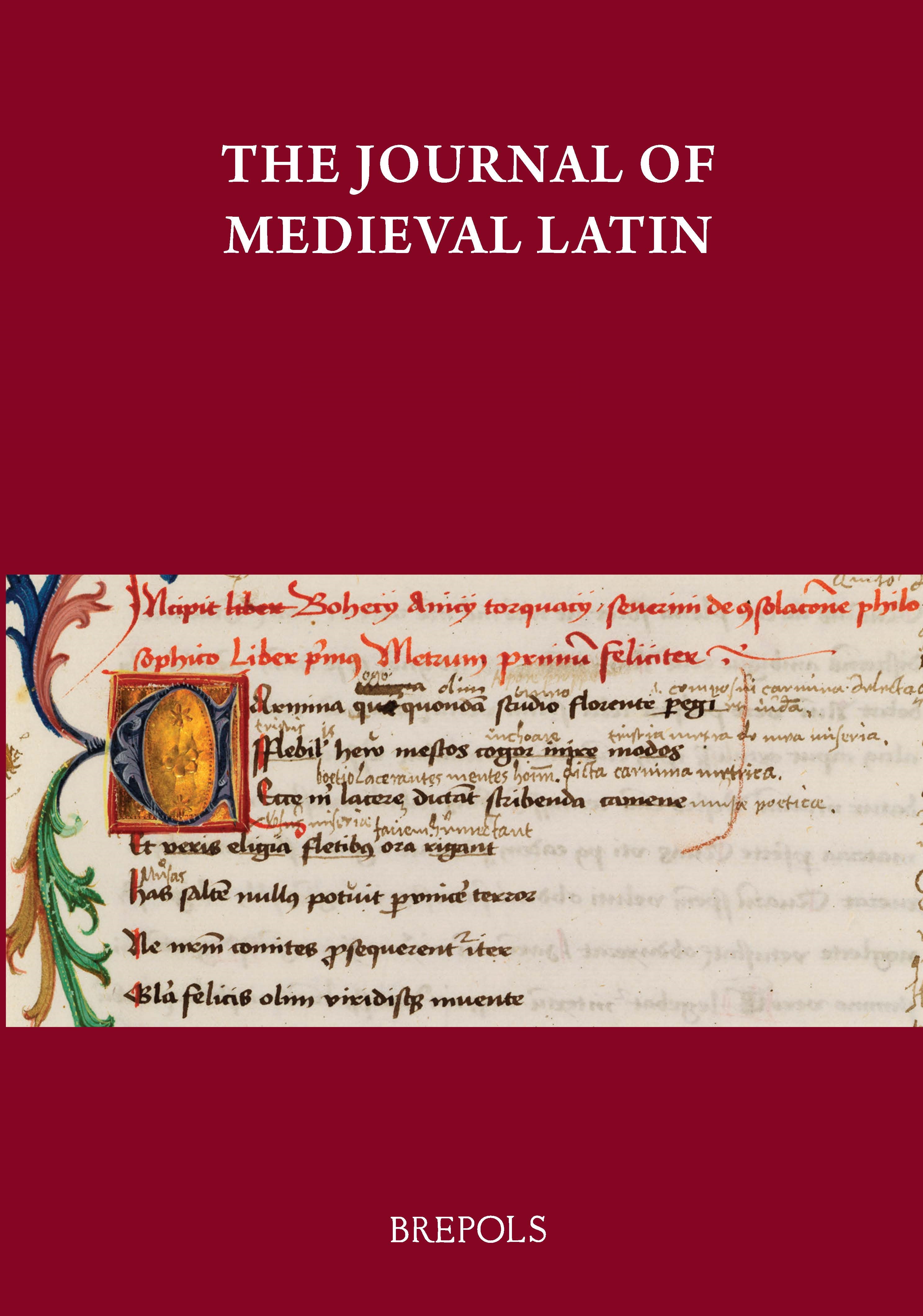
Volume 21, Issue 1, 2011
-
-
From Liber versuum to Poetria nova: The Evolution of Geoffrey of Vinsauf’s Masterpiece
show More to view fulltext, buy and share links for:From Liber versuum to Poetria nova: The Evolution of Geoffrey of Vinsauf’s Masterpiece show Less to hide fulltext, buy and share links for: From Liber versuum to Poetria nova: The Evolution of Geoffrey of Vinsauf’s MasterpieceBy: Martin CamargoAbstractGeoffrey of Vinsauf’s early thirteenth-century Poetria nova was the preeminent textbook on rhetorical composition in prose and verse for nearly three centuries. Before he created his masterpiece Geoffrey had taught for some twenty-five years and written two textbooks in prose. The popularity of the poem that Geoffrey wrote in response to King Richard Lionheart’s sudden death in 1199 seems to have instilled a new sense of his poetic powers that sparked a creative re-engagement with his pedagogy and its sources. The immediate result was an anthology of rhetorical poems, as suggested by references to it as a “book of verses” in the anonymous Tria sunt; but within a few years this had evolved into a concise and memorable textbook in hexameter verse that came to be regarded as the legitimate heir to Horace’s Ars poetica.
-
-
-
The Hispanic Vernacular Reception of William of Orléans’s Bursarii ovidianorum: The Translations of Ovid’s Heroides
show More to view fulltext, buy and share links for:The Hispanic Vernacular Reception of William of Orléans’s Bursarii ovidianorum: The Translations of Ovid’s Heroides show Less to hide fulltext, buy and share links for: The Hispanic Vernacular Reception of William of Orléans’s Bursarii ovidianorum: The Translations of Ovid’s HeroidesBy: Josep PujolAbstractMedieval translations of classical Latin texts into the vernacular, as well as being of interest in themselves, can also contribute to the study of the manuscript transmission of Latin commentaries on auctores. This article discusses two late-medieval Hispanic translations of Ovid’s Heroides (one into Catalan and the other into Castilian) as witnesses to the dissemination of William of Orleans’s Bursarii Ovidianorum in medieval Spain. A brief overview of the fifteenth-century Castilian translation, traditionally known as the Bursario, is followed by a detailed analysis of the introductions to the epistles in the fourteenth-century glossed Catalan translation. This analysis shows that the Catalan translation is very close to the text of manuscripts h and p of the Bursarii (Copenhagen, Kongelige Bibliotek, MS 2013 4°, and Paris, Bibliotheque nationale de France, MS lat. 7996) and offers an explanation for some of the particular features of these manuscripts.
-
-
-
Bede’s Homily on Benedict Biscop (Hom. i. 13)
show More to view fulltext, buy and share links for:Bede’s Homily on Benedict Biscop (Hom. i. 13) show Less to hide fulltext, buy and share links for: Bede’s Homily on Benedict Biscop (Hom. i. 13)AbstractThe article consists of a new translation of Bede’s important homily on the anniversary of the death of Benedict Biscop, founder of his monastery, footnoted to signal numerous changes from D. Hurst’s Corpus Christianorum text; discussion of the structure of the sermon, where it is argued that at least two versions have become entwined, leading to some incoherence; some remarks on the relationship between the homily and other sources of information on Biscop’s life; and a short appendix arguing against Hurst’s view of the manuscript tradition.
-
-
-
John of Garland’s Clauis Compendii: Notes and Explications
show More to view fulltext, buy and share links for:John of Garland’s Clauis Compendii: Notes and Explications show Less to hide fulltext, buy and share links for: John of Garland’s Clauis Compendii: Notes and ExplicationsBy: Gregory HaysAbstractThis article contains comments on a number of passages in John of Garland’s Clauis Compendii, primarily cases where the recent editio princeps by Elsa Marguin-Hamon can be improved or amended. Marguin-Hamon’s decision to privilege C (Cambridge, Gonville and Caius College 385/605) as a “manuscrit de base” is shown to be misguided; since the stemma is tripartite, the agreement of any two witnesses should give the reading of the archetype. Marguin-Hamon’s text can often be improved by repunctuation and closer attention to metre. Many problems in the work can be solved by comparison with parallel passages in other authors, including Isidore, Fulgentius, Priscian, Eberhard of Béthune, and “Macer,” as well as in John’s other works.
-
-
-
The Seventh-Century Hiberno-Latin Treatise Liber de ordine creaturarum. A Translation
show More to view fulltext, buy and share links for:The Seventh-Century Hiberno-Latin Treatise Liber de ordine creaturarum. A Translation show Less to hide fulltext, buy and share links for: The Seventh-Century Hiberno-Latin Treatise Liber de ordine creaturarum. A TranslationBy: Marina SmythAbstractThis article consists of both an introduction to, and a translation of the Liber de ordine creaturarum, an anonymous treatise written in Ireland in the second half of the seventh century. After summarizing the theological and cosmological content of the treatise, the introduction examines the date, the early manuscripts, the linguistic features and other elements in the text pointing towards an Irish environment. The reception of the Liber de ordine creaturarum is also traced: its influence was particularly strong in Anglo-Saxon England, but early Irish and Anglo-Saxon missionary activity and the mistaken attribution to Isidore of Seville ensured that the treatise spread throughout most of medieval Europe.
-
-
-
Alan of Lille, De planctu Naturae: The Fall of Nature and the Survival of Poetry
show More to view fulltext, buy and share links for:Alan of Lille, De planctu Naturae: The Fall of Nature and the Survival of Poetry show Less to hide fulltext, buy and share links for: Alan of Lille, De planctu Naturae: The Fall of Nature and the Survival of PoetryAbstractThe De planctu Naturae is neither a simple affirmation of the power of Natura nor a flat condemnation of human sin. The real interest of its narrative of Nature’s failure to control human conduct lies in its pairing of sexuality and language as a central concern. The most serious questions it raises have mainly to do with the purpose and value of poetry, in particular its ability to deal adequately with human desire. Nature’s one creative act is the generation of what amounts to a virtual new mythology around the figure of Cupido, and by implication a new, modern poetics. This is the poem’s legacy. The immediate influence of the De planctu was evidently shortlived, but the implications of Nature’s coming-to-terms with “fallen” human language were recognized a century later by Jean de Meun, who restages Nature’s complaint, and inaugurates a new, vernacular tradition.
-
-
-
Review Essay Claves and Clavigeri: Medieval Source Repertories in the Twenty-First Century
show More to view fulltext, buy and share links for:Review Essay Claves and Clavigeri: Medieval Source Repertories in the Twenty-First Century show Less to hide fulltext, buy and share links for: Review Essay Claves and Clavigeri: Medieval Source Repertories in the Twenty-First CenturyBy: J.R. Webb
-
-
-
Dieter Bitterli, Say What I Am Called: The Old English Riddles of the Exeter Book and the Anglo-Latin Riddle Tradition
show More to view fulltext, buy and share links for:Dieter Bitterli, Say What I Am Called: The Old English Riddles of the Exeter Book and the Anglo-Latin Riddle Tradition show Less to hide fulltext, buy and share links for: Dieter Bitterli, Say What I Am Called: The Old English Riddles of the Exeter Book and the Anglo-Latin Riddle TraditionBy: Robert Getz
-
-
-
Jean Grosfillier, Les séquences d’Adam de Saint-Victor: Étude littéraire (poétique et rhétorique), textes et traductions, commentaires
show More to view fulltext, buy and share links for:Jean Grosfillier, Les séquences d’Adam de Saint-Victor: Étude littéraire (poétique et rhétorique), textes et traductions, commentaires show Less to hide fulltext, buy and share links for: Jean Grosfillier, Les séquences d’Adam de Saint-Victor: Étude littéraire (poétique et rhétorique), textes et traductions, commentairesBy: Pascale Duhamel
-
-
-
Peter Hochgürtel, ed., Alexandri Neckam Suppletio Defectuum Carmina Minora
show More to view fulltext, buy and share links for:Peter Hochgürtel, ed., Alexandri Neckam Suppletio Defectuum Carmina Minora show Less to hide fulltext, buy and share links for: Peter Hochgürtel, ed., Alexandri Neckam Suppletio Defectuum Carmina MinoraBy: R.M. Thomson
-
-
-
Gunilla Iversen and Nicolas Bell, eds., Sapientia et Eloquentia: Meaning and Function in Liturgical Poetry, Music, Drama, and Biblical Commentary in the Middle Ages
show More to view fulltext, buy and share links for:Gunilla Iversen and Nicolas Bell, eds., Sapientia et Eloquentia: Meaning and Function in Liturgical Poetry, Music, Drama, and Biblical Commentary in the Middle Ages show Less to hide fulltext, buy and share links for: Gunilla Iversen and Nicolas Bell, eds., Sapientia et Eloquentia: Meaning and Function in Liturgical Poetry, Music, Drama, and Biblical Commentary in the Middle AgesBy: Kate Helsen
-
-
-
Jill Mann, From Aesop to Reynard: Beast Literature in Medieval Britain
show More to view fulltext, buy and share links for:Jill Mann, From Aesop to Reynard: Beast Literature in Medieval Britain show Less to hide fulltext, buy and share links for: Jill Mann, From Aesop to Reynard: Beast Literature in Medieval BritainBy: Andrew Galloway
-
-
-
F.A.C. Mantello and Joseph Goering, trans., The Letters of Robert Grosseteste, Bishop of Lincoln
show More to view fulltext, buy and share links for:F.A.C. Mantello and Joseph Goering, trans., The Letters of Robert Grosseteste, Bishop of Lincoln show Less to hide fulltext, buy and share links for: F.A.C. Mantello and Joseph Goering, trans., The Letters of Robert Grosseteste, Bishop of LincolnBy: Julian Haseldine
-
-
-
José Carlos Martín, with Carmen Cardelle De Hartmann and Jacques Elassi, Sources latines de L’Espagne tardo-antique et médiévale (Ve-XIVe siècles)
show More to view fulltext, buy and share links for:José Carlos Martín, with Carmen Cardelle De Hartmann and Jacques Elassi, Sources latines de L’Espagne tardo-antique et médiévale (Ve-XIVe siècles) show Less to hide fulltext, buy and share links for: José Carlos Martín, with Carmen Cardelle De Hartmann and Jacques Elassi, Sources latines de L’Espagne tardo-antique et médiévale (Ve-XIVe siècles)By: Lucy K. Pick
-
-
-
Joseph Pucci, Poems to Friends: Venantius Fortunatus. Translated, with Introduction and Commentary
show More to view fulltext, buy and share links for:Joseph Pucci, Poems to Friends: Venantius Fortunatus. Translated, with Introduction and Commentary show Less to hide fulltext, buy and share links for: Joseph Pucci, Poems to Friends: Venantius Fortunatus. Translated, with Introduction and CommentaryBy: Michael Dewar
-
-
-
Simon Tugwell OP, ed., Humberti de Romanis Legendae Sancti Dominici
show More to view fulltext, buy and share links for:Simon Tugwell OP, ed., Humberti de Romanis Legendae Sancti Dominici show Less to hide fulltext, buy and share links for: Simon Tugwell OP, ed., Humberti de Romanis Legendae Sancti DominiciBy: Andrew Romig
-
Volumes & issues
-
Volume 35 (2025)
-
Volume 34 (2024)
-
Volume 33 (2023)
-
Volume 32 (2022)
-
Volume 31 (2021)
-
Volume 30 (2020)
-
Volume 29 (2019)
-
Volume 28 (2018)
-
Volume 27 (2017)
-
Volume 26 (2016)
-
Volume 25 (2015)
-
Volume 24 (2014)
-
Volume 23 (2013)
-
Volume 22 (2012)
-
Volume 21 (2011)
-
Volume 20 (2010)
-
Volume 19 (2009)
-
Volume 18 (2008)
-
Volume 17 (2007)
-
Volume 16 (2006)
-
Volume 15 (2005)
-
Volume 14 (2004)
-
Volume 13 (2003)
-
Volume 12 (2002)
-
Volume 11 (2001)
-
Volume 10 (2000)
-
Volume 9 (1999)
-
Volume 8 (1998)
-
Volume 7 (1997)
-
Volume 6 (1996)
-
Volume 5 (1995)
-
Volume 4 (1994)
-
Volume 3 (1993)
-
Volume 2 (1992)
-
Volume 1 (1991)
Most Read This Month
