


Antiquité Tardive - Late Antiquity - Spätantike - Tarda Antichità
Revue Internationale d'Histoire et d'Archéologie (IVe-VIIIe siècle)
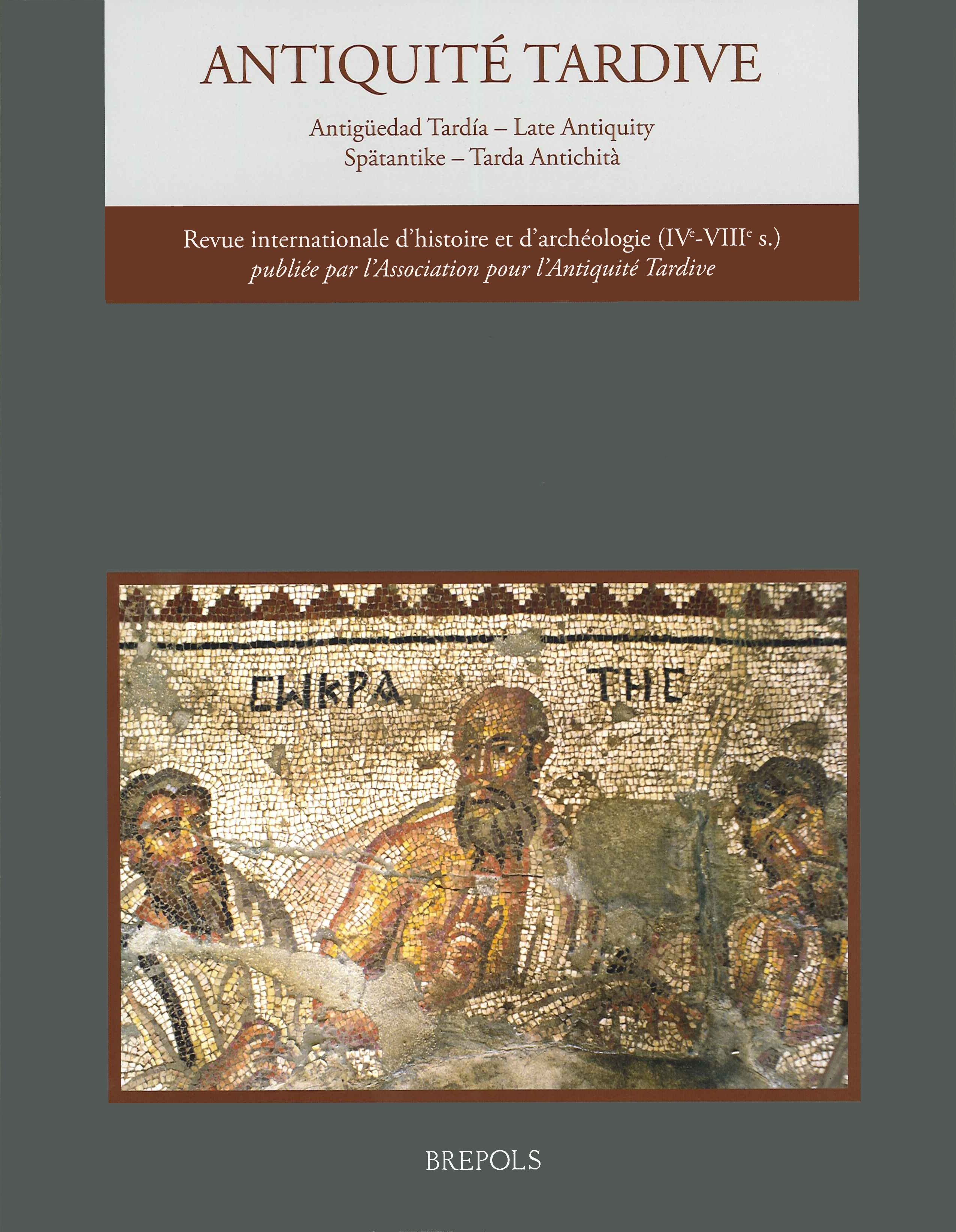
Volume 10, Issue 1, 2003
-
-
Front Matter (editorial information, title page, principales abbréviations, Table des matières, éditorial, in memoriam, bibliographie essentielle et abbréviations)
show More to view fulltext, buy and share links for:Front Matter (editorial information, title page, principales abbréviations, Table des matières, éditorial, in memoriam, bibliographie essentielle et abbréviations) show Less to hide fulltext, buy and share links for: Front Matter (editorial information, title page, principales abbréviations, Table des matières, éditorial, in memoriam, bibliographie essentielle et abbréviations)
-
-
-
Quelques aspects de l’administration des provinces romaines d’Afrique avant la conquête vandale
show More to view fulltext, buy and share links for:Quelques aspects de l’administration des provinces romaines d’Afrique avant la conquête vandale show Less to hide fulltext, buy and share links for: Quelques aspects de l’administration des provinces romaines d’Afrique avant la conquête vandaleBy: Claude LepelleyAbstract1. The Theodosian Code was compiled between 429 and 437. During these years the commissioners made much use of the archives in Africa, particularly those in Carthage when they were collecting those imperial constitutions which were retained in the new code. The fact that they were able to use these archives shows that in this region, which was not affected by the Vandals until 439, the records were well stocked and well maintained. 2. There is further evidence which shows that institutions were functioning normally: the Acts of the conference between the Catholics and Donatists at Carthage in 411, a passage from Salvian’s De Gubernatione Dei (probably informed about Africa by refugees he met in Marseilles), and testimony from Quodvultdeus, the exiled bishop of Carthage. 3. The Notitia Dignitatum, drawn up in 401, was partly revised for the West under Valentinian III. This document is not a theoretical organisational chart, and it provides evidence that in Africa a civil and military organisation was still complete and effective at the beginning of the 5th century. 4. It is recalled that there existed three distinct entities called Numidia: the province of this name (Numidia consularis); the western portion of Africa proconsularis, Numidia proconsularis‚ where the proconsul was represented by a legatus Numidiae; and lastly the ecclesiastical province of Numidia, which included both the civil province and the western part of Numidia proconsularis. 5. Two problems are examined: the complex question of the respective powers of the proconsul and the vicarius, and the problem of the location of the residence of the vicarius, who in 379 appears to have been forbidden to live in Africa proconsularis, even though certain offices of the vicariate still remained at Carthage. The vicarius appears to have returned subsequently to Carthage, but his tours of duty led him also to reside in other provincial metropoleis, particularly Cirta. 6. Regular functioning of the institutions is shown to have been disturbed by the corruption which was frequently denounced by the officials in charge. Certain of the letters of Augustine discovered by J. Divjak show that the phenomenon was aggravated on the eve of the Vandal conquest, probably linked to the disintegration of imperial authority which was a result of the invasions which were then rolling across Europe.
-
-
-
A book in progress
show More to view fulltext, buy and share links for:A book in progress show Less to hide fulltext, buy and share links for: A book in progressBy: Frank M. CloverAbstractDans les années 1970, quand j’étais au Département des Antiquités Grecques et Romaines du Louvre, l’huissier de la Conservation, un peu surpris, est venu m’annoncer qu’un jeune collègue américain demandait à me voir et qu’il portait un enfant sur le dos (dans cette sorte de porte-bébé dont l’usage n’était pas encore répandu en France). Depuis, le bébé a grandi et a fait une carrière internationale tout à fait originale, mais le père, à qui je rendis visite à mon tour, quelques années plus tard, dans son Université de Madison (Wisconsin) où il organisait la réunion annuelle des Byzantinistes américains et où il a pris récemment sa retraite, a continué à “tisser sa toile”, petit à petit, dans le domaine qu’il avait choisi : les relations du royaume vandale avec l’Empire Romain. Nous avons eu ensuite maintes fois l’occasion de dialoguer à ce sujet, oralement dans des réunions ou des colloques, ou par écrit dans des revues, notamment à propos des années régnales vandales et du culte monarchique subsistant dans le cadre du royaume. J’aurais voulu que l’auteur vienne poursuivre ce dialogue et, éventuellement, le clore à Tunis en 2000 ou à Paris en 2001. Des problèmes de santé ou d’organisation universitaire ont empêché ces déplacements, mais F. Clover nous a promis pour le numéro 11 une mise au point. En attendant, il m’a demandé de reproduire la note de présentation suivante et le plan de son livre dont il annonce l’impression en 2003/4, mais dont plusieurs chapitres ont paru sous des formes plus ou moins élaborées.
-
-
-
Los Vandalos in Hispania (409-429 a.D.)
show More to view fulltext, buy and share links for:Los Vandalos in Hispania (409-429 a.D.) show Less to hide fulltext, buy and share links for: Los Vandalos in Hispania (409-429 a.D.)By: Javier ArceAbstractThe article is an historical evaluation of the short period of the vandal presence in Spain during the first decades of the Vth century A.D. (409-429). Due to that chronological circunstance - the Vandals were phisically living in Baetica during 20 years - it is worthless to try to find any special evidence of their impact neither in the material culture or in the administrative or power structure of Roman Spain. Nevertheless the vandals showed, as Hydatius’ Chronicle attest, a strong military capacity organizing military raids to other terriories of the Peninsula (including the Baleric Islands) in order to take control of them. But suddenly, and without any explicit or clear reason (at least never mentioned in the ancient sources), they crossed to Africa in 429. The eventual reason for that surprising decision is discussed in the article in which I take into consideration the different interpretations given by the current scholarship.
-
-
-
L’établissement territorial des Vandales en Afrique
show More to view fulltext, buy and share links for:L’établissement territorial des Vandales en Afrique show Less to hide fulltext, buy and share links for: L’établissement territorial des Vandales en AfriqueBy: Yves ModéranAbstractSince L. Schmidt and C. Courtois, it has been generally understood that the territorial settlement of the Vandals in Africa started shortly after 439 when estates belonging to the Roman aristocracy and nobility were seized and redistributed to the warriors of Gaiseric. Over the last two decades, however, the theories of W. Goffart, developed by J. Durliat, have cast doubts over this model, with an increasing number of studies contesting the independence of the Vandal kingdom. In refutation of these theories, the present author first argues that Gaiseric and his successors, who were officially the “friends and allies of the Empire” and therefore treated as “client kings”, acted in practice like independent sovereigns, especially concerning the settlement of their people. Second, the author presents a collection of substantial texts that provide evidence (contrary to the thesis of Durliat) of the confiscation of properties, essentially in the province of Africa proconsularis. Most important, based on a study of religious persecution, he presents the scattering of the Vandalic families in the African countryside as the result of these confiscations. Finally, he offers an analysis of the complex methods employed by Justinian after 533 to recover or give back the territories, in favour of the State, of private individuals, or of the Church.
-
-
-
Quelques réflexions sur l’interprétation ethnique des sépultures habillées considérées comme vandales
show More to view fulltext, buy and share links for:Quelques réflexions sur l’interprétation ethnique des sépultures habillées considérées comme vandales show Less to hide fulltext, buy and share links for: Quelques réflexions sur l’interprétation ethnique des sépultures habillées considérées comme vandalesBy: Jörg KleemannAbstractAfter a critical evaluation of the research history and the analysis based on the findings from the north african graves of the fifth and early sixth century, we can conclude that by using the criteria of germanic dress accessories and germanic names on epitaphs, given earlier by G. G. Koenig, only eight graves with dress accessories and jewellery belong to the ethnical heterogeneous group of “Vandals”. Due to the almost exclusive use of gold within dress accessories and jewellery, we can therefore classify them as the burials of the upper class, which are either located in an urban church or in a suburban necropolis. These graves were restricted to the roman province of Proconsularis, the centre of Vandalic power. These graves, as far as it is possible to date them back precisely, all belong to the middle of the fifth century and present strong signs of romanisation. This indicates that, at least after two generations, the immigrated “Vandals” with the adopted roman funeral behaviour could not be distinguished from the indigenous people.
-
-
-
Habitus Vandalorum ? Zur Frage nach einer gruppen-spezifischen Kleidung der Vandalen in Nordafrika
show More to view fulltext, buy and share links for:Habitus Vandalorum ? Zur Frage nach einer gruppen-spezifischen Kleidung der Vandalen in Nordafrika show Less to hide fulltext, buy and share links for: Habitus Vandalorum ? Zur Frage nach einer gruppen-spezifischen Kleidung der Vandalen in NordafrikaAbstractIn his Historia persecutionis Africanae provinciae, Victor of Vita mentions Vandalic churchgoers in habitu barbaro. This raises the question whether there is archaeological proof of a specific attire of the North African Vandals. Unfortunately, the evidence does not substantiate the premise. This paper shows that neither finds from burials nor North African mosaics portrayal of hunters, both often quoted as evidence of Vandalic dress, help to identify a unique attire associated with the Vandals’ European roots. The mosaics and the burial finds rather show late antique and mediterranean characteristics. This excludes them as evidence of external features of ethnic Vandalic identity. If Victor’s history of the specific dress is not one of his numerous topoi, the lack of evidence may of course be due to the state of preservation of archaeological finds or the scarcity of contemporary illustrations. However, research should not be restricted to “alien” features. We know that in late antiquity dress indicated social status rather than ethnic identity. This is also what the burial offerings demonstrate. Moreover, research in other fields shows that the difference between “the Vandals” and “the Romans” was less than older scholars whose creed was based on a strong ethnic dualism between Romans and Germans, held possible. Hence, the idea of a distinctive national costume is no longer valid. We may therefore conclude that Victor’s habitus barbarus did not really have a “non Roman” or “barbarous” connotation. The paper will demonstrate that an attire which was very common in the Mediterranean, that of hunters and soldiers, could well be classified as barbarous on an ideological level. Thus, Victor could properly call habitus barbarus the garb and insignia of the servants of a hostile and barbarous royal court, even if the attire did not reflect older Germanic or Alanic ethnic traditions.
-
-
-
Les limites sud de la réoccupation byzantine
show More to view fulltext, buy and share links for:Les limites sud de la réoccupation byzantine show Less to hide fulltext, buy and share links for: Les limites sud de la réoccupation byzantineBy: Pol TroussetAbstractThe author re-examines the issue of the limits of the Byzantine reoccupation, specifically to the South of the Aures and the Nemencha, in the light of the new research in the fields of philology (Procopius’s lists in the De Aedificiis), archaeology and history. Despite the negative position originally taken by Diehl and maintained today by Pierre Morizot, it is possible now to identify most of the places fortified by Solomon in the Aures area – the majority of them traditional garrisons on the limes – and to prove with epigraphic and/or archaeological evidence that the Byzantines built a whole range of fortresses up to the Hodna. The Vandals maintained their authority in the area up to the reign of Gunthamund and it was therefore necessary for geo-strategic reasons to reoccupy it.
-
-
-
Zabi, Friki : notes sur la Maurétanie et la Numidie de Justinien
show More to view fulltext, buy and share links for:Zabi, Friki : notes sur la Maurétanie et la Numidie de Justinien show Less to hide fulltext, buy and share links for: Zabi, Friki : notes sur la Maurétanie et la Numidie de JustinienAbstractThis paper completes the list of Numidian fortifications recorded by Procopius and defines the limits of the Byzantine occupation towards the West in Mauretania Sitifensis. 1. The author provides a new edition of the lost inscription from the fortification of Zabè/Zabi (Durliat 24), based on a detailed drawing of the stone found in the papers of Renier at the Sorbonne. He then examines two other fortifications located to the North-West of Zabi, Tarmount (Aras) and Aïn Bessem. The examination leads him to question the extension of the “Numidia of Zabè” mentioned by Procopius and to offer the hypothesis of a quick retreat of the Byzantines towards the West of Mauretania Sitifensis, which has been proposed also by Yvette Duval from her reading of the list of Georges Cyprus. 2. He proposes the identification of the Frikè of Procopius with Qasr el Ifriki, an important site in East Numidia in the medieval itineraries (cf. Annex) with a fortification difficult to date. At the beginning of the Byzantine conquest, Frikè could have been the residence of the dux of Tigisi, later at Tigisi, mentioned in the famous inscription from Timgad.
-
-
-
La haute hiérarchie militaire en Afrique byzantine
show More to view fulltext, buy and share links for:La haute hiérarchie militaire en Afrique byzantine show Less to hide fulltext, buy and share links for: La haute hiérarchie militaire en Afrique byzantineAbstractNumerous fortresses preserved to this day attest to the effort invested by the Empire in defending the re-conquered African territories, but very little is known on the composition of the armed forces that carried out this task. The source data on the organisation and the commandment structure of Byzantine troops in Africa had been reviewed, more than twenty years ago, by Jean Durliat and by Denys Pringle, and, more recently, by John Martindale. The present study revisits a few issues that call for a further debate: the structural evolution of the upper echelon of the Byzantine commandment and the creation of the magister militum per Africam, the composition of the ducal forces, and the career of Peter, a dux of Numidia under Heraclius. It also presents a hitherto unnoticed evidence on Byzantine Tripolitania and its dux, Nersēh Kamsarakan, in the 650s contained in the Armenian Geography (Ašxarhac’oyc’) by Anania Širakac’i.
-
-
-
La céramique africaine aux époques vandale et byzantine
show More to view fulltext, buy and share links for:La céramique africaine aux époques vandale et byzantine show Less to hide fulltext, buy and share links for: La céramique africaine aux époques vandale et byzantineAuthors: N. Duval, A. Bourgeois, L. Slim, M. Bonnifay and J. PitonAbstractAfter a sketch of the evolution of the field by N. Duval (Avant-propos) and a description of the site of Neapolis by L. Slim, M. Bonifay and J. Piton (I), M. Bonifay attempts to date the last levels of occupation of Sidi Jdidi, Pupput and Neapolis with the ceramics (II). The abandoning of these sites is surely posterior to the last third of the 7th century: the African red slip ware, particularly Hayes 105, is abundant; lamps derived from Atlante X are frequent; and the amphora are mainly Late African types (Keay 61, 8A, 50, spatheia Keay 26) with a few of Byzantine type (Benghazi LRA 13). It is more difficult to decide if the sites were abandoned before the Arab occupation because of the continuity of the material from the 7th to the 8th century. A. Bourgeois offers some synthetic remarks on the African red slip ware of the Vandal period (III). Six tables provide a chronological inventory of the different forms of African red slip ware and red glaze (‘paleochristian’) lamps. The Vandal occupation did not put an end to the production of African red slip and the evolution of the forms does not seem to be influenced by the Vandals.
-
-
-
État des découvertes d’époque chrétienne des dix dernières années en Tunisie
show More to view fulltext, buy and share links for:État des découvertes d’époque chrétienne des dix dernières années en Tunisie show Less to hide fulltext, buy and share links for: État des découvertes d’époque chrétienne des dix dernières années en TunisieBy: Fathi BéjaouiAbstractFathi Bejaoui, director for archaeological research at the Institut National du Patrimoine in Tunis and specialist of Late Antiquity, reports here on the ten years of Christian archaeology in Tunisia since his similar report in 1986 for the XIth International Congress of Christian Archaeology (published in 1989). More than twenty short entries, illustrated with approximately forty photographs and accompanied by essential bibliography, give an idea of the numerous complete and partial excavations, which have enriched the list of rural churches (two new basilicas with opposing apses, one double church, and a great circular baptistery), and have provided several mosaics, pagan or Christian, some very late (a mosaic with mythological themes, the mark of a workshop, a stibadium mosaic). This report was completed during the colloquium from regional reports given by T. Ghalia and N. Ben Lazreg.
-
-
-
L’architecture religieuse en Tunisie aux Ve et VIe siècles
show More to view fulltext, buy and share links for:L’architecture religieuse en Tunisie aux Ve et VIe siècles show Less to hide fulltext, buy and share links for: L’architecture religieuse en Tunisie aux Ve et VIe sièclesBy: Taher GhaliaAbstractThe author, a specialist of Christian archaeology at the Institut National du Patrimoine in Tunis who has written a dissertation on the decoration of Christian churches, illustrates the evolution of the Christian basilica in Tunisia. He mentions several recently excavated or little-known churches: Hergla; Ad aquas near Hamman Lif, with a colonnaded apse like the church of the Mactar bath; Demna near Kelibia, where complementary excavations have been conducted; on the isle of Zembra to the North-West of Cap Bon; and at Bir Ftouha near Carthage and El Mahrine near Tebourba, two churches with deambulatory. He also attempts to link the architectural evolution – opposed-apses, the new orientation of churches in the Byzantine era, and double-churches – with the African liturgy. He concludes by recommending the study of the late topography of cities such as Mustis and the excavation of rural churches, in the areas, for example, of Sbeitla, Thelept and Kasserine.
-
-
-
La chronologie de la Maison des deux chasses à Kélibia
show More to view fulltext, buy and share links for:La chronologie de la Maison des deux chasses à Kélibia show Less to hide fulltext, buy and share links for: La chronologie de la Maison des deux chasses à KélibiaBy: M. EnnaïferAbstractThe author deals again with a house containing several layers of rich mosaics (including hunting scenes for which the house is named) that he presented to the 7th international colloquium on Grecoroman mosaics (Tunis 1994). The author returned to this large house and completed the excavations in order to discover its limits and access. With the help of several specialists, he attempts to define the absolute and relative chronologies of the house. Before the house, there was a salt fish factory with tanks for garum on the site. The house itself was constructed around the middle of the 5th century. Renovations were undertaken in the 6th century and the house was inhabited into the 7th century. This chronology allows the author to conclude that the Cap Bon area was prosperous in the Vandal period with a flourishing aristocracy still attracted by classical and mythological themes, a similar conclusion as has been drawn for Neapolis and Pupput in the same area.
-
-
-
L’inumazione in “spazio urbano” a Cartagine tra V e VII secolo d.C.
show More to view fulltext, buy and share links for:L’inumazione in “spazio urbano” a Cartagine tra V e VII secolo d.C. show Less to hide fulltext, buy and share links for: L’inumazione in “spazio urbano” a Cartagine tra V e VII secolo d.C.By: Anna LeoneAbstractStudies on intra-mural burials have been developed in the last ten years, focussing especially on Italy. The aim of this paper is to analyse the phenomenon in North Africa, particularly in Carthage, the capital of Africa Proconsularis during the Vandal and the Byzantine period. Study in this province has two main limitations: the first is that urban burials are already common at the end of the 4th century (earlier than in other parts of the Roman Empire) and the “urban” sectors are often difficult to define clearly; the second is due to the reliability of data, as much archaeological evidence was destroyed by excavations in the 19th-beginning of the 20th century. In spite of this Carthage is peculiar, because a large amount of information is available (even if not always securely dated). In considering the difficulty in defining the concept of “urban” especially in Late Antiquity, the analysis focuses more on what can be said to be “urban space”. Data are presented following a topographical order from north to south, after a short summary of the archaeological evidence from sites along the city wall. Analysis of burials seems to show that in the Vandal period the very few recorded tombs (always simple pits) were randomly located in completely abandoned sectors of the city. Later, in the early Byzantine period it seems possible to suggest a phase of re-organisation, with burials located all around churches, both inside and outside the city wall. Starting from the end of the 6th and the 7th century AD the situation seems to change and a larger number of burials in small groups are recorded, usually located in strict connection with the living and production areas. In the same period well organised cemeteries inside the city wall have also been excavated; as seen in the cemetery of the circus. The typology of well constructed graves (all stone cists) and in the case of the circus, the absence of reuse of decorated stone or marble fragments, seem to suggest the presence of a systematic and organised reuse of building material in that area. Finally it has to be pointed out that we have very few examples (and not surely dated) of graves belonging to the Early Arab period; which seems peculiar as we know that the city certainly survived and was inhabited after the Arab conquest. This anomaly is probably due to lack of knowledge, complicated possibly by similarity between late Byzantine and Islamic graves and maybe also by the waste of data resulting from old excavations.
-
-
-
Les recherches canadiennes dans le quartier de la “Rotonde de l’Odéon” à Carthage : un ensemble paléochrétien des IVe-Ve siècles ou une phase d’occupation et de construction du VIIIe siècle ?
show More to view fulltext, buy and share links for:Les recherches canadiennes dans le quartier de la “Rotonde de l’Odéon” à Carthage : un ensemble paléochrétien des IVe-Ve siècles ou une phase d’occupation et de construction du VIIIe siècle ? show Less to hide fulltext, buy and share links for: Les recherches canadiennes dans le quartier de la “Rotonde de l’Odéon” à Carthage : un ensemble paléochrétien des IVe-Ve siècles ou une phase d’occupation et de construction du VIIIe siècle ?Authors: Beaudoin Caron and Carl LavoieAbstractThis review deals with a new examination of the published data of the excavations west of the rotunda. These were carried out intermittently between 1976 and 2000 by Pierre Senay. He has steadfastly upheld the theory, once cautiously suggested by Alexandre Lézine, of the presence of a Christian basilica west of the rotunda and has identified the lot as a late Christian complex of the 4th century. The authors review the available data to study again the stratigraphy of the sector and conclude that a systematic filling was early on visible in the stratigraphy but not identified as such. This filling covers the area west of the rotunda all the way up to the cardo maximus and lies partly on top of a datable level, i. e. the geometric mosaic as well as a mysterious triconch-shaped structure, and is sealed by the substructure of a large mosaic, the “mosaïque aux oiseaux”. Within this systematic filling, very late Roman and a few Islamic sherds were recovered, as well as a coin dated to 759 A.D. (142 Heg). Senay has argued that the triconch is part of the basilica, but the stratigraphy does not substantiate this theory. The structures built within this filling, the “mosaïque aux oiseaux”, a basilica planned building and a basin, are therefore of Islamic date, and the mosaics associated with them are the first mosaics of Islamic date found in Carthage. This is proof that post-Byzantine Carthage was not merely a ruined city occupied by squatters, but that a civic life of some sort persisted there well into the Abbasid period. This survival of an antique urban way of life has already been noted elsewhere in North Africa.
-
-
-
Byrsa au Moyen-âge : de la “basilique Sainte-Marie” des rois vandales à la Mu’allaqa d’Al-Bakri
show More to view fulltext, buy and share links for:Byrsa au Moyen-âge : de la “basilique Sainte-Marie” des rois vandales à la Mu’allaqa d’Al-Bakri show Less to hide fulltext, buy and share links for: Byrsa au Moyen-âge : de la “basilique Sainte-Marie” des rois vandales à la Mu’allaqa d’Al-BakriAbstractThis paper proposes to identify the Mu’allaqa mentioned by Al-Bakri to Byrsa, the hill of Carthage, and the palace he describes there as a church dedicated to the Virgin Mary.
-
-
-
Two fortified sites in Byzantine Africa: Aïn Djelloula and Henchir Sguidan
show More to view fulltext, buy and share links for:Two fortified sites in Byzantine Africa: Aïn Djelloula and Henchir Sguidan show Less to hide fulltext, buy and share links for: Two fortified sites in Byzantine Africa: Aïn Djelloula and Henchir SguidanBy: Denys PringleAbstractDeux inscriptions latines retrouvées en 1975 respectivement parmi les ruines des fortifications byzantines d’Aïn Djelloula (Cululis) et d’Henchir Sguidan, en Tunisie, sont décrites et commentées. La première, comportant un poème de dix lignes d’hexamètres, datée du règne de Justinien, célèbre la construction des murs et la restauration de la cité par le préfet du prétoire Solomon et le tribun Nonnus entre les années 535 (ou 539) et 544, au moment même où elle fut rebaptisée au nom de l’impératrice Theodora. L’enceinte urbaine était irrégulière, mesurant 150 m sur 300 environ, et était renforcée par des tours rectangulaires. La pierre inscrite formait le linteau de la porte principale et était assez abondamment décorée. Les vers occupaient le champ épigraphique d’une tabula ansata flanquée d’une paire d’édicules composés d’éléments architecturaux, qui, vus ensemble, devaient représenter le fronton et l’abside d’une église. La seconde inscription date d’entre octobre 574 et août 578, pendant le règne de l’empereur Tibère II Constantin. Elle relate la construction d’un fort par le préfet Thomas et la collation à la cité, dont le nom primitif est inconnu, du nom d’Anastasiana, d’après l’impératrice Anastasia. Elle aussi a été inscrite sur le linteau de la porte qui donnait accès à l’intérieur du fort, une construction rectangulaire d’environ 53 m sur 45, pourvue de huit tours rectangulaires saillantes. La porte d’entrée occupait la tour centrale de la courtine ouest et avait une forme coudée ; elle est à rapprocher de la tour d’entrée, également coudée, du fort d’Aïn Tounga (Tignica), qui fut construit selon toute vraisemblance par le même préfet Thomas.
-
-
-
Un treno per Ravenna. Il contributo di Arnaldo Momigliano agli studi tardoantichi
show More to view fulltext, buy and share links for:Un treno per Ravenna. Il contributo di Arnaldo Momigliano agli studi tardoantichi show Less to hide fulltext, buy and share links for: Un treno per Ravenna. Il contributo di Arnaldo Momigliano agli studi tardoantichiBy: Arnaldo MarconeAbstractIn the years following World War II, Arnaldo Momigliano increasingly devoted his time to the study of Late Antiquity. Due to his characteristic talent for picking out the crucial points of a question, his contributions to the study of Late Antiquity are fundamental for the history of ideas, an area in which he often worked on lines parallel to those of Marrou. Among his pupils was Peter Brown, whose work Momigliano followed with particular interest.
-
Volumes & issues
-
Volume 32 (2024)
-
Volume 31 (2024)
-
Volume 30 (2022)
-
Volume 29 (2022)
-
Volume 28 (2021)
-
Volume 27 (2020)
-
Volume 26 (2019)
-
Volume 25 (2018)
-
Volume 24 (2017)
-
Volume 23 (2016)
-
Volume 22 (2015)
-
Volume 21 (2013)
-
Volume 20 (2013)
-
Volume 19 (2012)
-
Volume 18 (2011)
-
Volume 17 (2010)
-
Volume 16 (2009)
-
Volume 15 (2008)
-
Volume 14 (2007)
-
Volume 13 (2006)
-
Volume 12 (2005)
-
Volume 11 (2004)
-
Volume 10 (2003)
-
Volume 9 (2002)
-
Volume 8 (2001)
-
Volume 7 (2000)
-
Volume 6 (1999)
-
Volume 5 (1998)
-
Volume 4 (1997)
-
Volume 3 (1995)
-
Volume 2 (1994)
-
Volume 1 (1993)
Most Read This Month
