


Brepols
Brepols is an international academic publisher of works in the humanities, with a particular focus in history, archaeology, history of the arts, language and literature, and critical editions of source works.481 - 500 of 3194 results
-
-

Chanter par le Si en France au xvii e siècle
Pionniers et prémisses du solfège moderne
show More to view fulltext, buy and share links for:Chanter par le Si en France au xvii e siècle show Less to hide fulltext, buy and share links for: Chanter par le Si en France au xvii e siècleEn 1666, la « Methode facile pour apprendre à chanter la musique » (Paris, Ballard), est le premier ouvrage imprimé en France à recommander l'utilisation du Si. Cette septième syllabe de solmisation permet de s’affranchir du solfège ancien, des hexacordes et des muances. La gamme du Si, ou gamme française, s'impose comme une nouvelle norme, parallèlement à une actualisation du discours sur les échelles musicales, prélude à l’énonciation des principes de la tonalité.
Pourtant, depuis la fin du XVIe siècle, des solmisations heptacordales essaiment ailleurs, de l’Italie au Danemark. La France semble à rebours du reste de l’Europe : elle tarde à réagir à ce nouveau modèle et s’avère finalement être le seul pays où le Si est intégré durablement. Quel fut le cheminement de ces idées et pratiques ? Que disent-elles des représentations de l’espace sonore qui coexistent et s’anamorphosent au XVIIe siècle, isthme entre Humanisme et Lumières ? Ces questions serpentent dans la littérature depuis que Brossard, Montéclair ou Rousseau s’en sont emparés.
L’étude de sources essentiellement manuscrites permet aujourd’hui de préciser les jalons de cette histoire en France, de mettre en lumière des pionniers autant que des détracteurs du Si. Leurs témoignages sont issus de l'entourage scientifique de Mersenne, des sphères huguenotes et mauristes, des chapelles musicales parisiennes et finalement des méthodes destinées aux amateurs. C’est en questionnant ces pionniers, leurs écrits et les contextes dans lesquels ils ont évolué que ce pan de l’histoire du solfège est ici mis en perspective et, d’une certaine manière, humanisé.
-
-
-
Charisma and Religious Authority
Jewish, Christian, and Muslim Preaching, 1200-1500
show More to view fulltext, buy and share links for:Charisma and Religious Authority show Less to hide fulltext, buy and share links for: Charisma and Religious AuthorityThis volume of essays concentrates on the effects of preaching in late medieval and early modern Europe, particularly through the concept of charisma, a term introduced into the discussion of religion and politics by Max Weber. Used by Weber, the term indicates the power of a person to move others to action, to animate and mobilize them. The late medieval and early modern periods witnessed the emergence of preachers who became powerful public figures central to the mobilization of populations towards religious reform or crusades. Such preachers were also enmeshed in civic life and the life of courts. Super-preachers like Bernardino of Siena and John of Capestrano shaped opinion on a wide range of issues: the ethics of business, marriage and gender relations, attitudes towards minorities, the poor and social responsibility, as well as the role of kings and other rulers in society. Preaching events were the mass media of the day, and in their wake could follow pogrom, lay revival, crusade, peace movement, or reconciliation within a faction-riven city. The power of these events was great and not merely confined to the Christian community. This volume introduces for the first time a comparative dimension which looks at the theme of charisma and religious authority in the Jewish, Christian, and Muslim preaching traditions.
-
-
-
Charlemagne : les temps, les espaces, les hommes
Construction et déconstruction d’un règne
show More to view fulltext, buy and share links for:Charlemagne : les temps, les espaces, les hommes show Less to hide fulltext, buy and share links for: Charlemagne : les temps, les espaces, les hommesCe volume comprend les actes du colloque qui a eu lieu en 2014 à Paris à l’occasion du 1200e anniversaire de la mort de Charlemagne. Les articles ne commémorent pas en Charlemagne le père de l’Europe ni le fondateur d’empire, mais ils situent le demi-siècle de son gouvernement dans un jeu d’échelle spatial et temporel qui fait la part des traditions et des innovations et qui donne une meilleure place aux périphéries et aux laboratoires qu’elles ont pu constituer. Il s’agit de se départir autant que possible du travers historiographique qui consiste, en privilégiant toujours les mêmes sources, à attribuer à l’homme et au règne des initiatives et des réalisations qui participent de temporalités et d’expériences diverses et qui ne naissent pas toutes entre Loire et Rhin. Par une relecture et une déconstruction des sources les plus variées, le règne, la période et les acteurs sont reconsidérés dans toute leur complexité chronologique et spatiale.
-
-
-
Charles V, Prince Philip, and the Politics of Succession
Imperial Festivities in Mons and Hainault, 1549
show More to view fulltext, buy and share links for:Charles V, Prince Philip, and the Politics of Succession show Less to hide fulltext, buy and share links for: Charles V, Prince Philip, and the Politics of SuccessionThis book is based on an international conference held in the capital of Hainault to celebrate the city of Mons as European Capital of Culture (2015). For the first time, through a range of interdisciplinary studies, the magnificent festivals created to honour Prince Philip of Spain as he journeyed across Europe to receive his sovereignty of the Low Countries are brought to life. The splendour of entries in the cities of Northern Italy (such as Genoa and Milan) was challenged by the civic allegories of triumph displayed throughout the Low Countries in Ghent, Antwerp, and Amsterdam. Outpacing all that magnificence were the entertainments prepared by Mary of Hungary at Binche: triumphal arches, martial feats of arms, balls, masquerades, and castle-stormings entertained Emperor Charles V and his son Prince Philip.The essays in this volume reconstitute the political and social context of these extraordinary celebrations and focus on the purpose and role of festival in the changing political strategies of Charles V. They are illustrated with a total of 36 b&w and 36 colour images.Contributors: Sydney Anglo, Francesca Bortoletti, Stijn Bussels, Tobias Capwell, José Eloy Hortal Muñoz, Félix Labrador Arroyo, Margaret M. McGowan, R. L. M. Morris, Jessie Park, Yves Pauwels, M. J. Rodríguez-Salgado, Margaret Shewring, Hugo Soly, Lisa Wiersma.
-
-
-
Charters and the Use of the Written Word in Medieval Society
show More to view fulltext, buy and share links for:Charters and the Use of the Written Word in Medieval Society show Less to hide fulltext, buy and share links for: Charters and the Use of the Written Word in Medieval SocietyThere have been periods of growth and of decrease in the quantity of writing produced in the medieval centuries. The present volume is concerned with qualitative developments, asking: which developments can be distinguished in the roles played by writing in medieval societies? In which fields was writing used, and by whom? Why did these changes take place? When attempting to answer these questions, the scholar confronts basic questions about the sources at one’s disposal. Why were documents written? Why were they preserved and in what form? The volume pays especial attention to charters, since these documents have been continuously present throughout the Middle Ages. They also had an impact on most layers of society.
-
-
-
Chartes de l'abbaye de Remiremont, des origines à 1231
show More to view fulltext, buy and share links for:Chartes de l'abbaye de Remiremont, des origines à 1231 show Less to hide fulltext, buy and share links for: Chartes de l'abbaye de Remiremont, des origines à 1231L'abbaye de Remiremont, fondée vers 620, était une des plus grandes abbayes lotharingiennes, et aussi la principale institution religieuse féminine de Lorraine. Son recrutement dans la noblesse lui a perrnis d' établir des relations économiques et spirituelles avec toute l'aristocratie, jusqu'aux souverains, ainsi qu'en témoigne le célèbre Liber memorialis. Ses archives ont beaucoup souffert, de sorte que c'est dans un très grand nombre de dépôts d'archives et de bibliothèques qu'il faut chercher les originaux et des copies, très diverses d'ailleurs quant à leur date et leur forme.
La richesse de l' abbaye et ses importantes relations l' ont amenée à recevoir de nombreuses chartes, et à en concéder à plusieurs autres abbayes. C'est l' ensemble de ces actes, au nombre de 171 jusqu' en 1231, que Jean Bridot édite ici. Son travail reprend, complète et affine une première publication, assez confidentielle, qu'il avait donnée en 1980.
A côté du Liber memorialis édité par E. Hlawitschka, des documents nécrologiques réunis par M.-0. Boulard et d'un remarquable ensemble de notices de tradition dont la publication est préparée par Michel Parisse, ce recueil de chartes constitue le quatrième grand volet des sources romarimontaines médiévales.
-
-
-
Chaucer and the Discourse of German Philology
A History of Reception and an Annotated Bibliography of Studies, 1793-1948
show More to view fulltext, buy and share links for:Chaucer and the Discourse of German Philology show Less to hide fulltext, buy and share links for: Chaucer and the Discourse of German PhilologyIn the nineteenth and early twentieth century, German-speaking scholars played a decisive role in founding and shaping the study of medieval and early modern English language and culture. During this process, aesthetic and literary enthusiasms were gradually replaced, first by broadly comparative and then by increasingly narrow scientistic practices, all confusingly subsumed under the term 'philology'. Towards 1871, German and Austrian Anglicists were successful at imposing-- for about 30 years -- many of their philological discoursive practices on their English-speaking counterparts by focusing on strict textual criticism, chronology, historical linguistics, prosody, and literary history. After World War I, these philological practices were rejected in the U.K. and the United States because they were 'Made in Germany', but have remained essential features of German medieval scholarship until the present day.
This book offers a case study of these foundational developments by investigating the reception of Geoffrey Chaucer by eminent scholars such as V.A. Huber, W. Hertzberg, B. ten Brink, J. Zupitza, E. Fluegel, and J. Koch. The narrative of their nationalist, scientist, and self-fashioning efforts is complemented by a comprehensive annotated bibliography of German Chaucer criticism between 1793 and 1948.
-
-
-
Chemins de la pensée médiévale
Etudes offertes à Zénon Kaluza
show More to view fulltext, buy and share links for:Chemins de la pensée médiévale show Less to hide fulltext, buy and share links for: Chemins de la pensée médiévaleHistorien de la philosophie et de la théologie du Moyen Âge tardif, spécialiste des xiv e et xv e siècles, Zénon Kaluza a profondément marqué les études médiévales des dernières décennies. Ses travaux portent sur plusieurs grands thèmes de l’histoire doctrinale du Moyen Âge, notamment le «platonisme» parisien et pragois, les méthodes et les langages de la philosophie et de la théologie, les contextes institutionnels du savoir et, enfin, la question du rapport entre l’Église et l’État. Pour rendre hommage à l’homme et à son œuvre, ses collègues et amis lui offrent ce recueil d’articles. Réunies sous le titre de Chemins de la pensée médiévale, ces études explorent différents aspects de l’histoire de la philosophie et de la théologie ainsi que, dans une perspective plus large, de l’histoire intellectuelle et sociale du Moyen Âge. Par l’ampleur de son orientation thématique, le présent volume offre une excellente présentation de l’état actuel de la recherche sur la pensée médiévale.
-
-
-
Childhood Disability and Social Integration in the Middle Ages
Constructions of Impairments in Thirteenth- and Fourteenth-Century Canonization Processes
show More to view fulltext, buy and share links for:Childhood Disability and Social Integration in the Middle Ages show Less to hide fulltext, buy and share links for: Childhood Disability and Social Integration in the Middle AgesThis volume offers new insights into medieval disability studies by analysing miracle testimonies from canonization processes as sources for the study of medieval attitudes to and understanding of childhood physical impairments: how they were defined, and the social consequences of childhood disability on the family, on the community, and on children themselves.
In these texts, laypeople from different social groups carefully described events leading to children’s miraculous cures of physical impairments, as well as the conditions themselves. They thus provide an exceptionally rich (yet hitherto unexplored) window into the ways in which medieval society defined, explained, and understood children’s impairments.
Besides simply describing disabilities and miraculous cures, these testimonies also reveal various aspects of everyday experiences and communal attitudes towards impaired children. The few testimonies by the children themselves offer fascinating insights into personal experiences of physical disability and how disability affected a child’s socialization and the formation of identity.
This study thus aims to tease apart the often-complex ways in which medieval society both viewed physical differences and how it chose to (re)construct these differences in the discourse of the miraculous, as well as in everyday life.
-
-
-
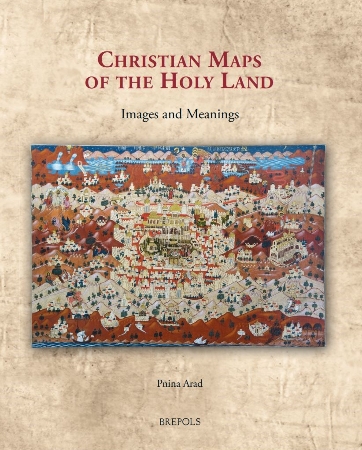
Christian Maps of the Holy Land
Images and Meanings
show More to view fulltext, buy and share links for:Christian Maps of the Holy Land show Less to hide fulltext, buy and share links for: Christian Maps of the Holy LandThis book offers a way of reading maps of the Holy Land as visual imagery with religious connotations. Through a corpus of representative examples created between the sixth and the nineteenth centuries, it studies the maps as iconic imagery of an iconic landscape and analyses their strategies to manifest the spiritual quality of the biblical topography, to support religious tenets, and to construct and preserve cultural memory.
Maps of the Holy Land have thus far been studied with methodologies such as cartography and historical geography, while the main question addressed was the reliability of the maps as cartographic documents. Through another perspective and using the methodology of visual studies, this book reveals that maps of the Holy Land constructed religious messages and were significant instruments through which different Christian cultures (Byzantine, Catholic, Protestant, and Greek Orthodox) shaped their religious identities. It does not seek to ascertain how the maps delivered geographical information, but rather how they utilized the geographical information in formulating religious and cultural values.
Through its examination of maps of the Holy Land, this book thus explores both Christian visual culture and Christian spirituality throughout the centuries.
-
-
-
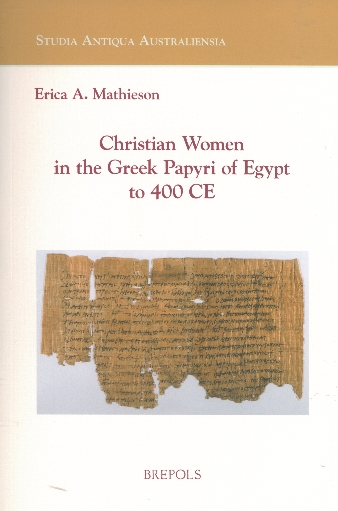
Christian Women in the Greek Papyri of Egypt to 400 CE
show More to view fulltext, buy and share links for:Christian Women in the Greek Papyri of Egypt to 400 CE show Less to hide fulltext, buy and share links for: Christian Women in the Greek Papyri of Egypt to 400 CEThe documentary papyri are an unparalleled source for the study of women in antiquity. Among them are numbers of female-authored texts which allow women’s voices to be heard. In the period to 400 CE twenty-six of these texts provide information on Christian women’s religious lives. This book analyses these papyri. They give insight into Christian women’s knowledge and use of biblical texts, their practice of prayer, their theological understanding of God, their lives and relationships. This book also examines texts written to Christian women or referring to Christian women among which are a valuable group referring to ascetic women. The perspectives of the papyri nuance what is known about women from other sources.
-
-
-
Christian readings of Aristotle from the Middle Ages to the Renaissance
show More to view fulltext, buy and share links for:Christian readings of Aristotle from the Middle Ages to the Renaissance show Less to hide fulltext, buy and share links for: Christian readings of Aristotle from the Middle Ages to the RenaissanceWidely recognized as one of the main characteristics of Latin Aristotelianism, the ‘Christianisation’ of Aristotle from the thirteenth to the seventeenth century has received as yet little attention. Aiming to answer the need for a more systematic investigation, the articles here collected approach Christian readings of the Stagirite’s works from different perspectives. Setting aside abstract discussions about ‘degrees of orthodoxy’, they address a few specific questions: which ‘images’ of Aristotle were offered by Medieval and Renaissance interpreters, and in particular how did some of them argue that — far from being a pagan or even an impious thinker — he did not contradict the truths revealed by Holy Scripture? Which strategies did they adopt to harmonize Aristotelian philosophy with Christian religion, or at least to avoid their clash? How did they conceive the task of expounding Aristotle’s thought? How did they understand and apply the distinctions, developed since the mid-thirteenth century, between the point of view of the philosophers and that of the believers, between what is true ‘speaking naturally’ and what is true ‘according to faith’? Were these distinctions — and other disclaimers or cautionary statements — effective in protecting masters that taught Aristotle’s texts from accusations of heresy? To what extent were ideas issuing from Christian theology integrated within the Peripatetic worldview, or even treated within Aristotelian commentaries?
Discussing these and related questions, the ten contributors to this volume examine relevant doctrines of outstanding thinkers – Roger Bacon (Chiara Crisciani), Siger of Brabant and Henry of Ghent (Pasquale Porro), Dante Alighieri (Gianfranco Fioravanti); offer a fine analysis of some commentaries on the Nicomachean Ethics (Iacopo Costa), the Politics (Stefano Simonetta) and the libri naturales (Amos Corbini); suggest innovative interpretations of the genesis of the Liber de bona fortuna (Valérie Cordonier) and of the condemnation of 1277 (Dragos Calma); inspect minor but significant figures of the Italian Renaissance such as Ludovico Beccadelli (Pietro Rossi) and Cesare Crivellati (Luca Bianchi).
-
-
-
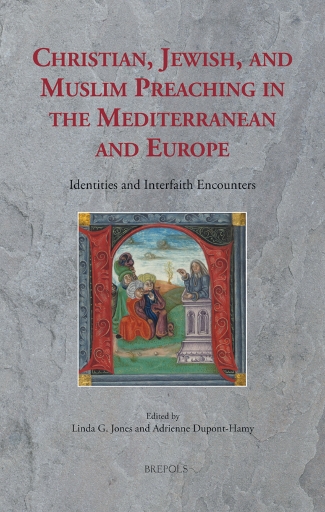
Christian, Jewish, and Muslim Preaching in the Mediterranean and Europe
Identities and Interfaith Encounters
show More to view fulltext, buy and share links for:Christian, Jewish, and Muslim Preaching in the Mediterranean and Europe show Less to hide fulltext, buy and share links for: Christian, Jewish, and Muslim Preaching in the Mediterranean and EuropeThis volume explores the sermons and activities of Christian, Jewish, and Muslim preachers who shaped ideas about religious and gendered identities and alterity throughout the Mediterranean and northern Europe. Preachers of all three traditions played a decisive role in defining the religious identities of their communities, often in response to negative images projected onto religious others. The studies cover a broad spectrum of premodern Europe and the Mediterranean and address the ways that preaching reflects transcultural contacts as well as social, intellectual, and hermeneutical encounters among diverse societies and religious communities.
The essays are divided into three themes. Part One, ‘Religious and Gendered Identities and Alterities,’ examines how religious identity is inflected by the presence or the ‘absent presence’ of religious others and interrogates how gender informs religious identity, piety, and alterity. The chapters in Part Two, ‘Hermeneutical Identities, Alterities, and Transcultural Relations in Christian and Jewish Preaching’, offer contrasting interpretations of the impact of anti-Judaism in Christian preaching and analyse Jewish responses to Christian polemic. Part Three, ‘Muslim and Christian Orators and Inter-faith Encounters,’ explores these encounters from the dual perspectives of Crusade and military conflict and interreligious dialogue, disputation, and proselytization. The volume positions itself at the intellectual crossroads between comparative medieval sermons studies and transcultural Mediterranean and European studies.
-
-
-
Christianisme des origines
Mélanges en l’honneur du Professeur Paul-Hubert Poirier
show More to view fulltext, buy and share links for:Christianisme des origines show Less to hide fulltext, buy and share links for: Christianisme des originesÀ l’occasion du départ à la retraite de Paul-Hubert Poirier de son poste de professeur en patrologie et en histoire de l’Église à la Faculté de théologie et de sciences religieuses de l’Université Laval, collègues, amis et anciens étudiants se sont réunis pour lui rendre hommage. Les vingt-sept contributions recueillies, qui s’illustrent par la variété des thèmes abordés et par leur grande qualité scientifique, témoignent de l’étendu des intérêts de Paul-Hubert Poirier pour les domaines touchant de près ou de loin le christianisme des premiers siècles, des quatre coins de la Méditerranée. Les articles rassemblés intéresseront tant les spécialistes de l’histoire et de la littérature des premiers siècles chrétiens, que ceux du christianisme syriaque, copto-égyptien et éthiopien, de la philosophie antique, du gnosticisme et du manichéisme.
-
-
-
Christianizing Peoples and Converting Individuals
show More to view fulltext, buy and share links for:Christianizing Peoples and Converting Individuals show Less to hide fulltext, buy and share links for: Christianizing Peoples and Converting IndividualsThe anniversary of Augustine’s arrival in Kent in 597, and the subsequent christianization of England, made conversion an obvious theme for the 1997 International Medieval Congress. It was also a theme which attracted massive interest, and not just from early medievalists interested in the christianization of England and its near-contemporary parallels. This volume presents reworkings of 28 of these contributions.
The Early Middle Ages are represented in a number of papers concerned with Central and Eastern Europe and as far east as Georgia. Interest in the Baltic region took this aspect of the christianization of Europe well into the fourteenth century. Papers on these regions constitute a good proportion of the present volume, and they provide a very useful point of entry into work currently being done on christinization in areas which are less well known to most historians than is Western Europe not least because of the range of languages involved.
With respect to later periods of the Middle Ages two issues predominated: one was the interface between Christians and Muslims in Spain and in the Holy Land and also between Christians and Jews once again in Spain, but also in England, and more generally in Western Europe. The other was the rather more theological question of the nature of conversion, as discussed by Aquinas, and in Franciscan writings. This wide-ranging volume concentrates on historical approaches to the topic. The different types of questions posed and materials used are a fascinating indication of the different interpretations to be found among specialists in different fields.
Christianization, as a process affecting complete peoples, or at least large groups, attracts attention, as does conversion of the individual. By putting these varying approaches together, this collection indicates the range of current work on christianization and conversion history and the range itself, quite apart from the individual studies, is an eye-opener.
-
-
-
Christians and Christianity in the Holy Land
From the Origins to the Latin Kingdoms
show More to view fulltext, buy and share links for:Christians and Christianity in the Holy Land show Less to hide fulltext, buy and share links for: Christians and Christianity in the Holy LandThis volume fills a major desideratum in historical scholarship on the religious history of the Holy Land. It presents a synthesis of our knowledge of the history of Christianity and the various churches that coexisted there from the beginnings of Christianity to the fall of the Crusader Kingdoms. It also offers analytical studies of major topics and problems. While the first part is organized chronologically, the second follows a thematic plan, dealing with the major themes pertaining to the topic, from various points of view and covering several disciplinary fields: history, theology, archaeology, and art history. The volume represents the outcome of an international project initiated by Yad Izhak Ben-Zvi of Jerusalem, and the contributors are leading experts in their fields.
-
-
-
Chromatius of Aquileia and His Age
show More to view fulltext, buy and share links for:Chromatius of Aquileia and His Age show Less to hide fulltext, buy and share links for: Chromatius of Aquileia and His AgeThis volume presents the proceedings of the International Congress Chromatius of Aquileia and His Age which took place at Aquileia (Italy) from 22 to 24 May 2008 under the direction of Pier Franco Beatrice (University of Padova) and Alessio Peršič (Università Cattolica del Sacro Cuore, Milan) and was fostered by the National Commitee for the Sixteenth Centenary of the Death of Saint Chromatius Bishop of Aquileia headed by Dr. Mons. Duilio Corgnali, in common accord with the Dioceses of the Autonomous Region of Friuli Venezia Giulia and the adjacent Slovenian and Austrian Dioceses of Ljubljiana, Koper / Capodistria, and Gurk-Klagenfurt.
The Congress was part of a vast range of celebratory activites inspired by the desire to create a renewed Christian historical awareness of both the significance of Aquileia and its Fathers and of the strong vitality of evangelical spirituality directed at creating a synthesis between East and West, between Greco-Roman civilization, the revealed Hebrew epos, and the disruptive diversity of the new invading peoples. The Christian communities are heirs to the long tradition of the Patriarcate of Aquileia which lasted for over a thousand years and it was the passionate interest in their Christian origins which prompted the Congress. The Aquileian metropolis—patriarcal see until the eighteenth century and a crossroads where Romans and Illyrians, Germanic peoples and Slavs all met—was a cradle of monasticism and home to some of its greatest masters (Martin, Chromatius, Rufinus, and Jerome). These scholars have proven to be the beneficiaries of earlier exegetic skills (Victorinus, Fortunatianus) as well as intrepid and creative mediators of the highest and most controversial expressions of Greek spiritual and theological culture in the Roman world and of the rediscovered veritas hebraica of Old Testament sources. Lastly, Paulus Diaconus and the Patriarch Paulinus II distinguished themselves as inspiration for a modern European identity after its slow Christian and barbarian palingenesis.
The Congress brought together scholars from Europe and America who are experts on the work of Chromatius—only recently saved from the near obscurity into which it had fallen in manuscript tradition—for the purpose of providing original contributions on an international level to Aquileian literary historiography, Chromatius in particular, not always taken into account and given due merit.
-
-
-
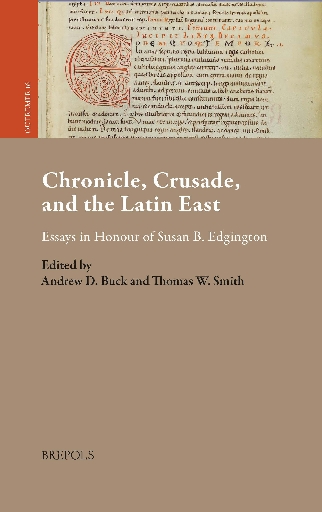
Chronicle, Crusade, and the Latin East
Essays in Honour of Susan B. Edgington
show More to view fulltext, buy and share links for:Chronicle, Crusade, and the Latin East show Less to hide fulltext, buy and share links for: Chronicle, Crusade, and the Latin EastChronicle, Crusade, and the Latin East offers a collection of essays exploring three closely connected thematic areas: the narrative traditions surrounding the early crusading movement, the influence of these textual traditions on wider processes of medieval historical writing and storytelling, and the history of crusading and the Latin East.
In recent years, the field of crusade studies has witnessed a significant groundswell of scholarly work, with particular emphasis on the narrative construction of crusading deeds in text and song, of the important role played by memory and memorialisation in transmitting crusading tales and promoting participation, and the nature of life in the Latin states of the East. This volume not only engages with, and offer fresh insights into, these topics, but also serves as a monument to the career of Susan B. Edgington, who has done so much to increase modern understanding of crusade narratives and the crusading past, and who has made a significant impact on the careers of many scholars. The collection of essays gathered here by established and early career historians, Edgington’s friends and students, thus furthers the study of both crusading as narrative and crusading as a lived experience.
-
-
-
Chronique d’Égypte
show More to view fulltext, buy and share links for:Chronique d’Égypte show Less to hide fulltext, buy and share links for: Chronique d’ÉgypteThe Chronique d’Égypte has been published annually every year since 1925 by the Association Égyptologique Reine Élisabeth (formerly the Fondation Égyptologique Reine Élisabeth) sponsored by the Ministry of Education and the Fondation Universitaire de Belgique. Originally published as a newsletter, it quickly evolved into an international scientific journal containing articles on various aspects of Egyptology, papyrology and coptology (including philology, history, archaeology, and history of art) as well as critical reviews of recently published books. The articles are written by experts of various nationalities.
More information about this journal on Brepols.net
-
-
-
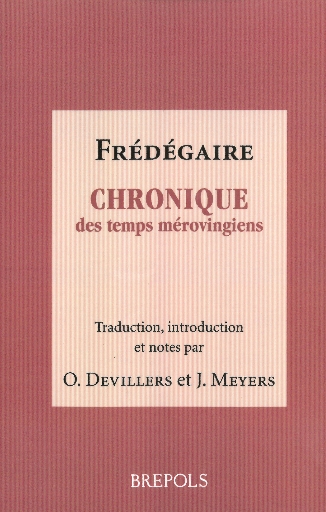
Chronique des temps mérovingiens (Livre IV et Continuations)
Texte latin selon l'édition de J.M. Wallace-Hadrill. Traduction, introduction et notes par O. Devillers et J. Meyers
show More to view fulltext, buy and share links for:Chronique des temps mérovingiens (Livre IV et Continuations) show Less to hide fulltext, buy and share links for: Chronique des temps mérovingiens (Livre IV et Continuations)La chronique de l'auteur connu sous le nom de Frédégaire est une source essentielle pour la connaissance des règnes mérovingiens. Le chroniqueur a pourtant été longtemps méprisé : sa langue était considérée comme barbare, et ses qualités d'historien étaient jugées de piètre valeur. Les recherches récentes ayant renouvelé l'étude de cette période, on a voulu tirer de l'oubli un auteur trop longtemps mal compris. Le lecteur trouvera donc ici, accompagnée du texte latin (selon l'édition de J.M. Wallace-Hadrill) et d'une abondante annotation, la traduction de la partie originale de la chronique et de ses continuations carolingiennes, qui poursuivent le récit jusqu'en 768. Une introduction substantielle défend l'hypothèse d'un chroniqueur unique écrivant vers 660, situe la chronique dans son contexte historique et l'appréhende à la fois comme une œuvre d'histoire et de littérature. Une étude spéciale est consacrée à la langue de l'auteur, témoin des mutations que connaît le latin au milieu du VIIe siècle. Olivier Devillers est un spécialiste d'historiographie romaine et Jean Meyers de langue et de littérature latines du Haut Moyen Âge. L'un et l'autre enseignent à l'Université Paul Valéry (Montpellier III).
-