


Brepols
Brepols is an international academic publisher of works in the humanities, with a particular focus in history, archaeology, history of the arts, language and literature, and critical editions of source works.501 - 520 of 3194 results
-
-
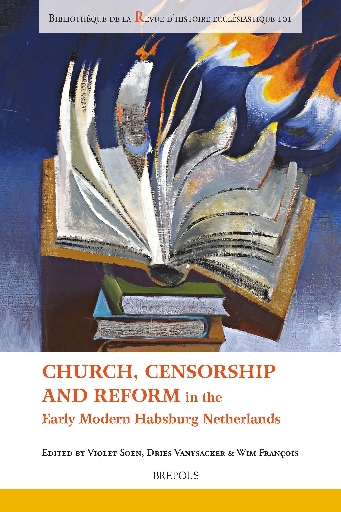
Church, Censorship and Reform in the Early Modern Habsburg Netherlands
show More to view fulltext, buy and share links for:Church, Censorship and Reform in the Early Modern Habsburg Netherlands show Less to hide fulltext, buy and share links for: Church, Censorship and Reform in the Early Modern Habsburg NetherlandsIn recent years, historiography has come to rethink the traditional account of a state-backed Counter-Reformation in the early modern Habsburg Netherlands. Hence, this volume takes a refreshing perspective on the themes of church and reform in this region from the late fifteenth century onwards. The first part interrogates the dynamics of repression and censorship in matters of religion. Six chapters underline that this censorship was not only state- or church-driven, but performed by a multitude of actors, ranging from professional organisations to university theologians. Throughout the Ancient Regime, this resulted in an institutionally and regionally fragmented policy, opening margins of manoeuver for those concerned. A second part focuses on more internal impulses for Catholic Reform in the sixteenth century, especially those created by the Council of Trent. As such, this volume helps to contextualise the Counter-Reformation of the seventeenth century in a long-term perspective, identifying the myriad of actors and motives behind this Catholic revival.
-
-
-
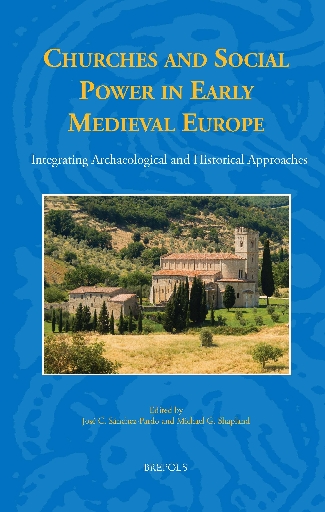
Churches and Social Power in Early Medieval Europe
Integrating Archaeological and Historical Approaches
show More to view fulltext, buy and share links for:Churches and Social Power in Early Medieval Europe show Less to hide fulltext, buy and share links for: Churches and Social Power in Early Medieval EuropeLocal churches were an established part of many towns and villages across early medieval Western Europe, and their continued presence make them an invaluable marker for comparing different societies. Up to now, however, the dynamics of power behind church building and the importance of their presence within the landscape have largely been neglected.
This book takes a comparative and interdisciplinary approach to the study of early medieval churches, drawing together archaeology, history, architecture, and landscape studies in order to explore the relationship between church foundation, social power, and political organization across Europe. Key subjects addressed here include the role played by local elites and the importance of the church in buttressing authority, as well as the connections between archaeology and ideology, and the importance of individual church buildings in their broader landscape contexts.
Bringing together case-studies from diverse regions across Western Europe (Italy, Spain, Portugal, Germany, France, the British Isles, Denmark, and Iceland), the seventeen contributions to this volume offer new insights into the relationships between church foundations, social power, and political organization. In doing so, they provide a means to better understand social power in the landscape of early medieval Europe.
-
-
-

Cinismo e Cristianesimo delle origini
show More to view fulltext, buy and share links for:Cinismo e Cristianesimo delle origini show Less to hide fulltext, buy and share links for: Cinismo e Cristianesimo delle originiGesù era Cinico? I suoi discepoli? E Paolo? Queste domande, che rientrano nel più generale tema della possibile influenza del Cinismo sul Cristianesimo delle origini, costituiscono un importante capitolo storiografico, nato in Germania nel primo Novecento e ampiamente sviluppatosi più tardi soprattutto negli Stati Uniti d’America.
A questi problemi è dedicato il presente volume, che, partendo da un’analisi sempre attenta alle evidenze testuali, intende vagliare, da una prospettiva storico-filosofica, la possibilità che Gesù e il Cristianesimo delle origini siano stati influenzati dal Cinismo, e da tale tradizione filosofica abbiano ricevuto sollecitazioni o stimoli. Lo studio è rivolto a testi quali i Vangeli Sinottici e le Lettere Paoline (nello specifico, la Prima Lettera ai Corinzi), in cui i fautori della Cynic Jesus Hypothesis hanno ritenuto di poter rinvenire elementi definibili come ‘cinici’.
Tale analisi si presta in maniera singolare a gettare luce non solo su autori importanti e temi della tradizione cinica particolarmente discussi, ma anche sui rapporti tra la tradizione ellenica e le origini del Cristianesimo.
Tema, quest’ultimo, di interesse non solamente storico-filosofico e teologico ma anche schiettamente teoretico, perché tocca la questione, viva e dibattuta ancora oggi, seppure talvolta sotto forme diverse, delle relazioni tra la riflessione filosofica e il credo religioso, tra fides e ratio.
-
-
-
Cinq parcours de recherche en sciences religieuses
show More to view fulltext, buy and share links for:Cinq parcours de recherche en sciences religieuses show Less to hide fulltext, buy and share links for: Cinq parcours de recherche en sciences religieusesÀl'heure de leur départ à la retraite, cinq directeurs d'études de la section des Sciences religieuses de l'EPHE ont choisi de rendre hommage à l'École : Odile Journet-Diallo, ethnologue africaniste, Christiane Zivie-Coche, égyptologue, Jean-Daniel Dubois, historien des gnostiques et des manichéens, Cristina Scherrer-Schaub, indianiste, et Jean-Paul Willaime, sociologue du protestantisme.
Chacun à sa manière retrace son parcours et ses préoccupations en soulignant, à l'occasion du 150e anniversaire de la création de l'EPHE, combien cette institution universitaire est originale et riche d'enseignements.
-
-
-
Cinquante années d’études médiévales. À la confluence de nos disciplines
Actes du Colloque organisé à l’occasion du cinquantenaire du CESCM, Poitiers, 1-4 septembre 2003
show More to view fulltext, buy and share links for:Cinquante années d’études médiévales. À la confluence de nos disciplines show Less to hide fulltext, buy and share links for: Cinquante années d’études médiévales. À la confluence de nos disciplinesEn 2003, le Centre d’Études supérieures de Civilisation médiévale de Poitiers a célébré ses cinquante années d’existence par la tenue d’une série de manifestations scientifiques et culturelles dont un grand colloque international au titre évocateur, retenu pour la présente publication: Cinquante années d’études médiévales. À la confluence de nos disciplines.
Les Actes de ce colloque, qui a reflété la place prééminente du CESCM au sein des études médiévales internationales ainsi que la diversité et la richesse du travail interdisciplinaire produit par les équipes de recherche et les services documentaires du Centre, constituent donc un ouvrage de référence non seulement pour les domaines abordés mais aussi pour la médiévistique en général.
-
-
-
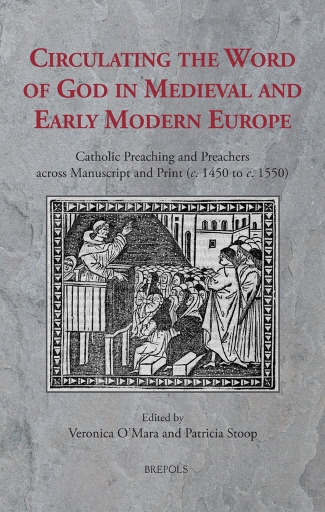
Circulating the Word of God in Medieval and Early Modern Europe
Catholic Preaching and Preachers across Manuscript and Print (c. 1450 to c. 1550)
show More to view fulltext, buy and share links for:Circulating the Word of God in Medieval and Early Modern Europe show Less to hide fulltext, buy and share links for: Circulating the Word of God in Medieval and Early Modern EuropeThis volume concentrates on how the sermon, a pivotal element in mass communication, aimed to shape the people of Europe. Rather than setting up the usual binary divides, it highlights the linguistic complications, the textual inter-relationships, the confessional cross-currents, and the variations between public and private sermon dissemination operating at different rates and with variable results throughout Europe. Effectively the emphasis here is on how Catholic preachers and Catholic preaching carried on in the period between the handwritten and the printed sermon, a time when not only the mode of production was changing but when the very purpose and meaning of preaching itself would soon alter in a western Christian world that was becoming no longer completely Catholic. By examining case-studies chosen from countries with contrasting manuscript and printing traditions (Denmark, England, Finland, France, Germany, Italy, the Low Countries, Romania, Spain, and Sweden), we aim to examine some of the main historical, literary, and theological factors in the development of the sermon in Latin and the vernaculars, which is itself in the process of changing formats, and sometimes languages, at a time of religious ferment from the advent of print to the death of Martin Luther. These essays, which are effectively in dialogue with each other, are divided into geographical/linguistic sections organized along broadly chronological lines. They circulate from the peripheries of Europe to the centre, moving from areas where evidence is now scarce to situations of thriving production.
-
-
-
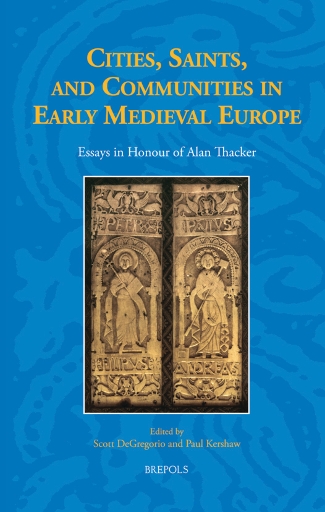
Cities, Saints, and Communities in Early Medieval Europe
Essays in Honour of Alan Thacker
show More to view fulltext, buy and share links for:Cities, Saints, and Communities in Early Medieval Europe show Less to hide fulltext, buy and share links for: Cities, Saints, and Communities in Early Medieval EuropeThis book honours the scholarship of English historian Dr. Alan Thacker by exploring the insular, the European and, more broadly, the Mediterranean connections and contexts of the history and culture of Anglo-Saxon England in the age of Bede, and beyond. It brings together original contributions by leading European and North American scholars of Late Antiquity and the early Middle Ages working across a range of disciplines: history, theology, epigraphy, and art history. Moving from the Irish Sea to the Bosporus, this collection presents a linked world in which saints, scholars, and the city of Rome all played powerful connective roles, creating communities, generating relationships, linking east to west, north to south, and present to past.
As in Thacker’s own work, Bede’s life and thought is a central presence. Bede’s attitudes to historical and contemporaneous conceptions of heresy, to the Irish church, and the evidence for his often complex relationships with his Northumbrian contemporaries all come under scrutiny, together with groundbreaking studies of his exegesis, christology, and historical method. Many of the contributions offer original insights into figures and phenomena that have been the focus of Dr. Thacker’s highly influential scholarship.
-
-
-
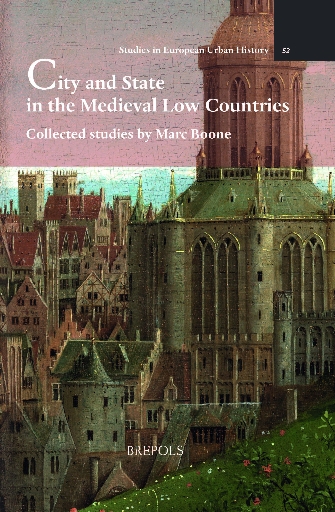
City and State in the Medieval Low Countries
Collected studies by Marc Boone
show More to view fulltext, buy and share links for:City and State in the Medieval Low Countries show Less to hide fulltext, buy and share links for: City and State in the Medieval Low CountriesThe oeuvre of Marc Boone (Ghent, 1955) has become standard reading for specialists of medieval European towns and cities, as well as for those interested in the history of state building - most notably that of the Burgundian polity. Honoring Ghent University’s venerable tradition of medieval studies begun by Henri Pirenne and building upon the work of his Doktorvater Walter Prevenier, Marc Boone also investigated taxation and the history of government spending, popular protest, and the persecution of “deviant” sexuality. Over the course of his rich career, he served as president of the European Association of Urban History and as dean of the Faculty of Arts and Philosophy of Ghent University. For more than twenty years, he taught the introductory course on historical criticism to every first-year student of the faculty, and thus had a major impact on the pensée critique of generations of young minds. Upon the occasion of his retirement in 2021, his former students have compiled this collection of some of his best historical essays, half of which have been translated from French and Dutch into English.
-
-
-
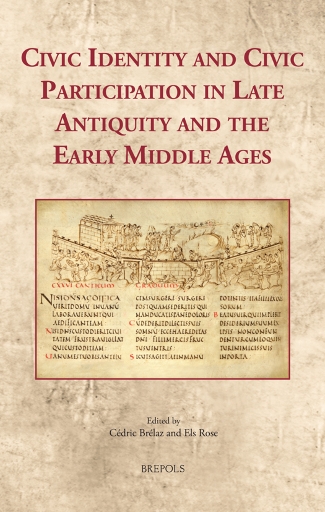
Civic Identity and Civic Participation in Late Antiquity and the Early Middle Ages
show More to view fulltext, buy and share links for:Civic Identity and Civic Participation in Late Antiquity and the Early Middle Ages show Less to hide fulltext, buy and share links for: Civic Identity and Civic Participation in Late Antiquity and the Early Middle AgesDuring the Ancient Greek and Roman eras, participation in political communities at the local level, and assertion of belonging to these communities, were among the fundamental principles and values on which societies would rely. For that reason, citizenship and democracy are generally considered as concepts typical of the political experience of Classical Antiquity. These concepts of citizenship and democracy are often seen as inconsistent with the political, social, and ideological context of the late and post-Roman world. As a result, scholarship has largely overlooked participation in local political communities when it comes to the period between the disintegration of the Classical model of local citizenship in the later Roman Empire and the emergence of ‘pre-communal’ entities in Northern Italy from the ninth century onwards.
By reassessing the period c. 300-1000 ce through the concepts of civic identity and civic participation, this volume will address both the impact of Classical heritage with regard to civic identities in the political experiences of the late and post-Roman world, and the rephrasing of new forms of social and political partnership according to ethnic or religious criteria in the early Middle Ages. Starting from the earlier imperial background, the fourteen chapters examine the ways in which people shared identity and gave shape to their communal life, as well as the role played by the people in local government in the later Roman Empire, the Germanic kingdoms, Byzantium, the early Islamic world, and the early medieval West. By focusing on the post-Classical, late antique, and early medieval periods, this volume intends to be an innovative contribution to the general history of citizenship and democracy.
-
-
-
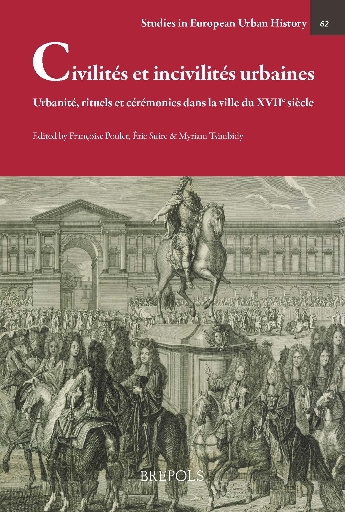
Civilités et incivilités urbaines
Urbanité, rituels et cérémonies dans la ville du xvii e siècle
show More to view fulltext, buy and share links for:Civilités et incivilités urbaines show Less to hide fulltext, buy and share links for: Civilités et incivilités urbainesLes notions d’urbanité, de politesse et de savoir-vivre connaissent depuis une dizaine d’années un intérêt renouvelé à la fois dans leurs dimensions politique, sociale et culturelle.
Cet ouvrage souhaite envisager le milieu urbain en tant qu’espace de civilité en croisant les regards des historiens et des spécialistes de la littérature de l’âge classique. Il s’agit aussi d’examiner les cérémonies et rituels du XVIIe siècle comme un ensemble de réseaux de pratiques codifiées, dans lequel interagissent notamment des usages collectifs et des préséances individuelles. Ces usages organisent l’espace urbain comme l’espace curial en se déployant en leur sein. La confrontation des archives et des documents littéraires, mais aussi des outils et des méthodologies utilisés par ces différents champs disciplinaires, permet d’étudier à nouveaux frais les relations entre des concepts trop rapidement perçus comme antonymiques : l’incivilité n’est jamais le contraire de la civilité, et il n’existe pas de civilisation, ni de société civilisée, qui puisse se revendiquer comme statique ou achevée. En revenant, dans le sillage des travaux de Norbert Elias, aux origines de la civilité moderne, envisagée à l’échelle européenne, cet ouvrage entreprend d’examiner ce processus, non pas de manière linéaire et téléologique, mais dans la complexité de ses évolutions et mutations, afin de mieux contextualiser les débats contemporains autour de l’incivilité.
-
-
-
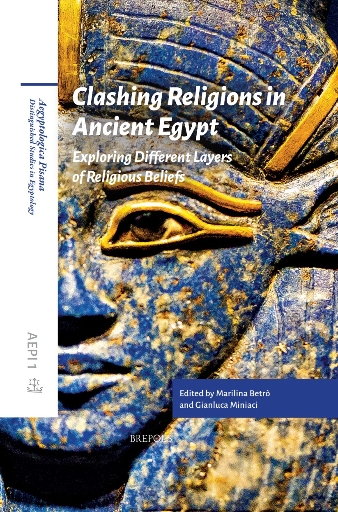
Clashing Religions in Ancient Egypt
Exploring Different Layers of Religious Beliefs
show More to view fulltext, buy and share links for:Clashing Religions in Ancient Egypt show Less to hide fulltext, buy and share links for: Clashing Religions in Ancient EgyptWhat did ‘religion’ mean for the Ancient Egyptians? Was the state involved in acting as a unifying and founding force for Egyptian religion or can we still identify some clashes between different religious practices? To what extent did different rituals, practices, and beliefs intersect and merge across time and space? Such questions have long preoccupied scholars working in the field, but they have often only been considered through the lens of official, ‘centralized’ texts. Yet increasingly, there is an acknowledgement that such texts require calibration from archaeological data in order to offer a more nuanced understanding of how people must have lived and worshipped.
The chapters gathered in the volume aim to offer a thorough exploration of Egyptian cultural and religious beliefs, and to explore how these impacted on other areas of daily life. Contributors explore the connection between religion and central power, the paradigms around burial and access to the afterlife, the interconnections between religion, demonology, magic, and medicine, and the impact of multicultural interaction on the religious landscape. What emerges from this discussion is an understanding that the only truly identifiable clash is that between modern, Eurocentric perspectives, and the views of the ancient Egyptians themselves.
-
-
-
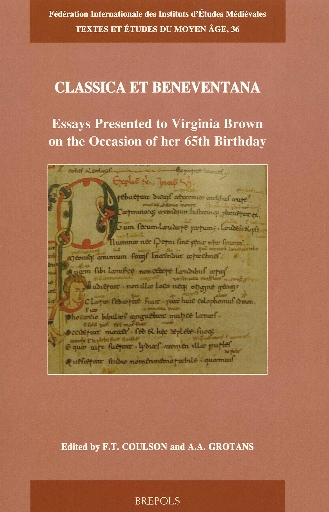
Classica et Beneventana
Essays Presented to Virginia Brown on the Occasion of her 65th Birthday
show More to view fulltext, buy and share links for:Classica et Beneventana show Less to hide fulltext, buy and share links for: Classica et BeneventanaThe Festschrift volume Classica et Beneventana, presented to Virginia Brown on the occasion of her 65th birthday, brings together eighteen insightful new essays by leading scholars devoted to the fields of classical reception and Latin palaeography. The authors investigate a wide-range of topics such as the development and application of the Beneventan script, comparative codicology, use of early liturgical manuscripts, medieval artes and biblical texts and their readers, and the reception and dissemination of classical texts during the Italian Renaissance.
Since 1970, Virginia Brown has been a Senior Research Fellow at the Pontifical Institute of Mediaeval Studies. She is recognized as one of the world’s leading authorities in classical reception and Latin palaeography. Her numerous publications on the Beneventan script have dramatically altered our knowledge of the dissemination of this southern Italian book hand from 800 to 1600. Her editorial work for the Catalogus translationum et commentariorum, as a member of the Editorial Board and since 1986 as Editor-in-Chief, has resulted in several learned volumes tracing the fortuna and study of classical authors from antiquity to the year 1600. As editor of Mediaeval Studies from 1975 to 1988, she single-handedly produced tomes noted for their scholarly rigor and acumen. This collection of essays serves as fitting tribute to a scholar who, via her scholarly research and editorial work, has done so much to advance the fields of palaeography, codicology, and the history of classical scholarship.
-
-
-
Cleveland Studies in the History of Art
show More to view fulltext, buy and share links for:Cleveland Studies in the History of Art show Less to hide fulltext, buy and share links for: Cleveland Studies in the History of ArtCleveland Studies in the History of Art publishes scholarly articles and shorter notes containing original research related to the museum’s permanent collection. While collection-based articles are particularly sought, others will also be considered. Articles are invited from outside contributors, as well as members of the staff.
-
-
-
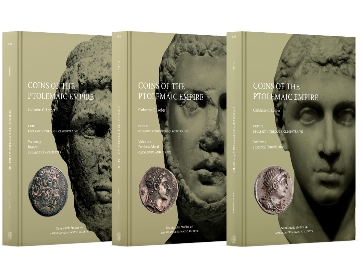
Coins of the Ptolemaic Empire, Part 2: Ptolemy V through Cleopatra VII
Volume 1: Historical Introduction, Volume 2: Catalogue of Precious-Metal Coins, Volume 3: Catalogue of Bronze Coins
show More to view fulltext, buy and share links for:Coins of the Ptolemaic Empire, Part 2: Ptolemy V through Cleopatra VII show Less to hide fulltext, buy and share links for: Coins of the Ptolemaic Empire, Part 2: Ptolemy V through Cleopatra VIIThirty years in the making, Coins of the Ptolemaic Empire, Part II, by Catharine C. Lorber, is the long-anticipated second half of the Coins of the Ptolemaic Empire (CPE) project, featuring the coins struck by Ptolemy V–Cleopatra VII. As with Part 1, Lorber essentially rewrites the sections on these rulers in J. N. Svoronos’ classic, but now much out-of-date, Ta Nomismata tou Kratous ton Ptolemaion (1904). The body of coinage catalogued by Svoronos is enlarged by hundreds of additional emissions in precious metal and bronze, recorded from subsequent scholarship, from hoards, from commercial sources, and from private collections. Lorber’s attributions, dates, and interpretations rest on numismatic research conducted after Svoronos, or on the latest archaeological and hoard information. She also provides extensive historical and numismatic introductions that give the coins deeper context and meaning.
-
-
-
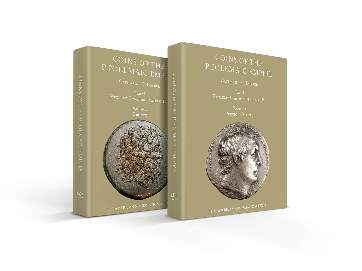
Coins of the Ptolemaic Empire, Part I: Ptolemy I through Ptolemy IV
Volume 1: Precious Metal, Volume 2: Bronze
show More to view fulltext, buy and share links for:Coins of the Ptolemaic Empire, Part I: Ptolemy I through Ptolemy IV show Less to hide fulltext, buy and share links for: Coins of the Ptolemaic Empire, Part I: Ptolemy I through Ptolemy IVCoins of the Ptolemaic Empire, Part 1, Volumes 1 and 2 (Precious Metal and Bronze) by Catharine Lorber, is the massive, long-anticipated catalogue of coins struck by the first four Ptolemaic kings. It essentially rewrites the sections on these rulers in J. N. Svoronos’ classic, but now much out of date, Ta Nomismata tou Kratous ton Ptolemaion (1904). The body of coinage catalogued by Svoronos is enlarged by more than 300 further emissions in precious metal and more than 180 emissions in bronze, recorded from subsequent scholarship, from hoards, from commercial sources, and from private collections, and constituting about a third of the total catalogue entries. Lorber’s attributions, dates, and interpretations rest on numismatic research since Svoronos, or on the latest archaeological and hoard information. She also provides extensive historical and numismatic introductions that give the coins deeper context and meaning. The coinage of Ptolemies I through IV is supplemented by a few issues possibly attributable to Cleomenes of Naucratis, the predecessor of Ptolemy I in Egypt, as well as by coinages of Ptolemy Ceraunus, Magas, and Ptolemy of Telmessus, members of the Lagid dynasty ruling their own kingdoms outside of Egypt.
-
