


Brepols Online Books Medieval Miscellanea Collection 2018 - bob2018mime

Collection Contents
4 results
-
-
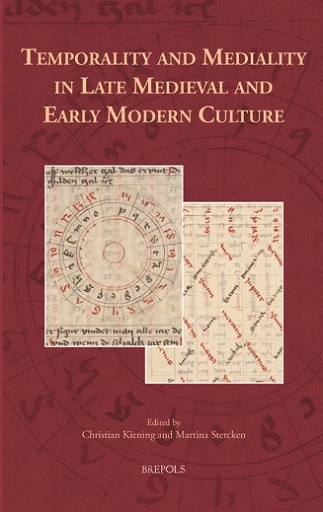
Temporality and Mediality in Late Medieval and Early Modern Culture
show More to view fulltext, buy and share links for:Temporality and Mediality in Late Medieval and Early Modern Culture show Less to hide fulltext, buy and share links for: Temporality and Mediality in Late Medieval and Early Modern CultureThis interdisciplinary volume explores the ways in which time is staged at the threshold between the Middle Ages and the early modern period. Proceeding from the reality that all cultural forms are inherently and inescapably temporal, it seeks to discover the significance of time in mediations and communications of all kinds.
By showing how time is displayed in diverse cultural strategies and situations, the essays of this volume show how time is intrinsic to the very concept of tradition. In exploring a variety of medial forms and communicative practices, they also reveal that while the beginning of the age of printing (around 1500) may mark a fundamental change in terms of reproduction and circulation, artefacts and other historical traditions continue to employ earlier systems and practices relating time and space.
The volume features articles by leading researchers in their respective fields, including studies on mosaics as a medium reflecting space and time; the triptych’s potential as a time machine; winged altarpieces mediating eternity; texts and images of the passion of Christ permeating past, present, and future; dimensions of time embedded in maps; a compendium of world knowledge organized by forms of time and temporality; the figuration of prophecy in times of crisis; the portrayal of time in architecture.
The volume thus provides a new approach to media and mediality from the perspective of cultural history.
-
-
-
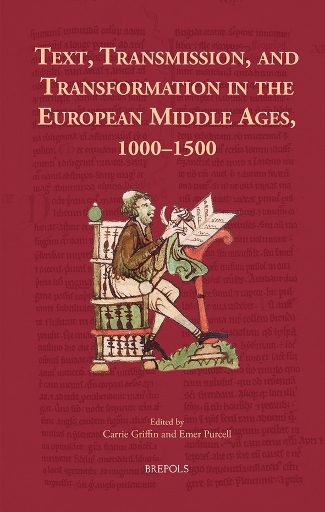
Text, Transmission, and Transformation in the European Middle Ages, 1000–1500
show More to view fulltext, buy and share links for:Text, Transmission, and Transformation in the European Middle Ages, 1000–1500 show Less to hide fulltext, buy and share links for: Text, Transmission, and Transformation in the European Middle Ages, 1000–1500These essays are concerned primarily with the different ways in which European writers, translators, and readers engaged with texts and concepts, and with the movement and exchange of those texts and ideas across boundaries and geographical spaces. It brings together new research on Anglophone and Latinate writings, as well as on other vernaculars, among them Old Norse, Anglo-Saxon, Medieval Irish, Welsh, Arabic, Middle Dutch, Middle German, French, and Italian, including texts and ideas that are experienced in aural and oral contexts, such as in music and song. Texts are examined not in isolation but in direct relation and as responses to wider European culture; several of the contributions theorize the translation of works, for example, those relating to spiritual instruction and prayer, into other languages and new contexts.
The essayists share a common concern, then, with the transmission and translation of texts, examining what happens to material when it moves into contexts other than the one in which it was produced; the influence that scribes, translators, and readers have on textual materiality and also on reception; and the intermingling different textual traditions and genres. Thus they foreground the variety and mobility of textual cultures of the Middle Ages in Europe, both locally and nationally, and speak to the profound connections and synergies between peoples and nations traceable in the movement and interpretation of texts, versions, and ideas. Together the essays reconstruct an outward-looking, networked, and engaged Europe in which people used texts in order to communicate, discover, and explore, as well as to record and preserve.
-
-
-
Towards the Authority of Vesalius
show More to view fulltext, buy and share links for:Towards the Authority of Vesalius show Less to hide fulltext, buy and share links for: Towards the Authority of VesaliusThe authority of Andreas Vesalius (1514-1564) in reviving human anatomy is without any doubt a landmark in the history of science. Yet his breakthrough was inconceivable without his predecessors’ works. Moreover, later on, his own legacy would not remain untouched or undisputed. The question of scientific authority is not new; however it has hardly been tackled in a multidisciplinary and diachronic way. This volume brings together contributions from international scholars working in the field of theology, art history, philosophy, history of science and historical linguistics. Its goal is to contextualize and analyse the complex interaction between dogma and authority on the one hand and empirical progress on the other, both in the development of anatomy and the views on the human body, mainly before Vesalius’s time. Indeed, it is not the volume’s aim to focus exclusively on the role of Vesalius nor to assess the concept of medical and anatomical authority in a comprehensive way. Avoiding to repeat insights from the history of science as such, it intends to put old views to the test, and to bring up new questions and answers from diverse perspectives concerning the work of Vesalius and his predecessors and successors, by presenting different case studies from Antiquity to the Early Modern Times.
-
-
-
Toward a Historical Sociolinguistic Poetics of Medieval Greek
show More to view fulltext, buy and share links for:Toward a Historical Sociolinguistic Poetics of Medieval Greek show Less to hide fulltext, buy and share links for: Toward a Historical Sociolinguistic Poetics of Medieval GreekHow can historical sociolinguistic analyses of Medieval Greek aid in the interpretation of Medieval Greek texts? This is the main question addressed by the papers collected in this volume. Historical sociolinguistics (HSL) is a discipline that combines linguistic, social, historical, and philological sciences, and suggests that a language cannot be studied apart from its social dimension. Similarly, the study of a language in its social dimension is nothing else than the study of communication between members of a given speech community by the means of written texts, the shared “signs” used by authors to communicate with their audiences.
This volume is divided into two parts. In the first, Cuomo’s and Bentein’s papers aim to offer an overview of the discipline and examples of applied HSL. Valente’s, Bianconi’s, and Pérez-Martín’s papers show how the context of production and reception of Byzantine texts should be studied. These are followed by Horrocks’ study on some features of Atticized Medieval Greek. In the second part, the contributions by Telelis, Odorico, and Manolova focus on the context of reception of texts by Georgios Pachymeres, Theodoros Pediasimos, and Nikephoros Gregoras respectively.
-