


Brepols Online Books Other Monographs Collection 2018 - bob2018moot

Collection Contents
4 results
-
-
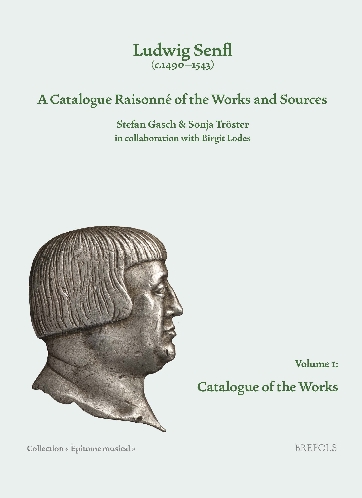
Ludwig Senfl (c.1490-1543): A Catalogue Raisonné of the Works and Sources
show More to view fulltext, buy and share links for:Ludwig Senfl (c.1490-1543): A Catalogue Raisonné of the Works and Sources show Less to hide fulltext, buy and share links for: Ludwig Senfl (c.1490-1543): A Catalogue Raisonné of the Works and SourcesUntil now, scholars have had an inadequate picture of the scope and transmission of the œuvre of Ludwig Senfl (c. 1490-1543), one of the most important Renaissance composers of the German-speaking lands. The current publication presents an extraordinary and exceptionally comprehensive catalogue raisonné for this Renaissance composer. Volume 1 of the two-volume set forms the catalogue of works (including lost and misattributed compositions). It is organized according to genre and provides a thorough description of every composition. Each entry includes a musical incipit, comments on the musical structure, and comprehensive information concerning the transmission and the authenticity of the composition in addition to many other details. In its layout, structure, and critical approach to Senfl's music, this volume enables farreaching research into the composer's style as well as a detailed characterisation of his œuvre, and thus it provides clues towards a long-desired chronology of the composer's works.The Senfl Catalogue serves as an encyclopaedic research tool for further scholarly investigation: it not only presents a lively and coherent picture of Senfl's œuvre, but also helps to explore the broader musical culture of his time. At the same time, the in-depth presentation and analysis of Senfl's music provides Early Music performers with new information on repertory that adds to the soundscape of the Renaissance.
-
-
-
La Genesi
show More to view fulltext, buy and share links for:La Genesi show Less to hide fulltext, buy and share links for: La GenesiIl commento alla Genesi di Pietro Comestore è parte di un’opera ben più vasta, composta intorno al 1170 e nota in epoca successiva con il titolo, pressoché intraducibile nelle lingue moderne, di Historia Scholastica. Il termine historia ne individua l’oggetto: è la storia sacra - la «storia» per eccellenza secondo la mentalità medievale - che, a partire dal libro della Genesi fino ai Vangeli, è narrata in stretta aderenza alla traccia biblica e, al contempo, puntualmente commentata sotto il profilo esegetico, con privilegio (quasi esclusivo) accordato all’esegesi storico-letterale. L’appellativo scholastica è suggello postumo ad indicare la generale adozione «scolastica» dell’opera, quale imprescindibile manuale di riferimento, almeno per l’intera epoca tardomedievale, nelle facoltà di teologia delle università europee. Un’opera, dunque, di assoluta rilevanza, ma la cui sterminata estensione nonché vastità della tradizione manoscritta sono state, e sono tuttora, di ostacolo a qualsivoglia progetto di edizione critica integrale e di studio analitico d’insieme.
Si propone qui la traduzione italiana con commento della sezione dell’opera corrispondente al libro della Genesi: la versione latina originale del testo è pubblicata nella collana Corpus Christianorum Continuatio Mediaevalis con il titolo Petri Comestoris. Scolastica Historia. Genesis (CC CM 191), a cura di A. Sylwan. I rimandi alle pagine corrispondenti dell’edizione sono forniti a margine di questa traduzione.
-
-
-
La prière dans la tradition platonicienne, de Platon à Proclus
show More to view fulltext, buy and share links for:La prière dans la tradition platonicienne, de Platon à Proclus show Less to hide fulltext, buy and share links for: La prière dans la tradition platonicienne, de Platon à ProclusThe present book studies prayer as a category of Platonic religious thought, from Plato to Late Antiquity. Following a chronological framework (Plato, the pseudo-Platonic Second Alcibiades, Maximus of Tyre, Plotinus, Porphyry, Iamblichus, Proclus), the book examines the relationship between philosophical reflection on prayer and a series of themes and related topics: the criticism and the interpretation of traditional cults, the conceptualization of religious emotions, the philosophical explanation of how astrology and magic work, the theories of the soul, and the theological description of reality in Late Neoplatonism.
The book aims to contribute to shed new light on the relationship between religion and philosophy in Antiquity and, in particular, on the forms of “scientific” religion that appear and develop in the philosophical schools in Late Antiquity. Special attention is paid to the relationship between philosophy, religion, and rhetoric. The rhetorical dimension of prayer is explored in relation to the role of persuasion and emotion in prayer and to the idea that exegetical commentary represents a hymn in prose addressed to the gods.
-
-
-
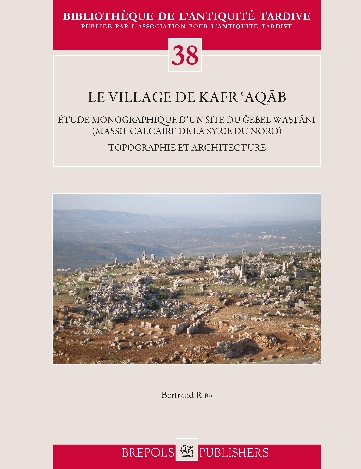
Le village de Kafr ʿAqāb
show More to view fulltext, buy and share links for:Le village de Kafr ʿAqāb show Less to hide fulltext, buy and share links for: Le village de Kafr ʿAqābThe new monographic study of the village of Kafr ʿAqāb is a contribution to broadening the field of research into the western part of the Limestone Massif in Northern Syria which, until now, had been the subject of only limited interest. The ruins of the site are mainly spread out over a vast rocky headland which is strategically situated at the northern extremity of the ğebel Waṣṭāni near the Orontes valley in the inland region of Antioch. These ruins reveal the existence of an ancient village with over 80 homes, various communal constructions, a monastery, two ecclesiastic complexes and a fortified building.
The study is based on a detailed analysis of surface ruins and has enabled the evolution of the village to be precisely determined from its first phase of occupation between the IInd and IIIrd century until it was abandoned during the medieval period. Most of the constructions date from the Roman and Proto-Byzantine periods. Each architectural group (houses, tombs, churches, agricultural buildings, etc.) is studied separately then resituated in the context of the village and the region thus enabling the author to determine this peasant community’s economic, demographic, social and religious history.
Mechanisms linked to the growth of the locality are examined in the light of strategies implemented in the appropriation and enhancement of the surrounding land such as controlling water and the diversification of crops which reveals the inhabitants’ extraordinary capacity to adapt to their natural environment. Discussion also covers the question of the interactions between the villagers and their relationships with other towns. Kafr ʿAqāb also owed its prosperity to the road network which was ingeniously woven between towns as well as to its proximity to major urban areas in Antioche and Apamea. The ruins reveal this highly favourable location for trade and the circulation of various cultural and artistic movements. Finally, numerous archaeological signs allow the study of the occupation of the village after it was invaded by VIIth century Arab conquerors. The author thus aims to reconstruct the history of this ancient site following a long and fascinating field study.
-