


Brepols Online Books Other Monographs Collection 2018 - bob2018moot

Collection Contents
3 results
-
-
Pierre Gassendi, De la phantaisie ou imagination
show More to view fulltext, buy and share links for:Pierre Gassendi, De la phantaisie ou imagination show Less to hide fulltext, buy and share links for: Pierre Gassendi, De la phantaisie ou imaginationLe présent livre VIII De phantaisia seu imaginatione se trouve dans la Physique du Syntagma , dans la partie qui concerne les êtres vivants ou animés, dont la rédaction se situe entre la moitié de 1644 et la fin de l’année suivante. Le livre est construit en six chapitres ; la thèse en est résumée à la fin du dernier. Dans l’ensemble, Gassendi articule de façon subtile des passages de doxographie et l’énoncé de sa propre position, qu’il désire situer par rapport à la tradition, procurant une démonstration à la fois historique et théorique. Le livre trouvant sa place à juste titre dans la Physique, c’est en naturaliste que Gassendi explore son objet : le rationalisme et le biologisme y trouvent une place essentielle. L’examen des doctrines antérieures auquel il se livre, comme il le fait presque systématiquement, ne prend en compte que celles qui envisagent l’imagination sous cet angle, excluant toute réflexion littéraire ou métaphysique sur l’imagination, « folle du logis ». Il se montre très soucieux de mettre en place un vocabulaire précis, où la phantaisie est la notion majeure pour une réalité qu’il juge de la plus grande importance pour le fonctionnement cognitif et comportemental de l’homme et des animaux, soit le système psychologique.
-
-
-
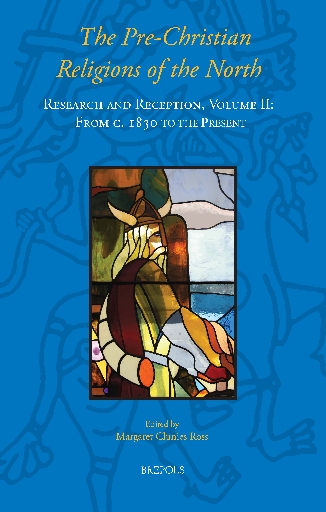
The Pre-Christian Religions of the North: Research and Reception, Volume II: From c. 1830 to the Present
show More to view fulltext, buy and share links for:The Pre-Christian Religions of the North: Research and Reception, Volume II: From c. 1830 to the Present show Less to hide fulltext, buy and share links for: The Pre-Christian Religions of the North: Research and Reception, Volume II: From c. 1830 to the PresentOver more than a thousand years since pre-Christian religions were actively practised, European – and later contemporary – society has developed a fascination with the beliefs of northern Europe before the arrival of Christianity, which have been the subject of a huge range of popular and scholarly theories, interpretations, and uses. Indeed, the pre-Christian religions of the North have exerted a phenomenal influence on modern culture, appearing in everything from the names of days of the week to Hollywood blockbusters. Scholarly treatments have been hardly less varied. Theories – from the Middle Ages until today – have depicted these pre-Christian religious systems as dangerous illusions, the works of Satan, representatives of a lost proto-Indo-European religious culture, a form of 'natural' religion, and even as a system non-indigenous in origin, derived from cultures outside Europe.
The Research and Reception strand of the Pre-Christian Religions of the North project establishes a definitive survey of the current and historical uses and interpretations of pre-Christian mythology and religious culture, tracing the many ways in which people both within and outside Scandinavia have understood and been influenced by these religions, from the Christian Middle Ages to contemporary media of all kinds. The previous volume (i) traced the reception down to the early nineteenth century, while the present volume (ii) takes up the story from c. 1830 down to the present day and the burgeoning of interest across a diversity of new as well as old media.
-
-
-
Philosopher-monks, episcopal authority, and the care of the self
show More to view fulltext, buy and share links for:Philosopher-monks, episcopal authority, and the care of the self show Less to hide fulltext, buy and share links for: Philosopher-monks, episcopal authority, and the care of the selfThis volume explores the Apophthegmata Patrum in the context of church-monastery dynamics in fifth-century Palestine. Positing that the Apophthegmata Patrum was compiled in response to perceived external interference, Zachary B. Smith provides the first examination of the Apophthegmata Patrum in its Palestinian context, illuminating monastic strategies for resisting episcopal control. Engaging literary and historical methods, this volume weaves a narrative that places the Apophthegmata Patrum squarely in the political and philosophical worlds of the eastern Mediterranean in late antiquity. The Apophthegmata Patrum’s compiler carefully selects stories to highlight problematic interactions between monks and ecclesiastics. He then appeals to classical and late antique philosophical categories of self-care to assert monastic autonomy, making the monks the new philosophers. In the context of contentious theological debates during the fourth and fifth centuries, these selected interactions and assertions tacitly advocate a path of monastic autonomy.
-