


BOB2020MIOT

Collection Contents
3 results
-
-
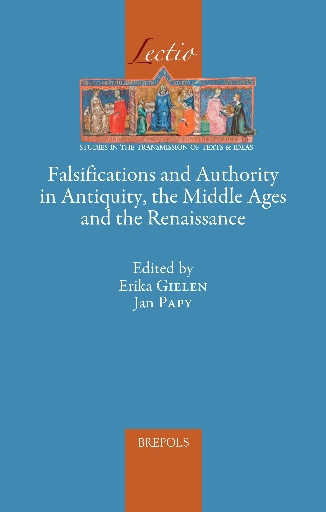
Falsifications and Authority in Antiquity, the Middle Ages and the Renaissance
show More to view fulltext, buy and share links for:Falsifications and Authority in Antiquity, the Middle Ages and the Renaissance show Less to hide fulltext, buy and share links for: Falsifications and Authority in Antiquity, the Middle Ages and the RenaissanceConfronted with the shifting idea of the authority of a text and its transmission and reception in a variety of genres, settings and contexts, this collective volume envisages to enlarge and deepen our understanding of these notions by tangling literary forgery and emulation. Authority and authoritative literary productions provoke all kinds of interest and emulation. Hermeneutical techniques, detailed exegesis and historical critique are invoked to put authority, and indeed also possible falsifications, to the test. Scholars from various disciplines working on texts, either authoritative or forged, and stemming from different periods of time, reflect on these topics on a methodological basis and from a hermeneutical entrance. In doing so, a threefold axis for questioning the phenomenon is proposed, namely the motif of falsification, the mechanism or technique applied, and the direct or indirect effect of this fraud.
-
-
-
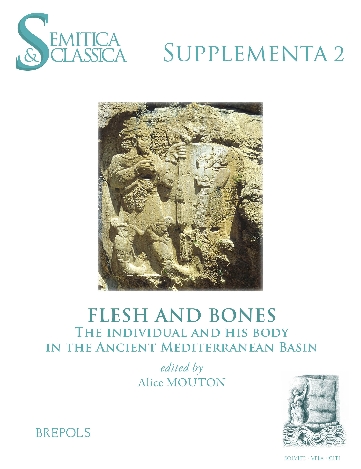
Flesh and Bones
show More to view fulltext, buy and share links for:Flesh and Bones show Less to hide fulltext, buy and share links for: Flesh and BonesThis volume gathers the papers presented during an interdisciplinary research seminar entitled “The individual and his body in the Ancient Mediterranean Basin.” This seminar was at the crossroads of history of religions and social anthropology, creating a dialogue between philologists, archaeologists, historians of religions and anthropologists. Its main aim consisted in studying self-perceptions of the body in the Ancient Near East, with incursions in other parts of the Mediterranean Basin in a comparatist perspective. In this volume, various themes are examined, such as: 1) the relationship between the body and language; 2) the body, perceptions and society, including a study of the senses as they are described in the texts; 3) the body as a symbol of social belonging; 4) the body as a medium for religious experience.
-
-
-
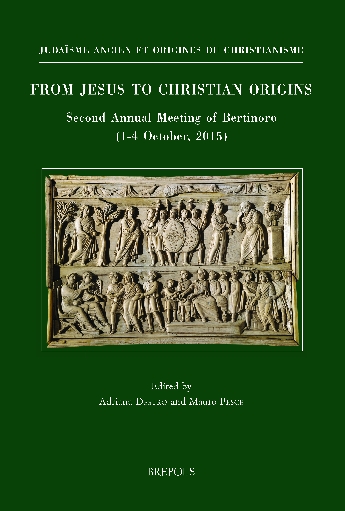
From Jesus to Christian Origins
show More to view fulltext, buy and share links for:From Jesus to Christian Origins show Less to hide fulltext, buy and share links for: From Jesus to Christian OriginsWithin the contemporary renewal of the exegetical and historical research on Jesus and early Christianity, this book stresses the importance of new epistemological and methodological perspectives in exegesis and History of Christianity (from the point of view of Cultural Anthropology and Comparative Religion). The articles of the first section present a consequent interpretation of Jesus within Jewish culture of the First century. Jesus activity is located within the Jewish movement of John the Baptizer. His words and political attitude is interpreted in the Jewish context of the Land of Israel under Roman administration. His movement is seen as a sub-group within Jewish society. The section dedicated to the first groups of Jesus’ disciples in the Land of Israel and in the ancient Mediterranean world mainly focuses on three constellations of questions: (a) the multiplicity and fractionation of Jesus’ groups, for example in Jerusalem in the period between 30 an 70 of the First century, (b) the fact that the post-Jesus Movement was sociologically characterized by a multiplicity of sub-groups of Jewish groups and movements; (c) the radical modifications provoked by the abandonment of Jewish contexts when the majority of followers was composed by Gentiles with limited relation with the daily practice of Jewish life and religion. Particular attention is dedicated to the connection of contemporary research with the interpretations of Jesus and early Christianity developed in the modern age.
-