


BOB2020MIOT

Collection Contents
21 - 26 of 26 results
-
-
The Making of Christianities in History
show More to view fulltext, buy and share links for:The Making of Christianities in History show Less to hide fulltext, buy and share links for: The Making of Christianities in HistoryThere has been a major trend among social scientists and historians to assume that the history of modernity can be studied without taking into consideration religion as an important factor. This in contrast to premodern societies in which religion would have played such a predominant and all-embracing role that a total symbiosis between religion and society would have existed. Both of these views are challenged by the authors of this volume. They claim that neither of them does justice to the complexity of the relationship between society and religion. They propose a theoretical framework that fully addresses this complexity by focussing on the variegated active ways in which religious agents (groups and individuals) process(ed) their societal and religious contexts in the modern era as well as in the premodern period. Viewed from this perspective, the history of Christianity appears as the heterogeneous result of an ongoing and unceasing selective processing by all Christians - and non-Christians - of their environment. The application of this new theoretical and methodological framework sheds light - often in a surprising and unexpected way - on various processes in the history of Christianity: the conflict-ridden parting of the ways between Jews and Christians; the emergence and development of early Christian rituals; the formation of a Cathar Counter- Church; the emergence of new forms of Christianity in North America; the complicated and ambiguous evolution of Roman Catholicism in modernity.
-
-
-
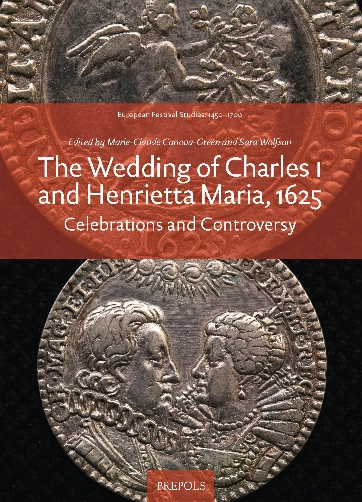
The Wedding of Charles I and Henrietta Maria, 1625
show More to view fulltext, buy and share links for:The Wedding of Charles I and Henrietta Maria, 1625 show Less to hide fulltext, buy and share links for: The Wedding of Charles I and Henrietta Maria, 1625On 11 May 1625 Charles I married Henrietta Maria, the youngest sister of Louis XIII of France. The match signalled Britain’s firm alignment with France against Habsburg Spain and promised well for future relations between the two countries. However, the union between a Protestant king and a Catholic princess was controversial from the start and the marriage celebrations were fraught with tensions. They were further disrupted by the sudden death of James I and an outbreak of the plague, which prevented large-scale public celebrations in London. The British weather also played its part. In fact, unlike other state occasions, the celebrations exposed weaknesses in the display of royal grandeur and national superiority. To a large extent they also failed to hide the tensions in the Stuart-Bourbon alliance. Instead they revealed the conflicting expectations of the two countries, each convinced of its own superiority and intent on furthering its own national interests. Less than two years later Britain was effectively in a state of war against France.
In this volume, leading scholars from a variety of disciplines explore for the first time the marriage celebrations of 1625, with a view to uncovering the differences and misunderstandings beneath the outward celebration of union and concord. By taking into account the ceremonial, political, religious and international dimensions of the event, the collection paints a rounded portrait of a union that would become personally successful, but complicated by the various tensions played out in the marriage celebrations and discussed here.
Contributors: R. Malcolm Smuts, Lucinda H. S. Dean, J. R. (Ronnie) Mulryne, Karen Britland, Marie-Claude Canova-Green, Erin Griffey, Margaret Shewring, Sara J. Wolfson, Sara Trevisan, Kevin Laam, Sydney Anglo, Margaret M. McGowan, John Peacock, Gordon Higgott, Ella Hawkins .
-
-
-
Théories et pratiques de la prière à la fin de l’antiquité
show More to view fulltext, buy and share links for:Théories et pratiques de la prière à la fin de l’antiquité show Less to hide fulltext, buy and share links for: Théories et pratiques de la prière à la fin de l’antiquitéLa prière est, à la fin de l’Antiquité, non seulement un élément essentiel de la pratique religieuse, publique et privée, mais aussi un objet éminent de réflexion philosophique et théologique, aussi bien au sein de la religion gréco-romaine que dans le christianisme. Les différents modes de rapport entre les théories et les pratiques de la prière forment ainsi la matière de ce livre, qui réunit quatorze contributions (suivies d'un épilogue) consacrées aux diverses facettes d’une interaction multiforme qui rend nécessaire la collaboration des spécialistes de différentes disciplines : histoire religieuse des mondes grec et romain, philosophie religieuse tardo-antique et littérature patristique. Cette collaboration se reflète dans un ensemble de questions qui traversent les contributions réunies dans ce volume : le lexique de la prière ; la tension entre ses dimensions personnelle et publique ; le contexte rituel des prières ; la géographie de la prière, donnant lieu à une tension entre les prières liées à un espace précis et les prières à caractère universel ; le lien entre prière et affectivité, celle des dieux, mais aussi celle des orants ; la polarité entre la prière vocale et la prière silencieuse, à la fois dans les milieux chrétiens et païens.
-
-
-
Transregional Territories
show More to view fulltext, buy and share links for:Transregional Territories show Less to hide fulltext, buy and share links for: Transregional TerritoriesThe early modern world was one of movement, contact, and exchange. Yet, this does not mean that it was borderless. On the contrary, connection existed only when people moved along and across the separations between polities, religions, and mentalities. So in order to understand early modern connections, one also needs to analyse the boundaries that accompanied them.In Transregional Territories, the early modern Low Countries are chosen as a ‘laboratory’ for studying border formation and border management through the lens of transregional history. Eight different cases highlight the impact of boundaries on the actions and strategies of individuals and governments. Crossing borders in early modern times was not merely an act of negating a territorial division, but rather a moment of intimate interaction with the separation itself. As such, this volume illustrates how borders forced historical actors to adapt their behaviour, and how historians can use a transregional vantage point to better understand these changes.The cases are presented by leading border specialists and scholars of the early modern Low Countries: Fernando Chavarría Múgica, Victor Enthoven, Raingard Esser, Yves Junot, Marie Kervyn, Christel Annemieke Romein, and Patricia Subirade.Bram De Ridder, Violet Soen, Werner Thomas, and Sophie Verreyken are all members of the Early Modern History Research Group of the KU Leuven. Together, they have published extensively on transregional history and the history of the early modern Low Countries, grouped under the label of transregionalhistory.eu.
-
-
-
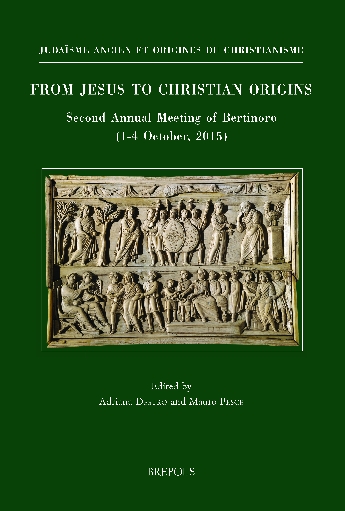
From Jesus to Christian Origins
show More to view fulltext, buy and share links for:From Jesus to Christian Origins show Less to hide fulltext, buy and share links for: From Jesus to Christian OriginsWithin the contemporary renewal of the exegetical and historical research on Jesus and early Christianity, this book stresses the importance of new epistemological and methodological perspectives in exegesis and History of Christianity (from the point of view of Cultural Anthropology and Comparative Religion). The articles of the first section present a consequent interpretation of Jesus within Jewish culture of the First century. Jesus activity is located within the Jewish movement of John the Baptizer. His words and political attitude is interpreted in the Jewish context of the Land of Israel under Roman administration. His movement is seen as a sub-group within Jewish society. The section dedicated to the first groups of Jesus’ disciples in the Land of Israel and in the ancient Mediterranean world mainly focuses on three constellations of questions: (a) the multiplicity and fractionation of Jesus’ groups, for example in Jerusalem in the period between 30 an 70 of the First century, (b) the fact that the post-Jesus Movement was sociologically characterized by a multiplicity of sub-groups of Jewish groups and movements; (c) the radical modifications provoked by the abandonment of Jewish contexts when the majority of followers was composed by Gentiles with limited relation with the daily practice of Jewish life and religion. Particular attention is dedicated to the connection of contemporary research with the interpretations of Jesus and early Christianity developed in the modern age.
-
-
-
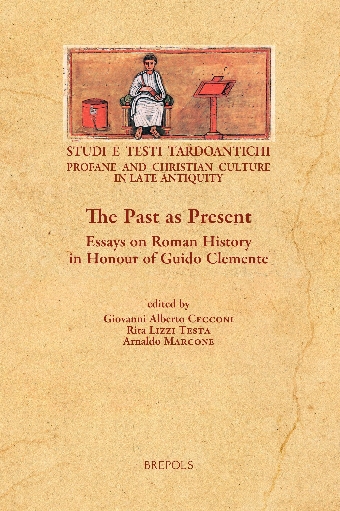
The Past as Present
show More to view fulltext, buy and share links for:The Past as Present show Less to hide fulltext, buy and share links for: The Past as PresentThis volume in honour of Guido Clemente collects essays by nearly 40 established and younger scholars from all over the world, who want to express their gratitude for prof. Clemente's direct or indirect teaching. While the essays included in the volume cover domains ranging from methodology and (the history of) historiography, over archaeology and epigraphy, to politics and religion, they all resort under the main theme of ‘the past as present’. This main theme is inspired by a prominent feature of Guido Clemente's scholarly work: the awareness that from the last centuries of the Roman Republic up until Late Antiquity, a sense of the past ‘as present’ marked the rhythm of everyday life and provided the key to understanding ongoing societal change.
-