


Brepols Online Books Medieval Miscellanea Collection 2022 - bob2022mime

Collection Contents
2 results
-
-
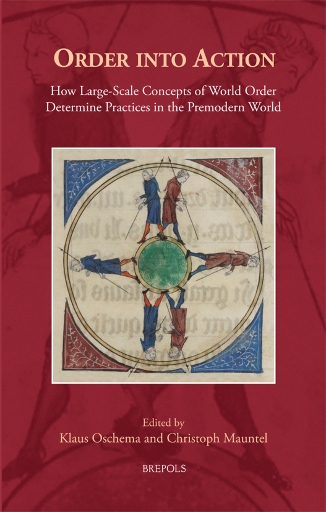
Order into Action
show More to view fulltext, buy and share links for:Order into Action show Less to hide fulltext, buy and share links for: Order into ActionThe construction (and application) of models that order complex phenomena such as ‘the world’ is not a ‘neutral’ activity: theoretical models and ideas help us to perceive and categorize the information conveyed by experience and tradition alike; in turn, they also influence the behaviour and actions of individuals and groups.
Collecting a global series of case studies on premodern societies, this volume proposes new research into premodern models of world-order and their effects. With its focus on the period between c. 1300 and 1600, it seeks to open up fresh perspectives for premodern Global History and the analysis of phenomena of transcultural contact and exchange.
Focussing on religious, political, and geographical ideas and models, the contributions explore whether and how large-scale concepts influenced or even determined concrete actions. The examples include socio-religious concepts (Christianity, terra paganorum, dār al-harb), political concepts (empire) and geographical notions. A special section is dedicated to comparative insights into societies in Sub-Saharan Africa, Australia, and pre-Columbian America. Taken together, the contributions underline the importance and effects of historically shaped cultural traits in the long term.
-
-
-
Omnium expetendorum prima est sapientia
show More to view fulltext, buy and share links for:Omnium expetendorum prima est sapientia show Less to hide fulltext, buy and share links for: Omnium expetendorum prima est sapientiaFounded at the beginning of the twelfth century on the outskirts of Paris, the Parisian school of Saint-Victor soon became an intellectual centre on a European scale: through the international recruitment of its masters; through the wide handwritten dissemination of their works, in particular those of Hugh and Richard; and finally through the extent of its doctrinal contribution to a common European culture, on a large number of points: the importance of acquiring a "general culture"; the need for a rigorous historical approach to biblical texts, open to rabbinic exegesis; a contagious interest in the writings and thought of the pseudo-Dionysius Areopagita; a major contribution to the constitution of a theological discipline; an effort to reconcile fervour in spiritual life and psychological finesse in the analysis of contemplation and its stages. In short, a curiosity for all fields of knowledge and, at the same time, an effort to unify them into a universal and unified wisdom.
The Book gathers new studies on original sources concerning Hugh of St. Victor, as the intellectual founder or the Victorine school; several of his Victorine brothers and disciples: Richard, Achard, Andrew, Godfrey, Absalon, up to late and little known Victorine masters as Pierre Leduc and Henri le Boulangier, at the time of the Great Schism (with critical edition of inedited texts); their influences on twelfth century texts as Ysagoge in theologiam or Speculum Ecclesiae, on Franciscan authors including Antony of Padua, Bonaventure, Rudolf of Biberach, and Duns Scotus, on romance literature of troubadours, on Carmelite authors of the sixteenth centruy and - a still uncharted territory - on Polish culture from Middle Ages to contemporary times.
-