


Brepols Online Books Medieval Miscellanea Collection 2024 - bob2024mime

Collection Contents
3 results
-
-
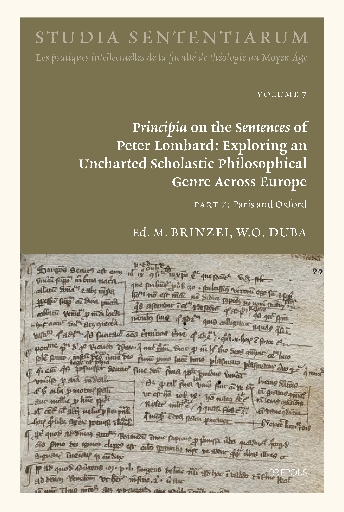
Principia on the Sentences of Peter Lombard
show More to view fulltext, buy and share links for:Principia on the Sentences of Peter Lombard show Less to hide fulltext, buy and share links for: Principia on the Sentences of Peter LombardPrincipia were an obligatory step on the medieval university path to becoming a master of theology. As inaugural lectures on the four books of the Sentences of Peter Lombard, they provided the first opportunity for a scholastic to defend a philosophical-theological worldview. These lectures were also a way for the theologian, now a sententiarius, to present himself and to make a name for himself, initially by delivering in a speech an introduction to the course and by debating with his fellows. The present book takes a collective approach to offer a survey of the evolution of the genre, mapping the dissemination of this exercise during the fourteenth and fifteenth centuries across Europe.
As an academic exercise, principia bridge ideas, texts, authors, and institutions across time. Exploring the corpus of surviving principia illuminates the philosophical creativity cultivated in the faculties of theology. The papers in these volumes thus not only discuss the structural aspects of principia, but also treat the philosophical and theological ideas defended and attacked during the principial debates and the topics and imagery used in the speeches.
The various chapters delve into the surviving material in a common attempt, firstly, to assemble pieces of evidence from Paris and Oxford into an image portraying how, when, and by whom the principia were performed in the first European universities. The second part illustrates the spread of the genre to the new faculties of theology in Central Europe and Italy, with case studies from Bologna, Cracow, Florence, Heidelberg, Prague, and Vienna, highlighting the pan-European diffusion of the practice.
-
-
-
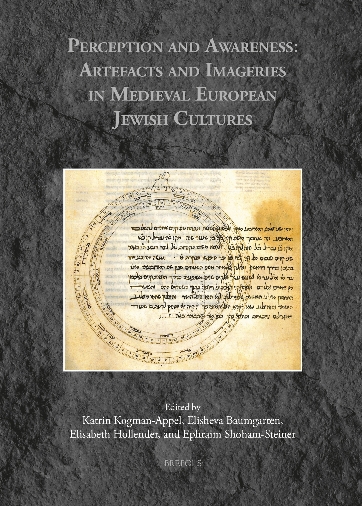
Perception and Awareness: Artefacts and Imageries in Medieval European Jewish Cultures
show More to view fulltext, buy and share links for:Perception and Awareness: Artefacts and Imageries in Medieval European Jewish Cultures show Less to hide fulltext, buy and share links for: Perception and Awareness: Artefacts and Imageries in Medieval European Jewish CulturesWhat did the world look like for Jews living in medieval Europe? How did they perceive and make use of the elements of their daily life, from items on the street to religious iconography within holy spaces — in particular synagogues and at the exterior of churches — and profane elements from the home? And how did they experience the visual and material cultures of their non-Jewish neighbours?
These questions form the core of this volume, which explores pre-modern Jewish approaches to images and material objects from a variety of perspectives. From clothing to manuscripts, and from lighting devices to the understanding of the invisible, the chapters gathered together in this multifaceted volume combine analyses of images and artefacts together with in-depth analyses of texts to offer fresh insights into the visual cultures that informed the world of European Jews in the Middle Ages.
-
-
-
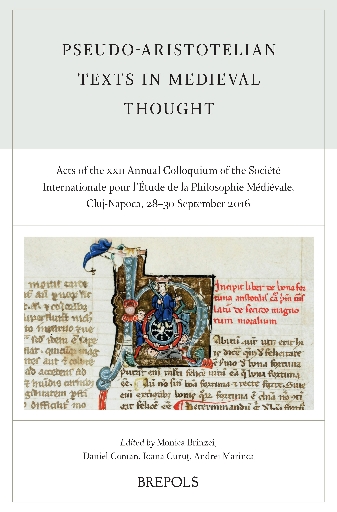
Pseudo-Aristotelian Texts in Medieval Thought
show More to view fulltext, buy and share links for:Pseudo-Aristotelian Texts in Medieval Thought show Less to hide fulltext, buy and share links for: Pseudo-Aristotelian Texts in Medieval ThoughtThe Philosopher, the Master of Those Who Know, was the dominant pagan authority in all four of the main traditions of medieval philosophy: Arabic, Greek, Hebrew, and Latin. Yet we now know that a number of works attributed to Aristotle were in fact spurious, authored by others who claimed to be, or whom others claimed to be, the Stagirite, for example, the Secretum secretorum, the Liber de causis, De mundo, De proprietatibus elementorum, De pomo, and De plantis. These writings strongly impacted medieval thought in various and fascinating ways, both in the original language, be it Arabic, Greek, Hebrew or Latin, and in translation. The mechanisms of their production, dissemination, and translation are themselves worthy of attention. Many of these works spawned commentary traditions of their own, parallel to those involving the classic texts of Peripatetic philosophy. Apparent contradictions between ideas expressed in these treatises and those found in what we consider to be authentic works, for instance ideas that appeared to derive more from the Academy than from the Lyceum, provoked questions about authenticity and about the possible evolution of Aristotle’s thought. Finally, these texts were employed in one way or another in many genres of philosophical literature in the Middle Ages, including metaphysics, natural and moral philosophy, theology, and even more exotic disciplines like chiromancy and alchemy. This volume aims to shed new light on various aspects of the history of Pseudo-Aristotelian texts in the Middle Ages.
-