


BOB2025MIOT

Collection Contents
5 results
-
-
De la lettre à l’esprit / From the Letter to the Spirit
show More to view fulltext, buy and share links for:De la lettre à l’esprit / From the Letter to the Spirit show Less to hide fulltext, buy and share links for: De la lettre à l’esprit / From the Letter to the SpiritLa parution du Guide divin dans le shî’isme originel en 1992 a marqué le début de l’itinéraire scientifique de Mohammad Ali Amir-Moezzi. Suivant une ligne directrice cohérente aux ramifications nombreuses, cet islamologue a transformé en profondeur les études shi’ites d’abord, notamment en soulignant l’importance de la « tradition ésotérique originelle » dans l’histoire de ce grand courant de l’islam, et les études coraniques ensuite, par la prise en compte des sources shi’ites anciennes et la critique du récit traditionnel « orthodoxe ». Détenteur de 1996 à 2024 de la chaire « Exégèse et théologie de l’islam shi’ite » à la section des sciences religieuses de l’École Pratique des Hautes Études, Mohammad Ali Amir-Moezzi est également un professeur hors du commun dont l’enseignement a formé et inspiré de nombreux chercheurs actuels. Ces volumes d’hommage réunissent quarante-quatre contributions de ses collègues et amis, dont nombre d’anciens étudiants, de tous horizons, portant sur les domaines d’études chers au dédicataire : études shi’ites ; études coraniques ; antiquité tardive et débuts de l’islam ; traditions mystiques de l’islam ; aspects de la vie religieuse et intellectuelle contemporaine. Témoignages d’amitié et de reconnaissance pour une œuvre scientifique majeure, les contributions savantes réunies dans ces volumes en font un ouvrage de référence.
-
-
-
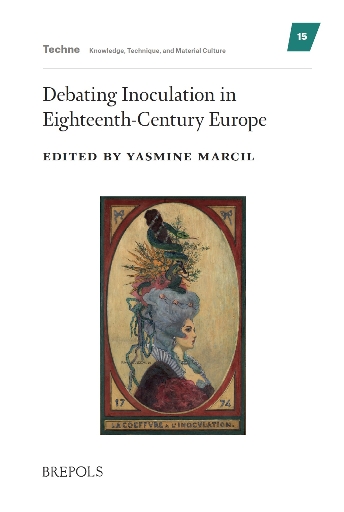
Debating Inoculation in Eighteenth-Century Europe
show More to view fulltext, buy and share links for:Debating Inoculation in Eighteenth-Century Europe show Less to hide fulltext, buy and share links for: Debating Inoculation in Eighteenth-Century EuropeSmallpox (known as "variole" or "petite vérole" in French) spread relentlessly across Europe during the eighteenth century, gaining an unprecedented and deadly momentum. While there was no cure for this highly infectious and often fatal disease, those that recovered from it were immune to future infections. This phenomenon was the origin of a practice of inoculation, whereby infectious material was introduced into the body to induce immunity. In Europe, this practice was initially experimented with in England, and it was subsequently adopted across the continent during the eighteenth century. Inoculation was, however, not without controversy—not least because the practice originated outside of Europe—and it became the subject of intense debate. This debate, this volume argues, extended beyond medical circles to include intellectuals and the broader public—a phenomenon driven by a growing periodical press. As books, scientific treatises, and plays crossed regional and national boundaries, debates on inoculation must, this volume shows, be examined within a European, transnational perspective, thereby considering how ideas were shaped by adaptation, translations, and citation. Doing so, this volume not only sheds new light on the history inoculation as a practice, but also illustrates how cultural history can enrich history of medicine
-
-
-
Discipline, Authority, and Text in Late Ancient Religion
show More to view fulltext, buy and share links for:Discipline, Authority, and Text in Late Ancient Religion show Less to hide fulltext, buy and share links for: Discipline, Authority, and Text in Late Ancient ReligionThis collection of essays on religious practice in the Mediterranean, Near East, and Middle East (ca. 100–800 ce) celebrates the impact that Professor David Brakke has had on the study of late antique religious history. Nineteen scholars celebrate the career of Professor Brakke with essays on a range of subjects on late ancient religion. Some chapters treat monastic texts, ascetic practice, and ritual performance; others address the roles of magic, demons, and miracle stories; still others examine Christian violence and martyrdom.
In particular, many of these essays explore the kinds of ascetic theory, practice, identity, organization, performance, and writing found throughout the diverse authors, groups, and locales of Late Antiquity. Essay topics cross disciplinary boundaries and operate in the overlapping intellectual space of Religious Studies, History, Classics, English, Anthropology, and Comparative Literature. By treating asceticism as a phenomenon within a relatively confined time period and geography across a variety of religious and literary traditions, this volume highlights the ascetic impulse within new areas.
The volume thus stands alone for its multifaceted discussions of religion and asceticism in Late Antiquity, and advances scholarly investigation of and discourse about late antique asceticism by expanding conceptual and disciplinary boundaries in new and exciting directions.
-
-
-
Disoriented
show More to view fulltext, buy and share links for:Disoriented show Less to hide fulltext, buy and share links for: Disoriented'Desnortar', or disoriented, means to lose the north or the sense of direction, to disorient. In Disoriented a collective book from a gender perspective, we consciously seek to lose both the geographical north and the north of the contemporary art canon. We aim to rethink and disrupt, from feminist, LGTBQ+ and postcolonial approaches, the coordinates that have articulated the discourses on the art history and art system along the 20th and 21st centuries. Coordinates that define how these artistic practices and systems of modernity and the contemporary are understood, the cardinal directions and main conceptual issues, or which artists are relevant or expendable according to the narratives of avant-garde and contemporary art history. It is crucial to reinterpret and disorientate, to disnorth and thereby shatter these references to overcome the gaps that prevent the emergence of alternative knowledges. To address questions or artists often perceived as peripheral to a grand historical narrative, we propose an intersection of modern and contemporary art history, gender, feminist, queer and postcolonial approaches, and transnational interrelations. This intersectionality allows us to actively lose the north of the canon and to direct our gaze towards subjects outside the usual centres of legitimation. Mostly, we attend to women artists, to peripheral geographical centres, to subaltern collectives, or to practices or materials regularly considered of little artistic interest. All of the above critiques how conventional discourses have excluded some collectives or certain artistic proposals, and the resistances that have emerged against them.
-
-
-
Dura-Europos: Past, Present, Future
show More to view fulltext, buy and share links for:Dura-Europos: Past, Present, Future show Less to hide fulltext, buy and share links for: Dura-Europos: Past, Present, FutureThis volume brings together an international and interdisciplinary host of scholars to reflect on the complicated legacies of exploration at the archaeological site of Dura-Europos, situated on the western bank of the Euphrates River near modern Salihiyeh (Syria). A chance discovery after World War I kicked off a series of excavations that would span the next century and whose finds are today housed in collections worldwide, including the Yale University Art Gallery, the Louvre, and the National Museum in Damascus. Dura-Europos exemplifies a multiethnic frontier town at the crossroads of major trade routes. Its textual remains and remarkably-preserved Christian, Jewish, and polytheist religious sanctuaries provide key resources for the study of antiquity and attest to the cross-cultural interconnectivity that was demonstrably central to the ancient world but which has been too often obscured by Eurocentric historiographic traditions and siloed disciplinary divisions.
Foreign-run, large-scale archaeological campaigns of the early twentieth century, like those at Dura-Europos, have created narratives of power and privilege that often exclude local communities. The significance of these imbalances is entangled with the destruction the site has experienced since the 2011 outbreak of conflict in Syria. As a step toward making knowledge descendant of early excavations more accessible, this volume includes Arabic summaries of each paper, following up on the simultaneous Arabic interpretation provided at the 2022 hybrid conference whose proceedings form the core of this publication. The papers address topics connected to essential themes in relation to Dura-Europos: long-distance trade relations and cross-border interactions in antiquity, including the exchange of technologies, people, and materials; Christianity, Judaism, and other religious practices, and their relations to one another; contemporary trafficking of looted artifacts; cultural heritage and the Islamic State; and the evolving role of museum collections, technologies, and archival materials for research.
-