Brepols Online Books Medieval Miscellanea Original Archive v2016 - bobar16mimeo

Collection Contents
101 - 120 of 254 results
-
-
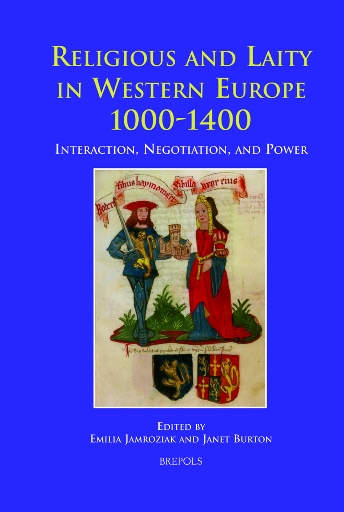
Religious and Laity in Western Europe, 1000-1400
show More to view fulltext, buy and share links for:Religious and Laity in Western Europe, 1000-1400 show Less to hide fulltext, buy and share links for: Religious and Laity in Western Europe, 1000-1400This volume examines forms of interaction between monastic or mendicant communities and lay people in the high Middle Ages in Britain, France, the Low Countries, and Scandinavia. The nineteen papers explore these issues in geographically and chronologically diverse settings in a way that no English-language collection has yet attempted. It brings together the latest research from established as well as younger historians. The first section ‘Patrons and Benefactors: power, fashion, and mutual expectations’ examines lay involvement in foundations, the rights held by patrons, and how they used these powers, as well as networks of relationships within broader groups of benefactors. The authors demonstrate how changing fashions shaped the fortunes of particular orders and houses and explore how power relations between different types of patrons and benefactors - royal figures, kinship, and other social groupings - affected the mutual expectations of the various parties. The second section of the volume, entitled ‘Lay and Religious: negotiation, influence, and utility’, shows how lay people’s ideas of the role of religious houses could impact upon their patronage of, and support for, monastic or mendicant institutions. Conversely, religious communities offered multi-faceted benefits - practical, intellectual, or spiritual - for the secular world. The book concludes by focusing on the rapid growth of confraternities, their relation to their urban mendicant and monastic contexts, and how the role and forms of confraternities evolved in the late medieval period.
-
-
-
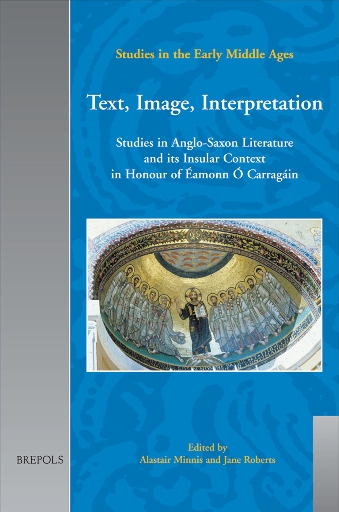
Text, Image, Interpretation:
show More to view fulltext, buy and share links for:Text, Image, Interpretation: show Less to hide fulltext, buy and share links for: Text, Image, Interpretation:In emulation of Professor Éamonn Ó Carragáin, who has, over the last few decades, demonstrated how words and images together join in that extraordinary cultural achievement which is the Ruthwell Cross, the volume seeks to transcend the established methods of the single discipline.
The twenty-six essays draw together insights from fields as diverse as archaeology, art history, and liturgy to reflect on the literature and material culture of the Anglo-Saxons. The first section looks outwards from the insular context, to medieval Rome, more generally to western Europe, and backwards to the world-geography of the ancient world; its illustrations include colour plates to illumine the hangings, clothing and vestments extant from Anglo-Saxon England. A range of texts is considered in the central section, Latin, English, and Old Norse. The third section focuses on sculpture, buildings and the insular landscape, juxtaposing the sculptured stonework of Northern Britain with early Christian monuments and remains from Ireland; among the illustrations are striking coloured photographs of Irish ecclesiastical sites. The contributors are from Canada, the United States, Italy, Britain, and Ireland.
-
-
-

Texte et discours en moyen français
show More to view fulltext, buy and share links for:Texte et discours en moyen français show Less to hide fulltext, buy and share links for: Texte et discours en moyen françaisC’est dans le cadre du renouveau de la linguistique diachronique et de l’attention croissante portée au moyen français que s’inscrivent les présentes études sur la linguistique textuelle du moyen français. Quels sont, dans cette période, les éléments linguistiques contribuant à la structuration du texte? Comment la cohésion textuelle et la continuité thématique sont-elles assurées? Les contributions réunies ici explorent ces domaines, en décrivant l’emploi d’une série de connecteurs, modalisateurs et signes de ponctuation et en analysant les mécanismes sous-jacents au fonctionnement des expressions anaphoriques et des constructions topicalisantes et focalisantes.
Le présent volume, qui est le fruit du XIe colloque international sur le moyen français tenu à Anvers (19-21 mai 2005), offre une analyse originale et détaillée des outils linguistiques dont dispose le moyen français pour rendre accessible son discours.
-
-
-
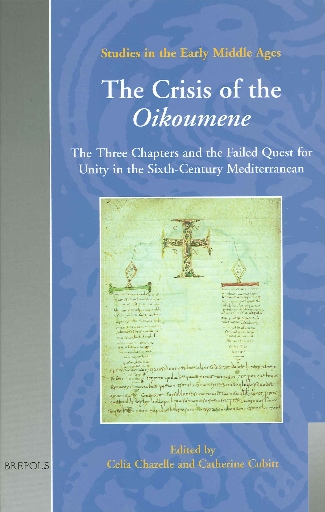
The Crisis of the Oikoumene
show More to view fulltext, buy and share links for:The Crisis of the Oikoumene show Less to hide fulltext, buy and share links for: The Crisis of the OikoumeneThe sixth-century theological controversy over the ‘Three Chapters’, which centred on the nature of Christ, provoked one of the most serious and long-lived religious schisms of the early Middle Ages. The fault lines ran not only between the Byzantine imperial court and the papacy, but between Rome and the churches in the former western empire’s successor states. In Italy, the schism endured into the seventh century, and the repercussions were felt long thereafter. Though rooted in the complexities of christological debate, the tensions reveal the growing political as well as cultural divide between Byzantium, Rome, and the West. Thus the controversy is critical for our understanding of the late-antique and early-medieval Mediterranean world, and of the inheritance of empire in western Europe and North Africa. This book presents ten chapters by an international group of scholars who examine different facets of the Three Chapters Controversy and its profound impact on these regions.
-
-
-
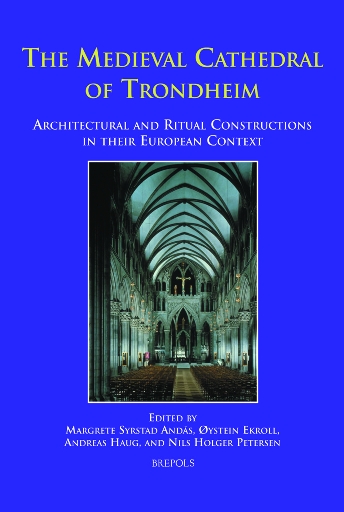
The Medieval Cathedral of Trondheim
show More to view fulltext, buy and share links for:The Medieval Cathedral of Trondheim show Less to hide fulltext, buy and share links for: The Medieval Cathedral of TrondheimMedieval cathedrals and the various practices connected to them form an important and complex part of the European cultural heritage. The buildings themselves and their reception into the modern arts ensure their presence within today’s cultural memories and sensibilities. In the mid-twelfth century, a new archbishop’s seat was erected in the Norwegian city of Trondheim (or Nidaros) in the far north of Europe. This interdisciplinary volume, written by scholars of history, architecture, and liturgy, explores the medieval cathedral of Trondheim as a local construction in a European context. As a see of the Western Church, it was set in an international Latinate culture. At the same time, the construction of the building itself and the ritual practices in and around it were influenced by local political, religious, and cultural conditions. The relationship between the physical construction of a cathedral and its function in medieval liturgical and other ritual practices is a topic of wide relevance for architectural and liturgical scholarship. The so-called Ordo Nidrosiensis, the thirteenth-century ordinal of the province of Nidaros, is an immense help in interpreting the architectural construction and sacred space of Nidaros Cathedral and the Ordo is dealt with in many of the articles. In accordance with general medieval practice, both the Nidaros ordinal and this volume may be described as international in content but edited with regard to local considerations.
-
-
-
The Medieval Translator. Traduire au Moyen Age
show More to view fulltext, buy and share links for:The Medieval Translator. Traduire au Moyen Age show Less to hide fulltext, buy and share links for: The Medieval Translator. Traduire au Moyen Age[Fundamental to all translation work, the concept of “displacement” allows one to take into account the multiple successive states inhering in a single text, and to interpret these variations. Translation is, in effect, a form of transfer; more specifically, it involves a movement from one context to another, be it national, social, political, historical, linguistic or religious. The texts examined here illustrate, each in their unique way, the relationship between contextual change and audience. They are also the product of subtle interactions between a variety of elements, the result of which is a “reinvention” of their respective roles and uses over time. For example, a text intending to entertain may also have educational outcomes; a book of local miracles may attract pilgrims and contribute to the economic life of a monastery; a text and its translations may at some point be appropriated for polemical purposes, while a library of translated texts founded on humanist principals may also serve political ends.
Furthermore, each successive adaptation and its accompanying annotations impacts upon the tonality of a text. While this diversity of meanings may inspire some (such as the medieval poet Marie de France), it moreover raises a number of important and difficult questions for the modern translator. How, for example, does one translate the “harmonics” underlying a series of mystical puns? The “solution” usually involves a compromise that both enhances and undermines the translated text.
This volume presents a selection of twenty-eight papers delivered at the Seventh International Conference dedicated to The Theory and Practice of Translation in the Middle Ages, which took place at the University of Paris III — Nouvelle Sorbonne in July 2004. The period covered by the texts and their translations extends from antiquity to the present day. The literary and critical breadth of these papers, as well as the rigorous interrogation of the modern translation theory, illustrates the remarkable vitality and diversity of current scholarship in this field.
,Au cœur de toute activité de traduction, le concept de déplacement permet de rendre compte des multiples états successifs d’un même texte et d’en interpréter les variations. Toute traduction est en effet une translation, c’est-à-dire un changement d’environnement, que ce dernier soit national, social, politique, historique, linguistique ou ecclésial. Les textes examinés ici témoignent chacun à sa manière des transformations qu’ils ont subies lorsque, changeant de langue, de style ou d’époque, ils ont changé de destinataires. La dynamique qui les traverse se nourrit de subtils côtoiements: un désir légitime de divertir peut fort bien s’accommoder d’une intention didactique; un recueil de miracles locaux peut attirer des pèlerins, contribuant ainsi à la vie économique d’un monastère; un texte et ses traductions peuvent devenir l’objet d’utilisations polémiques; se constituer en humaniste une bibliothèque de traductions peut aussi servir un dessein politique.
Par ailleurs les transpositions successives et leurs gloses, comme en musique, entraînent des changements de tonalité. Ce ‘surplus’ de sens qu’encourage Marie de France pourra cependant se heurter à des résistances: comment par exemple préserver d’une langue à l’autre toutes les harmoniques que libère un enchaînement de jeux de mots mystiques? Ainsi l’inévitable compromis qui s’imposera au traducteur sera souvent le choix d’un enrichissement doublé d’une déperdition.
Ce volume présente une sélection des communications entendues lors du septième colloque international consacré à la théorie et la pratique de la traduction des textes au Moyen Age qui s’est tenu à l’Université de Paris III — Sorbonne Nouvelle en juillet 2004. La période couverte par ces textes et leurs traductions s’étend de l’Antiquité jusqu’à nos jours. Ce sont au total vingt-huit études qui sont ici proposées. La richesse des domaines abordés, la haute technicité des analyses, de même que la place faite aux questionnements de la traductologie moderne illustrent la remarquable vitalité des études actuelles relatives aux multiples aspects de la traduction des textes médiévaux.
]
-
-
-
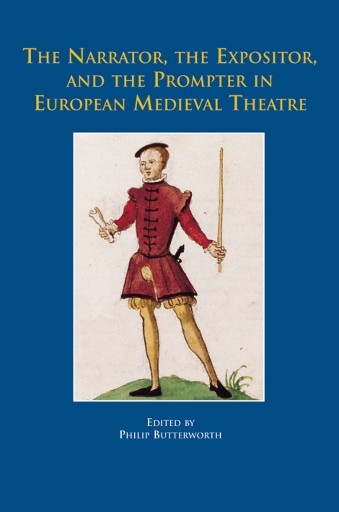
The Narrator, the Expositor, and the Prompter in European Medieval Theatre
show More to view fulltext, buy and share links for:The Narrator, the Expositor, and the Prompter in European Medieval Theatre show Less to hide fulltext, buy and share links for: The Narrator, the Expositor, and the Prompter in European Medieval TheatreInterest in the content of this book has developed out of an examination of the prompter who operated in full view of the audience and offered all the lines to the players. In 2001 at Groningen a production of the Towneley Second Shepherds’ Play focused on an examination of this convention. Many of the audience responses then were concerned with the figure of the prompter as he was seen to operate simultaneously both ‘inside’ and ‘outside’ the action of the play. Such a role and its function is fascinating, not only in its own right, but also in relation to how it might inform us about the nature and purpose of presented theatre. The ability of such a figure to move in and out of the action, and thus different realities, characterizes a relationship to the action and the audience. The same fascination exists in relation to roles of the narrator and the expositor. Sometimes these roles are overt ones; sometimes they ‘double up’ with roles of actors, personages or characters. These figures are of pivotal significance in the communication of those plays in which they operate. The purpose of this book is to investigate the nature of these roles in order to identify their influence upon the performance of medieval plays.
-
-
-
The Old English Homily
show More to view fulltext, buy and share links for:The Old English Homily show Less to hide fulltext, buy and share links for: The Old English HomilyThe quarter-century that has passed since Paul Szarmach’s and Bernard Huppé’s groundbreaking The Old English Homily and its Backgrounds (1978) has seen staggering changes in the field of Anglo-Saxon homiletics. Primary materials have become accessible to scholars in unprecedented levels, whether digitally or through new critical editions, and these have generated in turn a flood of secondary scholarship. The articles in this volume showcase and build on these developments. The first five essays consider various contexts of and infuences on Anglo-Saxon homilies: patristic and early medieval Latin sources, continental homiliaries and preaching practices, traditions of Old Testament interpretation and adaptation, and the liturgical setting of preaching texts. Six studies then turn to the sermons themselves, examining style and rhetoric in the Vercelli homilies, the codicology of the Blickling Book, sanctorale and temporale in the works of Ælfric, and the challenges posed by Wulfstan’s self-referential corpus. Finally, the last entries take us past the Conquest to discuss the re-use of homiletic material in England and its environs from the eleventh to eighteenth century. Together these articles offer medieval scholars a new Old English Homily, one that serves both as an introduction to key figures and issues in the field and as a model of studies for the next quarter-century.
-
-
-
The Rural History of Medieval European Societies
show More to view fulltext, buy and share links for:The Rural History of Medieval European Societies show Less to hide fulltext, buy and share links for: The Rural History of Medieval European SocietiesThis collection gathers together a range of scholars who reflect on recent historiographical developments in medieval rural history within their respective countries. Each contribution provides a survey of a recent area of research, as well as documenting its significant results, and offering perspectives for future investigations. This international approach not only provides a deeper insight into how medieval rural studies relates to current debates in the social sciences, but it also highlights the connections between specific national historical traditions and present-day research issues in their historical contexts. By comparing different European regions it is possible to see more clearly the similarities and the differences which lie between them; this volume therefore constitutes a truer means of constructing syntheses and for identifying fruitful lines of future research.
-
-
-
The World of Marsilius of Padua
show More to view fulltext, buy and share links for:The World of Marsilius of Padua show Less to hide fulltext, buy and share links for: The World of Marsilius of PaduaPerhaps no author of the Latin Middle Ages has been the subject of so much controversy and even vitriol than Marsilius of Padua (c. 1275-1342/43). As author of the notorious heretical tract, the Defensor Pacis, Marsilius became an infamous figure throughout the intellectual and political centres of Europe during his own lifetime. His magnum opus, a sharply pointed dissection of the damage done to earthly political life by the incursions of the papacy and a plea for conciliar ecclesiology, was repeatedly condemned during the fourteenth century and in later years. Yet the treatise continued to be disseminated and received translation into several vernacular languages. During the Reformation, Marsilius and his Defensor Pacis enjoyed another round of acclamation and denunciation, depending upon one’s confession. In July 2003, a group comprising many of the world’s most renowned scholars of medieval political thought gathered for a ‘Marsilius of Padua World Congress’. The contents of the present volume represent a compendium of innovative scholarly contributions to the understanding of Marsilius, his life and times, and his lasting impact on Western thought. Included are chapters that reflect a range of recent, ground-breaking research by both senior scholars and the future leaders in the field. After a general survey of the current state of scholarship on Marsilius, the volume divides into three thematically organized sections, covering a variety of historical, textual, methodological, theological, and theoretical questions. In all of the essays, readers will discover the wealth and complexity of Marsilius’s thought as well as the startling range of approaches and methods of interpretation taken in the study of his work. The volume’s selection of authors is international in scope and represents the first interdisciplinary scholarly collaboration in the field of Marsilian studies to occur in the twenty-first century.
-
-
-
University, Council, City. Intellectual Culture on the Rhine (1300-1550)
show More to view fulltext, buy and share links for:University, Council, City. Intellectual Culture on the Rhine (1300-1550) show Less to hide fulltext, buy and share links for: University, Council, City. Intellectual Culture on the Rhine (1300-1550)Stretching from Basel to Cologne, the Rhine formed the geographical axis of a broad cultural realm in the late Middle Ages, lending vitality not only to its cities and universities but also to the two great Councils to which it played host. Already in the fourteenth century, the lives of such famous German mystics as Meister Eckhart, Heinrich Seuse and Johannes Tauler testify to the presence of an advanced intellectual culture in the cities of the upper and lower Rhine. In the fifteenth century, the most famous Councils of the late Middle Ages took place along the Rhine, namely the Councils of Constance and Basel, which formed loci of intellectual exchange and which became seedbeds of philosophical ideas that engaged and influenced such participants as Heymericus de Campo and Nicholas of Cusa. With the establishment of the Universities of Cologne (1388), Freiburg (1457), Basel (1459) and Mainz (1476), the intellectual culture of this region took an institutional form that continues to exist to this day, and symbolizes the stability of the intellectual culture of the Rhineland. The main purpose of this volume is to explore the intellectual richness and vitality of the Rhineland in its various facets and on its different levels.
-
-
-
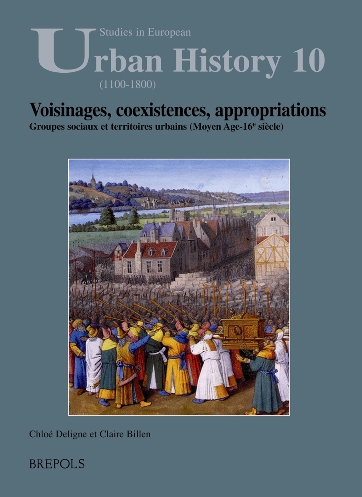
Voisinages, coexistences, appropriations
show More to view fulltext, buy and share links for:Voisinages, coexistences, appropriations show Less to hide fulltext, buy and share links for: Voisinages, coexistences, appropriationsFruit des travaux du colloque intitulé «Groupes sociaux et territoires urbains (Moyen Age-16e siècle)» organisé en décembre 2004 à l’Université Libre de Bruxelles, cet ouvrage rassemble douze contributions originales consacrées aux dynamiques sociales de l’espace urbain en Europe de l’ouest durant le bas Moyen Âge.
Dans sa première partie, l’ouvrage montre la structuration à long terme de l’espace urbain par les stratégies d’occupation de groupes dominants: chapitres canoniaux, élites scabinales, métiers (Tours, Namur, Trévise). Il confronte ce processus d’appropriation à la capacité de réagencement matériel ou symbolique déployée par certains acteurs urbains. Accident aléatoire (Tortosa), circonstances politiques (Bruges), modulation des rapports à la ville (Ratisbonne) redessinent les territoires respectifs, rallument sans cesse la lutte pour la maîtrise de l’espace et de ses éléments signifiants.
Dans sa seconde partie, l’ouvrage donne à penser la société urbaine dans ses relations avec des horizons plus lointains. Dans un premier temps sont abordées les relations des villes avec leur arrière-pays, sur lequel les groupes citadins dominants réinventent sans cesse les modalités économiques et juridiques de leur contrôle (Bruxelles, Chieri, Dijon). Dans un second temps, sont considérées les armatures urbaines de certains territoires (Brabant, Hainaut, Saint-Empire) dont la vivacité économique dépend de l’intensité des relations marchandes.
Les articles réunis ici éclairent, souvent d’un jour nouveau, non seulement l’histoire singulière des villes concernées mais plus fondamentalement les processus et les logiques à l’œuvre dans l’agencement et le réagencement permanent des espaces urbains.
-
-
-
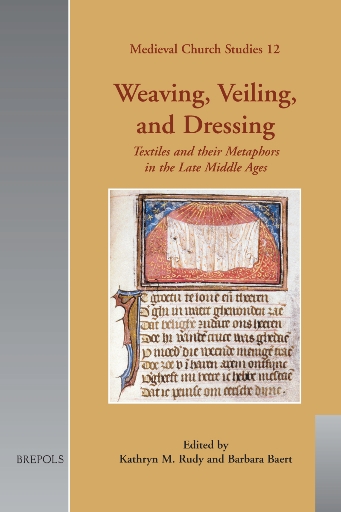
Weaving, Veiling, and Dressing
show More to view fulltext, buy and share links for:Weaving, Veiling, and Dressing show Less to hide fulltext, buy and share links for: Weaving, Veiling, and DressingChristianity is a religion of clothing. To become a priest or a nun is to take the cloth. The Christian liturgy is intimately bound with veiling objects and revealing them. Cloths hide the altar, making it all the more spectacular when it is revealed. Fragments of imported silk cradle the relic, thereby giving identity to the dessicated bone. Much of that silk came from the east, meaning that a material of Islamic origin was a primary signifier of sanctity in Christianity. Weaving, Veiling, and Dressing brings together twelve essays about text and textile, about silk and wool, about the formation of identity through fibre. The essays bring to light hitherto unseen material, and for the first time, establish the function of textiles as a culturally rich way to approach the Middle Ages. Textiles were omnipresent in the medieval church, but have not survived well. To uncover their uses, presence, and meanings in the Middle Ages is to reconsider the period spun, draped, clothed, shrouded, and dressed. Textiles in particular were essential to the performance of devotion and of the liturgy. Brightly dyed cloth was a highly visible maker of meaning. While some aspects of culture have been studied, namely the important tapestry industry, as well as some of the repercussions and activities of cloth guilds, other areas of textile studies in the period are yet to be studied. This book brings an interdisciplinary approach to new material, drawing on art history, anthropology, medieval text history, theology, and gender and performance studies. It makes a compelling miscellany exploring the nature of Christianity in the largely uninvestigated field of text and textile interplay.
-
-
-
Études d’exégèse carolingienne: autour d’Haymon d’Auxerre
show More to view fulltext, buy and share links for:Études d’exégèse carolingienne: autour d’Haymon d’Auxerre show Less to hide fulltext, buy and share links for: Études d’exégèse carolingienne: autour d’Haymon d’AuxerreL’interprétation juste de la Bible constitue l’un des principaux enjeux de la renaissance carolingienne. Révéler le sens du Livre, en partie déterminé par la tradition exégétique, revient à fournir aux réformateurs modèles et prescriptions. En cela, l’exégèse est une source majeure non seulement pour l’histoire culturelle, mais aussi pour l’histoire des représentations. Pourtant, les commentaires bibliques demeurent, aujourd’hui encore, peu utilisés par les historiens, en partie parce que les textes sont souvent inédits.
C’est à ces sources que s’attache le présent volume, rassemblant les contributions d’un atelier de recherches tenu à Auxerre les 25 et 26 avril 2005. Le champ balayé par ces études, centrées sur la figure d’un exégète carolingien majeur, Haymon d’Auxerre, est vaste: critique d’authenticité, examen de la tradition manuscrite, comparaison avec les sources et les contemporains du moine d’Auxerre pour comprendre la spécificité de sa pensée. Il en résulte une connaissance plus fine non seulement de l’exégèse du maître auxerrois, mais aussi des échanges entre lettrés carolingiens et de la postérité médiévale de leurs œuvres.
-
-
-
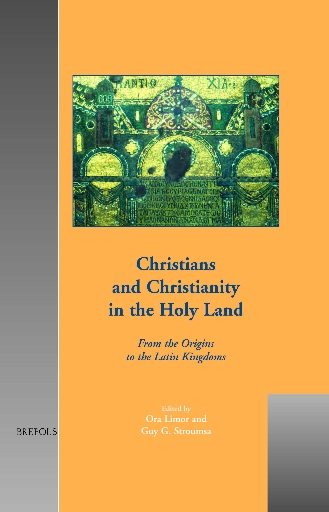
Christians and Christianity in the Holy Land
show More to view fulltext, buy and share links for:Christians and Christianity in the Holy Land show Less to hide fulltext, buy and share links for: Christians and Christianity in the Holy LandThis volume fills a major desideratum in historical scholarship on the religious history of the Holy Land. It presents a synthesis of our knowledge of the history of Christianity and the various churches that coexisted there from the beginnings of Christianity to the fall of the Crusader Kingdoms. It also offers analytical studies of major topics and problems. While the first part is organized chronologically, the second follows a thematic plan, dealing with the major themes pertaining to the topic, from various points of view and covering several disciplinary fields: history, theology, archaeology, and art history. The volume represents the outcome of an international project initiated by Yad Izhak Ben-Zvi of Jerusalem, and the contributors are leading experts in their fields.
-
-
-
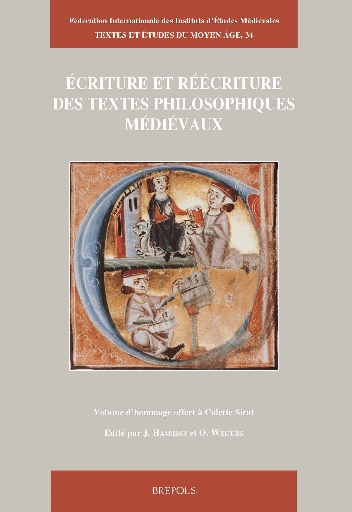
Ecriture et réécriture des textes philosophiques médiévaux
show More to view fulltext, buy and share links for:Ecriture et réécriture des textes philosophiques médiévaux show Less to hide fulltext, buy and share links for: Ecriture et réécriture des textes philosophiques médiévauxPhilosophe et paléographe, Colette Sirat s’est illustrée dans ces deux domaines pendant toute sa carrière académique. Un fil conducteur relie d’ailleurs ces deux secteurs d’activité: les manuscrits qui sont toujours à la base de ses recherches, fournissant ainsi les sources mêmes et les documents de première main de ses études philosophiques.
Ses publications ont fait date tant dans l’histoire de la philosophie juive que dans les études de paléographie hébraïque et d’histoire de l’écriture. Le thème de ce volume la préoccupe depuis bien longtemps. En effet, la manière d’écrire des textes au moyen âge, la réécriture constante pour beaucoup d’entre eux, constitue un sujet encore peu étudié, bien qu’il s’agisse d’un trait essentiel de la culture écrite de cette époque. Il a été limité aux textes philosophiques, domaine dans lequel ce phénomène est particulièrement présent et qui est l’un des terrains de chasse de la récipiendaire.
Dans tous ses travaux, on découvre les mêmes traits fondamentaux, dont une grande curiosité intellectuelle, une largeur de vue due à un vaste programme de lectures dans des domaines très divers et une richesse d’idées nouvelles sont peut-être les plus marquants.
-
-
-
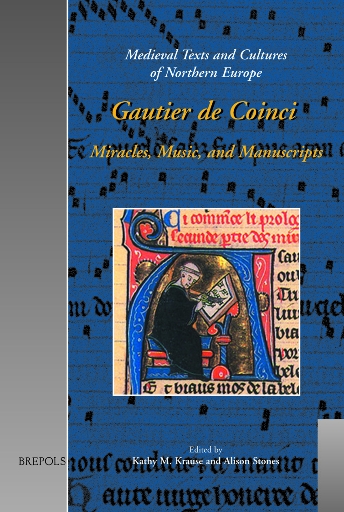
Gautier de Coinci
show More to view fulltext, buy and share links for:Gautier de Coinci show Less to hide fulltext, buy and share links for: Gautier de CoinciGautier de Coinci (c. 1177-1236) was a Benedictine prior, a poet and composer, and the author of several very popular religious works, including a large collection of Miracles of the Virgin in French, which enjoyed a wide circulation during the Middle Ages. Gautier drew on multiple Latin sources for his work, embellishing and personalizing them as he adapted them to his poetic design. Conceiving of his collection of miracles as a complete work, Gautier carefully organized the tales into two books, framing each with authorial exordia and lyrics praising the Virgin. In addition to its obvious literary interest, the subsequent manuscript tradition offers a remarkable panorama of medieval manuscript production, in particular due to the fascinating combination of text, music and illustration. Bringing together a select group of scholars from multiple disciplines (including art history, musicology, and literary studies), this collection of essays explores complementary aspects of Gautier, his works, and his manuscripts. The volume offers both breadth and depth in its examination of Gautier de Coinci and his Miracles de Nostre Dame. It promises to redefine Gautier studies through its interdisciplinary consideration of the varied facets of his work as it makes available to scholars and students the first interdisciplinary examination of this key figure in medieval vernacular religious culture.
-
-
-
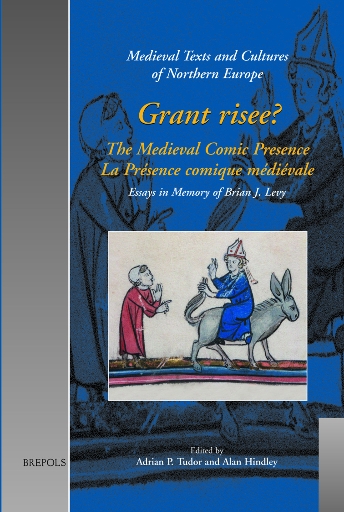
Grant risee?
show More to view fulltext, buy and share links for:Grant risee? show Less to hide fulltext, buy and share links for: Grant risee?Celebrating the work of Brian J. Levy in the realm of comedy and humour in the Middle Ages, this collection of twenty essays explores unusual, unexpected or unacknowledged elements of humour in medieval literature and art. Scholars from Britain, France, Italy, the USA, Denmark, and the Netherlands consider comic elements taking an unusual form; a comic presence in unexpected places; comic elements intentionally or unintentionally hidden; comic elements surprisingly vaunted; a comic presence in standard contexts which stands out for a particular reason; comic elements which are for some reason controversial; comic elements as yet unidentified or unacknowledged; a commonly acknowledged comic presence which is in fact no such thing. Essays in English and French deal with a broad range of subjects. If the Roman de Renart is particularly well represented amongst these essays, other subjects make up the majority of the book. These include: Cicero’s De Oratorei; the Mannekin pis; late-medieval wall paintings; German and French Drama; fabliaux; vernacular pious tales and dits; the romance epic Richard Coeur de Lyon; Les Quinze joyes de mariage; bestiaries; and misericords. Sometimes shocking, often surprising, and always intriguing, the medieval comic presence rarely corresponds to our expectations and assumptions. This book shows that in numerous cases the medieval joke is actually on the modern scholar.
-