
Full text loading...



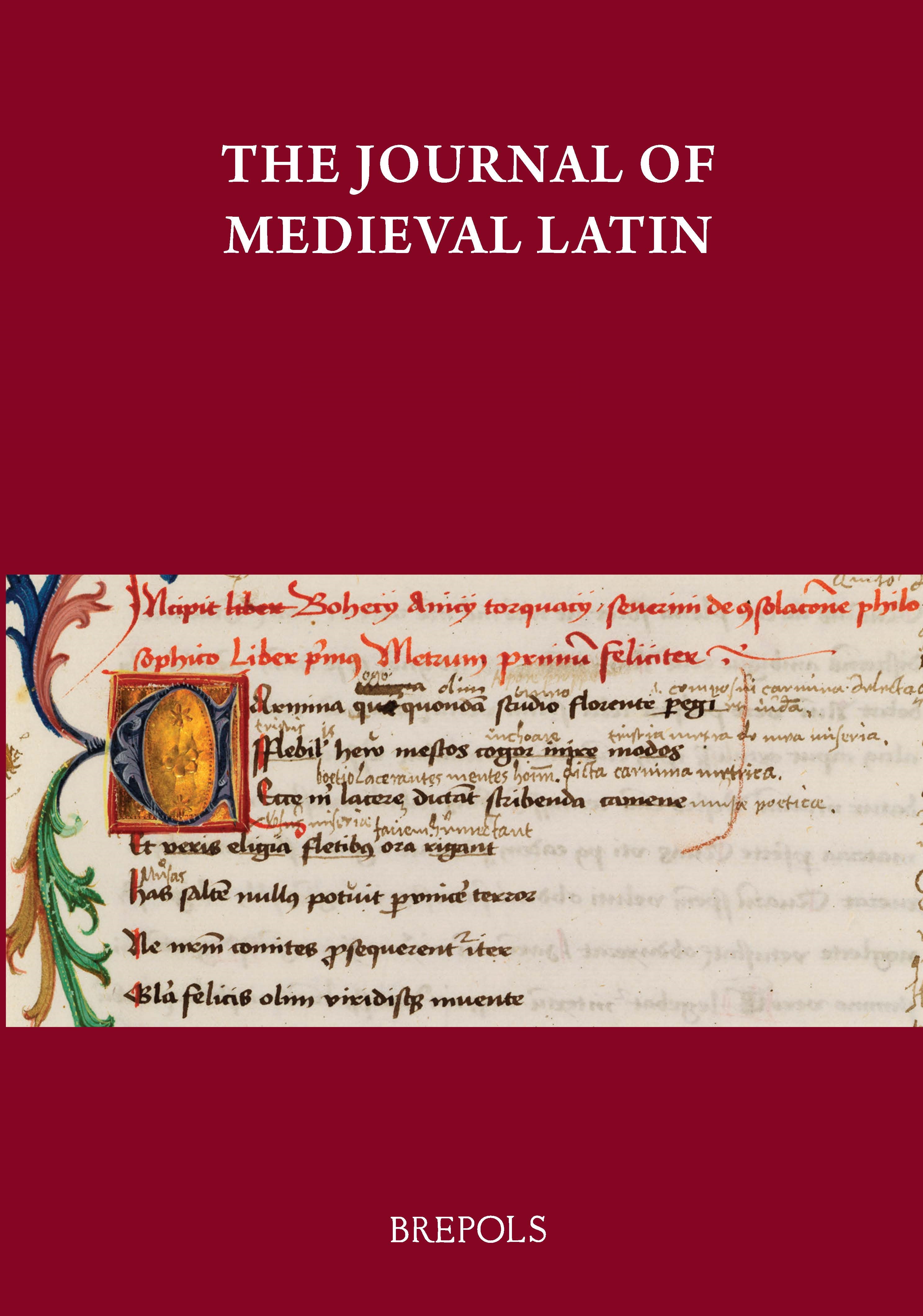
The Ars Ambrosiana is an anonymous commentary on Donatus’s Ars maior transmitted in Milan, Biblioteca Ambrosiana, MS L 22 sup. (saec. IX¾, Bobbio), fols. 1r-145v. Modern scholars generally agree that it was compiled by an Irish scholar at Bobbio in the seventh century. The article argues contrary to the consensus that the compiler was not Irish. New evidence is presented in favour of the hypothesis, specifically an Old Irish textual element embedded in the grammar, which the compiler attempted to explain but misunderstood entirely. The most logical conclusion is that the compiler was a Continental scholar who used an Irish grammatical source, from which he derived the Old Irish material. The article also identifies passages that may have originated in the Irish source and uses evidence contained within them to establish an approximate date of composition. Finally, the article proposes a new criterion for dating the Ars Ambrosiana and argues for a composition date between 650 and 800.
AbstractL’Ars Ambrosiana est un commentaire anonyme sur l’Ars maior de Donat, transmis par le biais de Milan, Biblioteca Ambrosiana, MS L 22, sup. (saec. IX¾, Bobbio), fols. 1r-145v. De nos jours les chercheurs s’entendent généralement pour affirmer que l’oeuvre a été compilée par un érudit irlandais à Bobbio au cours du VIIe siècle. Cet article va à l’encontre du consensus scientifique et soutient que le compilateur n’était pas irlandais. Il présente de nouvelles preuves pour démontrer cette hypothèse, en particulier un élément textuel en vieil irlandais inclus dans la grammaire, que le compilateur a tenté d’expliquer mais qu’il a tout à fait mal compris. La conclusion la plus logique s’avère donc que le compilateur aurait été un érudit originaire du Continent, ayant employé une source grammaticale irlandaise, de laquelle il aurait dérivé quelque matière en vieil irlandais. Cet article identifie également des passages qui auraient pu provenir de la source irlandaise et utilise des indices fournis par ces mêmes passages pour établir une date de composition approximative. En dernier lieu, l’article propose un nouveau critère pour la datation de l’Ars Ambrosiana et avance une date de composition se situant entre 650 et 800.