


The Journal of Medieval Latin
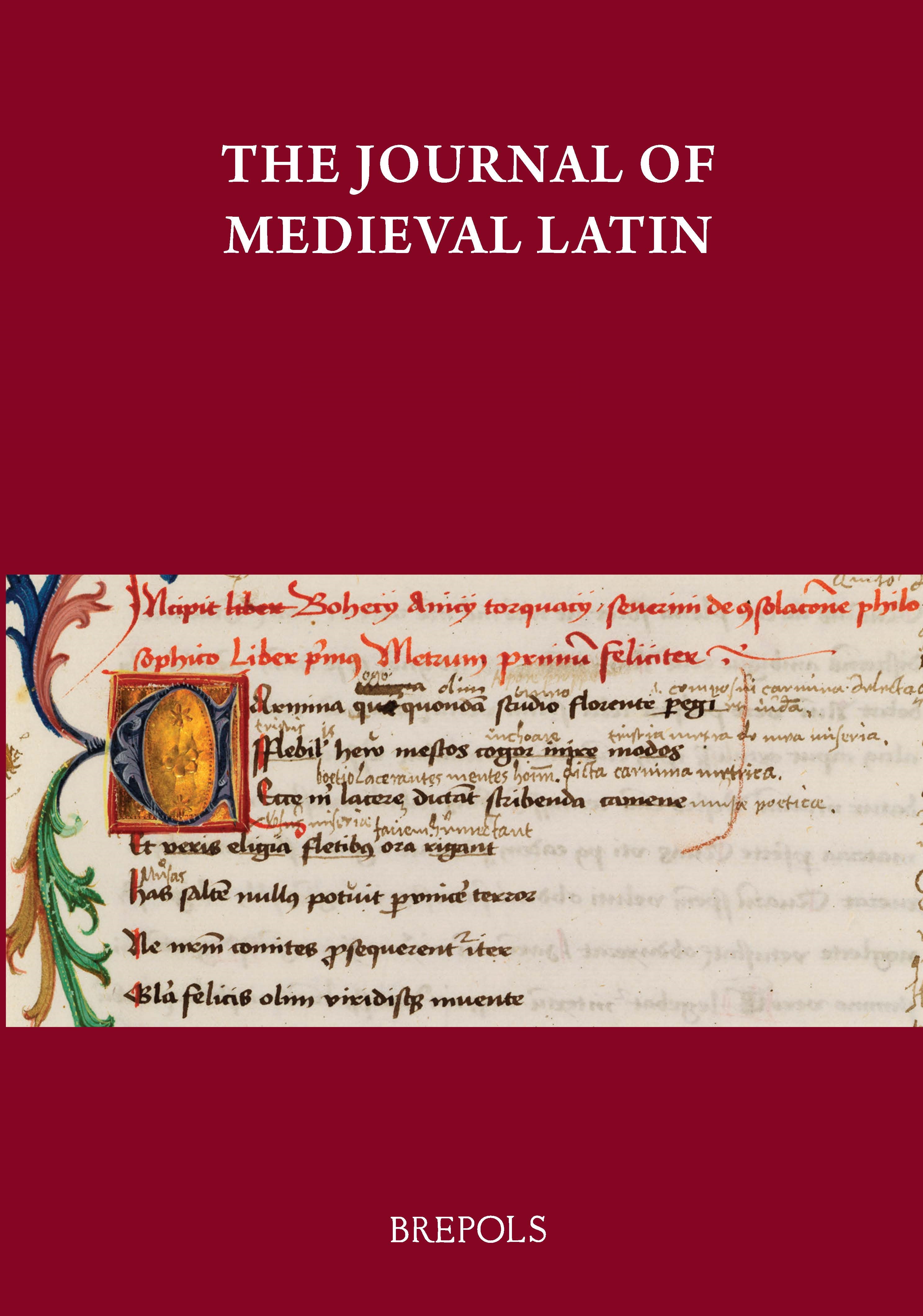
Volume 30, Issue 1, 2020
-
-
Front Matter (“Thirty Years of The Journal of Medieval Latin”, “In memoriam Édouard Jeauneau (1924-2019)”, “In memoriam Richard Sharpe (1954-2020)”, “In memoriam Peter Dronke (1934-2020)”)
show More to view fulltext, buy and share links for:Front Matter (“Thirty Years of The Journal of Medieval Latin”, “In memoriam Édouard Jeauneau (1924-2019)”, “In memoriam Richard Sharpe (1954-2020)”, “In memoriam Peter Dronke (1934-2020)”) show Less to hide fulltext, buy and share links for: Front Matter (“Thirty Years of The Journal of Medieval Latin”, “In memoriam Édouard Jeauneau (1924-2019)”, “In memoriam Richard Sharpe (1954-2020)”, “In memoriam Peter Dronke (1934-2020)”)
-
-
-
Stephen of Ripon’s Vita S. Wilfridi: Genre, Political Theory and Historical Representation in the Early Middle Ages
show More to view fulltext, buy and share links for:Stephen of Ripon’s Vita S. Wilfridi: Genre, Political Theory and Historical Representation in the Early Middle Ages show Less to hide fulltext, buy and share links for: Stephen of Ripon’s Vita S. Wilfridi: Genre, Political Theory and Historical Representation in the Early Middle AgesBy: Evan WilsonAbstractThis article argues that the battle narratives in Stephen of Ripon’s Vita S. Wilfridi (VSW) intervene in and illuminate the connected histories of genre, political theory, and historical representation in the early Middle Ages. As I demonstrate, battle narratives are ubiquitous in early medieval “histories,” but only tend to occur in saints’ lives in the context of miracle sto- ries. Moreover, the manner of representing battle in both genres preserves a distinction be- tween political and religious spheres of action. However, the battle narratives in the VSW con- tain no miracles; instead, they argue that Wilfrid’s sanctity as bishop was transferred to King Ecgfrith and Northumbria as actors on the stage of political history. To carry out this argument, Stephen intersperses his battle narratives with discourses of ideal kingship and biblical typology. The model of sanctity he thus deploys, and the theory of closely coordinated royal and ecclesiastical power that underpins it, reflect a missionary ideology that would later be enacted in Bede’s Historia ecclesiastica and in histories from the Carolingian period. Stephen’s novel use of the battle narrative suggests that the boundary between vitae and historiae was both permeable and productive; it enabled him and others to construct a sacralised political sphere in historical narrative.
AbstractCet article avance que les récits de bataille dans la Vita S. Wilfridi (VSW) d’Étienne de Ripon contribuent et jettent une lumière sur l’histoire interreliée du genre littéraire, de la théorique politique et de la représentation historique au haut Moyen Âge. Comme je le démontre, les récits de bataille sont omniprésents dans les « histoires » du haut Moyen Âge, mais dans les vies de saints, elles ont seulement tendance à apparaître dans le contexte de récits miraculeux. Qui plus est, la façon de représenter les scènes de bataille dans ces deux genres littéraires maintient une distinction entre deux sphères d’action, l’une politique et l’autre religieuse. Cependant, les récits de bataille dans la VSW ne contiennent pas de miracles; elles font plutôt valoir que la sainteté de Wilfrid en tant qu’évêque s’est transférée au roi Ecgfrith et à la Northumbrie en tant qu’acteurs sur la scène de l’histoire politique. Afin de d’étayer cet argument, Étienne entremêle ses récits de bataille de références à la royauté idéale et à la typologie biblique. Le modèle de sainteté qu’il met de l’avant ainsi que la théorie sous-tendant ce même modèle, alliant étroitement pouvoirs royal et épiscopal, se font l’écho d’une idéologie missionnaire qui serait plus tard mise en pratique par l’Historia ecclesiastica de Bède et les histoires de l’époque carolingienne. La vision innovatrice que démontre l’emploi des récits de bataille par Étienne laisse entendre que la frontière entre vitae et historiae était à la fois perméable et productive; elle permettait à des auteurs comme Stéphane de construire une sphère politique sacralisée au sein d’un récit historique.
-
-
-
Charlemagne’s Failure of Charity in Ps. Turpin’s Chronicle and Beyond
show More to view fulltext, buy and share links for:Charlemagne’s Failure of Charity in Ps. Turpin’s Chronicle and Beyond show Less to hide fulltext, buy and share links for: Charlemagne’s Failure of Charity in Ps. Turpin’s Chronicle and BeyondBy: Benjamin GarstadAbstractThe Chronicle of ps. Turpin is disparaged for its compositional failings, but it has its strengths too. These are exemplified by the episode in which the pagan king Aigolande upbraids Charlemagne for neglecting to provide for the paupers he sustains as well as the clergymen of his court. On account of Charlemagne’s oversight Aigolande refuses baptism and continues the war that eventually results in Roland’s death. This episode serves many purposes; it pro- vides coherence to the narrative, motivation and sympathetic humanity to the antagonists of the piece, depth and fallibility to the character of Charlemagne, substance to the character of Turpin himself, and a punch to a moral lesson the Chronicle attempts to deliver. Its im- portance was recognized in the ps. Turpin tradition, and the remarkably subtle and effective device of turning the criticisms of a heathen on the faults of Christian society was adapted and repeated for centuries.
AbstractLa Chronique du Ps. Turpin a souvent été critiquée en raison de ses défauts de compositions, mais elle comporte également des qualités. Celles-ci sont mises en évidence par l’épisode dans lequel le roi païen Aigolande semonce Charlemagne, l’accusant d’avoir négligé de subvenir aux besoins des pauvres sous sa protection ainsi qu’à ceux des hommes d’Églises de sa cour. Au nom de la négligence de Charlemagne, Aigolande refuse le baptême et continue la guerre qui mènera éventuellement à la mort de Roland. Cet épisode remplit plusieurs fonctions : il donne une cohérence au récit, des motifs et une humanité aux antagonistes du récit, une profondeur et une certaine faillibilité à la figure de Charlemagne, de la substance au person- nage de Turpin lui-même et finalement, de la force à la leçon morale que la Chronique tente de transmettre. L’importance de cet épisode a été reconnue par la tradition du Ps. Turpin, et la technique remarquablement subtile et efficace de diriger les critiques d’un païen contre les fautes de la société chrétienne a été adaptée et émulée pendant des siècles.
-
-
-
On the Date, Authorship, and Newly Discovered Old Irish Material in the Ars Ambrosiana
show More to view fulltext, buy and share links for:On the Date, Authorship, and Newly Discovered Old Irish Material in the Ars Ambrosiana show Less to hide fulltext, buy and share links for: On the Date, Authorship, and Newly Discovered Old Irish Material in the Ars AmbrosianaBy: Jason O’RorkeAbstractThe Ars Ambrosiana is an anonymous commentary on Donatus’s Ars maior transmitted in Milan, Biblioteca Ambrosiana, MS L 22 sup. (saec. IX¾, Bobbio), fols. 1r-145v. Modern scholars generally agree that it was compiled by an Irish scholar at Bobbio in the seventh century. The article argues contrary to the consensus that the compiler was not Irish. New evidence is presented in favour of the hypothesis, specifically an Old Irish textual element embedded in the grammar, which the compiler attempted to explain but misunderstood entirely. The most logical conclusion is that the compiler was a Continental scholar who used an Irish grammatical source, from which he derived the Old Irish material. The article also identifies passages that may have originated in the Irish source and uses evidence contained within them to establish an approximate date of composition. Finally, the article proposes a new criterion for dating the Ars Ambrosiana and argues for a composition date between 650 and 800.
AbstractL’Ars Ambrosiana est un commentaire anonyme sur l’Ars maior de Donat, transmis par le biais de Milan, Biblioteca Ambrosiana, MS L 22, sup. (saec. IX¾, Bobbio), fols. 1r-145v. De nos jours les chercheurs s’entendent généralement pour affirmer que l’oeuvre a été compilée par un érudit irlandais à Bobbio au cours du VIIe siècle. Cet article va à l’encontre du consensus scientifique et soutient que le compilateur n’était pas irlandais. Il présente de nouvelles preuves pour démontrer cette hypothèse, en particulier un élément textuel en vieil irlandais inclus dans la grammaire, que le compilateur a tenté d’expliquer mais qu’il a tout à fait mal compris. La conclusion la plus logique s’avère donc que le compilateur aurait été un érudit originaire du Continent, ayant employé une source grammaticale irlandaise, de laquelle il aurait dérivé quelque matière en vieil irlandais. Cet article identifie également des passages qui auraient pu provenir de la source irlandaise et utilise des indices fournis par ces mêmes passages pour établir une date de composition approximative. En dernier lieu, l’article propose un nouveau critère pour la datation de l’Ars Ambrosiana et avance une date de composition se situant entre 650 et 800.
-
-
-
Clerical Concubines: Three Poems
show More to view fulltext, buy and share links for:Clerical Concubines: Three Poems show Less to hide fulltext, buy and share links for: Clerical Concubines: Three PoemsBy: A.G. RiggAbstractThis article presents a new edition and the first English translation of three satirical poems that address the issue of the celibacy of the clergy. The poems, Nouus Rumor Anglie, Prisciani Regula, and Clerus et Presbiteri, were first published in modern times by Thomas Wright in 1841. The three texts are written in quatrains of regular Goliardic verse and the topic in all is the opposition of the clergy to attempts to ban clerical marriage or concubinage. Even though the themes in the three poems are similar, their narratives and structures vary widely. It is impossible to be precise about the date of composition, but the first half of the thirteenth century can be postulated. There is a very strong connection to England which is probably where the poems were written.
AbstractCet article offre une nouvelle édition et la première traduction anglaise de trois poèmes satiriques portant sur le célibat du clergé. Les poèmes, Nouus Rumor Anglie, Prisciani Regula, et Clerus et Presbiteri, ont été publiés pour la première fois à l’époque contemporaine par Thomas Wright en 1841. Ces trois textes ont été composés en quatrains de la forme régulière goliardique et tous traitent le sujet de l’opposition du clergé face aux tentatives de prohiber le mariage des clercs ou le concubinage. Bien que les thèmes abordés par les trois poèmes soient similaires, les récits qu’ils relatent et la structure qui les définit varient grandement. Il est impossible d’être précis quant à la date de composition de ces textes, mais on peut avancer comme hypothèse la première moitié du XIIIe siècle. On trouve également dans ces oeuvres un lien fort avec l’Angleterre, lieu où elles ont probablement été rédigées.
-
-
-
Payen Bolotin’s Targeting of the Tironensians and Cistercians in his De Falsis Heremitis
show More to view fulltext, buy and share links for:Payen Bolotin’s Targeting of the Tironensians and Cistercians in his De Falsis Heremitis show Less to hide fulltext, buy and share links for: Payen Bolotin’s Targeting of the Tironensians and Cistercians in his De Falsis HeremitisBy: David A. TraillAbstractWritten in 1130, Payen’s poem provides a vivid picture of the reaction of a canon of Chartres to the burgeoning eremitical orders of the twelfth century. After summarizing the poem, the article goes on to suggest that while the author avoids explicitly identifying which monastic orders he is criticizing, a thinly veiled reference to Bernard of Clairvaux at line 163 makes it clear that the Cistercians are principally to blame. However, it was the Tironensians who lived closest to Chartres and, now led by an entrepreneurial abbot, were successfully contending with the Chartres chapter for support from the bishop, the local aristocracy, and ordinary people, and it is now clear, thanks to Kathleen Thompson’s excellent study of their order that they are also targeted and to a greater extent than she suggests. The article concludes with the Latin text and the first translation of the poem.
Abstractchanoine de Chartres sur la naissance des ordres érémitiques du XIIe siècle. Cet article débute avec un résumé du poème. Il propose ensuite que, bien que Payen se garde d’identifier explicitement les ordres monastiques dont il fait la critique, une allusion peu subtile à Bernard de Clairvaux (au vers 163) démontre clairement que ce sont les Cisterciens qui font les frais des reproches de l’auteur. Pourtant, les Tironiens étaient ceux qui vivaient le plus proche de Chartres et qui, sous la direction d’un abbé entreprenant, rivalisaient avec bien du succès contre le chapitre de Chartres pour l’appui de l’évêque, des aristocrates de la région et du peuple. Il est désormais évident, grâce à l’excellente monographie de Kathleen Thompson sur les Tironiens, qu’ils sont eux aussi visés dans le poème, et ce même davantage que Thompson l’a suggéré. L’article se termine avec le texte latin du poème et sa toute première traduction en anglais.
-
-
-
Breuiarium Artis grammaticae Alcuini: Edition and Study
show More to view fulltext, buy and share links for:Breuiarium Artis grammaticae Alcuini: Edition and Study show Less to hide fulltext, buy and share links for: Breuiarium Artis grammaticae Alcuini: Edition and StudyBy: Isabela GrigorașAbstractAlcuin’s Ars grammatica is preserved in twenty-four manuscripts, either completely or partially. Only one ninth century manuscript from Biblioteca Apostolica Vaticana, MS Reg. lat. 251, transmits an abridged version of it. This study presents a critical edition of the Breviarium Artis grammaticae Alcuini, preceded by a presentation of the context in which the text was written and a description of the Vatican manuscript. Furthermore, it offers an analysis of the structure of the Breviarium compared to that of the Ars grammatica and also a discussion of the interpolations from other texts. The purpose of this edition is, on the one hand, to bring to light a textus unicus from the textual tradition of the Ars grammatica, and, on the other, to present the work of an early medieval abbreviator by preserving, as much as possible, its phonetic and orthographic peculiarities.
AbstractL’Ars grammatica d’Alcuin est conservée, complètement ou partiellement, dans vingt-quatre manuscrits. Un seul manuscrit du neuvième siècle siècle de la Biblioteca Apostolica Vaticana, MS Reg. lat. 251, en transmet une version abrégée. Cette étude présente une édition critique du Breviarium Artis grammaticae Alcuini, précédée d’une présentation du contexte dans lequel le texte a été composé et d’une description du manuscrit du Vatican. En outre, cette étude offre une analyse de la structure du Breviarium par rapport à l’Ars grammatica et des interpolations d’autres textes. Le but de cette édition est, d’une part, de mettre en lumière un textus unicus issu de la tradition textuelle de l’Ars grammatica et, d’autre part, de présenter le travail d’un abréviateur du haut Moyen Âge, en préservant, autant que possible, ses particularités phonétiques et orthographiques.
-
-
-
A New Manuscript Source for the Legend of Saint Clement in Denmark
show More to view fulltext, buy and share links for:A New Manuscript Source for the Legend of Saint Clement in Denmark show Less to hide fulltext, buy and share links for: A New Manuscript Source for the Legend of Saint Clement in DenmarkBy: Åslaug OmmundsenAbstractAmong the manuscript fragments in the Norwegian and Danish National Archives in Oslo and Copenhagen, six fragments have been identified from a large manuscript from about 1200 containing texts on St. Clement. These fragments constitute rare medieval witnesses to the work on St. Clement written by Leo of Ostia at the beginning of the twelfth century, transmitting parts of the first and third book: De origine beati Clementis (BHL 1851ab) and De translatione sancti Clementis (also known as Legenda italica) (BHL 2073). Although five fragments are found in Oslo and one in Copenhagen, the manuscript was probably dismembered in Copenhagen in the early seventeenth century, making a Danish medieval ownership more likely than a Norwegian one in this particular case.
St. Clement played a significant role in Denmark and the rest of Scandinavia, and the lack of surviving Latin texts on Clement has previously been puzzling to scholars. Not only do these fragments testify to the dissemination of Leo of Ostia’s work to the northernmost parts of Europe, they also in several cases offer a better transmission of the author’s texts than the manuscripts known up to now. A transcription of the transmitted texts is presented in an Appendix.
AbstractParmi les fragments de manuscrits des Archives nationales d’Oslo et de Copenhague, six fragments ont été identifiés comme provenant d’un manuscrit de grande taille, datant d’environ l’an 1200 et contenant des textes sur saint Clément. Ces fragments constituent de rares témoins médiévaux de l’oeuvre sur saint Clément rédigée par Léon d’Ostie au commencement du XIIe siècle et ils transmettent des sections du premier et du troisième livre de cette oeuvre: De origine beati Clementis (BHL 1851ab) et De translatione sancti Clementis (aussi connue sous le titre de la Legenda italica) (BHL 2073). Bien que cinq fragments puissent être trouvés à Oslo et un seul à Copenhague, le manuscrit d’origine a probablement été démembré à Copenhague au début du XVIIe siècle. Ceci rend plus plausible la possibilité que ce manuscrit soit d’appartenance danoise plutôt que norvégienne.
Saint Clément a joué un rôle important au Danemark ainsi que dans le reste de la Scandinavie. Pourtant, on y a retrouvé peu de textes latins sur Clément au grand étonnement des chercheurs. Ces fragments témoignent non seulement de la dissémination de l’oeuvre de Léon d’Ostie jusqu’aux régions les plus septentrionales d’Europe, elles offrent de surcroît dans plusieurs cas une meilleure transmission des textes de l’oeuvre que les manuscrits connus des chercheurs jusqu’à aujourd’hui. Une transcription des textes transmis est présentée dans l’appendice.
-
-
-
The Manuscript Tradition of Burchard of Mount Sion’s Descriptio Terre Sancte
show More to view fulltext, buy and share links for:The Manuscript Tradition of Burchard of Mount Sion’s Descriptio Terre Sancte show Less to hide fulltext, buy and share links for: The Manuscript Tradition of Burchard of Mount Sion’s Descriptio Terre SancteBy: Jonathan RubinAbstractBurchard of Mount Sion’s Descriptio Terre Sancte is well known to scholars of the medieval Holy Land as a systematic account of that territory composed in the 1280s. It was also extremely popular in late medieval and early modern times, as is made clear by the considerable number of extant manuscripts and printed editions which provide it. And yet, very little is known about the text as Burchard actually composed it and about the way it evolved over time. The aim of this paper is to propose, for the first time, a full survey of the manuscripts providing the so-called long version of the Descriptio, revealing their division into families as well as the relations between them. It is hoped that this analysis will bring us much closer to Burchard’s original text and, at the same time, facilitate future studies on specific problems related to the Descriptio’s tradition and reception.
AbstractLa Descriptio Terre Sancte de Burchard de Mont Sion, rédigée vers 1280, est une oeuvre familière aux spécialistes de la Terre Sainte médiévale, qui la considèrent comme un compterendu systématique de cette région. Ce texte connut également une grande popularité au cours du bas Moyen Âge ainsi qu’au début de l’époque moderne, comme le démontre le vaste nombre de manuscrits et d’éditions imprimées de cette oeuvre qui nous sont parvenus. Pourtant, nous savons très peu de choses sur le texte tel qu’il fut rédigé par Burchard ainsi que sur la façon dont il a évolué au fil du temps. Le but de cet article est d’offrir, pour la première fois, une étude exhaustive de tous les manuscrits de ce qu’on appelle la “longue version” de la Descriptio. Nous analyserons les différentes familles de manuscrits ainsi que les rapports entre celles-ci. Nous espérons que cette étude permettra nous rapprocher du texte original de Burchard, et en même temps facilitera la recherche concernant la tradition et la réception de la Descriptio Terre Sancte.
-
-
-
English Hebraism and Hermeneutic History: The Psalter Prologues and Epilogue of Henry Cossey, OFM
show More to view fulltext, buy and share links for:English Hebraism and Hermeneutic History: The Psalter Prologues and Epilogue of Henry Cossey, OFM show Less to hide fulltext, buy and share links for: English Hebraism and Hermeneutic History: The Psalter Prologues and Epilogue of Henry Cossey, OFMBy: Andrew KraebelAbstractThis article presents the first edition and English translation of substantial selections from the Psalter commentary of Henry Cossey, OFM (d. ca. 1336). Though largely absent from recent discussions of medieval Christian Hebraism, Cossey evidently learned some Hebrew, and he used this knowledge to critique other recent literalistic exegetes, most prominently Nicholas Trevet and Nicholas of Lyre. An introductory essay places Cossey’s work at Oxford ca. 1330, discusses the complex program of marginal notes in the single surviving manuscript (Cambridge, Christ’s College, MS 11), and explores some of his critical disagreements with Trevet and Lyre. The edition and translation include his prologues and an epilogue on Hebrew prepositions.
AbstractCet article présente la première édition et traduction anglaise de sélections majeures du commentaire du Psautier d’Henri Cossey, OFM (mort vers 1336). Bien qu’il soit largement absent des récentes discussions autour de l’hébraïsme chrétien médiéval, il semble clair que Cossey ait acquis quelques connaissances de l’hébreu et qu’il s’en servît pour critiquer d’autres exégètes littéralistes contemporains, en particulier Nicolas Trevet et Nicolas de Lyre. Un essai introductif situe les activités de Cossey à Oxford vers 1330, aborde le programme complexe d’annotations marginales qu’on retrouve dans le seul manuscrit nous étant parvenu (Cambridge, Christ’s College, MS 11) et se penche sur certains des désaccords critiques de Cossey avec Trevet et Lyre. L’édition et la traduction comportent les prologues de Cossey et son épilogue qui traite des prépositions en hébreu.
-
-
-
Latin Poetic Stories About Muhammad and Their Stylistic Network
show More to view fulltext, buy and share links for:Latin Poetic Stories About Muhammad and Their Stylistic Network show Less to hide fulltext, buy and share links for: Latin Poetic Stories About Muhammad and Their Stylistic NetworkBy: Francesco StellaAbstractThe Latin verse lives of Mohammed appear suddenly between the eleventh and twelfth centuries, developing in a novelistic direction the scant information found in the prose biographies of the Prophet written between the eight and tenth centuries. The poems of Embrico of Mainz (saec. XI/XII) and Walter of Compiègne (saec. XII) go beyond the educational and apologetic needs raised by the crusader culture and show a special attention to the structure of the narrative. The literary climate of the twelfth century combines tenth-century poetic hagiography, the Arab tales of Peter Alfonsi, and eleventh-century novels to develop a relatively homogeneous narrative about Mohammed, which in the period of the Crusades is accompanied by more or less imaginary elements and subsequent rewriting of the main episodes in the story. Still, only versification, which reflects the influence of both the satirical style in vogue from the twelfth century onwards and its expressive naturalistic and erotic lexicon, allows the European literature of the earlier Middle Ages to transform the figure of Muhammad into a brilliant and lucky picaro, and Islam into an imaginary republic of sexual liberation.
AbstractLes vies latines en vers de Mahomet font soudainement leur apparition entre le XIe et le XIIe siècle, élaborant de façon romanesque le peu d’information qu’on trouve dans les biographies en prose du Prophète, rédigées entre le VIIIe et le Xe siècle. Les poèmes hagiographiques d’Embrico de Mayence et de Gauthier de Compiègne font bien plus que seulement subvenir aux besoins éducatifs et apologétiques issus de la culture croisée et démontrent plutôt une attention particulière à la structure du récit. Le climat littéraire du XIIe siècle se conjugue alors à l’hagiographie en vers du XIIe siècle, aux contes arabes traduits par Pierre Alfonsi et aux romans et aux comédies élégiaques du XIIe siècle pour constituer un récit relativement homogène à propos de Mahomet, un récit qui, à l’époque des croisades, s’accompagne d’éléments plus ou moins imaginaires et de réécritures postérieures des épisodes principaux de la trame narrative. Pourtant, seule la versification, influencée à la fois par le style satirique en vogue à partir du XIIe siècle et par un lexique naturaliste et érotique, permet à la littérature européenne du haut Moyen Âge de transformer le Prophète en une figure picaresque, brillante et recevant les faveurs de la fortune, et l’Islam en une république imaginaire marquée par la libération sexuelle.
-
- Review Essay
-
-
-
Editions of Texts for Teaching Medieval Latin: Martha Bayless, Fifteen Medieval Latin Parodies, Donka D. Markus, Reading Medieval Latin with the Legend of Barlaam and Josaphat, and Andrew Rabin and Liam Felsen, The Disputatio puerorum: A Ninth-Century Monastic Instructional Text
show More to view fulltext, buy and share links for:Editions of Texts for Teaching Medieval Latin: Martha Bayless, Fifteen Medieval Latin Parodies, Donka D. Markus, Reading Medieval Latin with the Legend of Barlaam and Josaphat, and Andrew Rabin and Liam Felsen, The Disputatio puerorum: A Ninth-Century Monastic Instructional Text show Less to hide fulltext, buy and share links for: Editions of Texts for Teaching Medieval Latin: Martha Bayless, Fifteen Medieval Latin Parodies, Donka D. Markus, Reading Medieval Latin with the Legend of Barlaam and Josaphat, and Andrew Rabin and Liam Felsen, The Disputatio puerorum: A Ninth-Century Monastic Instructional TextBy: Tristan Major
-
-
- Reviews
-
-
-
V. ALICE TYRRELL. Merovingian Letters and Letter Writers
show More to view fulltext, buy and share links for:V. ALICE TYRRELL. Merovingian Letters and Letter Writers show Less to hide fulltext, buy and share links for: V. ALICE TYRRELL. Merovingian Letters and Letter WritersAuthors: Bronwen Neil and Catherine Rosbrook
-
-
-
-
VENETIA BRIDGES. Medieval Narratives of Alexander the Great: Transnational Texts in England and France
show More to view fulltext, buy and share links for:VENETIA BRIDGES. Medieval Narratives of Alexander the Great: Transnational Texts in England and France show Less to hide fulltext, buy and share links for: VENETIA BRIDGES. Medieval Narratives of Alexander the Great: Transnational Texts in England and FranceBy: Maureen Boulton
-
-
-
SARAH B. LYNCH. Elementary and Grammar Education in Late Medieval France. Lyon, 1285-1530
show More to view fulltext, buy and share links for:SARAH B. LYNCH. Elementary and Grammar Education in Late Medieval France. Lyon, 1285-1530 show Less to hide fulltext, buy and share links for: SARAH B. LYNCH. Elementary and Grammar Education in Late Medieval France. Lyon, 1285-1530By: Hedwig Gwosdek
-
-
-
PAULINA TARASKIN. Reading Horace’s Lyric: A Late Tenth-Century Annotated Manuscript from Bavaria (British Library, Harley 2724)
show More to view fulltext, buy and share links for:PAULINA TARASKIN. Reading Horace’s Lyric: A Late Tenth-Century Annotated Manuscript from Bavaria (British Library, Harley 2724) show Less to hide fulltext, buy and share links for: PAULINA TARASKIN. Reading Horace’s Lyric: A Late Tenth-Century Annotated Manuscript from Bavaria (British Library, Harley 2724)
-
-
-
Hugonis de Sancto Victore De Oratione Dominica; De Septem Donis Spiritus Sancti, ed. Francesco Siri, CCCM 276
show More to view fulltext, buy and share links for:Hugonis de Sancto Victore De Oratione Dominica; De Septem Donis Spiritus Sancti, ed. Francesco Siri, CCCM 276 show Less to hide fulltext, buy and share links for: Hugonis de Sancto Victore De Oratione Dominica; De Septem Donis Spiritus Sancti, ed. Francesco Siri, CCCM 276By: David Foley
-
Volumes & issues
-
Volume 35 (2025)
-
Volume 34 (2024)
-
Volume 33 (2023)
-
Volume 32 (2022)
-
Volume 31 (2021)
-
Volume 30 (2020)
-
Volume 29 (2019)
-
Volume 28 (2018)
-
Volume 27 (2017)
-
Volume 26 (2016)
-
Volume 25 (2015)
-
Volume 24 (2014)
-
Volume 23 (2013)
-
Volume 22 (2012)
-
Volume 21 (2011)
-
Volume 20 (2010)
-
Volume 19 (2009)
-
Volume 18 (2008)
-
Volume 17 (2007)
-
Volume 16 (2006)
-
Volume 15 (2005)
-
Volume 14 (2004)
-
Volume 13 (2003)
-
Volume 12 (2002)
-
Volume 11 (2001)
-
Volume 10 (2000)
-
Volume 9 (1999)
-
Volume 8 (1998)
-
Volume 7 (1997)
-
Volume 6 (1996)
-
Volume 5 (1995)
-
Volume 4 (1994)
-
Volume 3 (1993)
-
Volume 2 (1992)
-
Volume 1 (1991)
Most Read This Month
