


Antiquité Tardive - Late Antiquity - Spätantike - Tarda Antichità
Revue Internationale d'Histoire et d'Archéologie (IVe-VIIIe siècle)
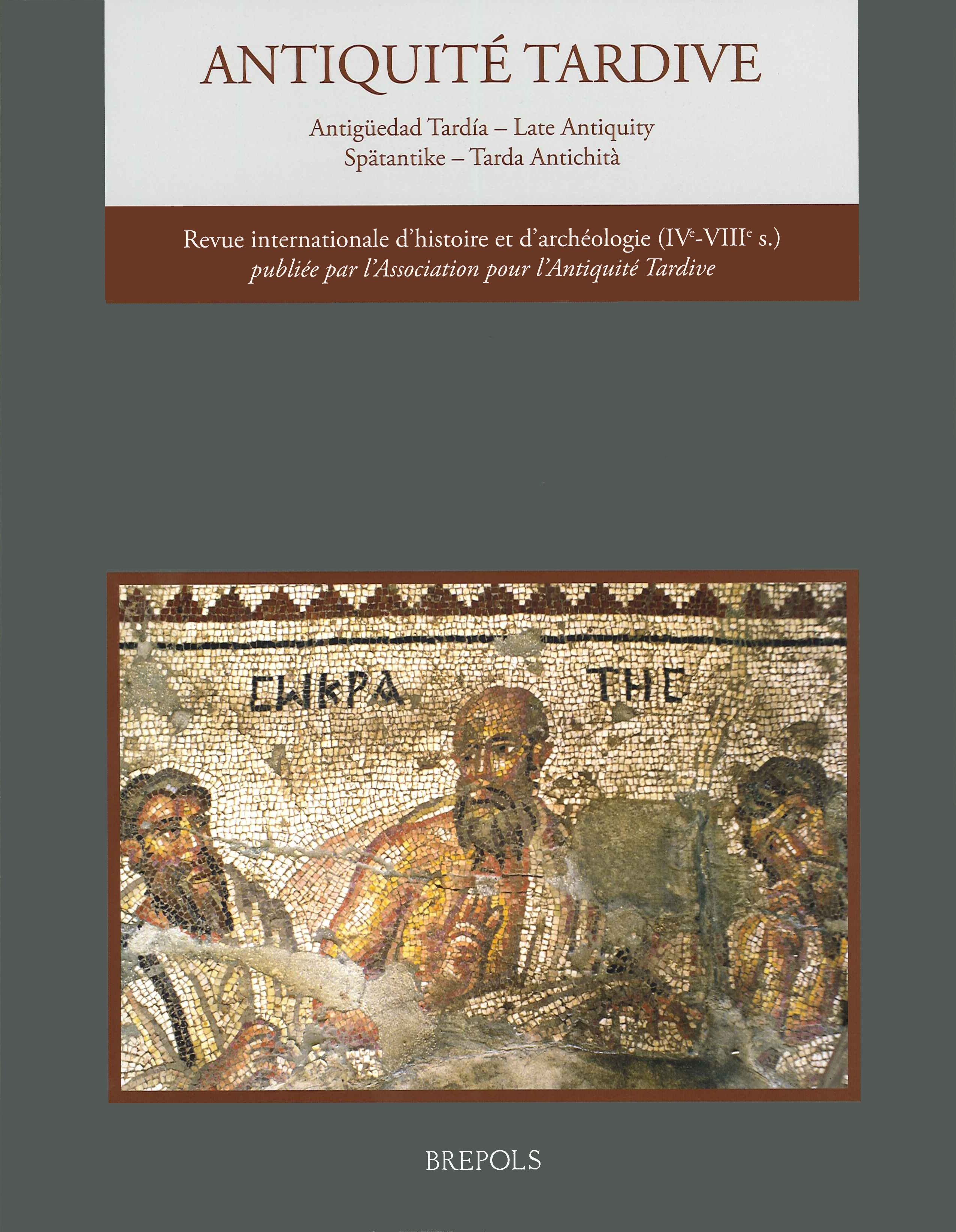
Volume 11, Issue 1, 2004
-
-
Front Matter (editorial information, title page, principales abbréviations, Table des matières, éditorial, avant-propos, bibliographie essentielle et abbréviations)
show More to view fulltext, buy and share links for:Front Matter (editorial information, title page, principales abbréviations, Table des matières, éditorial, avant-propos, bibliographie essentielle et abbréviations) show Less to hide fulltext, buy and share links for: Front Matter (editorial information, title page, principales abbréviations, Table des matières, éditorial, avant-propos, bibliographie essentielle et abbréviations)
-
-
-
Une guerre de religion : les deux Églises d’Afrique à l’époque vandale
show More to view fulltext, buy and share links for:Une guerre de religion : les deux Églises d’Afrique à l’époque vandale show Less to hide fulltext, buy and share links for: Une guerre de religion : les deux Églises d’Afrique à l’époque vandaleBy: Yves ModéranAbstractSoon after the invasion of Africa, Genseric began to establish an Arian Church to the expense of the Catholic Church in the Proconsular province where he settled his people. This religious policy, which continued until at least 523, is usually identified as a persecution, but from the time of their arrival in Africa, the Vandals had intended to convert to Arianism the people among whom they settled. As a result the Arian Church began against the Catholic Church a war of religion, which has been neglected by historians and which is studied here under four headings: the theological debate, the fight for the churches, the rivalry for the celebrations of the rites and the feasts of saints and the struggle over assisting the poor. The results of what should be described as an Arian mission are difficult to measure, but should not be underestimated as has been the case until now.
-
-
-
Timekeeping and Dyarchy in Vandal Africa
show More to view fulltext, buy and share links for:Timekeeping and Dyarchy in Vandal Africa show Less to hide fulltext, buy and share links for: Timekeeping and Dyarchy in Vandal AfricaBy: Frank M. CloverAbstractComment date-t-on les documents publics et les épitaphes dans l’Afrique Vandale ? On a beaucoup discuté de ce problème, parfois même source de controverses. Pour le résoudre, on peut prendre en considération les relations entre les Vandales conquérants et l’élite des nouveaux sujets, c’est-à-dire l’aristocratie romano-africaine. On constate une amélioration de ces relations pendant la période 480-530, en partie à cause de l’ affaiblissement des rois successeurs de Geiséric. L’influence de l’aristocratie se traduit dans le système de datation vandale qui a suivi deux principes (Type A et Type B). Le type A est l’année de règne avec ou sans nom du roi (anno N regis X ou anno N). Tous les rois vandales l’ont utilisée. Le premier roi, Geiséric, a donné une double signification au 19 octobre 439 : c’est le jour de la prise de Carthage par les Vandales et le début de son règne comme rex. Le type B est plus compliqué, lui aussi avec ou sans nom du roi : anno N Karthaginis domini nostri regis X (attesté seulement pour le règne de Gunthamund, 484-496) et anno N Karthaginis. On pense généralement que le type B commence aussi sous Geiséric. Sur la base de l’examen des monnaies d’argent datées anno III ou IV Karthaginis, l’auteur propose de faire commencer le type B sous Gunthamund. C’est la mention de Carthage avec ou sans nom du roi qui marquerait l’influence de l’aristocratie romaine vers la fin de l’occupation vandale : Carthage était toujours la métropole de l’Afrique et la lumière de la civilisation pour les deux éléments du pouvoir à l’heure vandale. [Auteur, revu par N. Duval]
-
-
-
L’atelier de Carthage et la diffusion de la monnaie frappée dans l’Afrique vandale et byzantine (439-695)
show More to view fulltext, buy and share links for:L’atelier de Carthage et la diffusion de la monnaie frappée dans l’Afrique vandale et byzantine (439-695) show Less to hide fulltext, buy and share links for: L’atelier de Carthage et la diffusion de la monnaie frappée dans l’Afrique vandale et byzantine (439-695)By: C. MorrissonAbstractThis article offers an update of numismatic research and monetary history studies on the Carthage mint in the Vandal and Byzantine period in which the author has been participating for the last three decades. It considers first the various problems in the dating of Vandal anonymous issues, many of which can still be debated in the absence of clear hoard evidence. The iconography and inscriptions of Vandal coinage illustrate the ambiguous status of the kings who never claimed more than the title rex and who respected de facto the imperial monopoly of gold striking, while advertising the provincial values of the Roman elite. It is thus unique among contemporary Germanic coinages which were less creative and imitated closely the Roman model by acknowledging the emperor’s supreme authority as federate or clients. The successive Byzantine coinage in Carthage took over part of the monetary tradition set up by the Vandals and developed one of the most original productions in the Empire as regards metrology, fabric and iconography. It was apparently more widely distributed in the Mediterranean world and further to the north than the Vandal coinage. Finds of both coinages, however, ranging from Britain and Austria to Syria and Palestine, provide clear evidence of the large influence and extended network of African exports to the late 7th c., as does the ceramics distribution pattern with which they should be compared in greater detail. [Author and M. Featherstone]
-
-
-
Les dates régnales de la dynastie vandale et les structures du royaume vandale
show More to view fulltext, buy and share links for:Les dates régnales de la dynastie vandale et les structures du royaume vandale show Less to hide fulltext, buy and share links for: Les dates régnales de la dynastie vandale et les structures du royaume vandaleBy: N. DuvalAbstractThe author offers comments on the two papers of Frank M. Clover and Cécile Morrisson published above and traces the evolution of the questions debated since he took first positon on them in 1954. [Rédaction]
-
-
-
Un acte de la préfecture d’Afrique sur l’Église de Byzacène au début du règne de Justin II
show More to view fulltext, buy and share links for:Un acte de la préfecture d’Afrique sur l’Église de Byzacène au début du règne de Justin II show Less to hide fulltext, buy and share links for: Un acte de la préfecture d’Afrique sur l’Église de Byzacène au début du règne de Justin IIBy: D. FeisselAbstractA small collection of legal texts on the privileges of the Church of Byzacium comprises three imperial rescripts (dated 541, 542 and 568) and an act of the Prefecture of Africa published by G. Haenel in 1857. In his opinion, the act reflects a lost constitution of Justin II dated 5 December 566. Yet our revision of the sole manuscript (formerly in Udine, now in Leipzig) leads to the reconsideration of the text on several points. The formula of the date placed at the beginning indicates that the prefectoral act, issued before this date, was then read at an official proceeding. The date is otherwise inconsistent, in as much as the 5 December of the second year of the reign of Justin II (566/7) cannot coincide with the first year after his consulate. We observe, on critical examination of the edition of contemporary imperial documents, that, contrary to the opinion of E. Stein, the consulate in question may just as well be that of 568 as that of 566. If, then, the post-consulate as indicated is correct, the act of the Prefecture of Africa must have been read in December of 567 or 569. In addition, the expansive nomenclature of the author, Flavius Michaelius Petrus Thomas Callinicus Iulianus, probably reveals the existence of a new prefect of Africa, Julianus. However, it is not impossible, if the document dates from before 568, that its author was Thomas, a known prefect, and that the two names which follow are those of contemporary prefects. As for the primate of Byzacium mentioned in the document, his name was Spesindeum, typical of Africa in this period. The same bishop is the addressee of the rescript of 568. In conclusion, a revised edition is given of the prefectoral act and (as an appendice) the rescript of 568. Comparison of these two texts, largely parallel despite their divergences, leaves open the question asked at the beginning: the hypothesis of a rescript of Justin II on the Church of Byzacium before that of 568 remains doubtful. [Author, translated by M. Featherstone]
-
-
-
La céramique africaine, un indice du développement économique ?
show More to view fulltext, buy and share links for:La céramique africaine, un indice du développement économique ? show Less to hide fulltext, buy and share links for: La céramique africaine, un indice du développement économique ?By: M. BonifayAbstractThe lack of recently excavated rural sites in North Africa over the last 30 years has led to reliance on the testimony of African pottery and amphorae as indicators of economic growth. Regarding the most common agricultural products of Roman Africa attested by pottery, too much importance has perhaps been accorded to olive oil. It is true that several types of African amphorae carried olive oil (type Africana I), but most of them did not. Some were devoted to the transport of salted fish or garum, and others to the commercialisation of African wine (type Keay 25 ?). It also appears that African Red Slip Ware cannot be positively linked to olive production and did not usually travel with amphorae cargoes. Consequently, is it not better to consider that African Red Slip Ware travelled with the most voluminous export of Roman Africa, that is, cereals? [Author]
-
-
-
Les deux baptistères de Sidi Jdidi (Tunisie)
show More to view fulltext, buy and share links for:Les deux baptistères de Sidi Jdidi (Tunisie) show Less to hide fulltext, buy and share links for: Les deux baptistères de Sidi Jdidi (Tunisie)Authors: M. Bonifay, A. Ben Abed, M. Fixot and S. RoucoleAbstractThe Christian topography and architecture of Sidi Jdidi (Tunisia), possibly identified as the city of Aradi, has been studied for ten years. Three churches have been completely excavated, two of them, at the northern limit of the little town, are part of the ‘episcopal group’. The third church, in the south part of the city, has been understood to be a church devoted to the cult of relics. The aim of this contribution is to describe the two baptisteries found near the apse of each basilica belonging to the ‘double church’ and to look for their meaning. Further it gives the occasion to describe the becoming of an episcopal group between the end of the fourth century and the sixth century. During the Byzantine period, a baptistery appears to have been erected near the western basilica : it has quite large dimensions and its shape, a Latin cross ended by an apse, seems original too. The piscina, at the crossing of the arms, was planned as a polylobe. An analysis of the masonry work shows that this baptistery was rebuilt partly from a previous one which occupied part of the place normally destined to a sacristy ; a funerary chapel, which became the nave of the new monument, was also erected for it. Therefore, dimensions and shape must be understood as dependent on what existed before and as a result, cannot be strictly compared with other buildings of the same family. The previous baptistery has been built together with the church at the end of the fourth century ; traces of it can be detected on the floor and in some upper parts of the Byzantine building. The neighbouring basilica, which runs parallel on the east side, was separated from the other one by an insula which contained domestic items for the needs of the church, such as two mills, one for oil, the other one for corn, and a great oven. This insula and the second church were built at the same time as the first one. The eastern sacristy of this second church contained another piscina placed in the north-west corner of the room, decorated with two lobes. This shows that this polylobe shape can be attributed to an older period than the sixth century to which most of the instances found in Africa belong. The symbolic meaning of the shapes is certainly less important than the simple decorative purpose either for polylobes or for cruciform plans. Originally, in this city, it seems that both baptisteries were used together but it is impossible to know what their respective functions were. Both churches were destroyed during the second half of the fifth century and the east one was never rebuilt. So the cathedral was restricted to the west church, the new architecture of which was significant of its main functions, first with the very large baptistery and secondly with the turris erected on the two first southern bays as a shrine for a martyrological cult. This new monumentality, however, which firmly expressed the main functions of the new basilica cannot hide the failure to cope with the old plan with both churches and the insula which, too, was abandoned. [Authors]
-
-
-
Vitalité de l’architecture domestique à Carthage au Ve siècle : l’exemple de la maison dite de la Rotonde, sur la colline de l’Odéon
show More to view fulltext, buy and share links for:Vitalité de l’architecture domestique à Carthage au Ve siècle : l’exemple de la maison dite de la Rotonde, sur la colline de l’Odéon show Less to hide fulltext, buy and share links for: Vitalité de l’architecture domestique à Carthage au Ve siècle : l’exemple de la maison dite de la Rotonde, sur la colline de l’OdéonAuthors: C. Balmelle, A. Ben Abed-Ben Khader, A. Bourgeois, Cl. Brenot, H. Broise, J.-P. Darmon, M. Ennaïfer and M.-P. RaynaudAbstractFranco-Tunisian excavations at Carthage (1991-1998) in the “Rotunda House” have revealed much about the eastern slope of the Odeon before the 439 invasion and at the beginning of the Vandal Kingdom. Analysis of both archaeological and architectural data shows that this insula is far from being abandoned. In the first third of the 5th century, there is significant razing and filling for a new construction — an ambitious architectural project, but uncompleted, perhaps because of the Vandal invasion of 439. At the beginning of the Vandal period, another building uses the former’s walls, but reorganizes the circulation patterns. With a large peristyle-court and two upper reception-rooms, the public part of the house receives more emphasis than the private. The new aristocracy clearly perpetuates the lifestyle of the old. This is the first example of domestic architecture and mosaics dated from the Vandal period on the basis of archaeological criteria. [Authors]
-
-
-
Monuments du culte chrétien en Maurétanie Tingitane
show More to view fulltext, buy and share links for:Monuments du culte chrétien en Maurétanie Tingitane show Less to hide fulltext, buy and share links for: Monuments du culte chrétien en Maurétanie TingitaneBy: É. LenoirAbstractÉliane Lenoir, who has excavated the only positively identified church of Mauretania Tingitana at Zilil, surveys the archaeological evidence of Christianity in that province. She first describes the Zilil church; she then mentions the existence in Tanger of a building with naves, which has been sometimes recognised as a church, and the excavation at Ceuta of a monument in which tombs were found, but no liturgical installation. She reviews Christian inscriptions and objects with Christian symbols from Volubilis. She rejects the identification of a building in Lixus, which is actually a mosque, as a church, and refutes the hypothesis of the Christianisation of Banasa, arguing there is too little evidence. [Noël Duval]
-
-
-
Encore à propos des Sirmondiennes… : arguments présentés à l’appui de la thèse de l’authenticité, en réponse à une mise en cause récente
show More to view fulltext, buy and share links for:Encore à propos des Sirmondiennes… : arguments présentés à l’appui de la thèse de l’authenticité, en réponse à une mise en cause récente show Less to hide fulltext, buy and share links for: Encore à propos des Sirmondiennes… : arguments présentés à l’appui de la thèse de l’authenticité, en réponse à une mise en cause récenteBy: O. HuckAbstractThe Collectio Sirmondiana, containing imperial laws contemporary with those listed in the Theodosian Code, yet transmitted by means of a different tradition, is definitely a source and a tool of comparison for anyone concerned with the methods and constraints of late antique legal codification. For almost four hundred years its authenticity has been the subject of a most complex historical debate, lately reopened by Élisabeth Magnou Nortier. Her work revives a polemical trend and takes up the convictions voiced by Godefroy, the Swiss scholar, about a possible medieval falsification of the Sirmondian collection. In his attempt to refute the contextual, paleographic and textual arguments which underlie Magnou-Nortier’s publication, the author of the present article aims to re-establish on more solid foundations the authenticity of the most valuable collectio. [Author]
-
-
-
Mythologie classique et mosaïques tardives d’Hispanie (IVe s.)
show More to view fulltext, buy and share links for:Mythologie classique et mosaïques tardives d’Hispanie (IVe s.) show Less to hide fulltext, buy and share links for: Mythologie classique et mosaïques tardives d’Hispanie (IVe s.)By: Janine LanchaAbstractIn the 4th century at the western limits of the Roman Empire, when paganism and Christianity are still coexisting, the pagan Hispano-Roman aristocracy assumes a specific position in regard to Greco-Roman myths. Traditional iconographical programs inspired by classical literature and the innovative use of the wedding of Cadmos and Harmonia in the presence of the Olympian gods in different rooms of villas demonstrate a real revival of classical mythology in this culture. The following mosaics are considered: (I) the Triumph of Dionysus, a favorite late antique theme, with different and original characteristics in the villas of Torre de Palma (Alentejo, Portugal), Fuente Alamo (Puente-Genil, Córdoba) and El Olivar d’El Centeno (Cáceres) ; (II) the wedding of Cadmos and Harmonia in the villa of La Malena (Zaragoza) ; (III) the death of Adonis in the presence of Mars and Venus, in the oecus of the villa of Carranque (Toledo); and (IV) the mosaics discovered in 1997 in the villa of Arellano (Navarra) by M. A. Mezquíriz, for which the A. proposes a different identification. [Author]
-
-
-
The donation and will of Vincent of Huesca: Latin text and English translation
show More to view fulltext, buy and share links for:The donation and will of Vincent of Huesca: Latin text and English translation show Less to hide fulltext, buy and share links for: The donation and will of Vincent of Huesca: Latin text and English translationBy: S. CorcoranAbstractRéédition et traduction anglaise du testament de Vincent de Huesca (576) et de l’acte de la donation précédemment faite par lui en faveur du monastère d’Asán en 551, qui documentent les structures socio-économiques de la zone pyrénéenne de l’actuelle Huesca à l’époque visigothique.
-
-
-
Poblamiento y organización del espacio : la Tarraconense pirenaica en el siglo VI
show More to view fulltext, buy and share links for:Poblamiento y organización del espacio : la Tarraconense pirenaica en el siglo VI show Less to hide fulltext, buy and share links for: Poblamiento y organización del espacio : la Tarraconense pirenaica en el siglo VIAuthors: E. Ariño Gil and P. C. DíazAbstractThe donation and will of Vicente of Asán, dating from AD 551 and 576 respectively, are two basic documents concerning the property structure in the Visigothic period. These documents have been subjected to specialised research for nearly a century; however, the exact location of the toponyms contained in them –a fundamental point for a full understanding of the structure of Vicente’s properties– remains an unsolved question. This paper tackles this problem, combining archaeological field work with the historical review of the document, as well as the study of mediaeval documentation in order to trace the survival of sixth century toponyms in the subsequent period. We can now identify with certainty approximately 50% of minor toponyms, which makes possible a historical analysis of how Vicente of Asán’s patrimony was organised. His centre of interest is clearly located in the Pyrenean area of Huesca, in the La Fueva and Boltaña valleys (the ancient terrae terrantonensis and boletana of the document). Later the patrimony also included land along the Esera and Cinca valleys, reaching even the Ebro valley, with properties in the territories of Barbotum, Labitolosa, Ilerda and Caesaraugusta. From this we can infer a complementary economy between the lands on the valleys of the main rivers and the mountain areas, which allowed diversification of production and better exploitation of resources. Cattle raising was an important activity, and there was short-distance seasonal transhumance. Furthermore, the reconstruction of microtoponymy allows us, first, to define with some detail the borders of the urban territories mentioned by the texts, and second, to detect that the lines of inner mediaeval colonisation followed those documented for the Visigothic period. [Authors]
-
-
-
L’entrée septentrionale du palais impérial de Thessalonique : l’arc de triomphe et le vestibulum d’après les fouilles d’Ejnar Dyggve en 1939
show More to view fulltext, buy and share links for:L’entrée septentrionale du palais impérial de Thessalonique : l’arc de triomphe et le vestibulum d’après les fouilles d’Ejnar Dyggve en 1939 show Less to hide fulltext, buy and share links for: L’entrée septentrionale du palais impérial de Thessalonique : l’arc de triomphe et le vestibulum d’après les fouilles d’Ejnar Dyggve en 1939By: Hjalmar TorpAbstractIn the months from early March through June 1939, the Danish archaeologist Ejnar Dyggve carried out extensive excavations in Thessaloniki. Work centered on the Rotonda, on the area between the Rotunda, the Arch of Galerius and the Odos Egnatia, and on the areas south of the Egnatia. Due to World War II, the results were only partially published in preliminary articles and reports. The present paper first provides a short discussion of seven trial digs carried out to the south of the Egnatia. The main focus is on the large building (42.70 x ca. 17.65 m), which was partially unearthed immediately to the south of the existing Arch (beneath the actual Odos Egnatia). Structurally, the building was shown to form a component unit of the now-destroyed southern section of the Arch. Decorated with splendid floor mosaics and communicating with the (ca. 2.4 m) lower, southern terrain by means of a monumental marble stairway (of approximately 18 m width), the building was interpreted as a vestibulum, joining the residential quarters of the palace and the Rotunda, which are separated by the Egnatia.
-
-
-
Hommage à Ejnar et Ingrid Dyggve : la théorie du palais du Bas-Empire et les fouilles de Thessalonique
show More to view fulltext, buy and share links for:Hommage à Ejnar et Ingrid Dyggve : la théorie du palais du Bas-Empire et les fouilles de Thessalonique show Less to hide fulltext, buy and share links for: Hommage à Ejnar et Ingrid Dyggve : la théorie du palais du Bas-Empire et les fouilles de ThessaloniqueBy: N. DuvalAbstractH. Torp’s publication here of papers, drawings and pictures from E. Dyggve’s 1939 dig in Thessalonica, interrupted by the war, allows the author to look at the genesis of Dyggve’s theory on the late antique imperial palace. This theory, mainly based on Dyggve’s familiarity with Diocletian’s palace in Split and his research on the ‘basilica discoperta’ in Marusinac, is somewhat fragile and incomplete, but it remains a great contribution. The author reviews here the whole dossier of what is presently known of he building complex attributed to Galerius in Thessalonica. He analyzes the historical circumstances that drew Galerius to choose Thessalonica as his capital around 299, and the homogeneity and contemporaneity of the different architectural elements, as well as their relation to the defensive wall and to the hippodrome. This is the first critical analysis of all the visible remains. [Author]
-
-
-
Dos episodios de la vida de Eliseo en el hipogeo de Dino Compagni
show More to view fulltext, buy and share links for:Dos episodios de la vida de Eliseo en el hipogeo de Dino Compagni show Less to hide fulltext, buy and share links for: Dos episodios de la vida de Eliseo en el hipogeo de Dino CompagniBy: M. Del AmoAbstractIn the Catacomb of Via Latina (Via Dino Compagni) on the back wall of an arcosolium in Ferrua’s cubiculum B (Pavia’s E), are represented two scenes from Prophet Eliseus’s life. On the left is the ascension of Elias in the presence of Eliseus (the chariot of fire, 2 Kings 2, 11 18); on the right, Eliseus’s choice as a disciple of Elias (1 Kings 19, 19-21). All that remains are the two oxen of Eliseus’s sacrifice and the young Eliseus seated on a stone near a plough and a yoke. The latter scene is a “unicum” in ancient Christian iconography; no other examples before the 16th century are known.[Author]
-
-
-
Recherches sur les sépultures paléochrétiennes en sarcophage (Occident, IVe-VIe siècles)
show More to view fulltext, buy and share links for:Recherches sur les sépultures paléochrétiennes en sarcophage (Occident, IVe-VIe siècles) show Less to hide fulltext, buy and share links for: Recherches sur les sépultures paléochrétiennes en sarcophage (Occident, IVe-VIe siècles)AbstractThe paper gives a short presentation of a Habilitationschrift (Göttingen, 2001), published in autumn 2003, on “Sarkophagbestattungen des 4.-6. Jhs. im Westen des Römischen Reiches”. The author examines a corpus of sarcophagi (with inscriptions), ranging from the 3rd to 5th centuries, in order to study their ordinatores as a social body and to understand the ideological and religious significance of the use of sarcophagi rather than other type of burial. Many aspects of these questions are taken into account, like the distribution of the deceased according to gender and age, the social, ideological and religious meanings of the funerary iconography, the question of the visibility of both images and inscriptions and the availability of sarcophagi as semi-manufactured products. [Redaction]
-
-
-
Nouvel essai de reconstitution matérielle de l’épitaphe de Sidoine Apollinaire (RICG, VIII, 21)
show More to view fulltext, buy and share links for:Nouvel essai de reconstitution matérielle de l’épitaphe de Sidoine Apollinaire (RICG, VIII, 21) show Less to hide fulltext, buy and share links for: Nouvel essai de reconstitution matérielle de l’épitaphe de Sidoine Apollinaire (RICG, VIII, 21)By: P. MontzamirAbstractThe author proposes a material reconstruction of the famous epitaph of Sidonius Apollinaris known by a 10th-11th-century manuscript and two stone fragments. His reconstruction is based on the statistics of the dimensions of the letters and spaces between them. The inscription would have been about 0,8 m high and 2,20 m long. The stone was therefore not part of a sarcophagus, but more likely set vertically above the tomb or horizontally on the top of it. He also argues in favour of the authenticity of the date given by the manuscript, which is usually suspected because it is based on the reign of the Eastern emperor Zeno. Nothing definitive can be determined about the place of Sidonius’s tomb, but the two fragments may have been discovered in the vicinity of the vicus christianorum where his predecessors were buried. [Editors]
-
-
-
La question de l’unicité ou de la multiplicité des auteurs de l’Histoire Auguste
show More to view fulltext, buy and share links for:La question de l’unicité ou de la multiplicité des auteurs de l’Histoire Auguste show Less to hide fulltext, buy and share links for: La question de l’unicité ou de la multiplicité des auteurs de l’Histoire Auguste
-
-
-
Das Ljubljana-Symposium 1998 und das Konzept der Ethnogenese: Slowenien und die Nachbarländer zwischen Antike und karolingischer Epoche
show More to view fulltext, buy and share links for:Das Ljubljana-Symposium 1998 und das Konzept der Ethnogenese: Slowenien und die Nachbarländer zwischen Antike und karolingischer Epoche show Less to hide fulltext, buy and share links for: Das Ljubljana-Symposium 1998 und das Konzept der Ethnogenese: Slowenien und die Nachbarländer zwischen Antike und karolingischer EpocheBy: A. SoroceanuAbstract“Slovenia and its neighbouring countries between Antiquity and the Carolingian Period” constituted the subject of an international symposium that took place in 1998 in Ljubljana. One of its primary purposes was a detailed presentation of the period between the 6th and the 9th centuries regarding different aspects of life in the present territory of Slovenia and the adjacent regions. At the same time, the delegates attempted to analyse the notion of ethnogenesis from a variety of viewpoints; in particular, Slovenian ethnogenesis and the transition from the structures of Antiquity to those of the Early Middle Ages were examined. The immediate result of the Symposium was the publication of two volumes (in the year 2000) containing the papers and the discussions, organized into sections and subjects. Questions of continuity and ethnogenesis were investigated under historical and archaeological aspects; studies concerned with Church history, art history and literary history complete this volume. Linguists, scholars in onomastics, and specialists in modern history also presented the results of their own researches. The volumes are provided with detailed bibliographies and systematic indexes (by persons, places, sources, and authors). The final discussions, containing some feed-back from the Symposium, appear at the end of the second volume. The two volumes can therefore be considered as an authoritative introduction to Slovenia and its region in the periods covered. The monograph by Hans-Dietrich Kahl, Der Staat der Karantanen (The Karantan State), printed two years later (2002) as a supplement to the two Slovenia volumes, represents a significant completion of the Ljubljana Symposium. This Slav phenomenon, of particular interest in being “the first about which we really know anything”, was reconstructed from different sources (documentary, archaeological and ethnographic), to provide information on its boundaries, populations, and structures. In search of the historical truth, H.-D. Kahl attempts to point out that modern nations – in this case Slovenia – do not need historical myths or legends for their own development. On the contrary, they need more serious scientific research, based on credible sources. [Author, revised by M. J. Jones]
-
-
-
Sacred letters of the law: the emperor’s hand in late Roman (literary) history
show More to view fulltext, buy and share links for:Sacred letters of the law: the emperor’s hand in late Roman (literary) history show Less to hide fulltext, buy and share links for: Sacred letters of the law: the emperor’s hand in late Roman (literary) historyBy: M. VesseyAbstractCet article offre une réflexion sur trois ouvrages récents consacrés au Code théodosien : Tony Honoré, Law in the Crisis of Empire 379–455 AD: The Theodosian Empire and its Quaestors, Oxford : Clarendon Pr., 1998 ; Jill Harries, Law and Empire in Late Antiquity, Cambridge : Cambridge University Pr., 1999 ; John F. Matthews, Laying Down the Law: A Study of the Theodosian Code, Yale : Yale University Pr., 2000, et plus généralement sur les questions que l’étude des lois comme texte amène à se poser sur ce qu’est la littérature dans l’Antiquité tardive. [Rédaction]
-
-
-
Back Matter (Bulletin crique et Notes de lecture)
show More to view fulltext, buy and share links for:Back Matter (Bulletin crique et Notes de lecture) show Less to hide fulltext, buy and share links for: Back Matter (Bulletin crique et Notes de lecture)AbstractHistoire et archéologie de l’Antiquité tardive Régions Philologie et sources Notes de lecture Livres reçus par la revue entre janvier et décembre 2003
-
Volumes & issues
-
Volume 32 (2024)
-
Volume 31 (2024)
-
Volume 30 (2022)
-
Volume 29 (2022)
-
Volume 28 (2021)
-
Volume 27 (2020)
-
Volume 26 (2019)
-
Volume 25 (2018)
-
Volume 24 (2017)
-
Volume 23 (2016)
-
Volume 22 (2015)
-
Volume 21 (2013)
-
Volume 20 (2013)
-
Volume 19 (2012)
-
Volume 18 (2011)
-
Volume 17 (2010)
-
Volume 16 (2009)
-
Volume 15 (2008)
-
Volume 14 (2007)
-
Volume 13 (2006)
-
Volume 12 (2005)
-
Volume 11 (2004)
-
Volume 10 (2003)
-
Volume 9 (2002)
-
Volume 8 (2001)
-
Volume 7 (2000)
-
Volume 6 (1999)
-
Volume 5 (1998)
-
Volume 4 (1997)
-
Volume 3 (1995)
-
Volume 2 (1994)
-
Volume 1 (1993)
Most Read This Month
