


Antiquité Tardive - Late Antiquity - Spätantike - Tarda Antichità
Revue Internationale d'Histoire et d'Archéologie (IVe-VIIIe siècle)
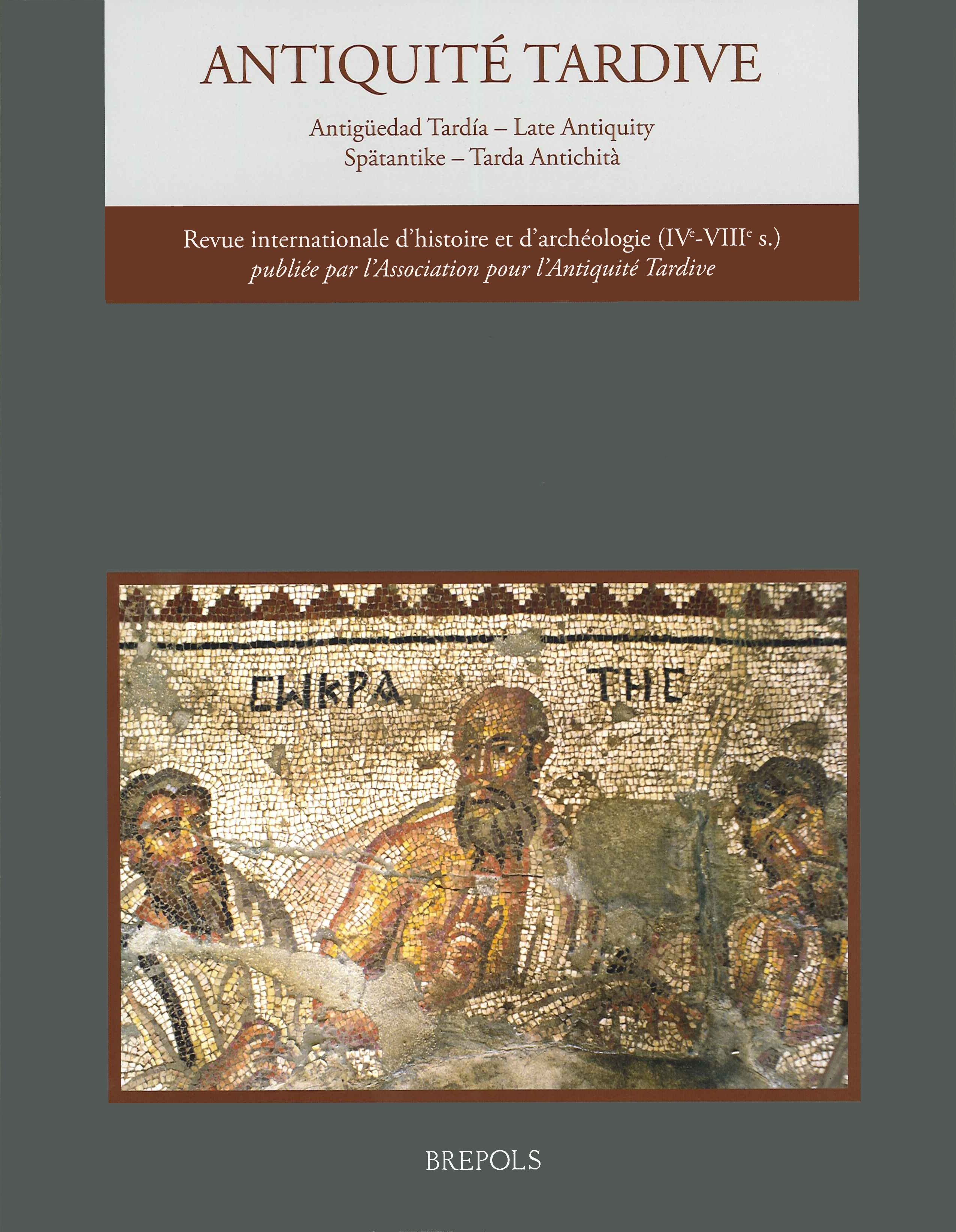
Volume 11, Issue 1, 2004
-
-
La question de l’unicité ou de la multiplicité des auteurs de l’Histoire Auguste
show More to view fulltext, buy and share links for:La question de l’unicité ou de la multiplicité des auteurs de l’Histoire Auguste show Less to hide fulltext, buy and share links for: La question de l’unicité ou de la multiplicité des auteurs de l’Histoire Auguste
-
-
-
Das Ljubljana-Symposium 1998 und das Konzept der Ethnogenese: Slowenien und die Nachbarländer zwischen Antike und karolingischer Epoche
show More to view fulltext, buy and share links for:Das Ljubljana-Symposium 1998 und das Konzept der Ethnogenese: Slowenien und die Nachbarländer zwischen Antike und karolingischer Epoche show Less to hide fulltext, buy and share links for: Das Ljubljana-Symposium 1998 und das Konzept der Ethnogenese: Slowenien und die Nachbarländer zwischen Antike und karolingischer EpocheBy: A. SoroceanuAbstract“Slovenia and its neighbouring countries between Antiquity and the Carolingian Period” constituted the subject of an international symposium that took place in 1998 in Ljubljana. One of its primary purposes was a detailed presentation of the period between the 6th and the 9th centuries regarding different aspects of life in the present territory of Slovenia and the adjacent regions. At the same time, the delegates attempted to analyse the notion of ethnogenesis from a variety of viewpoints; in particular, Slovenian ethnogenesis and the transition from the structures of Antiquity to those of the Early Middle Ages were examined. The immediate result of the Symposium was the publication of two volumes (in the year 2000) containing the papers and the discussions, organized into sections and subjects. Questions of continuity and ethnogenesis were investigated under historical and archaeological aspects; studies concerned with Church history, art history and literary history complete this volume. Linguists, scholars in onomastics, and specialists in modern history also presented the results of their own researches. The volumes are provided with detailed bibliographies and systematic indexes (by persons, places, sources, and authors). The final discussions, containing some feed-back from the Symposium, appear at the end of the second volume. The two volumes can therefore be considered as an authoritative introduction to Slovenia and its region in the periods covered. The monograph by Hans-Dietrich Kahl, Der Staat der Karantanen (The Karantan State), printed two years later (2002) as a supplement to the two Slovenia volumes, represents a significant completion of the Ljubljana Symposium. This Slav phenomenon, of particular interest in being “the first about which we really know anything”, was reconstructed from different sources (documentary, archaeological and ethnographic), to provide information on its boundaries, populations, and structures. In search of the historical truth, H.-D. Kahl attempts to point out that modern nations – in this case Slovenia – do not need historical myths or legends for their own development. On the contrary, they need more serious scientific research, based on credible sources. [Author, revised by M. J. Jones]
-
-
-
Sacred letters of the law: the emperor’s hand in late Roman (literary) history
show More to view fulltext, buy and share links for:Sacred letters of the law: the emperor’s hand in late Roman (literary) history show Less to hide fulltext, buy and share links for: Sacred letters of the law: the emperor’s hand in late Roman (literary) historyBy: M. VesseyAbstractCet article offre une réflexion sur trois ouvrages récents consacrés au Code théodosien : Tony Honoré, Law in the Crisis of Empire 379–455 AD: The Theodosian Empire and its Quaestors, Oxford : Clarendon Pr., 1998 ; Jill Harries, Law and Empire in Late Antiquity, Cambridge : Cambridge University Pr., 1999 ; John F. Matthews, Laying Down the Law: A Study of the Theodosian Code, Yale : Yale University Pr., 2000, et plus généralement sur les questions que l’étude des lois comme texte amène à se poser sur ce qu’est la littérature dans l’Antiquité tardive. [Rédaction]
-
-
-
Back Matter (Bulletin crique et Notes de lecture)
show More to view fulltext, buy and share links for:Back Matter (Bulletin crique et Notes de lecture) show Less to hide fulltext, buy and share links for: Back Matter (Bulletin crique et Notes de lecture)AbstractHistoire et archéologie de l’Antiquité tardive Régions Philologie et sources Notes de lecture Livres reçus par la revue entre janvier et décembre 2003
-
Volumes & issues
-
Volume 32 (2024)
-
Volume 31 (2024)
-
Volume 30 (2022)
-
Volume 29 (2022)
-
Volume 28 (2021)
-
Volume 27 (2020)
-
Volume 26 (2019)
-
Volume 25 (2018)
-
Volume 24 (2017)
-
Volume 23 (2016)
-
Volume 22 (2015)
-
Volume 21 (2013)
-
Volume 20 (2013)
-
Volume 19 (2012)
-
Volume 18 (2011)
-
Volume 17 (2010)
-
Volume 16 (2009)
-
Volume 15 (2008)
-
Volume 14 (2007)
-
Volume 13 (2006)
-
Volume 12 (2005)
-
Volume 11 (2004)
-
Volume 10 (2003)
-
Volume 9 (2002)
-
Volume 8 (2001)
-
Volume 7 (2000)
-
Volume 6 (1999)
-
Volume 5 (1998)
-
Volume 4 (1997)
-
Volume 3 (1995)
-
Volume 2 (1994)
-
Volume 1 (1993)
Most Read This Month
