


Antiquité Tardive - Late Antiquity - Spätantike - Tarda Antichità
Revue Internationale d'Histoire et d'Archéologie (IVe-VIIIe siècle)
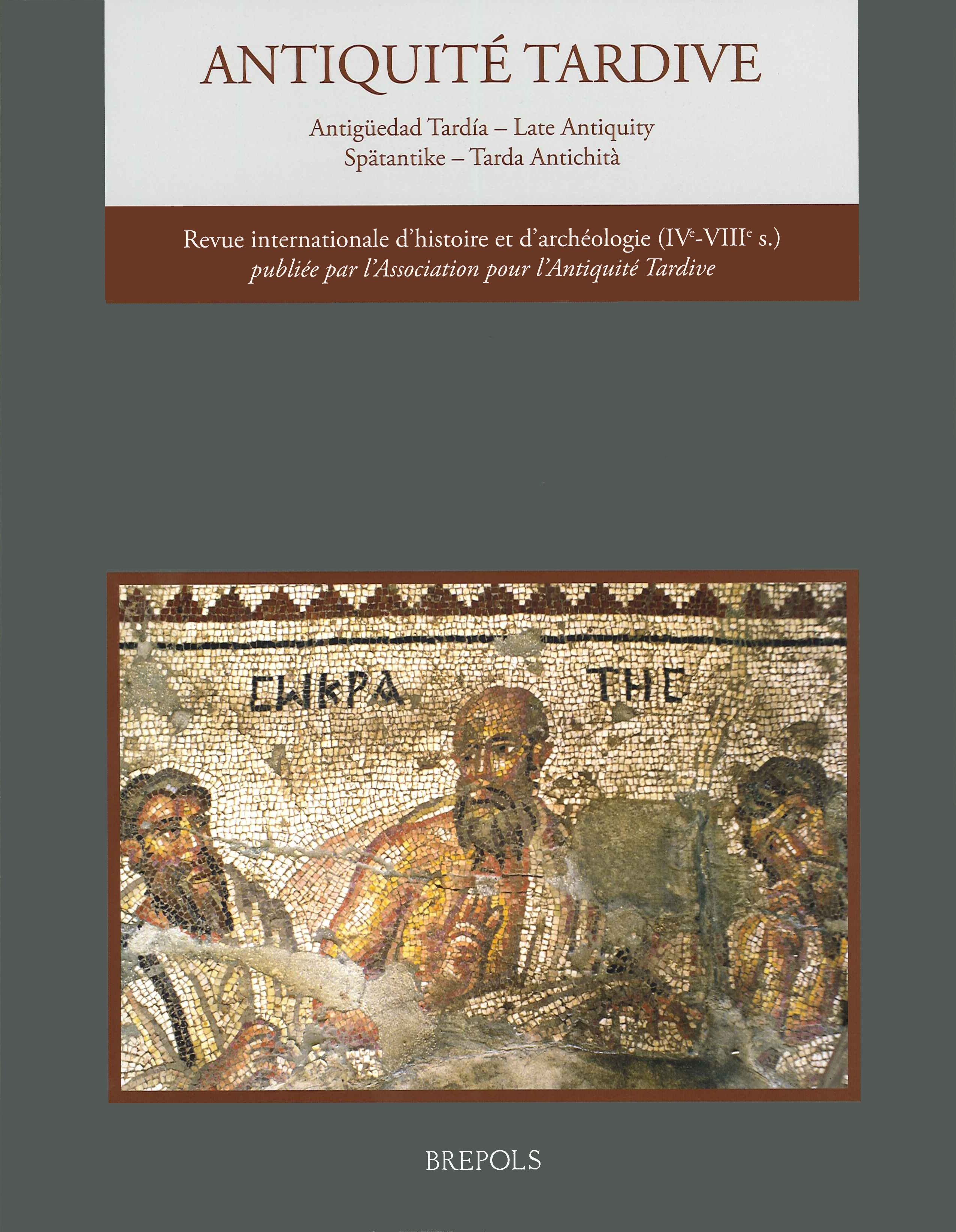
Volume 14, Issue 1, 2007
-
-
Tributación y escenarios locales en el centro de la península ibérica: algunas hipótesis a partir del análisis de las pizarras «visigodas»
show More to view fulltext, buy and share links for:Tributación y escenarios locales en el centro de la península ibérica: algunas hipótesis a partir del análisis de las pizarras «visigodas» show Less to hide fulltext, buy and share links for: Tributación y escenarios locales en el centro de la península ibérica: algunas hipótesis a partir del análisis de las pizarras «visigodas»AbstractThe “Visigothic” slates are a group of texts that have been found in different archaeological sites of the central part of Iberian Peninsula. Although they are one of the rare remains of late antique private documentation, there is not any social analysis of them, due to the problems of their interpretation. In spite of this, some philological works has been carried out, making some aspects about the language and culture clear. This paper tries to achieve a first approach to a social explanation of the slates through three hypothesis: the tributary meaning of great part of the pieces, the connection of the remains with some intermediate places of the countryside and the view of the slates as a trace of the implementation of channels that linked the central authority with the local powers.
-
-
-
The early byzantine baptisteries of Crete
show More to view fulltext, buy and share links for:The early byzantine baptisteries of Crete show Less to hide fulltext, buy and share links for: The early byzantine baptisteries of CreteAbstractLes recherches concernant l’architecture chrétienne en Crète se résument principalement à des fouilles entreprises dans les vestiges d’églises et à de courtes descriptions insérées dans des catalogues. Il en ressort une image fragmentaire des baptistères crétois, qui se voient systématiquement comparés à ceux de la Grèce continentale sans tenir compte de la présence de fonts baptismaux qui permettraient une identification plus sure. L’objectif de cette étude est de revenir sur ces données et de proposer une interprétation des aménagements architecturaux et liturgiques qui se fonde à la fois sur le matériel archéologique et les sources. Cette nouvelle lecture ouvre l’hypothèse, en Crète, d’une simplification du rituel du baptême que traduirait l’intégration des fonts baptismaux dans la partie orientale de l’église, contrairement à la tradition de la Grèce qui les séparait. Cet aménagement particulier attesterait en outre l’influence de différentes pratiques architecturales, provenant aussi bien du littoral de la mer Égée que d’Orient.
-
-
-
Antiquité tardive: construction et déconstruction d’un modèle historiographique
show More to view fulltext, buy and share links for:Antiquité tardive: construction et déconstruction d’un modèle historiographique show Less to hide fulltext, buy and share links for: Antiquité tardive: construction et déconstruction d’un modèle historiographiqueAbstractThe concept of Late Antiquity as an autonomous historical period was launched in the 1970s and has been gaining ground ever since. The chronological, geographical and epistemological expansion of its boundaries goes hand in hand with an optimistic historical vision: the era which was previously known as “an age of anxiety” has become “an age of ambition.” Its hero is the holy man – a new sociological type whose power in this world and the next endows the society from which he emerges with a remarkable dynamism. Born of a reaction to the historiographical model of crisis and decline, which corresponds to the tripartite periodisation “Antiquity, Middle Ages, Modern Times”, the postmodern concept of a long, autonomous, dynamic and multi-cultural Late Antiquity is now in its turn the subject of a reaction. The new millennium has seen the beginnings of a return to the study of the political, administrative and economic structures of the end of the ancient world, and, perhaps inevitably, to a more traditional, and therefore a more sombre view of this period. After analysing the main stages in the debate between these two fundamental positions, and evoking its ideological background, the article argues for a Late Antiquity which is autonomous but fluid – an interval between two entities, Antiquity and the Middle Ages, during which a society centred on Man mutated into one constituted for the greater glory of God. It further suggests that the explanation as to how an anthropocentric culture was transformed into a theocracy should be sought in the area of religion with all its parameters (social, psychological and especially theological), and that the interpretative tool for such an analysis should be the concept of violence, both physical and intellectual.
-
-
-
Chronique d’historiographie tardive
show More to view fulltext, buy and share links for:Chronique d’historiographie tardive show Less to hide fulltext, buy and share links for: Chronique d’historiographie tardiveAbstractThis survey article comments on four recent works: a new volume of the Ammiamus commentary by four Dutch scholars (book 25), the first chapters of a recent book by Rita Lizzi Testa focussed on Ammianus 28,1, the first modern edition, with an italian translation and extensive introduction of the highly questionable Johannes Antiochenus by Umberto Roberto, and finally a long paper by R. W. Burgess on several late antique “Quellenforschung”questions.
-
Volumes & issues
-
Volume 32 (2024)
-
Volume 31 (2024)
-
Volume 30 (2022)
-
Volume 29 (2022)
-
Volume 28 (2021)
-
Volume 27 (2020)
-
Volume 26 (2019)
-
Volume 25 (2018)
-
Volume 24 (2017)
-
Volume 23 (2016)
-
Volume 22 (2015)
-
Volume 21 (2013)
-
Volume 20 (2013)
-
Volume 19 (2012)
-
Volume 18 (2011)
-
Volume 17 (2010)
-
Volume 16 (2009)
-
Volume 15 (2008)
-
Volume 14 (2007)
-
Volume 13 (2006)
-
Volume 12 (2005)
-
Volume 11 (2004)
-
Volume 10 (2003)
-
Volume 9 (2002)
-
Volume 8 (2001)
-
Volume 7 (2000)
-
Volume 6 (1999)
-
Volume 5 (1998)
-
Volume 4 (1997)
-
Volume 3 (1995)
-
Volume 2 (1994)
-
Volume 1 (1993)
Most Read This Month
