


Antiquité Tardive - Late Antiquity - Spätantike - Tarda Antichità
Revue Internationale d'Histoire et d'Archéologie (IVe-VIIIe siècle)
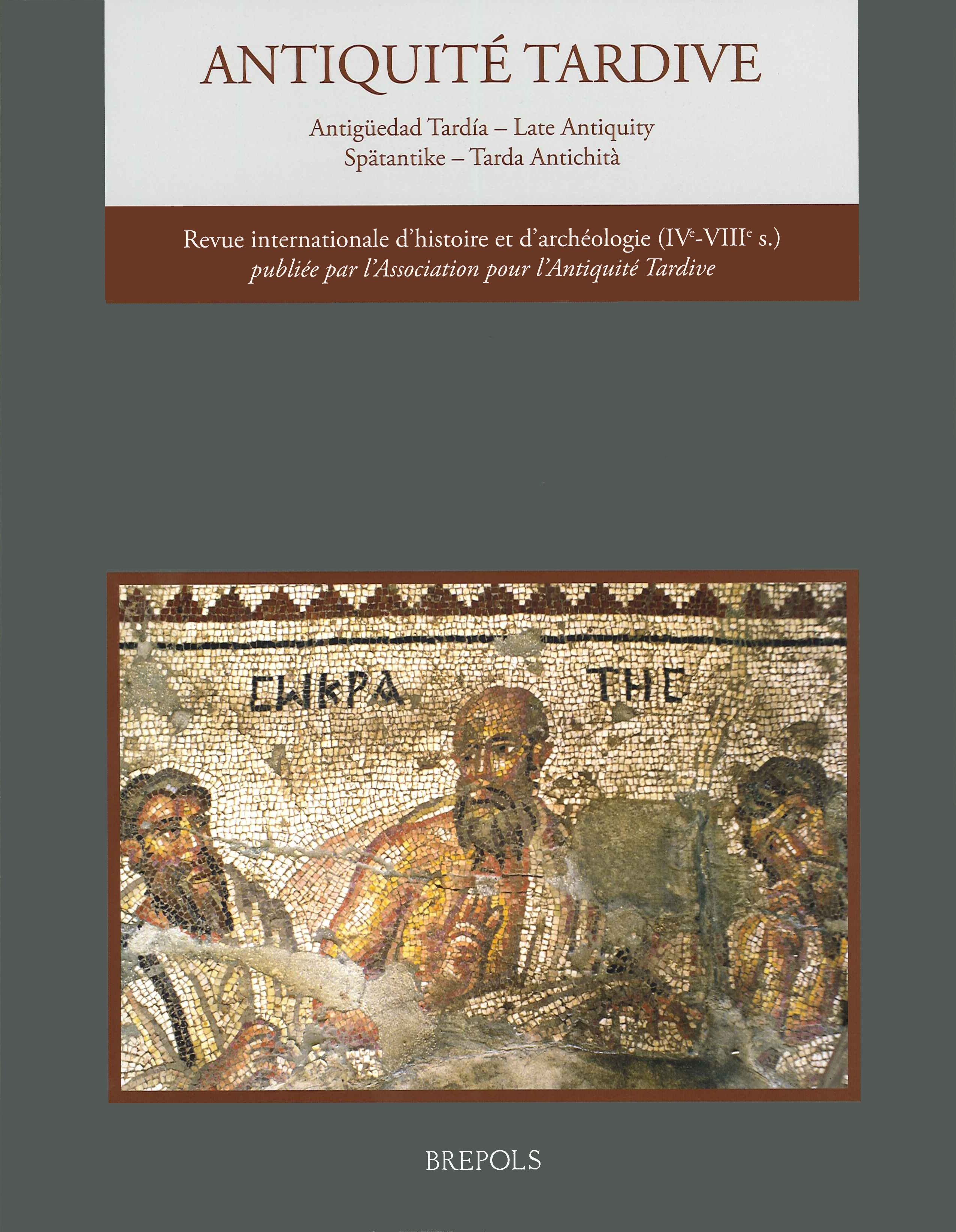
Volume 28, Issue 1, 2021
- Varia
-
-
-
I tetrarchi, le statue divine e i tesori dei temple
show More to view fulltext, buy and share links for:I tetrarchi, le statue divine e i tesori dei temple show Less to hide fulltext, buy and share links for: I tetrarchi, le statue divine e i tesori dei templeBy: Ignazio TantilloAbstractThis article is based on the analysis of some inscriptions which date to the Tetrarchic age (approximately between 285 and 312) and have received little attention in scholarship. They are dedications of statues of deities, set up in different sanctuaries by order of the emperors themselves (Diocletian and Maximian, Galerius, Maximinus Daia, Licinius), through the agency of their provincial representatives, the governors. Some of these (it is the case of two statues from Didyma) seem to be acts of disinterested pietas and to fit perfectly into the inveterate tradition of the celebration of gods, coherently with the self-representation of tetrarchs as it is shown in panegyrics, inscriptions and coins. Others instead (a couple of dedications from ancient Ilion) explicitly - and quite surprisingly - refer to the fact that the statues were made of (a part of) the precious metal which the emperors ordered to be taken from the same temples, according to a practice of ‘exchange’ which is not unparalleled in previous times. A similar procedure (statues made from metal belonging to temple treasures) seem to have been followed by Licinius in two different temples of Dionysopolis in Scythia. The request of crude metal is then examined in the framework of the fiscal and monetary policy of the emperors of the first, second and third Tetrarchy, as it is illustrated by several papyri. Finally, the possibility that seizure of temples’ properties was not uncommon in the Tetrarchic period invites us to reconsider the originality and the meaning of Constantine’s politics towards pagan sanctuaries.
-
-
-
-
Unter den strengen Augen der Kaiser. Ein sextarium trisaugusteum mit Kaiserinschrift vom Anfang des 5. Jahrhunderts
show More to view fulltext, buy and share links for:Unter den strengen Augen der Kaiser. Ein sextarium trisaugusteum mit Kaiserinschrift vom Anfang des 5. Jahrhunderts show Less to hide fulltext, buy and share links for: Unter den strengen Augen der Kaiser. Ein sextarium trisaugusteum mit Kaiserinschrift vom Anfang des 5. JahrhundertsAbstractA Roman bronze measure with inscription is presented here. It can be dated to AD 402-408, due to the three emperors mentioned, Arcadius, Honorius, and Theodosius II. In the incised text the measure is called a sextarium exagialem, unc(iae) XXIIII, a sextarium for the weight of 24 ounces (= two Roman pounds). A test of the weight with spelt led to the confirmation of this weight indication.
The beaker has an extraordinary designed handle. The busts of three emperors looking at the vessel are fixed on a vertical crossbeam at the top of the handle, illustrating imperial control and authority. An inscription from the horreum of Andriake (Lycia) provides the late antique terminus technicus for this kind of measure, sextarium trisaugusteum.
-
- Chronique
-
-
-
Anonymus De rebus bellicis : un état des lieux: À propos de De rebus bellicis, Sur les affaires militaires, texte établi, traduit et commenté par Philippe Fleury, Paris, Les Belles Lettres (CUF), 2017
show More to view fulltext, buy and share links for:Anonymus De rebus bellicis : un état des lieux: À propos de De rebus bellicis, Sur les affaires militaires, texte établi, traduit et commenté par Philippe Fleury, Paris, Les Belles Lettres (CUF), 2017 show Less to hide fulltext, buy and share links for: Anonymus De rebus bellicis : un état des lieux: À propos de De rebus bellicis, Sur les affaires militaires, texte établi, traduit et commenté par Philippe Fleury, Paris, Les Belles Lettres (CUF), 2017AbstractThe initial project of a mere review of the newly published edition / commentary / French translation of the De rebus bellicis by Philippe Fleury developed into an update of our perception of this most discussed text and its author. Here are successively considered, the date when the libellus was written, the geographic origin of the Anonymus, the addressee’s identification, the social extraction of the author, the extent to which he was original and trustworthy. Then comes an assessment of his skills or ignorance as regards currency, military finance and fiscal matters, military machinae, justice and laws. The various interpretations by modern commentators and their translations are compared.
New achievements in our knowledge of the period during the past sixty years brought a major shift in our relation to the text and author of the De rebus bellicis. When this text became a major focus of historical research, it was expected to provide us a fresh information on the fourth-century realities. Nowadays, new tools are at hand for assessing what escaped the Anonymus’ attention, knowledge or understanding. Such a confrontation does not benefit his reputation as an original reformer and brilliant inventor, whereas a new dimension of his personality can be highlighted, i.e. the quest for promoting himself, by claiming that he holds miracle solutions to any problem, and his flippancy when, after arousing curiosity and expectation in his preface, he is no longer interested in fulfilling his boldest promises.
To sum up, we can find in the libellus direct or more distant echoes of a variety of problems which arose in his period, but expressed in the greatest confusion, without any logical linking or synthetic view, through a mere contradictory and confused juxtaposition of table talks, common hearsay, existing or planned governmental provisions, moralizing common places and rhetorical topics. Consequently, we should stop considering the De rebus bellicis as an unicum. Engaging a broader discussion is badly needed.
-
-
-
-
La montagne d’Aaron : un bilan de recherches archéologiques
show More to view fulltext, buy and share links for:La montagne d’Aaron : un bilan de recherches archéologiques show Less to hide fulltext, buy and share links for: La montagne d’Aaron : un bilan de recherches archéologiquesBy: Anne MichelAbstractThis paper presents the results of sixteen years research on the mountain of the Jabal Harun at Petra. Conducted by a Finnish team led by Jaako Frösen from the University of Helsinki, the project focused on the archaeological excavations and the analysis of the monastery of Aaron, including the complete survey of the mountain. As it implemented all the disciplines that compound the today archaeological sciences, the results go way beyond simply studying the architecture of the monastery, by reconstituting the human settlement on the mountain, from the Palaeolithic period up to the present day, and its relations with the city of Petra.
-
-
-
Bulletin critique
show More to view fulltext, buy and share links for:Bulletin critique show Less to hide fulltext, buy and share links for: Bulletin critiqueAbstractArchéologie et histoire de l’art de l’Antiquité tardive
Armin F. Bergmeier, Visionserwartung. Visualisierung und Präsenzerfahrung des Göttlichen in der Spätantike, Wiesbaden (C. Olovsdotter) ; Daniel Chrupcala (dir.), Christ Is Here! Studies in Biblical and Christian Archaeology in Memory of Michele Piccirillo ofm (B. Riba) ; Johannes G. Deckers, Guntram Koch, Repertorium der christlich-antiken Sarkophage, 5. Konstantinopel, Kleinasien-Thracia, Syria, Palestina-Arabia (J. Dresken-Weiland) ; Gregor Kalas, The Restoration of the Roman Forum in Late Antiquity: Transforming Public Space (F. Diosono) ; Daniel Keller, Jennifer Price, Caroline Jackson (dir.), Neighbours and Successors of Rome: Traditions of glass production and use in Europe and the Middle East in the later first millennium AD (S. Fünfschilling) ; Janine lancha, Cristina Oliveira, Corpus dos mosaicos de Portugal/Corpus des mosaïques du Portugal, II, 2, Algarve este (J. Balty) ; Philipp Niewöhner (dir.), Milet, XI. Die Byzantinischen Basiliken von Milet (J.-P. Sodini) ; Thilo Ulbert (dir.), Forschungen in Resafa-Sergiupolis, vol. 7 (J.-C. Balty) ; Emilie M. van Opstaal (dir.), Sacred Thresholds. The Door to the Sanctuary in Late Antiquity (A.E. Felle) ; David Walsh, The Cult of Mithras in Late Antiquity. Development, Decline and Demise ca. A.D. 270-430 (A.B. Griffith) ; Sebastian Watta, Sakrale Zonen im frühen Kirchenbau des nahen Ostens. Zum Kommunikationspotential von Bodenmosaiken für die Schaffung heiliger Räume (P. Niewöhner)
Histoire de l’Antiquité tardive
Roberto Alciati (dir.), Norm and Exercise. Christian Asceticism between Late Antiquity and Early Middle Ages (D. Brakke) ; Elena Gritti, Prosopografia romana fra le due partes imperii (98-604). Contributo alla storia dei rapporti fra Transpadana e Oriens (V. Puech) ; Georgios Kardaras, Byzantium and the Avars, 6th-9th Century AD. Political, Diplomatic and Cultural Relations (G. Szenthe) ; Soazic Kerneis (dir.), Une histoire juridique de l’Occident. Le droit et la coutume (iiie-ixe siècle) (P. Jaillette) ; Clemens Koehn, Justinian und die Armee des frühen Byzanz (G. Sartor) ; Avshalom laniado, Ethnos et droit dans le monde protobyzantin, ve-vie siècle. Fédérés, paysans et provinciaux à lumière d’une scholie juridique de l’époque de Justinien (G. Sartor) ; Adolfo La Rocca, Fabrizio Oppedisano, Il Senato romano nell’Italia ostrogota (V. Fauvinet-Ranson) ; Marta Sordi, Les chrétiens et l’Empire romain ; Marta Sordi, Ambroise, Rome et Milan (364-395 ap. JC). Naissance de l’Empire romain-chrétien et fin du paganisme politique (C. Ferrari) ; Lucia Maddalena Tissi, Gli oracoli degli dèi greci nella Teosofia di Tubinga (N. Spanu) ; Lucia Maddalena Tissi, Helmut Seng, Chiara Ombretta Tommasi (dir.), Stimmen der Götter. Orakel und ihre Rezeption von der Spätantike bis in die Frühe Neuzeit (E.G. Simonetti) ; Giusto Traina (dir.), Mondes en guerre, 1. De la préhistoire au Moyen Âge (D. Lee)
Régions
Walter Ameling (dir.), Die Christianisierung Kleinasiens in der Spätantike (S. Destephen) ; Constantinople réelle et imaginaire. Autour de l’œuvre de Gilbert Dagron (S. Destephen) ; Cristiano Dognini, Ilaria Ramelli, Les Apôtres en Inde dans la patristique et la littérature sanskrite (C. Jullien) ; Andrei Gândilă, Cultural Encounters on Byzantium’s Northern Frontier, c. AD 500-700. Coins, Artifacts and History (A. Madgearu) ; Philipp Pilhofer, Das frühe Christentum im kilikischisaurischen Bergland. Die Christen der Kalykadnos-Region in den ersten fünf Jahrhunderten (S. Destephen)
Philologie et sources
Laurent Capron, Codex hagiographiques du Louvre sur papyrus (P.Louvre Hag.) (A. Papaconstantinou) ; Grégoire de nysse, Homélies sur le Notre Père (M. Danezan) ; Ludwig Koenen, Jorma Kaimio, Maarit Kaimio, Robert W. Daniel, The Petra Papyri, II ; Antti arJava, Jaakko Frösén, Jorma kaimio, The Petra Papyri, V (J. Gascou) ; Paulin de Nole, Correspondance avec Sulpice Sévère (S. Gioanni) ; Dracontius, De raptu Helenae (L. Galli Milić)
-
-
-
Back Matter (“Publications reçues en 2020”, “Instructions aux auteurs”, “Recommendations to authors”)
show More to view fulltext, buy and share links for:Back Matter (“Publications reçues en 2020”, “Instructions aux auteurs”, “Recommendations to authors”) show Less to hide fulltext, buy and share links for: Back Matter (“Publications reçues en 2020”, “Instructions aux auteurs”, “Recommendations to authors”)
-
Volumes & issues
-
Volume 32 (2024)
-
Volume 31 (2024)
-
Volume 30 (2022)
-
Volume 29 (2022)
-
Volume 28 (2021)
-
Volume 27 (2020)
-
Volume 26 (2019)
-
Volume 25 (2018)
-
Volume 24 (2017)
-
Volume 23 (2016)
-
Volume 22 (2015)
-
Volume 21 (2013)
-
Volume 20 (2013)
-
Volume 19 (2012)
-
Volume 18 (2011)
-
Volume 17 (2010)
-
Volume 16 (2009)
-
Volume 15 (2008)
-
Volume 14 (2007)
-
Volume 13 (2006)
-
Volume 12 (2005)
-
Volume 11 (2004)
-
Volume 10 (2003)
-
Volume 9 (2002)
-
Volume 8 (2001)
-
Volume 7 (2000)
-
Volume 6 (1999)
-
Volume 5 (1998)
-
Volume 4 (1997)
-
Volume 3 (1995)
-
Volume 2 (1994)
-
Volume 1 (1993)
Most Read This Month
