


Bulletin de Philosophie Médiévale
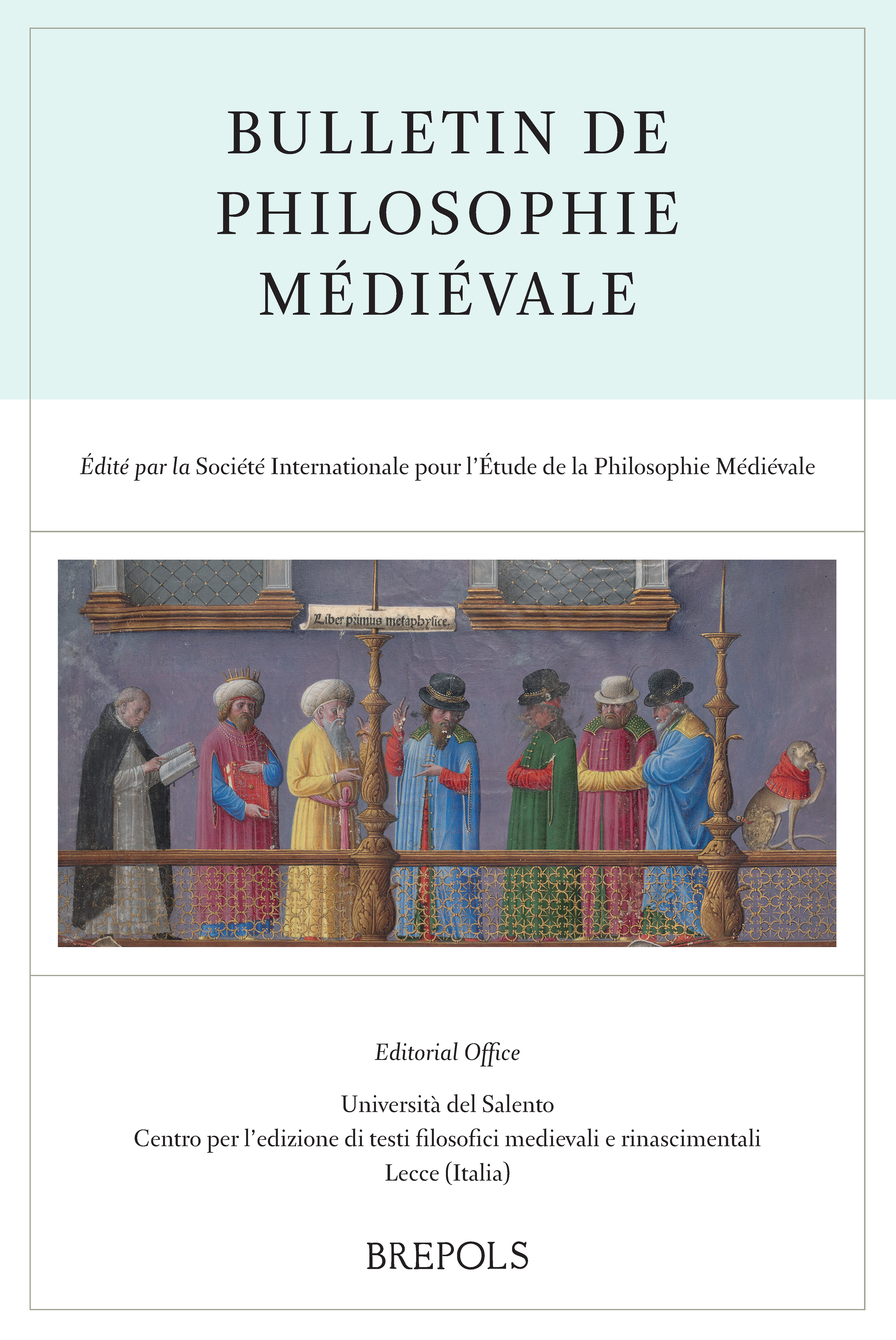
Volume 59, Issue 1, 2017
- Recherches et notes
-
-
-
Les noms propres dans le Commentaire moyenà l’Éthique à Nicomaque d’Averroès. Contribution à une étude sur les traductions latine et hébraïque du Commentaire
show More to view fulltext, buy and share links for:Les noms propres dans le Commentaire moyenà l’Éthique à Nicomaque d’Averroès. Contribution à une étude sur les traductions latine et hébraïque du Commentaire show Less to hide fulltext, buy and share links for: Les noms propres dans le Commentaire moyenà l’Éthique à Nicomaque d’Averroès. Contribution à une étude sur les traductions latine et hébraïque du CommentaireAbstractLes présentes remarques se proposent d’observer la façon dont les noms propres ont été traités par Averroès dans son Commentaire moyen à l’Éthique à Nicomaque (= CmEN), rédigé à partir de la traduction arabe du traité aristotélicien (ENar), dont une seule copie unique existe aujourd’hui, conservée dans la bibliothèque Quaraouiyine de Fès. Perdu dans sa version originale arabe, ce Commentaire n’existe – à l’exception d’une trentaine de petits fragments – que dans sa traduction latine, réalisée en 1240 par Hermann l’Allemand, et dans sa traduction hébraïque, achevée par Samuel de Marseille en 1340. Analyser l’attitude d’Averroès devant les noms propres de ENar, qui pour la plupart ont été translittérés par le traducteur arabe, entraîne par voie de conséquence un examen de la façon dont Hermann et Samuel ont à leur tour réagi face à des noms propres (quand ils ont été conservés par Averroès dans son Commentaire), dont ils ne connaissaient pas nécessairement les référents puisqu’ils appartiennent à une aire culturelle différente de la leur.
-
-
-
-
Il libro Epsilon della Metafisica di Aristotele nell’Epitome di Averroè (1126-1198)
show More to view fulltext, buy and share links for:Il libro Epsilon della Metafisica di Aristotele nell’Epitome di Averroè (1126-1198) show Less to hide fulltext, buy and share links for: Il libro Epsilon della Metafisica di Aristotele nell’Epitome di Averroè (1126-1198)By: Carmela BaffioniAbstractThis article deals with Averroes’s interpretation of Metaph. Ε 1, where Aristotle discusses the nature and object of metaphysics, as well as its place in the hierarchy of sciences. Among Averroes’s predecessors, al-Kindī seems to see a coincidence between metaphysics and theology, since God can be described as the “first cause of everything”. However, al-Fārābī and Avicenna discovered that “first philosophy” could be conceived as an ontology distinct from theology; moreover, they considered theology to be only a part of metaphysics, not even the most important one. In the Great Commentary on Metaphysics - where the Arabic translation of the work by the Jacobite monk Usṭāth is quoted, Averroes often just paraphrases the original passages. One may infer that theology in the strict sense is merely mentioned by way of example. In the Epitome of Metaphysics, the objects of metaphysics are “general” ones; metaphysics studies the “absolute being” and cannot be identified with theology as “pertaining to God”.
-
-
-
The Elucidarium of Honorius Augustodunensis in the Prohemium of the Liber Introductorius of Michael Scot
show More to view fulltext, buy and share links for:The Elucidarium of Honorius Augustodunensis in the Prohemium of the Liber Introductorius of Michael Scot show Less to hide fulltext, buy and share links for: The Elucidarium of Honorius Augustodunensis in the Prohemium of the Liber Introductorius of Michael ScotAbstractThis article examines the use of Honorius Augustodunensis’s Elucidarium in the Prohemium of a three-part introduction to the astrological sciences, namely the Liber introductorius by Michael Scot. The investigation into the adoption of the Elucidarium in the Prohemium not only reveals the work of Honorius Augustodunensis as a major source of the Prohemium but, more importantly, challenges the recent consensus on the relation between the two versions in which the Liber quatuor distinctionum—the first book of the Liber introductorius—has been transmitted. The present contribution will argue that the Long Version is indeed prior to the Short one. The use of the Elucidarium both by Michael Scot and by Godfrey of Viterbo is explored within the article and highlights the need for further research to clarify whether they shared an intellectual framework, or even drew on a common textual source.
-
-
-
The Avicennan aestimatio (al-wahm) in Fakhr al-Dīn al-Rāzī’s Theory of Talismanic Action at a Distance
show More to view fulltext, buy and share links for:The Avicennan aestimatio (al-wahm) in Fakhr al-Dīn al-Rāzī’s Theory of Talismanic Action at a Distance show Less to hide fulltext, buy and share links for: The Avicennan aestimatio (al-wahm) in Fakhr al-Dīn al-Rāzī’s Theory of Talismanic Action at a DistanceBy: Michael NobleAbstractIn al-Sirr al-Maktūm (‘The Hidden Secret’), a magisterial work on astral magic, the twelfth century Persian philosopher-theologian Fakhr al-Dīn al-Rāzī formulated one of the most sophisticated theories of talismanic action at a distance ever produced in the Islamic world. Al-Rāzī deployed Avicennan psychology to explain how a practitioner’s soul might connect with the celestial spheres, the principles of sublunary change, and ‘blend’ their forces into a talismanic metal idol; then, performing a ritual mimetic of his intended effect, could direct these forces to bring about his objective, from a distance, altering sublunary phenomena in accordance with his will. In constructing this theory, Rāzī drew on the psychologizing Avicennan accounts of thaumaturgy and veridical dreams, foregrounding what was common to both: the internal sense known as the wahm (aestimatio).
-
-
-
„ut supra dictum est“ - „als ich ouch mê gesprochen hân“. Zur Frage nach dem internen Gedächtnis in Eckharts lateinischem und deutschem Werk
show More to view fulltext, buy and share links for:„ut supra dictum est“ - „als ich ouch mê gesprochen hân“. Zur Frage nach dem internen Gedächtnis in Eckharts lateinischem und deutschem Werk show Less to hide fulltext, buy and share links for: „ut supra dictum est“ - „als ich ouch mê gesprochen hân“. Zur Frage nach dem internen Gedächtnis in Eckharts lateinischem und deutschem WerkBy: Loris SturleseAbstractInternal cross-references are frequent in Eckhart’s Latin works. In many cases it is easy to identify the passages he had in mind, but several quotations refer to works which are no longer extant or, more probably, to treatises the author intended to write but never actually wrote. This network of cross-indications constitutes a virtual internal memory that links the different parts of Eckhart’s work together in a coherent system. In the German works, the recurring reference to ideas and thoughts already “uttered” (“gesprochen”) seems to explicate the same function, particularly in the hypothesis that they refer to passages contained in a written collection of sermons. In this sense, it would seem that Eckhart’s typical formula “als ich mêr gesprochen hân” should not be translated as a generic “as I have often said” (common translation), but as a precise reference to a previous sermon in the collection (viz. “as I have already said above”) and simulates orality in the homiletic literary style, in the same way as Latin written works refer to previous passages as “sicut (iam) supra dictum est”.
-
-
-
Meister Eckhart’s Self-translations into the Vernacular
show More to view fulltext, buy and share links for:Meister Eckhart’s Self-translations into the Vernacular show Less to hide fulltext, buy and share links for: Meister Eckhart’s Self-translations into the VernacularBy: Markus VinzentAbstractThe present article presents a new manuscript discovery of an Eckhart manuscript hitherto thought to have been lost. The text section of Eckhartian texts consist to a large extent of questions, two of which are being discussed here. As it seems these texts are not, as previously believed, vernacular translations of Eckhart’s Latin exegetical commentaries, but of Latin questions which Eckhart seems to have collected in his Liber quaestionum and translated into the vernacular. ‘Eckhart’ here is taken as a broad label that may encompass Eckhart himself as well as his early readers.
-
-
-
Vérité prophétique et vérité philosophique dans l’œuvre de Rabbi Josef Ibn Caspi
show More to view fulltext, buy and share links for:Vérité prophétique et vérité philosophique dans l’œuvre de Rabbi Josef Ibn Caspi show Less to hide fulltext, buy and share links for: Vérité prophétique et vérité philosophique dans l’œuvre de Rabbi Josef Ibn CaspiBy: Shalom SadikAbstractThe aim of this article is to analyze the opinion of a Jewish Averroist Rabbi Josef Ibn Caspi (Provence and Spain 1260-1345) on the relation between prophetical and philosophical truth. In the beginning of the article, we will see that in some of his writings, R. Caspi claims the prophet’s knowledge to be superior to that of the philosopher. However, in the second part of the article, we will analyze his commentary on Maimonides Guide of the Perplexed. In this commentary R. Caspi also mentions the opposite opinion: that the knowledge of the prophet is only his knowledge as a philosopher and that even true prophets’ (Ezekiel and Zakary) can have a few false prophecies just as good philosophers may have a few wrong opinions. He thus equates the knowledge of a prophet to that of a philosopher. In the conclusion of the article we try to determine how one can distinguish between the texts that explain the true opinion of R. Caspi and the text that our author wrote only for political and pedagogical reasons.
-
-
-
Iacopo, i sogni e il monte calamita. Le fonti filosofiche del trattato sui sogni dello Specchio di vera penitenza
show More to view fulltext, buy and share links for:Iacopo, i sogni e il monte calamita. Le fonti filosofiche del trattato sui sogni dello Specchio di vera penitenza show Less to hide fulltext, buy and share links for: Iacopo, i sogni e il monte calamita. Le fonti filosofiche del trattato sui sogni dello Specchio di vera penitenzaBy: Lorenza TromboniAbstractThe article analyses the chapter on dreams of the Specchio di vera penitenza by Iacopo Passavanti, a Dominican friar who lived in 14th century Florence, focusing on the philosophical sources employed by the preacher. This section of the Specchio is in fact peculiar, since Iacopo discusses here the value of dreams for human knowledge by means of Aristotelian concepts and doctrines, but it does not mention them explicitly. Moreover, while discussing on dreams, Iacopo lingers on the myth of the magnetic mountain following the pseudo-Aristotelian De lapidibus and the treatise On Minerals by Albert the Great. The article studies also Passavanti’s other sources concerning this passage, such as the De lapidibus by Marbodus of Rennes and the Speculum historiale by Vincent of Beauvais.
-
-
-
Nicholas of Cusa on Rational Perception
show More to view fulltext, buy and share links for:Nicholas of Cusa on Rational Perception show Less to hide fulltext, buy and share links for: Nicholas of Cusa on Rational PerceptionAuthors: Christian Kny and José Filipe SilvaAbstractDespite being one of the major figures in late medieval thought and being the subject of numerous studies, certain topics concerning the Cardinal Nicholas of Cusa (1401-1464) remain in need of further investigation. One of these is an aspect of his theory of cognition: his account of sense perception. It is our aim in this study to systematically look at his scattered remarks on the topic and make a number of suggestions as to the nature of his thought on how we come to know external things. It is not our purpose to offer a comprehensive account of his theory of cognition. Our focus in this article is on his account of perception and the specific claim that Nicholas develops a model whereby reason operates together with the senses in perceptual experience. Despite being tentative our claim is grounded on suggestions found in the scholarship on Cusanus; but these suggestions remain quite vague and in need of exploration. In this article, we closely examine the textual evidence and develop our claim based on this examination. In order to substantiate it, we proceed as follows: first, we consider the core theses on perception in several of Nicholas’ works. Second, we bring these elements together and propose a reading of how perception is rational according to Cusanus. Despite being an academic outsider and employing terminology in a way that sometimes obstructs interpretive access, our paper shows that Nicholas is well-acquainted with the different traditions in the philosophy of perception, especially perspectivist optics and medieval Augustinianism. In addition, and as the result of the role he attributes to reason in our experience of the world, Cusanus occupies an important place in the history of the development of theories of perception.
-
-
-
An Inventory of Medieval Commentaries on pseudo-Aristotle’s Physiognomonica
show More to view fulltext, buy and share links for:An Inventory of Medieval Commentaries on pseudo-Aristotle’s Physiognomonica show Less to hide fulltext, buy and share links for: An Inventory of Medieval Commentaries on pseudo-Aristotle’s PhysiognomonicaBy: Lisa DevrieseAbstractPseudo-Aristotle’s Physiognomonica is one of the main authoritative texts in the field of ancient and medieval physiognomy. After its thirteenth century translation into Latin by Bartholomew of Messina, the treatise was widely diffused across Europe. Nevertheless, its medieval reception and use remains largely unexplored. The present paper aims to fill this gap and offers a new inventory of all the medieval commentaries written on pseudo-Aristotle’s Physiognomonica. The newly discovered material allows us to demonstrate that this physiognomic text was more widely read and commented upon than was previously accepted, which inevitably changes the picture of medieval physiognomy in general.
-
-
-
Common Real Being and the Scope of Metaphysics according to Fray Juan de Fuica O.F.M. (17th-18th Centuries, Chile)
show More to view fulltext, buy and share links for:Common Real Being and the Scope of Metaphysics according to Fray Juan de Fuica O.F.M. (17th-18th Centuries, Chile) show Less to hide fulltext, buy and share links for: Common Real Being and the Scope of Metaphysics according to Fray Juan de Fuica O.F.M. (17th-18th Centuries, Chile)AbstractIn this essay, I introduce the reader to some major themes of the metaphysical thought of Juan de Fuica (ca. 1660-17??), a Chilean Franciscan Friar, who, in his activities as professor of philosophy, explained and developed, with many traces of originality, the philosophy of John Duns Scotus. In his cursus on metaphysics, Fuica presents the object of metaphysics, that is, the objective concept of the real being in common. Above all, he shows that being can receive a relative essential definition, in which one can find the aspect of “non-repugnance” or “non-contradictoriness”, which is effectively common to the real being and the being of reason. Fuica, thus, makes an original contribution to the understanding of the scope of metaphysics and its connection to mental objects and the human mind broadly speaking.
-
-
-
Congrès terminés
show More to view fulltext, buy and share links for:Congrès terminés show Less to hide fulltext, buy and share links for: Congrès terminésAbstract(1) Paris: « Le théologico-politique au Moyen Âge » (Olivier Boulnois, Isabelle Moulin)
(2) Köln: “Freedom of Teaching and Educational Policy. Censures, Condemnations, Corrections in the Late Medieval Schools” (Andrea Colli)
(3) Washington D.C.: “Aspectus and Affectus. Robert Grosseteste, Understanding and Feeling” (Timothy Farrant, Joshua Harvey)
(4) Padova: “Rappresentazioni della natura nel Medioevo” (Nicoletta Di Vita, Giovanni Mandolino)
(5) Sao Leopoldo: “A atualidade do pensamento de Francisco Suárez, 400 anos depois” (Alfredo Santiago Culleton, Daniel Schwartz)
(6) Berlin: “A Path through the Ages. Philosophy and Doxography from Ancient to Early Modern Philosophy” (Barbara Tautz, Benno van Croesdijk)
(7) Trento: “L’uomo nel pensiero di Bonaventura da Bagnoregio. Ad 800 anni dalla nascita del Doctor Seraphicus” (Davide Riserbato)
(8) Torino: “Alessandro di Afrodisia nel Medioevo e nel Rinascimento. Convegno internazionale in ricordo di Paolo Accattino” (Alessia Astesiano).
(9) Santa Fe de Bogotá: “Pensares coloniales. Explorando nuestro patrimonio filosófico” (José Higuera Rubio, Roberto Hofmeister Pich)
(10) Padova: “L’Isagoge di Porfirio e la sua ricezione tardoantica e medievale” (Sara Abram, Luca Farina, Giovanni Mandolino)
(11) Macerata: “Giornata di studi sulle Collationes oxonienses di Giovanni Duns Scoto” (Alessandro De Pascalis, Emanuele Sorichetti).
(12) Paris: « La création » (Marta Borgo)
-
-
-
Commissions
show More to view fulltext, buy and share links for:Commissions show Less to hide fulltext, buy and share links for: CommissionsAbstractCommission for Jewish Philosophy (2013-2017) (Steven Harvey, Resianne Fontaine)
-
-
-
Informations concernant la SIEPM
show More to view fulltext, buy and share links for:Informations concernant la SIEPM show Less to hide fulltext, buy and share links for: Informations concernant la SIEPMAbstract(1) In memoriam Marilyn McCord Adams (Mark G. Henninger)
(2) In memoriam Arthur Hyman (Alfred.L. Ivry)
(3) In memoriam Mauro Zonta (Ulrich Rudolph, Lukas Mühlethaler)
(4) Minutes of the 88th Meeting of the Bureau of the SIEPM (Porto Alegre, 24 July 2017)
(5) Minutes of the 89th Meeting of the Bureau of the SIEPM (Porto Alegre, 25 July 2017)
(6) Minutes of the 14th General Assembly of the SIEPM (Porto Alegre, 27 July 2017)
(7) Minutes of the 90th Meeting of the Bureau of the SIEPM (Porto Alegre, 28 July 2017)
-
-
-
Back Matter ("Tables", "Manuscrits", "Noms d’auteurs anciens et médiévaux", "Noms d’auteurs modernes et contemporains", "Table des matières")
show More to view fulltext, buy and share links for:Back Matter ("Tables", "Manuscrits", "Noms d’auteurs anciens et médiévaux", "Noms d’auteurs modernes et contemporains", "Table des matières") show Less to hide fulltext, buy and share links for: Back Matter ("Tables", "Manuscrits", "Noms d’auteurs anciens et médiévaux", "Noms d’auteurs modernes et contemporains", "Table des matières")
-
Volumes & issues
-
Volume 66 (2024)
-
Volume 65 (2023)
-
Volume 64 (2022)
-
Volume 63 (2021)
-
Volume 62 (2020)
-
Volume 61 (2019)
-
Volume 60 (2018)
-
Volume 59 (2017)
-
Volume 58 (2016)
-
Volume 57 (2015)
-
Volume 56 (2014)
-
Volume 55 (2013)
-
Volume 54 (2012)
-
Volume 53 (2011)
-
Volume 52 (2010)
-
Volume 51 (2009)
-
Volume 50 (2008)
-
Volume 49 (2007)
-
Volume 48 (2006)
-
Volume 47 (2005)
-
Volume 46 (2004)
-
Volume 45 (2003)
-
Volume 44 (2002)
-
Volume 43 (2001)
-
Volume 42 (2000)
-
Volume 41 (1999)
-
Volume 40 (1998)
-
Volume 39 (1997)
-
Volume 38 (1996)
-
Volume 37 (1995)
-
Volume 36 (1994)
-
Volume 35 (1993)
-
Volume 34 (1992)
-
Volume 33 (1991)
-
Volume 32 (1990)
-
Volume 31 (1989)
-
Volume 30 (1988)
-
Volume 29 (1987)
-
Volume 28 (1986)
-
Volume 27 (1985)
-
Volume 26 (1984)
-
Volume 25 (1983)
-
Volume 24 (1982)
-
Volume 23 (1981)
-
Volume 22 (1980)
-
Volume 21 (1979)
-
Volume 20 (1978)
-
Volume 19 (1977)
-
Volume 18 (1976)
-
Volume 16-17 (1974)
-
Volume 15 (1973)
-
Volume 14 (1972)
-
Volume 13 (1971)
-
Volume 10-11-12 (1968)
-
Volume 8-9 (1966)
-
Volume 7 (1965)
-
Volume 6 (1964)
-
Volume 5 (1963)
-
Volume 4 (1962)
-
Volume 3 (1961)
-
Volume 2 (1960)
-
Volume 1 (1959)
Most Read This Month
