


Troianalexandrina
Anuario sobre literatura medieval de materia clásica / Yearbook of Classical Material in Medieval Literature
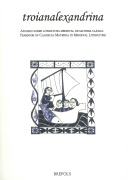
Volume 17, Issue 1, 2017
- Troiana
-
-
-
El rastre de la Historia destructionis Troiae de Guido delle Colonne en la versió catalana de la Histoire ancienne jusqu’à César del ms. 352 de la Biblioteca de Catalunya
show More to view fulltext, buy and share links for:El rastre de la Historia destructionis Troiae de Guido delle Colonne en la versió catalana de la Histoire ancienne jusqu’à César del ms. 352 de la Biblioteca de Catalunya show Less to hide fulltext, buy and share links for: El rastre de la Historia destructionis Troiae de Guido delle Colonne en la versió catalana de la Histoire ancienne jusqu’à César del ms. 352 de la Biblioteca de CatalunyaAbstractThe paper analyses the influence of Guido delle Colonne’s Historia destructionis Troiae (HT) on one of the two extant Catalonian translations of Histoire ancienne jusqu’à César (HAC), as it appears in manuscript 352 of Biblioteca de Catalunya. The analysis focuses mainly on the episodes related to the adventures of Jason, the Argonaut, in the Quest for the Golden Fleece, narrated in fragments inserted in that Catalonian translation of HAC, which are directly derived from delle Colonne’s work. The analysis makes it possible to ascertain that the Catalonian translator/compiler of this version of HAC used the Latin text of HT rather than Jaume Conesa’s Catalonian translation despite the fact that he combined it with some details from the Catalonian translation of Seneca’s Medea, a work also included in this Catalonian version of the compendium history. The narrative, based on the Latin text of HT, which is an innovation with regard to HAC, was therefore structured in a curious way by including elements taken from that tragedy by Seneca (references to Orpheus, allusion to the dismembering of Medea’s younger brother, etc.). The analysis also focuses on translation errors and sheds light on some specific, misleading elements of this version (for example, the fact that a dwarf attends Medea in her chamber) that might have been thought to be taken from an unknown source. As the Trojan section of ms. 352 has not been published before (except for some small fragments), the edition of the episodes of the Trojan history studied here has been included as an appendix.
-
-
-
-
Hector chef de guerre: une figure en évolution
show More to view fulltext, buy and share links for:Hector chef de guerre: une figure en évolution show Less to hide fulltext, buy and share links for: Hector chef de guerre: une figure en évolutionBy: Sandrine LegrandAbstractThe Trojan king Priam makes his son Hector commander-in-chief of the army to fight the Greeks who came to lay siege to Troy. In the Roman de Troie, written by Benoît de Sainte-Maure in the twelfth century, Hector is an idealized leader and a model for the knights reading his text. Hector is fearless and his feat is exceptional. The third prose version of the Roman de Troie, written in the thirteenth century, introduces a slight change. His portrait as a leader changed. Indeed, Hector’s impetuosity is less glorified and even considered as a danger for the Trojan army.
-
- Alexandrina
-
-
-
Callisthène, Aristote, Diogène: Alexandre le Grand face au sage dans trois pièces brèves de Hans Sachs
show More to view fulltext, buy and share links for:Callisthène, Aristote, Diogène: Alexandre le Grand face au sage dans trois pièces brèves de Hans Sachs show Less to hide fulltext, buy and share links for: Callisthène, Aristote, Diogène: Alexandre le Grand face au sage dans trois pièces brèves de Hans SachsAbstractThe article deals with three works of the Nurnberg playwright and master-singer Hans Sachs (1495-1576), representing three different categories of texts (Spruchgedicht, comedy, dialogue). In some cases, Sachs wrote several versions of the episodes he selected from his sources.
In these three short texts, Alexander the Great’s authority and power are questioned by famous Greek sages. The tense political and religious context of the sixteenth century accounts for the potentially subversive dimension of the texts: Von Callistene, dem weysen natürlichen meister, 1558, Ein gesprech könig Alexander Magnus mit Diogene, dem philosopho, 1558 and Das gesprech Alexandri Magni mit dem philosopho Diogeni, 1560. This highly critical trend is compatible with a humorous tone, as shown by the comedy Persones, die Königin, 1554, a play in which the character of Alexander recedes into the background.
From a moral point of view, the sage’s position almost always prevails in these texts, even when he is not able to avoid pitfalls such as excessive confidence in the power of reason (Callisthenes) or misogyny (Aristotle). The author highlights personal defects of the young king that are imaginary or attested by Plutarch and Boccaccio: indirectly drawing a portrait of the ideal prince, Sachs is clearly influenced by Renaissance humanism. Yet the medieval roots of his inspiration cannot be denied.
-
-
-
-
El Alejandro de las Escuelas: La Alexandreis de Gautier de Châtillon en Castilla (II) (con unas palabras sobre el Alexandre de María Rosa Lida).
show More to view fulltext, buy and share links for:El Alejandro de las Escuelas: La Alexandreis de Gautier de Châtillon en Castilla (II) (con unas palabras sobre el Alexandre de María Rosa Lida). show Less to hide fulltext, buy and share links for: El Alejandro de las Escuelas: La Alexandreis de Gautier de Châtillon en Castilla (II) (con unas palabras sobre el Alexandre de María Rosa Lida).AbstractThis article critically re-examines María Rosa Lida’s works devoted to the Alexander legend (matière d’Alexandre) in Spain, paying special attention to her abandoned project of a new edition of the Libro de Alexandre with the help of previously unpublished documents. This historiographical review serves as a background and starting point for the study of the Libro deçimo de Alixandre, an anonymous Castilian translation of Gautier de Châtillon’s Alexandreis, probably redacted around mid-fifteenth century and preserved in a single copy (Madrid, Biblioteca Nacional de España, MS 12672). Together with a survey of the manuscripts of the Alexandreis held by Spanish libraries and of earliest references to this Latin poem in the Iberian Peninsula –above all in Castile– this article offers a detailed codicological analysis of BNE, MS 12672. In doing so, the facticious nature of the codex and the relative chronologies of the different materials there compiled are revealed. As a result, evidence is provided about the role of the Libro déçimo de Alixandre in this multi-layered volume and about the reception of this text at large.
-
- Varia
-
-
-
Unos pasajes corruptos del Libro de Apolonio
show More to view fulltext, buy and share links for:Unos pasajes corruptos del Libro de Apolonio show Less to hide fulltext, buy and share links for: Unos pasajes corruptos del Libro de ApolonioBy: Giovanni BrunoAbstractThere is only one extant manuscript of the Spanish Libro de Apolonio. This manuscript was copied about 150 years after the anonymous author had written the poem about Apollonius of Tyre. Like any manuscript, this copy contains errors introduced by the copyist or former copyists. Since there is no possibility to compare different versions, attempts to rectify the corrupted passages must be made through conjectural emendations based on metrics, semantics, narrative logic and the usus scribendi of the Spanish authors of the middle of the thirteenth century and particularly those of the poetic school of the mester de clerecía. This article contains 12 new emendations to the Libro de Apolonio, as a further contribution to the important work of different scholars who in recent years have formulated emendation proposals of this text.
-
-
- Scripta
-
-
-
Dal De tyranno di Leonardo Bruni al Libro de Senofonte philósopho: una mediazione di Pier Candido Decembrio?
show More to view fulltext, buy and share links for:Dal De tyranno di Leonardo Bruni al Libro de Senofonte philósopho: una mediazione di Pier Candido Decembrio? show Less to hide fulltext, buy and share links for: Dal De tyranno di Leonardo Bruni al Libro de Senofonte philósopho: una mediazione di Pier Candido Decembrio?By: Marta MaterniAbstractIn the last decades, in parallel with a deeper understanding of the humanismo vernáculo and the translations cultural phenomenon, comparative studies have increasingly highlighted the complex network of “textual” relations between the Italian humanist Pier Candido Decembrio and the Iberian Peninsula. All this has had mainly two consequences: the presence of numerous Italian manuscripts in Spanish libraries, and the realization of numerous translations, both from Italian and Latin Pier Candido works. Scholarly focus has been often on the most well-known work, the Italian translation of Quintus Curtius Rufus’ Historiae Alexandri. But ms. 39 of the Real Academia de la Historia presents us a unique testimony: an Iberian translation of the Xenophon’s Hiero apparently from a Pier Candido Decembrio’s romanceamiento. The existence of this Italian work seems doubtful, but the attribution itself is culturally interesting. In this article we intend to offer, first, the text, in order to later realize a deeper textual and linguistic analysis, especially in relation to another translation from Pier Candido Decembrio, the Apokolokyntosis. Since the Spanish translation refers to the Latin version of Leonardo Bruni, De tyranno, we also offer a transcription of this text, still today lacking of a critical edition. A culturally significant witness was chosen for this purpose: this is indeed the personal transcription of the Latin work owned by Pier Candido Decembrio.
-
-
- Recensiones
-
-
-
Simone Pinet, The Task of the Cleric: Cartography, Translation, and Economics in Thirteenth-Century Iberia
show More to view fulltext, buy and share links for:Simone Pinet, The Task of the Cleric: Cartography, Translation, and Economics in Thirteenth-Century Iberia show Less to hide fulltext, buy and share links for: Simone Pinet, The Task of the Cleric: Cartography, Translation, and Economics in Thirteenth-Century Iberia
-
-
Volumes & issues
-
Volume 23 (2023)
-
Volume 22 (2022)
-
Volume 21 (2021)
-
Volume 20 (2020)
-
Volume 19 (2019)
-
Volume 18 (2018)
-
Volume 17 (2017)
-
Volume 16 (2016)
-
Volume 15 (2015)
-
Volume 14 (2014)
-
Volume 13 (2013)
-
Volume 12 (2012)
-
Volume 11 (2011)
-
Volume 10 (2010)
-
Volume 9 (2009)
-
Volume 8 (2008)
-
Volume 7 (2007)
-
Volume 6 (2006)
-
Volume 5 (2005)
-
Volume 4 (2004)
-
Volume 3 (2003)
-
Volume 2 (2002)
-
Volume 1 (2001)
Most Read This Month
