


Antiquité Tardive - Late Antiquity - Spätantike - Tarda Antichità
Revue Internationale d'Histoire et d'Archéologie (IVe-VIIIe siècle)
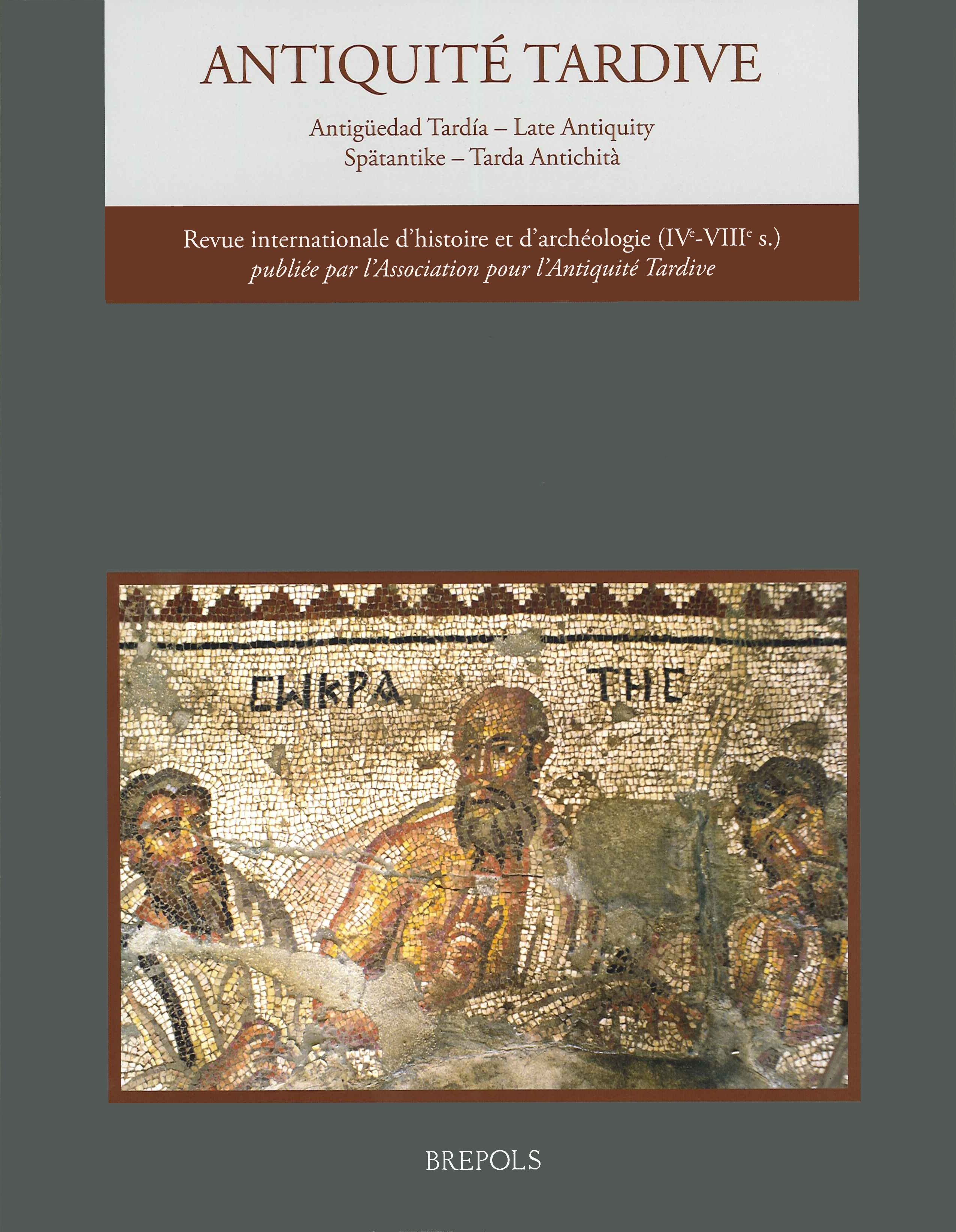
Volume 13, Issue 1, 2006
-
-
Front Matter (editorial information, title page, principales abbréviations, Table des matières, éditorial)
show More to view fulltext, buy and share links for:Front Matter (editorial information, title page, principales abbréviations, Table des matières, éditorial) show Less to hide fulltext, buy and share links for: Front Matter (editorial information, title page, principales abbréviations, Table des matières, éditorial)
-
-
-
Une production caractéristique de cruches en alliage cuivreux (VIe-VIIIe siècles) : typologie, techniques et diffusion
show More to view fulltext, buy and share links for:Une production caractéristique de cruches en alliage cuivreux (VIe-VIIIe siècles) : typologie, techniques et diffusion show Less to hide fulltext, buy and share links for: Une production caractéristique de cruches en alliage cuivreux (VIe-VIIIe siècles) : typologie, techniques et diffusionAbstractAn homogeneous group of cylindrical copper made jugs, brought together by their similar form and manufacturing technique, allows the identification of a large production dated to the VIth century, which had a wide diffusion from Constantinople through the Aegan coasts and the whole Mediterranean area. Two categories may be singled out depending upon whether their connected accessories were iron or bronze made, such accessories being the handle and the stripe used for fastening the handle to the neck while strenghthening the latter. The chain which links the lid to the handle is another typical feature of this group, which was equally imitated in contemporary ceramics. The diffusion map of those jugs suggests that there existed a net of multiple workshops reproducing identical types.
-
-
-
A group of bronze jugs in the Istanbul Archaeological Museums and the issue of their Cypriot origin
show More to view fulltext, buy and share links for:A group of bronze jugs in the Istanbul Archaeological Museums and the issue of their Cypriot origin show Less to hide fulltext, buy and share links for: A group of bronze jugs in the Istanbul Archaeological Museums and the issue of their Cypriot originAuthors: Brigitte Pitarakis and Pinar BursaAbstractDans les dernières décennies du XIXe siècle, le Musée Archéologique d’Istanbul tout nouvellement créé reçut un vaste assortiment d’objets provenant de Chypre. Parmi ceux-ci se trouve un ensemble de sept cruches en alliage de cuivre, semblables par la forme et par la technique, qui peuvent être attribuées au même atelier. Le trait distinctif de ces cruches est leur base plate qu’on retrouve également sur des pichets en terre cuite du VIIe siècle trouvés sur la côte égéenne. Cet ensemble de cruches conservées à Istanbul peut être rapproché de deux autres exemplaires présentant une ressemblance étonnante qui proviennent, l’un d’Amathus (Chypre), l’autre de Megali Lakka (Samos). Le contexte archéologique à Amathus et le trésor monétaire déposé dans l’exemplaire de Samos permettent de dater l’ensemble du groupe de fin VIe - début VIIe siècle et posent la question d’un même atelier chypriote.
-
-
-
Bronze vessels from Late Roman and Early Byzantine Eleutherna on Crete
show More to view fulltext, buy and share links for:Bronze vessels from Late Roman and Early Byzantine Eleutherna on Crete show Less to hide fulltext, buy and share links for: Bronze vessels from Late Roman and Early Byzantine Eleutherna on CreteAbstractCet article présente quatre vases en bronze provenant du site antique d’Eleutherna, dans la partie septentrionale de la Crète. L’auteur étudie plus particulièrement trois vases de cuisine provenant d’un habitat privé. Ces objets ont été trouvés dans une couche de destruction créée par le séisme de 365 apr. J.-C. Il présente ensuite trois fragments d’un encensoir hexagonal trouvé dans la fouille d’une salle de bain, et qui date du VIe-VIIe s. apr. J.-C. Enfin, l’auteur pose le problème de la provenance de la matière première, des techniques employées et du lieu de fabrication des objets métalliques d’Eleutherna.
-
-
-
A Collective find from the early Byzantine Age found in Stara Zagora
show More to view fulltext, buy and share links for:A Collective find from the early Byzantine Age found in Stara Zagora show Less to hide fulltext, buy and share links for: A Collective find from the early Byzantine Age found in Stara ZagoraAuthors: Pavlina Ilieva and Ivo M. CholakovAbstractL’article se propose de dresser le catalogue des objets de bronze qui font partie du trésor protobyzantin découvert accidentellement en 1907 dans la ville de Stara Zagora. Le trésor se compose darticles de fonction et de date diverses qui ont été dissimulés au moment de l’invasion barbare subie par l’antique cité de Beroe dans les dernières années de son existence. D’une façon certaine, ces objets attestent l’existence d’une fonderie de bronze en activité entre la deuxième moitié du VIe et le début du VIIe siècle. D’après les caractéristiques des objets, l’atelier était principalement spécialisé dans la réparation. On reconnaît des traces visibles de réparation sur les samovars (authepsae nos 1-44) comme sur les pièces de vaiselle en bronze usagées. Les pièces qui apparaissent comme neuves ou sans trace d’utilisation sont des couvercles (no 16) et des anses (no 10) en cuivre. Selon toute probabilité, les cuvettes avec passoire (nos 17-21) font partie de la production de l’atelier. Ils sont conserves en bon état. Très certainement, au vu de leurs éléments de connexion endommagés les canalizations hydrauliques (no 41) et le robinet (no 42) étaient hors d’usage et prêts pour la refonte. La série des objets d’usage sacerdotal présente des caractéristiques différentes : qualité élevée, articles importés de grande valeur. Il est intéressant de constater l’absence de traces de réparation sur ces pièces ; la lampe par exemple est en excellent état (no 31). Bien conservés également sont les chandeliers (nos 32- 34) de même que les trépieds pliants (nos 22-23) Les supportss pour lampes d’éclairage en verre sont réduits en morceaux, mais le disque avec chaîne (no 35), une partie des chaînes de suspension (no 38) et les croix (nos 39-40) sont prêts à être réutilisés. Par contre, certaines pièces sont endommagées, des cloches déformées et écrasées, ainsi qu’un petit disque et le deuxième chandelier. Un important apport du trésor de Stara Zagora est la possibilité d’analyser l’organisation du travail artisanal protobyzantin. Sur la base des données conservées, on peut avancer l’hypothèse que la fonderie de Beroe ait fonctionné sous le patronage de l’Église.
-
-
-
Copper alloy jewellery at the Benaki Museum: 4th to 7th century
show More to view fulltext, buy and share links for:Copper alloy jewellery at the Benaki Museum: 4th to 7th century show Less to hide fulltext, buy and share links for: Copper alloy jewellery at the Benaki Museum: 4th to 7th centuryAbstractL’article examine les types caractéristiques de bijoux en alliage de cuivre des IVe-VIIe siècles conservés dans la collection du Musée Benaki. Les analyses métallographiques exécutées sur la plupart de ces accessoires de parure ont confirmé qu’à quelques exceptions près l’alliage le plus fréquent était quaternaire – cuivre, zinc, plomb et étain. Les prototypes de ces bijoux modestes se trouvent du côté des objets en or précieux qui étaient destinés aux couches supérieures de la société protoyzantine et qui dictaient les modes appelées à se répandre dans tout l’Empire. Leur iconographie également suit les tendances de l’époque. Par ailleurs, la plupart des bijoux examinés ici ont valeur d’amulettes : ils ont une fonction prophylactique spécifique qui se combine avec leur but décoratif. Enfin, pour ce qui est de l’importance qu’ils revêtaient pour leurs propriétaires et de la signification sociale dont ils étaient chargés, nous pouvons supposer, à l’aide des sources, que les bijoux de bronze étaient relativement bon marché et qu’en apparence ils n’étaient pas très appréciés. Ils satisfaisaient des besoins d’agrafage, d’ornement et de protection, mais ils semblent avoir été de peu de valeur en temps de récession ou de difficultés financières, et ne jouissaient d’aucun statut d’objet qui compte.
-
-
-
Une lampe de la collection Khoury dans son contexte typologique : les lampes à bec allongé et recourbé avec anses à volutes ou à rinceaux
show More to view fulltext, buy and share links for:Une lampe de la collection Khoury dans son contexte typologique : les lampes à bec allongé et recourbé avec anses à volutes ou à rinceaux show Less to hide fulltext, buy and share links for: Une lampe de la collection Khoury dans son contexte typologique : les lampes à bec allongé et recourbé avec anses à volutes ou à rinceauxAbstractThe lamp in the Khoury Collection belongs to a group of lamps typical of Late Antiquity, that is, lamps with elongated spout and volute or scroll handle. The provenance of the parallels cited (Palestine, Lebanon, Iraq, Turkey) does not allow us to draw secure conclusions on the origins of this type, although the Eastern Mediterranean is the most likely. On the other hand the diversity of the minor morphological details (foot, handle attachment) and proportions suggests that production took place in several different centres or workshops.
-
-
-
La vaisselle de bronze dite “copte” dans les royaumes romano-germaniques d’Occident. État de la question
show More to view fulltext, buy and share links for:La vaisselle de bronze dite “copte” dans les royaumes romano-germaniques d’Occident. État de la question show Less to hide fulltext, buy and share links for: La vaisselle de bronze dite “copte” dans les royaumes romano-germaniques d’Occident. État de la questionBy: Patrick PérinAbstractBronze moulded vases (particularly basins, jugs and paterae) were discovered in rich VIIth century burrials, in Italy as well as in south-western Germany, along the Rhine and in the South West of England. On typological and stylistic criteria, those vases were most generally assigned to coptic Egypt and their geographic distribution has been interpreted as evidence for a major commercial route. Recent studies, however, challenged this interpretation, albeit still commonly admitted nowadays. First, there are no relevant parallels for that kind of vessels in Egypt. Second, metallographic analyses clearly showed that those bronze vases showed a high percentage of lead but a low one of zinc, contrary to authentified coptic bronzes. Even if we cannot exclude an east-mediterranean origin, though parallels are equally rare in the Byzantine world and Egypt, we should better surmise a production from Byzantine Italy. Several finds recently made in southern France as well as in the bed of rivers Saône and Seine testify that this vessel (which is not to be found among the materials of VIIth century burials due to the evolution of funerary customs in Merovingian Gaul) may have been equally transported from the Mediterranean to England via the valleys of Rhône, Saône and Seine. To end with, we question the interpretation of the distibution map of this luxury vessel which, even if actually related to usual trading routes connecting Italy with England via Gaul or the western parts of Germany, may well not reflect proper exchanges of economic nature, but rather a limited circulation of prestige objects particularly sought-after by the élite.
-
-
-
La vaisselle de bronze conservée au Musé copte du Caire. Étude préliminaire à un catalogue
show More to view fulltext, buy and share links for:La vaisselle de bronze conservée au Musé copte du Caire. Étude préliminaire à un catalogue show Less to hide fulltext, buy and share links for: La vaisselle de bronze conservée au Musé copte du Caire. Étude préliminaire à un catalogueAbstractThe Coptic Museum in Cairo holds a collection of 1500 metal objects. Among them are 400 items relating to the kitchen and the table. They are mainly made of copper alloy. This presentation follows a typological classification, the one adopted for the whole catalogue of metal objects, the author is in charge of. The open shape includes various plates, bowls and basins. Some of them display mythological figures, such as Achilles’ childhood, or dancers, while the handles of paterae adopt the appearance of Aphrodite and dolphins. The close shape concerns a variety of flasks and bottles. The last series contains instruments to pour liquids, and spoons. One part of the collection belongs to the widespread Byzantine style and derives from classical forms whereas the other part is more typically Egyptian, showing Coptic features in their specific shapes or decoration. The purpose of such articles is not often clear. Some of them might be used for the liturgy.
-
-
-
Il vasellame bronzeo dell’inizio dell’epoca bizantina: l’Italia. Riflessioni e storia degli studi
show More to view fulltext, buy and share links for:Il vasellame bronzeo dell’inizio dell’epoca bizantina: l’Italia. Riflessioni e storia degli studi show Less to hide fulltext, buy and share links for: Il vasellame bronzeo dell’inizio dell’epoca bizantina: l’Italia. Riflessioni e storia degli studiBy: Francesca ZagariAbstractThe protobyzantine bronze tableware found in Italy is not very well known. Despite a recent increase in Italian studies in metallurgy, inquiries remain uncommon about that kind of artefacts for the early Middle Ages. The scarsity of the studies incontrovertibly depends upon the number of findings and the difficulty in ascribing the items, when undated by the stratigraphical contexts, to a precise chronology and ascertaining the byzantine character of production. Moreover, we have to consider the phenomenon of reuse which, especially for the copper alloys, was of large consequence in the past. As regards the archaeological research, of still great importance are the various topics related to the so-called “coptic bronzes”, which form the best known class of Italian early medieval bronze tableware. Besides them are to be found more usual artefacts (also more difficult to be dated), frequently part of “hoards” concealed in cisterns or deposit-wells of central and northern Italy. This paper, which is intended to outline the directions of recent research, specially mentions findings of bronze tableware in central and southern Italy; a geographical area which but recently began to be the object of specific studies on the early Middle Ages. Rome indisputably stands as an exception, being an important center for production of early medieval bronze tableware, as revealed by archaeology. The paper finally tackles the contribution made by recent studies to our knowledge of iconography and technics of metal working in the Middle Ages, although thematics or chronological references differ with those of protobyzantine bronze tableware.
-
-
-
Sur quelques objets en bronze nouvellement trouvés en Tunisie
show More to view fulltext, buy and share links for:Sur quelques objets en bronze nouvellement trouvés en Tunisie show Less to hide fulltext, buy and share links for: Sur quelques objets en bronze nouvellement trouvés en TunisieBy: Fathi BéjaouiAbstractThe collection of bronze objects here presented mainly results from administrative seizures made in Tunisia in the 80’. It consists in three sets belonging probably to candelabra, plus a jug and and a bowl. The first pieces (lamps and candelabra) don’t show great originality since the same forms and types are present equally in other groups found in Africa (Pupput in Tunisia or Babar in Algeria) or in those (which are many) belonging to private collections. The bowl is definitely the most interesting piece owing to its form and decorative pattern. It looks indeed like an exact replica of similar objects, though produced in African sigillata (Hayes 53). The depicted theme, Abraham’s sacrifice, is the very one which is to be found, to the slightest detail, on sigillata. This case, unfortunately isolated, does not allow, for the moment, to conclude in favour of a local production, though such a possibility is not ruled out.
-
-
-
La vaisselle de bronze dans l’Afrique byzantine : état des questions
show More to view fulltext, buy and share links for:La vaisselle de bronze dans l’Afrique byzantine : état des questions show Less to hide fulltext, buy and share links for: La vaisselle de bronze dans l’Afrique byzantine : état des questionsAuthors: François Baratte and Hélène JacquestAbstractFinds of Byzantine tableware and lightening objects are fewer in North Africa than in others Mediterranean countries: should we see it as the reflect of economic realities or as the effect of a deficiency in research ? An accurate inquiry brings a wiser view of the situation : the main hoards are studied here as well as the isolated discoveries and show, not surprisingly, the great number of lightening objects, lamps and candlesticks, used mostly in churches. It is difficult to assign them a precise date because these objects could stay in use during a long time. The problem of workshops remains largely unsolved : while some of those objects were brought from abroad, others were surely made locally; but we cannot ascertain typical “African” characters for objects looking so similar in the whole Byzantine world.
-
-
-
Les objets métalliques d’Umm al-Walid (Jordanie)
show More to view fulltext, buy and share links for:Les objets métalliques d’Umm al-Walid (Jordanie) show Less to hide fulltext, buy and share links for: Les objets métalliques d’Umm al-Walid (Jordanie)By: Jacques BujardAbstractThe excavation, by the Swiss archaeological mission commissioned by the Max van Berchem Foundation, of an umayyad qasr at Umm al-Walid (Jordan) enabled to find an interesting metallic material. A metallographic study of a number of these objects could be carried out in 1991 by the Restoration Laboratory of the Musée d’art et d’histoire in Geneva, under the direction of François Schweizer and Martine Degli Agosti. It appeared that a most direct relation linked together the type of object and its alloy’s composition. Some kettles are made from copper, a metal which is fit for hammer modelling, when scent burners and a kettle have such alloy’s composition as to facilitate smelting, due to the high grade presence of lead in the alloy which lowers the melting-point and makes engraving, piercing with drill and filing off for finish all together easier. For a cup and a plate, the bronze workers choosed a richly tinned alloy which confers to the objects a colour akin to that of gold.
-
-
-
Un grupo de situlas decoradas de la Antigüedad tardía: función, cronología, significado
show More to view fulltext, buy and share links for:Un grupo de situlas decoradas de la Antigüedad tardía: función, cronología, significado show Less to hide fulltext, buy and share links for: Un grupo de situlas decoradas de la Antigüedad tardía: función, cronología, significadoBy: Javier ArceAbstractThe article studies a group of late antique bronze situlae decorated with mythological, Christian or hunting scenes. All of them can be considered an homogeneous production originated in the same workshop between the second half of the Vth century and the first of the VIth. Some of them bear inscriptions in greek indicating that they were gifts for different persons (women as well as men). One is a donation to a church (Kale e-Zerzevan). After a detailed study of the group Mundell Mango and others has arrived to the conclusion that they were a product of the fabricae armorum established at Antioch or, perhaps, produced for the supply of the soldiers. In their decoration they think possible to recognize “military overtones” and some kind of triumphal ideology. Here the author suggests that the group has nothing to do with the army or the office of the CSL, but rather that they belong to a private or personal sphere as objetcs to be used in bathing contexts (with the exception of the Zerzevan’ exemplar) for women or men alike. Of all the situlae studied only one has been found in an archaeological context, two of them are casual finds and the rest are distributed between different museum collections with unknown provenance. How the three items found in the British Isles or in Spain arrived to so remote places can be only subject to speculation, but they cannot be interpreted as products of commerce between the Eastern Empire and the Western provinces in the first half of the VIth Century. The most remarkable feature of the group is perhaps that they are all products of the same workshop which can be tentatively assigned to Antioch, Constantinople, Nicomedia or even Alexandria in Egypt.
-
-
-
Conclusions
show More to view fulltext, buy and share links for:Conclusions show Less to hide fulltext, buy and share links for: ConclusionsAbstractDrawing the conclusions of the colloquium, this article presents a synthesis of documentary fonts and specialised litterature concerned with the production of bronze objects in late Antiquity. It starts reviewing the main categories of products (jewels, dress ornaments and fittings, tableware and domestic outfits, building fittings, tools, lightening devices, liturgic objects). Dating problems are due to the fixity of shapes which linger during centuries. This kind of ware makes difficult identifying production areas, not to tell about workshops. The origin of ores is impossible to ascertain ; the very composition of alloys rather fits to the looked for type of product than it betrays a provenance area ; the decorative criteria untimely prompted regional attributions (e.g., the so-called “coptic” pots) which lack any validity considering the banality of patterns; the almost complete lack of excavated workshops hinders the study of techniques. The scientists who took part in the colloquium, while displaying the greatest caution, paved alternative ways by privileging other clues – fabrication devices (assemblage des objets complexes) which could disclose workshop’s abilities, decorative features on earthenware borrowed from metalware – which they managed to crosscheck with the places where the objects were found. There is urgent need for assembling regional catalogues of bronze objects.
-
-
-
Un rang impérial nouveau à l’époque de la quatrième Tétrarchie : Filius Augustorum.
show More to view fulltext, buy and share links for:Un rang impérial nouveau à l’époque de la quatrième Tétrarchie : Filius Augustorum. show Less to hide fulltext, buy and share links for: Un rang impérial nouveau à l’époque de la quatrième Tétrarchie : Filius Augustorum.By: Alexandra StefanAbstractThe first part of this study has revised ten inscriptions mentioning the title Filius Augustorum that styled Maximinus and Constantine between 308 and 310 (AnTard, 12); this second part now demonstrates that this new title corresponded to a new imperial rank, and clarifies its chronology and its political implications. According to the inscriptions, the coins and the papyri, that confirm Lactantius’ assertion (De mort. persec., 32. 4), it appears that Galerius replaced the rank of Caesar by that of Filius Augustorum, which was halfway between that of Caesar and that of Augustus. The new imperial title offered a new definition of the divine filiation of Maximinus and Constantine, which served political purposes; it was the last of the series established after 305, and was set up as quite symetrical to that of Pater Augustorum which styled Diocletian as consul that very year 308. The assumption that Galerius established the new rank towards the 20th of December 308 was made possible by the examination of the approximate journey times of the imperial messengers between the Carnuntum conference on the 11th of November 308 and the first mention of the new title in P. Panop. 15, on the 16th of January 309. The speed of these messengers also brings up the question of the existence already in 308-309 of the cursus uelox, first attested in 318. Although Galerius had nominated him consul for 309 with the title of Filius Augustorum, Constantine rejected the new rank, refused to recognize the consuls nominated by Galerius and stopped issuing coinage in his colleague’s name. Maximinus’ resistance to the new rank found expression in the regnal formulas, the coin issues, and the association of the title Caesar with Filius Augustorum in his own titulature and in that of Constantine, as it appears in some papyri. Galerius had to make some concessions, and as a consequence of these political dissensions, a total of seven different titulatures of Maximinus and Constantine were identified between 308 and 310 in the central and eastern regions of the Empire. Created in emergency as a corrective to the decisions taken at Carnuntum that had increased the political crisis, the new rank helped Galerius to keep on the integrity of the Empire at a very difficult moment, and to carry on for a year and half with an imperial tetrarchic college structured according to a hierarchical conception, before replacing about mid-May 310 the new title by that of Augustus, that henceforth styled all the four emperors of the college.
-
-
-
Problemi di cronologia costantiniana. L’imperatore, Vettius Rufinus e il senato
show More to view fulltext, buy and share links for:Problemi di cronologia costantiniana. L’imperatore, Vettius Rufinus e il senato show Less to hide fulltext, buy and share links for: Problemi di cronologia costantiniana. L’imperatore, Vettius Rufinus e il senatoAbstractThe analysis of the subscriptio of CTh VIII, 18, 1, a letter of Constantine to the Senate and the magistrates of Rome, and the examination of the historical and chronological context in which the letter was composed shows that Vettius Rufinus, who read out the letter in the Senate, was not holding office as urban prefect, but was an ex prefect and an ex consul. The letter should therefore be dated not to July –September 315, as has long been thought, but to summer 318. The study of the chronology of the letter which is preserved in CTh VIII, 18, 1 requires the reconstruction of the series of constitutions issued by Constantine in summer 318, when he was away in Aquileia. The selection of the man to read the imperial letter to the Senate (a former urban prefect and former consul) leads to reconsideration of the criteria for presidency and for the reading of documents at meetings of the Senate of Rome in the high imperial and the late antique periods. By the early fourth century the Senate was no longer convened and chaired by the consuls, but by the urban prefect. In the late antique period, however, the urban prefect did not normally read imperial communications to the Senate. Comparison with other late antique imperial letters to the Senate, which were read by the principes senatus, shows that reading imperial documents to the Senate became, from the third century, a privilege and an important mark of honour for the most eminent senators in the assembly. The urban prefect was almost never the most distinguished senator to be present. The study of the career of Vettius Rufinus confirms his importance in 318, and his entitlement to read the imperial letter to the meeting. The reconstruction of his cursus honorum, known from a famous inscription from Atina (CIL X, 5061 = ILS 1217), shows that he held the proconsulate of Achaia as perhaps the last to be assigned by lot, in the traditional way; it allows a more balanced distribution of his career, and suggests that the inscription was erected in Atina in summer 315. As for the question of his eponymous consulate, it appears that he was consul ordinarius in 316, not 323. The examination of the pairs of eponymous consuls in those two years, and the comparison with others, between the second and fourth centuries, suggests an important alteration in the criteria for precedence in pairs of eponymous consuls. In the high imperial period precedence was based on the primacy of entry to the first consulate (that is, on earlier entry to the ranks of consularis); this changed in late antiquity to precedence based on the status of the office held by the consul at the moment of his appointment as consul ordinarius, a system which is reflected in the structure of the Notitia Dignitatum. This change can be seen in the years 326-328, at the time of the Constantinian reform of the praetorian prefecture, and certainly after Vettius Rufinus was consul ordinarius.
-
-
-
Aureliano, Valentiniano I e il vino del popolus Romanus
show More to view fulltext, buy and share links for:Aureliano, Valentiniano I e il vino del popolus Romanus show Less to hide fulltext, buy and share links for: Aureliano, Valentiniano I e il vino del popolus RomanusBy: Domenico VeraAbstractThe evidence of Historia Augusta, Vita Aureliani 48, is unreliable; Aurelian did not found the public wine allowance to the plebs annonaria, which was initiated in a later time, probably in the interval between Diocletian and Constantine. The sale of public wine at prices linked to free market prices resulted in heavy tensions, whose echo is audible in the Historia Augusta, opposing the mass of urban consumers and the Roman senators who had control on the staples. Most probably the wines of the fiscus were delivered in the inns (cauponae), and not in the Temple of Sol, as most authors sustained. The end of the distributions of wine takes place between the Gothic reign and the byzantine reconquista.
-
Volumes & issues
-
Volume 32 (2024)
-
Volume 31 (2024)
-
Volume 30 (2022)
-
Volume 29 (2022)
-
Volume 28 (2021)
-
Volume 27 (2020)
-
Volume 26 (2019)
-
Volume 25 (2018)
-
Volume 24 (2017)
-
Volume 23 (2016)
-
Volume 22 (2015)
-
Volume 21 (2013)
-
Volume 20 (2013)
-
Volume 19 (2012)
-
Volume 18 (2011)
-
Volume 17 (2010)
-
Volume 16 (2009)
-
Volume 15 (2008)
-
Volume 14 (2007)
-
Volume 13 (2006)
-
Volume 12 (2005)
-
Volume 11 (2004)
-
Volume 10 (2003)
-
Volume 9 (2002)
-
Volume 8 (2001)
-
Volume 7 (2000)
-
Volume 6 (1999)
-
Volume 5 (1998)
-
Volume 4 (1997)
-
Volume 3 (1995)
-
Volume 2 (1994)
-
Volume 1 (1993)
Most Read This Month
