


BOB2023MIOT

Collection Contents
4 results
-
-
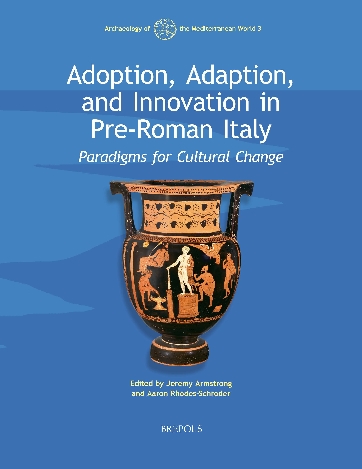
Adoption, Adaption, and Innovation in Pre-Roman Italy
show More to view fulltext, buy and share links for:Adoption, Adaption, and Innovation in Pre-Roman Italy show Less to hide fulltext, buy and share links for: Adoption, Adaption, and Innovation in Pre-Roman ItalyThe ancient Mediterranean basin was once thought to be populated by large, monolithic, cultural-political entities. In this conception, ‘the Greeks’, ‘the Romans’, and other stable and homogenous cultures interacted and vied for supremacy like early modern states or empires. Today, however, thanks largely to an ever-increasing archaeological record, critical and sensitive approaches to the literary evidence, and the impact and application of new theoretical approaches, the ancient Mediterranean region is instead argued to be full of dynamic microcultures organized in a fl uid set of overlapping networks. While this atomization of culture has resulted in more interesting and accurate micro-histories, it has also challenged how we understand cultural interaction and change.
This volume draws on this new understanding of cultural identity and contact to address the themes of adoption, adaption, and innovation in Pre-Roman Italy from the 9th-3rd centuries BCE. The contributors to this volume build upon recent paradigm shifts in research that challenge traditional Hellenocentric models and work to establish a new set of frameworks for approaching the tangled question of how ‘indigenous’ and ’foreign’ features relate to one another in the material record. Using focused case-studies, ranging from the role played by mobile populations in transferring ideas and technologies to the different ways in which ‘foreign’ artistic elements were used by Italian peoples, the volume explores what the - now commonly accepted - connectedness of a wider Mediterranean world meant for the people of Italy in practical terms, and offers new models for how concepts and ideas were transmitted, reinterpreted, repurposed, and re-appropriated in early Italy to fit within their local context.
-
-
-
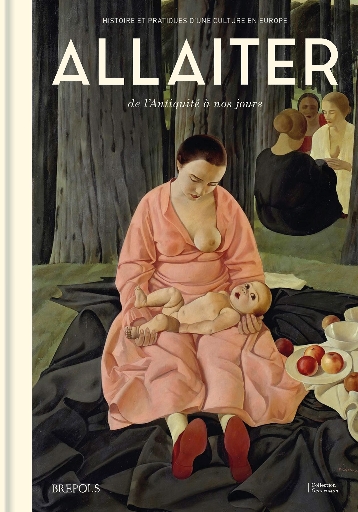
Allaiter de l’Antiquité à nos jours
show More to view fulltext, buy and share links for:Allaiter de l’Antiquité à nos jours show Less to hide fulltext, buy and share links for: Allaiter de l’Antiquité à nos joursAujourd’hui, l’allaitement est au centre des préoccupations des organismes internationaux, en ce qui concerne les soins destinés aux nouveau-nés et la santé des femmes. Ces questions occupent une place importante dans les débats autour de la maternité et du travail féminin. Mais les pratiques et les représentations de l’allaitement sont traversées par des tensions politiques, économiques et religieuses. Pouvons-nous éclairer les controverses par une mise en perspective historique large de leurs enjeux socio-culturels ? Faire l’histoire de l’allaitement en Europe est une manière de contribuer à une approche globale de la question de la reproduction. Emboîtant le pas aux recherches récentes sur la maternité, les quatre sections de cet ouvrage proposent les résultats d’une vaste enquête collective pluridisciplinaire et ouvrent des pistes pour une réflexion critique sur les enjeux actuels de la parentalité et de la reproduction. Les chapitres de ce volume associent les investigations historiques, anthropologiques et archéologiques à l’histoire de l’art et aux études littéraires. L’ouvrage présente également une riche documentation visuelle et des focus conçus comme outils pour la recherche, la divulgation scientifique et la didactique.
-
-
-
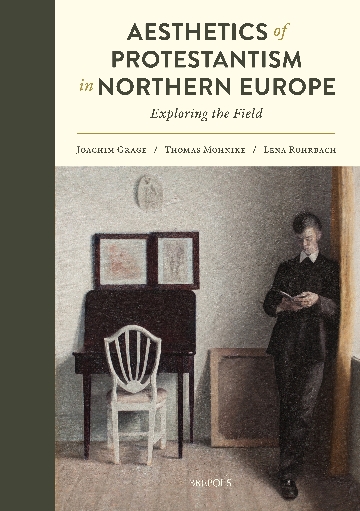
Aesthetics of Protestantism in Northern Europe
show More to view fulltext, buy and share links for:Aesthetics of Protestantism in Northern Europe show Less to hide fulltext, buy and share links for: Aesthetics of Protestantism in Northern EuropeThis book explores the aesthetic consequences of Protestantism in Scandinavia. Fourteen case studies from the sixteenth to the twenty-first century discuss five abstract and trans-historical principles that characterize Scandinavian aesthetics and that arguably derive from Protestant thinking and practice, namely: simplicity, logocentrism, tension between pronounced individualism and collectivism, relatedness to the world, and ethics. The contributions address the peculiar aesthetics of Scandinavian print, literature, architecture, film, and opera and reflect on the influence of Protestant traditions on the establishment of genres and writing practices. This volume is the first in a new series that will focus on the aesthetics of Protestantism in Scandinavia, both theoretically and through exemplary individual analyses.
-
-
-
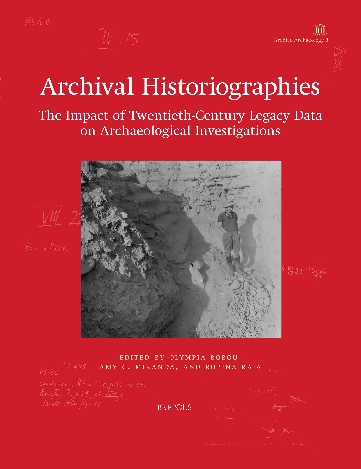
Archival Historiographies
show More to view fulltext, buy and share links for:Archival Historiographies show Less to hide fulltext, buy and share links for: Archival HistoriographiesArchives held in institutions around the world hold a wealth of material but traditionally, the fields of Classical and ancient Near Eastern archaeology have been slow to make use of such legacy data in their investigations. In recent years, however, this trend has begun to change, and scholars increasingly recognize the importance of archival material to their research. Drawing directly on these trends, this volume offers the first in-depth analysis of what it means to engage in archive archaeology and how it can influence understandings of both the ancient world and the recent past. Excavation historiographies and the formation of archaeological archives in the twentieth century are investigated in locations from across the Eastern Mediterranean and the Middle East, with current understanding of sites such as Dura Europos or Palmyra being fundamentally reassessed in the light of the archival material. Crucially, the volume contributions gathered here look to the future as well as to the past: archives are acknowledged as essential to cultural heritage preservation and restitution initiatives, and chapters explore best practices, as well as presenting some of the manifold potentials of archive and legacy data to future research.
-