


BOB2023MIOT

Collection Contents
4 results
-
-
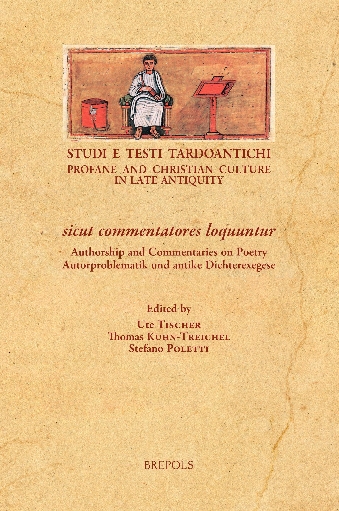
sicut commentatores loquuntur
show More to view fulltext, buy and share links for:sicut commentatores loquuntur show Less to hide fulltext, buy and share links for: sicut commentatores loquunturAncient commentaries on poetry - due to their heteronomous nature, their miscellaneous character, and the fact that most of them are transmitted in abridged and anonymous form - are usually not considered ‘authorial’ texts in the same way as poems or literary prose are. On the other hand, as didactic texts, they rely on authority to convey their interpretation, and they also often seem to have been perceived as products of authorial activity, as paratexts, references and pseudepigraphic attributions demonstrate.
The aim of this volume is to explore this tension and to examine commentaries and scholia on poetry in terms of authorship and ‘authoriality’. The contributions use several Latin and Greek corpora as case studies to shed light on how these texts were read, how they display authorial activity themselves, and how they fulfil their function as didactic works. They provide reflections on the relationship of author, authorship, and authority in ‘authorless’ traditions, explore how authorial figures and authorial viewpoints emerge in an implicit manner in spite of the stratified nature of commentaries, investigate the authorial roles adopted by commentators, compilers and scribes, and elucidate how commentators came to be perceived as authors in other exegetic traditions.
-
-
-
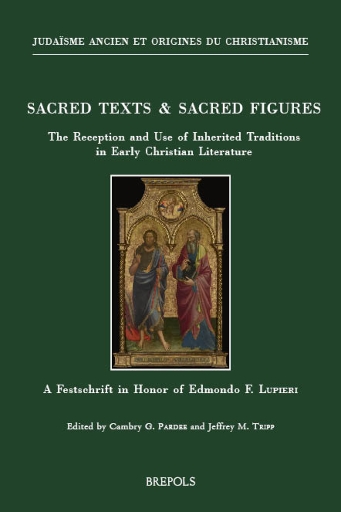
Sacred Texts & Sacred Figures: The Reception and Use of Inherited Traditions in Early Christian Literature
show More to view fulltext, buy and share links for:Sacred Texts & Sacred Figures: The Reception and Use of Inherited Traditions in Early Christian Literature show Less to hide fulltext, buy and share links for: Sacred Texts & Sacred Figures: The Reception and Use of Inherited Traditions in Early Christian LiteratureIn tribute to the scholarly legacy of Edmondo F. Lupieri, in Sacred Texts & Sacred Figures an international group of esteemed biblical scholars offer essays on the ways religious traditions, texts, and even the legacies of notable figures were received, re-interpreted, and used by the authors of gospels, epistles, and apocalypses to address the ever-evolving circumstances of emerging Christianity. In the first and second centuries ce, oral and written traditions about the life of Jesus proliferated and formed the basis for written narratives. The authors of the gospels received and redacted those traditions to make distinctive theological claims about Jesus and to address their specific milieu and the wider movement of Jesus-followers. Among some groups of Jesus-followers the sacred texts of Judaism remained paramount. Authors like that of the Epistle to the Hebrews re-examined their inheritance of Jewish scriptures in order to demonstrate the continuity of their novel claims about Jesus with the sacred texts and traditions of Judaism. Similarly, the authors of first- and second-century apocalypses drew on the heritage of Jewish apocalypticism to write and record new revelations of and about Jesus. In addition to traditions and texts, authors in the first and second centuries re-examined the legacy of significant Jewish figures and followers of Jesus and wrote about them in the context of their own contemporary circumstances. Using innovative strategies and written in an engaging style, the essays assembled here explore the reception and reinterpretation of sacred traditions, texts, and figures in the writings of early Christianity.
-
-
-
Spinoza en Angleterre
show More to view fulltext, buy and share links for:Spinoza en Angleterre show Less to hide fulltext, buy and share links for: Spinoza en AngleterreLe volume s’interroge sur la place de Spinoza dans les milieux intellectuels, philosophiques et scientifiques de l’Angleterre et de l’Europe du xvii e siècle, et il analyse les contextes scientifiques privilégiés qui ont fourni à Spinoza plusieurs motifs de réflexion et qui ont compté ensuite parmi ses principaux lieux de réception. Le rapport entre Spinoza et le débat philosophique en Angleterre a retenu l’attention des historiens depuis longtemps. Il s’agit d’un terrain historiographique complexe où questions de sources, réception des idées et enjeux polémiques se mêlent souvent. La première partie du volume a une approche plus thématique : on se focalise sur un thème de la philosophie de Spinoza pour y voir, comme dans un prisme, le reflet des débats croisés entre Pays-Bas et Angleterre. La deuxième partie du volume est consacrée principalement à Spinoza et à la considération du rapport avec la physique hobbesienne. La troisième partie du volume porte sur les polémiques autour des œuvres de Spinoza qui furent lues durant le dix-huitième siècle en Angleterre et sur le continent, les spéculations philosophiques d’un cartésien athée et les œuvres d’un impie. Le parcours intellectuel du livre, qui rassemble les contributions de A. Di Nardo, R. Evangelista, G. Giglioni, E. Guillemeau, M. Laerke, F. Mignini, A. Sangiacomo, C. Santinelli, M. Sanna, C. Secretan, L. Simonutti, T. Verbeek, s’achève par la postface de Pierre-François Moreau.
-
-
-

Studies in Maximus the Confessor’s Opuscula Theologica et Polemica
show More to view fulltext, buy and share links for:Studies in Maximus the Confessor’s Opuscula Theologica et Polemica show Less to hide fulltext, buy and share links for: Studies in Maximus the Confessor’s Opuscula Theologica et PolemicaOpuscula theologica et polemica is a collection of minor works of Maximus the Confessor that has not received much scholarly attention so far. Nevertheless, it offers a unique insight in the Christological and personological universe of the Christian thinker. The present volume is the first attempt to bring together scholars of different traditions and to apply different approaches - theological, philosophical, philological and historical - to this seminal work.
-