


BOB2023MIOT

Collection Contents
4 results
-
-
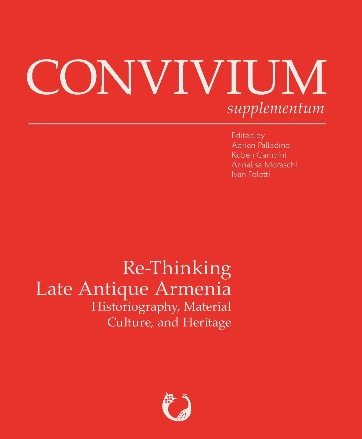
Re-Thinking Late Antique Armenia: Historiography, Material Culture, and Heritage
show More to view fulltext, buy and share links for:Re-Thinking Late Antique Armenia: Historiography, Material Culture, and Heritage show Less to hide fulltext, buy and share links for: Re-Thinking Late Antique Armenia: Historiography, Material Culture, and HeritageThis book questions the place of Armenian visual and material culture in the period known as Late Antiquity, at a time when Armenia is usually presented as an in-between space defined by surrounding external entities: the Roman and the Persian, and later Arab world. The volume includes articles that confront this notion both from the perspective of art history, architecture, and archaeology, and from a historiographical point of view, which examines the reception of Armenian arts by scholars from Italy, Russia, and France. The articles in this richly illustrated volume aim to reposition Armenia as one of the forces of artistic creation and mediation to be reckoned with within the Mediterranean and Eurasian space of Late Antiquity. This project draws on the papers presented at the conference “Re-Constructing Late Antique Armenia (2nd–8th Centuries CE). Historiography, Material Culture, Immaterial Heritage” that took place in February 2022 at the Center for Early Medieval Studies in Brno, Czech Republic.
-
-
-

A Radical Turn? Re-appropriation, Fragmentation, and Variety in the Post-Classical World (3rd-8th c.)
show More to view fulltext, buy and share links for:A Radical Turn? Re-appropriation, Fragmentation, and Variety in the Post-Classical World (3rd-8th c.) show Less to hide fulltext, buy and share links for: A Radical Turn? Re-appropriation, Fragmentation, and Variety in the Post-Classical World (3rd-8th c.)This thematic issue draws on the papers presented at the conference “Radical Turn? Subversions, Conversions, and Mutations in the Postclassical World (3rd-8th c.)” that took place last autumn in Brno, Czech Republic. Its aim is to contribute to the rehabilitation of the period of “Late Antiquity”, which has often been neglected in scholarly circles as a mere transitional period between the classical past and the medieval future. Individual papers reflect on the cultural production of this period from the perspectives of different disciplines (art history, classical philology, archaeology, and history), offering new insights on various aspects of late antique.
-
-
-
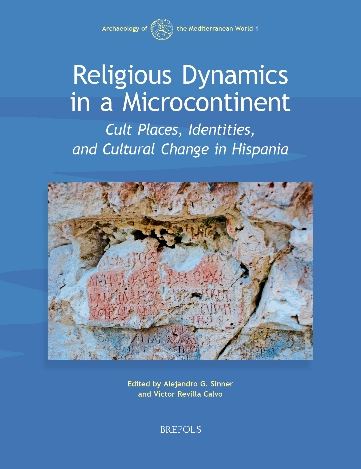
Religious Dynamics in a Microcontinent
show More to view fulltext, buy and share links for:Religious Dynamics in a Microcontinent show Less to hide fulltext, buy and share links for: Religious Dynamics in a MicrocontinentThe Roman conquest of the Iberian peninsula, a land already inhabited by peoples who were characterized by cultural, ethnic, and social diversity, was one of the longest and most complex colonial processes to have occurred in the Roman world. Different political entities saw integration and interaction taking place at different speeds and via different mechanisms, and these differences had a profound impact on the development of religious dynamics and cultural change across the peninsula.
This edited volume draws together contributions from a number of experts in the field in order to deepen our understanding of religious phenomena in Hispania - in particular cult, rituals, mechanisms, and spaces - and in doing so, to offer new insights into processes of cultural and social change, and the impact of conquest and colonialism. The chapters gathered here identify how forms of religious interaction occurred at different levels and scales, and explore the ways in which religion and religious practices underpinned the construction, development, and renegotiation of different identities. Through this approach they shed important light on the crucial role of cultic practices in defining cultural and social identity as Iberia’s provincial communities were drawn into the Roman world.
-
-
-
Roman Identity
show More to view fulltext, buy and share links for:Roman Identity show Less to hide fulltext, buy and share links for: Roman IdentityRecent years have seen a significant increase in migration and displacement. Due to economic, political, and climatic pressures, large numbers of individuals are leaving their countries of origin and settling in new environments and societies. As a result, national identity has increasingly come to the fore in public discourse. Shaping and reshaping national agendas, debates surrounding national identity are affecting policies and influencing voting behaviours. Discourse on this issue is often centred on the idea of autochthony and nativism. Yet we do not encounter such anxieties in ancient Rome, one of the longest-lasting political orders in history. Unlike among the Greeks, the idea of autochthony did not take root among the Romans. Instead, Rome’s identity tended to be fluid, accommodating the development of highly variegated and multi-ethnic groups and societies.
The purpose of this volume is to understand how the Romans represented themselves and how others defined and regarded them. It aims to identify the various narratives that contributed to the construction of Roman self-representation by raising the following questions: What stories did Romans tell about themselves? How did they enact and perform their selfhood in biographic and autobiographical sources? How did Greek and Judean sources understand and define Roman identity? And, taken together, how did these narratives influence Roman self-perception?
Rather than arguing for a monolithic or coherent understanding of Romanitas, this volume explores a variety of performances and manifestations of Roman identity. It focuses both on sources where the self or individual is the primary focus, alongside more general texts dealing with specific elements of Roman identity.
-