


BOB2023MIOT

Collection Contents
5 results
-
-
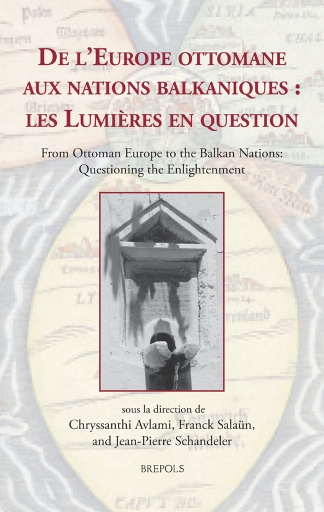
De l’Europe ottomane aux nations balkaniques : les Lumières en question
show More to view fulltext, buy and share links for:De l’Europe ottomane aux nations balkaniques : les Lumières en question show Less to hide fulltext, buy and share links for: De l’Europe ottomane aux nations balkaniques : les Lumières en questionThe Enlightenment has often been used as a fundamental reference point for understanding the evolution of societies. Nevertheless, the broad nature of this term hides great inequalities between different historiographical traditions, with some countries considered to have ‘ownership’ of this intellectual and cultural current, which arose in the eighteenth century, while other lands have been considered at best peripheral, or at worst have been wholly disregarded. This is particularly true of the Ottoman Empire, and of the Balkan states, founded in the first decades of the nineteenth century, which have often been studied only through their relationship with France, Great Britain, and German. This, however, is not sufficient for understanding how these countries entered modernity. The studies gathered in this book seek to question the invention of the National Enlightenment, the history of representations of the European Enlightenment and their variations in Balkan space and time, and the phenomena of acculturation and rejection that can be identified in the histories of these lands in order to offer new insights into the contradictory aspirations of nations that have often been torn between several different models of society.
-
-
-

Descartes and Medicine
show More to view fulltext, buy and share links for:Descartes and Medicine show Less to hide fulltext, buy and share links for: Descartes and MedicineThis volume provides a more exhaustive interpretation of René Descartes’ medical views and its reception in the seventeenth century. Filling the gap in the recent scholarship, the contributions in the volume follow four axes: exegetical, textual, philosophical, and contextual. Authors in this book deal with Descartes’ physiology, anatomy, and therapy by reconstructing Cartesian texts, detailing possible medical and philosophical sources, discussing medical collaborations and oppositions, and exploring obscurities and failures in Descartes’ medicine. In laying bare the more promising issues of Cartesian programme and discussing the reception and opposition in the seventeenth century, the volume also uncovers the limitations within his interpretation, ultimately revealing a more nuanced application of his methodology to a field of natural philosophy. While medical studies play a not secondary role in Descartes’ entire work, the volume aims to discuss in detail the importance of medicine as a suitable field to understand Cartesian philosophy from a significant perspective in seventeenth-century Europe.
-
-
-
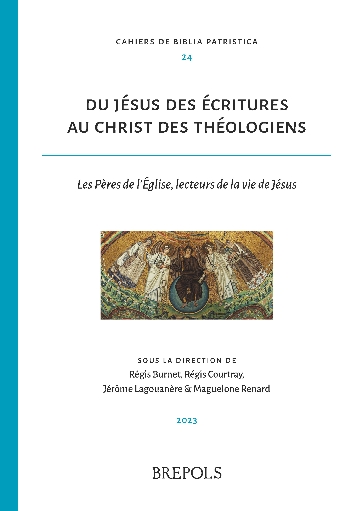
Du Jésus des Écritures au Christ des théologiens
show More to view fulltext, buy and share links for:Du Jésus des Écritures au Christ des théologiens show Less to hide fulltext, buy and share links for: Du Jésus des Écritures au Christ des théologiensPour parler de la foi chrétienne, les Pères ont souvent recouru à des exposés concrets, s’appuyant sur des personnages bibliques. Or, de tous ces modèles bibliques, Jésus est sans conteste le paradigme. Les premiers écrivains chrétiens se sont ainsi attachés à expliquer les épisodes de sa vie pour en dégager des enseignements spirituels, moraux ou doctrinaux, soulevant de la sorte aussi bien des questions d’exégèse que de théologie.
La grande question qui s’est posée dès le début à la communauté chrétienne fut de démontrer que le Jésus de Nazareth de la Bible est bien le « Christ ». Cette question s’est posée de manière complexe et souvent violente au cours des premiers siècles du christianisme.
Partant de la lecture que les Pères ont faite de la figure de Jésus, notamment dans les Évangiles, le présent volume s’interrogera sur l’élaboration progressive, parfois polémique, des différents éléments constitutifs du personnage théologique du Christ. Il s’agira de permettre de mieux saisir la manière dont la figure de Jésus, telle qu’on la trouve dans les Écritures, a été peu à peu comprise et réélaborée dans des lectures théologiques.
Ces réflexions des Pères conservent toute leur portée aujourd’hui, tant les questions soulevées dès les premiers siècles du christianisme continuent d’être actuelles : elles concernent tant les historiens des religions que les théologiens, sans oublier les exégètes et tous ceux qui s’intéressent à la réception du personnage du Christ.
-
-
-
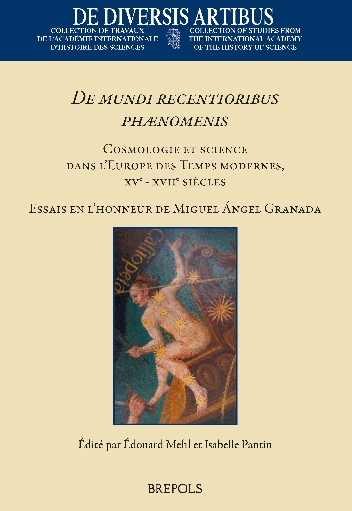
De mundi recentioribus phænomenis
show More to view fulltext, buy and share links for:De mundi recentioribus phænomenis show Less to hide fulltext, buy and share links for: De mundi recentioribus phænomenis« Sur les phénomènes les plus récents de l’univers » : le titre de ce recueil d’essais offerts à Miguel Ángel Granada est emprunté à l’ouvrage de Tycho Brahe sur la comète de 1577. Il fait allusion au lien entre les prodiges qui ont traversé le ciel, entre la fin du 16e et le début du 17e siècle (les supernovas de 1572 et de 1604, les grandes comètes de 1577 et 1618) et les renouvellements profonds, philosophiques, religieux, culturels, qui ont marqué cette période. Ce lien, le travail mené par Miguel Angel Granada depuis une trentaine d’années n’a cessé de l’approfondir. En explorant la complexité de ce qu’on appelle la Révolution scientifique, il a aussi été un acteur majeur de la transformation et de l’élargissement de l’histoire des sciences : l’étude de l’astronomie mathématique, longtemps centrale, s’intègre désormais à une histoire des savoirs, des institutions, des contextes politiques et religieux.
Les articles qui composent ce recueil s’inscrivent dans ce sillage. Ils s’inspirent des découvertes et des idées de ce grand chercheur, et prolongent certaines de ses enquêtes, en abordant tous les domaines, de la métaphysique à l’astrologie. Ils restituent ainsi l’image d’une Europe savante en train de se constituer par la circulation et la dissémination des idées, de Rostock à Naples, de Lisbonne à Prague, ou de Londres à Wittenberg.
-
-
-
Dealing with Disagreement
show More to view fulltext, buy and share links for:Dealing with Disagreement show Less to hide fulltext, buy and share links for: Dealing with DisagreementAncient philosophy is known for its organisation into distinct schools. But those schools were not locked into static dogmatism. As recent scholarship has shown, lively debate persisted between and within traditions. Yet the interplay between tradition and disagreement remains underexplored. This volume asks, first, how philosophers talked about differences of opinion within and between traditions and, second, how such debates affected the traditions involved. It covers the period from the first century BCE, which witnessed a turn to authoritative texts in different philosophical movements, through the rise of Christianity, to the golden age of Neoplatonic commentaries in the fifth and sixth centuries CE.
By studying various philosophical and Christian traditions alongside and in interaction with each other, this volume reveals common philosophical strategies of identification and differentiation. Ancient authors construct their own traditions in their (polemical) engagements with dissenters and opponents. Yet this very process of dissociation helped establish a common conceptual ground between traditions. This volume will be an important resource for specialists in late ancient philosophy, early Christianity, and the history of ideas.
-