


Brepols Online Books Medieval Miscellanea Collection 2025 - bob2025mime

Collection Contents
3 results
-
-

The Power of Words in Late Medieval Devotional and Mystical Writing
show More to view fulltext, buy and share links for:The Power of Words in Late Medieval Devotional and Mystical Writing show Less to hide fulltext, buy and share links for: The Power of Words in Late Medieval Devotional and Mystical WritingThis volume honours Denis Renevey's contribution to late medieval devotional and mystical studies via a series of essays focusing on a topic that has been of central relevance to Denis's research: the power of words. Contributors address the centrality of language to devotional and mystical experience as well as the attitudes towards language fostered by devotional and mystical practices. The essays are arranged in four sections: 'Other Words: Figures and Metaphors: treating the application of the languages of romantic love, medicine, and travel to descriptions of devotional and mystical experience; 'Iconic Words: Images and the Name of Jesus; considering the deployment of words and the Word (Jesus) as powerful images in devotional practice; 'Testing Words: Syntax and Semantics; exploring the ways in which medieval writers stretch the conventions of language to achieve fresh perspectives on devotional and mystical experiences; and 'Beyond Words: The Apophatic and The Senses; offering novel perspectives on a group of texts that address the difficulty of expressing God and visionary experience with words.
The volume's global purpose is to demonstrate the attractions of an explicitly philological approach for scholars studying the Christian tradition.
-
-
-
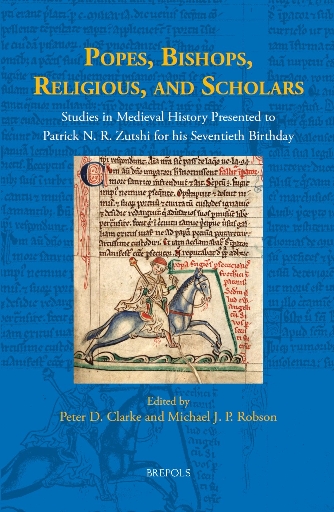
Popes, Bishops, Religious, and Scholars
show More to view fulltext, buy and share links for:Popes, Bishops, Religious, and Scholars show Less to hide fulltext, buy and share links for: Popes, Bishops, Religious, and ScholarsPatrick Zutshi is a leading authority on the later medieval Western Church and papacy and internationally recognised as an expert in papal diplomatic and the Avignon Curia. This volume brings together essays by over twenty of Patrick’s colleagues and friends, all distinguished scholars in medieval history, to celebrate his 70th birthday. The volume reflects both Patrick’s wide scholarly interests, ranging from the administration of the papal curia to intellectual and legal history and the mendicant orders, and his extensive network of colleagues and collaborators in different countries, including Germany, Italy, Ireland, Switzerland, Finland, Australia, USA, and UK. This collection of essays also engages with important themes in later medieval history of wide interest to university students, their teachers, and other researchers in the field, comprising: Mendicants and the Religious Life; University and Intellectual History; Bishops and Secular Clergy; and the Papal Curia between Avignon and Rome. All the essays draw on original research, reflecting Patrick’s own research and editing of manuscript and archival sources.
-
-
-

Power in Numbers
show More to view fulltext, buy and share links for:Power in Numbers show Less to hide fulltext, buy and share links for: Power in NumbersAround the turn of the first millennium, the political and religious landscape of Central Europe began to change dramatically. As the decentralized pagan societies along its borders became Christian, the polity that later became the Holy Roman Empire began to expand significantly according to the principles of the Imperium Christianum — an idea that first originated with Charlemagne, but that was consciously revived by Emperor Otto I and his predecessors as a way of extending power and authority into the Empire’s newly converted eastern fringes. This acculturation was effective, and societies began to actively adopt the new ideology and social order on their own initiative.
Drawing on material first presented at conferences held in the Department of Archaeology at Charles University, Prague, this volume draws together researchers working on different yet connected events along the Empire’s eastern frontier, and the often-overlooked part of society who nevertheless participated in these events, in particular commoners and the rural population. The papers gathered here cover affairs of the early state and church, networks of archaeological and historical heritage, and archaeological, historical, and digital investigations, to offer a blend of both synthetic archaeological and historical overviews and more focused geographical and thematic case studies that explore the role of Christianization in the centralization processes that occurred at the edge of the Ottonian-Salian world. The result is a forward-looking volume that seeks to explore new approaches to historical narratives, in particular by emphasizing the importance of archaeological material in examining early state formation and religious change. Moreover, it is the first synthetic study to directly compare the north-east and south-east peripheries of the later Holy Roman Empire, making it possible to shed new light on these lands at the periphery of Western Christendom.
-