


Brepols Online Books Medieval Miscellanea Collection 2025 - bob2025mime

Collection Contents
3 results
-
-
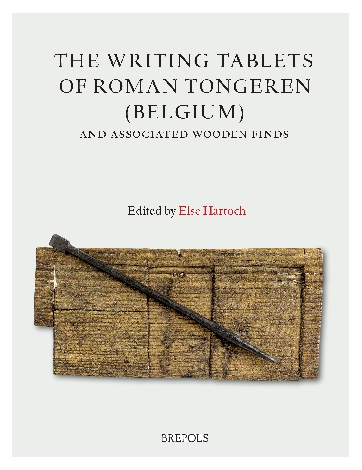
The Writing Tablets of Roman Tongeren (Belgium)
show More to view fulltext, buy and share links for:The Writing Tablets of Roman Tongeren (Belgium) show Less to hide fulltext, buy and share links for: The Writing Tablets of Roman Tongeren (Belgium)Roman wooden writing tablets, known in Latin as tabulae ceratae, have been found by archaeologists in various locations around the former capital of the civitas/municipium Tungrorum or Roman Tongeren (now the Belgian city of Tongeren-Borgloon). These rare and delicate finds are remarkable not only due to the excellent state of their preservation, but also because they are inscribed with the remnants of texts, once etched into an overlying wax layer, that can, to the discerning eye, still be deciphered. The tablets not only provide concrete information about religious, judicial and administrative practices, but they also enhance our understanding of the complex processes of Romanisation and Latinisation in the northwestern civitates and municipia of the Roman Empire.
Unearthed in the first half of the twentieth century, with a second group discovered in 2013, the Roman tablets housed in the Gallo-Roman Museum of Tongeren-Borgloon and in the city’s municipal heritage depository, became the object of an in-depth study by an international team of specialists piloted by the Gallo-Roman Museum. It is the results of this project that are presented here in this volume for the first time. The painstaking process of deciphering and interpreting the script marks and text fragments is explored via analysis of palaeography, philology and onomastics, along with key scientific techniques such as wax analysis, wood species identification, and script visualisation by Multi-Light Reflectance Imaging. Rich detail is also provided about other associated wooden finds that shed light on how and where the tablets were produced.
The result is a beautifully illustrated and insightful volume that introduces the lost world of Roman Tongeren and its writing tablets to professionals and the general public alike.
-
-
-
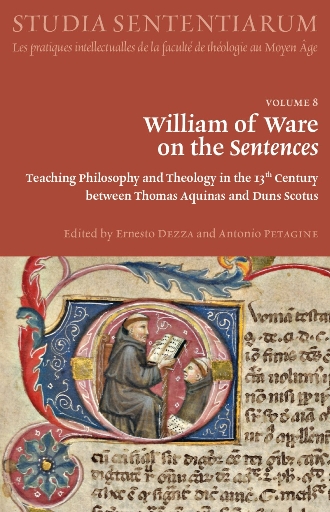
William of Ware on the Sentences
show More to view fulltext, buy and share links for:William of Ware on the Sentences show Less to hide fulltext, buy and share links for: William of Ware on the SentencesThe Franciscan William of Ware – the Magister Scoti – flourished as a theologian at the end of the thirteenth century. Although he wielded significant influence on fourteenth-century theological and philosophical debates, his thought remains little known and even less studied than it deserves. A major cause for this situation lies in the difficulty of accessing the text of his Questions on the Four Books of the Sentences, which is largely unedited.
This volume is the first entirely devoted to William of Ware. It aims to promote a renewed knowledge of his texts and doctrines. The book includes updated information on studies and editions of Ware's texts, and specific studies on crucial aspects of his doctrines, such as theology, metaphysics, physics, epistemology, Christology, and anthropology. Additionally, the volume presents previously unpublished questions from his Commentary on the Sentences.
Overall, the volume serves as an essential reference for the thought and texts of William of Ware and provides a new and illuminating perspective on scholastic culture during the turn from the thirteenth to the fourteenth century.
-
-
-
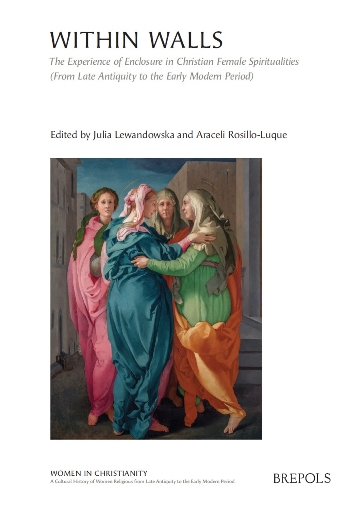
Within Walls
show More to view fulltext, buy and share links for:Within Walls show Less to hide fulltext, buy and share links for: Within WallsWhat different mechanisms did women religious use to interpret the communal and individual aspects of enclosure throughout history? To what extent was enclosure a pivotal feature of Christian spiritual, social and cultural life? How did social and political contexts shape the strategies of nuns and beatas in accepting or rejecting strict enclosure?
Within Walls explores the diverse experiences of enclosure within female Christian spiritualities, presenting it as a crucial concept for a deep understanding of the history of women religious. The volume primarily aims to show the different ways in which women religious lived, negotiated and redefined enclosure in its material and symbolic dimensions. Covering the period from the New Testament era to the late sixteenth century, and spanning regions from the Holy Land and Egypt to Western Europe and colonial Mexico, it explores the evolving meanings and uses of the confined life as experienced and shaped by women religious in Christianity.
The case studies presented in this volume—from the strategies of seclusion of early Christian anchoresses to the plethora of voices of Mediaeval and Early Modern female communities and the authority wielded by individual nuns, pilgrims, prioresses, reformers and mystics—argue that there was by no means a single form of enclosure in female Christian religious life. Instead, inspired by Philip Sheldrake’s interpretation of sacred spaces as polyphonic, this volume stresses the multivocality and multilocality of the term. Adopting an interdisciplinary approach that integrates microhistory, human geography, the cultural analysis of materiality, literary studies, feminist and gender studies, indigenous methodologies, art studies, postcolonial anthropology and the philosophy of religion and spirituality, Within Walls provides fresh perspectives on the most intricate dimension of religious life in history.
-