


Brepols Online Books Other Miscellanea Archive v2016 - bobar16miot

Collection Contents
8 results
-
-
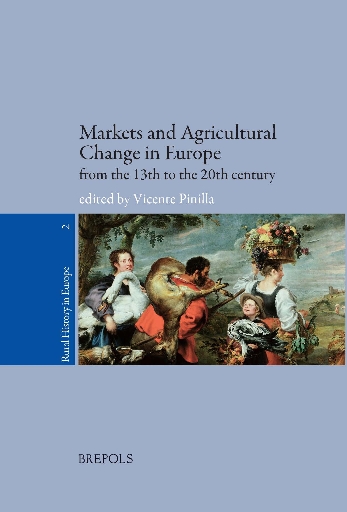
Markets and Agricultural Change in Europe from the 13th to the 20th century
show More to view fulltext, buy and share links for:Markets and Agricultural Change in Europe from the 13th to the 20th century show Less to hide fulltext, buy and share links for: Markets and Agricultural Change in Europe from the 13th to the 20th centuryThe main target of this book is to explore how the involvement of rural populations and communities in different kinds of markets (mainly for agricultural commodities) has influenced the management of rural land in Europe. Most of the papers focus on precisely what were the forces driving agricultural change in rural Europe. Although the importance of these changes were very different from the Middle Ages until the present days, a common approach that emerged was to stress the importance of urban and external markets in order to give incentives to changes in the management of rural land. The transition of agriculture and its producers, respectively, into a highly market-integrated sector and strongly market-oriented peasants formed the driving force and prima causa of European agricultural revolutions during early modern times. Expansion of market allowed for an intense process of specialization, with clear competitive advantages with respect to earlier land uses.
Vicente Pinilla, professor of Economic History at the University of Zaragoza, has published widely in the field of economic history, notably of nineteenth- and twentieth -century Spanish agriculture and international trade in agricultural products.
-
-
-
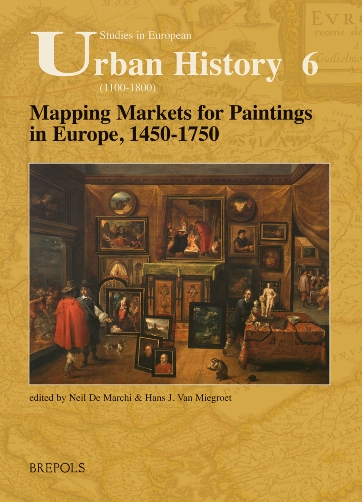
Mapping Markets for Paintings in Europe, 1450-1750
show More to view fulltext, buy and share links for:Mapping Markets for Paintings in Europe, 1450-1750 show Less to hide fulltext, buy and share links for: Mapping Markets for Paintings in Europe, 1450-1750Over the course of the fifteenth century easel paintings edged out tapestries, frescoes and wood inlay pictures on the walls of private dwellings. Millions of such paintings were produced in the period 1450-1800, in all shapes and sizes, and across the whole range of prices. Who bought them? How were they distributed? What place did they occupy among other "luxury" possessions? Such questions seem to require that visual culture be treated as an integral part of family spending and commercial pursuits. This volume is the outcome of a four-year collaboration between art historians, economists, social historians and museum professionals from the US, Australia and Europe; its aim was to map the new ground identified by these and related questions, in local contexts, but with comparative and longitudinal concerns constantly in mind. The result is an entirely new matrix of the business and artistic interactions through which visual cultures in early modern Europe were formed. The editors, Neil De Marchi and Hans J. Van Miegroet, an economist and an art historian, have collaborated across their disciplines for ten years. Here they have interspersed participants' essays with brief connecting observations, to produce a text that respects disciplinary expertise while making connections across locations and across time. Much has been written about European paintings; but how markets in paintings emerged, who they served, what roles and institutions were developed that enabled them to function effectively, and how exchange affected visual preferences, have not been studied in such a deliberately wide-angled, comparative way. Mapping Markets is not only a book about paintings, but a compendium of cross-disciplinary methods and insights. It charts the state of research in this trans-disciplinary field, identifies gaps, and poses questions for scholars and students wishing to pursue further the issues raised here.
-
-
-
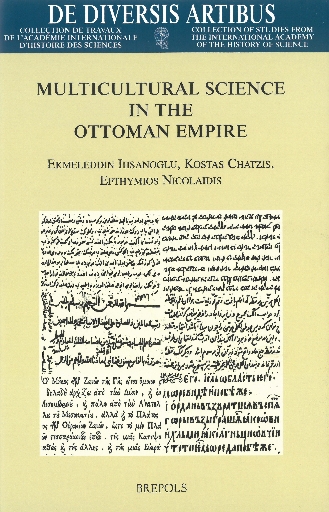
Multicultural science in the Ottoman empire
show More to view fulltext, buy and share links for:Multicultural science in the Ottoman empire show Less to hide fulltext, buy and share links for: Multicultural science in the Ottoman empireThis book contains research papers related to the scientific activities in the Ottoman Empire which comprise various scientific traditions, including the Islamic tradition inherited by the Ottoman Turks and carried on by the Arabs, who were part of the Empire and then joined by European peoples, such as the Bosnians and Albanians newly converted to Islam ; as well as the tradition of different Christian peoples living in Anatolia and the Balkans, (e.g. the Greek Colleges where “ new ” science was taught), and the contributions of native Jewish scholars as well as those who emigrated from Andalusia. The Ottoman world had the necessary grounds for the interaction of all these different traditions. The Ottoman Empire held vast lands in Europe and, as a result of the contact with European science from the very early ages, the new scientific European tradition spread in the Ottoman lands for the first time outside its own cultural environment where it originated.
The Ottoman Empire gave rise to 29 national states in Europe, the Middle East and North Africa. The Ottomans both depended on the previously established Turkish-Islamic scientific tradition and at the same time engaged in attempts to transfer the new technologies and sciences that developed in the Western world. The new European science and technology was also adopted very early by the followers of the Enlightenment and later by those of Nationalism among the non muslim populations of the Empire, and of course by the national states originated from this Empire.
All these aspects about the nature of science in the Ottoman Empire and the complex network of scientific and educational relations of the various populations in this Empire and the national states which followed, as well as the relations between the science of these populations and these new states and Europe, have been discussed in these papers almost for the first time.
-
-
-
Mundus Emblematicus
show More to view fulltext, buy and share links for:Mundus Emblematicus show Less to hide fulltext, buy and share links for: Mundus EmblematicusThe thirteen articles in this volume deal with the Neo-Latin emblem book after the birth of the genre with Andrea Alciato’s Emblematum libellus (1531). While the interest in emblematics has grown considerably during the last decades, the seminal Neo-Latin production has received relatively little attention. In Mundus Emblematicus an international team of experts in the field makes this part of the emblem tradition accessible to a broad scholarly audience. The articles cover a variety of emblem books published at the time, ranging from influential humanist collections (for instance those by Achille Bocchi, Hadrianus Junius, or Joachim Camerarius) to alchemist (Michael Maier) or religious emblems (such as the books of the Calvinist Théodere de Bèze, or the Jesuit Herman Hugo). In each paper subjects dealt with include the historical context of the work and its makers, the relation between word and image, the structure of the collection as a whole, and the emblematic game (intertextuality in word and image). Moreover, several articles explore the interaction between the emblem and connected literary phenomena, like the commonplace-book, the fable or the use of commentaries. All papers are in English and all examples from Latin texts are translated.
Together, these articles show the variety within the Neo-Latin emblem production, thus challenging traditional approaches of the emblem. As such Mundus Emblematicus contributes towards a more comprehensive view of the forms and functions of the genre as a whole
-
-
-
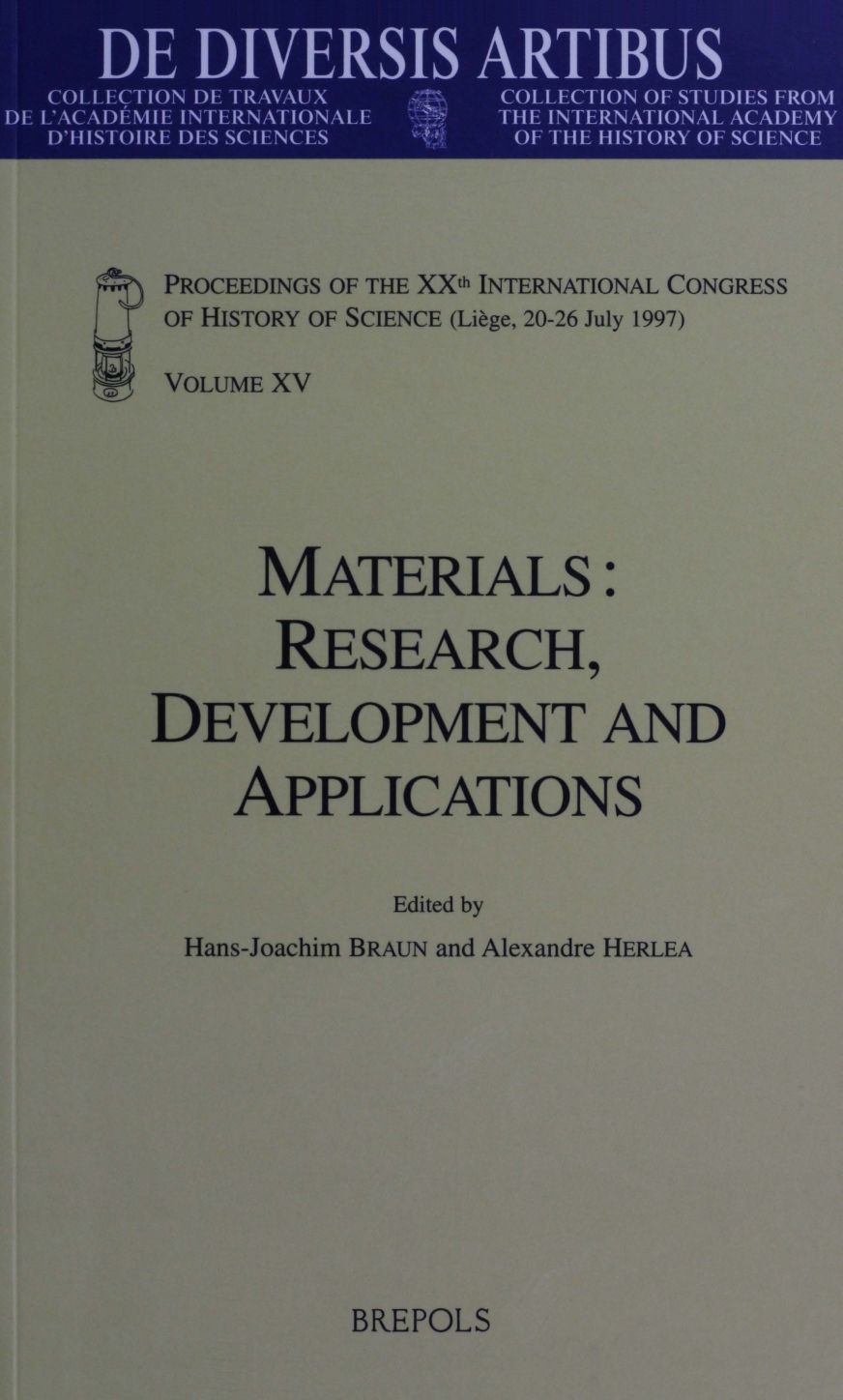
Materials: Research, Development and Applications
show More to view fulltext, buy and share links for:Materials: Research, Development and Applications show Less to hide fulltext, buy and share links for: Materials: Research, Development and ApplicationsThe theme of materials in the history of technology has never been as well researched as other more popular areas like energy, production technology or transport and communication. The present collection of papers originating from the symposium on "Materials: Science, Technology and Early Applications" in conjunction with the xx th International History of Science Congress in Liège, 1997, make a contribution to remedying this unsatisfactory situation. They concentrate on the 19th and 20th centuries and range from research on the metallurgy of zinc in the late 18th and early 19th century to the prospects of ceramic materials to ameliorate contemporary environmental problems.
-
-
-
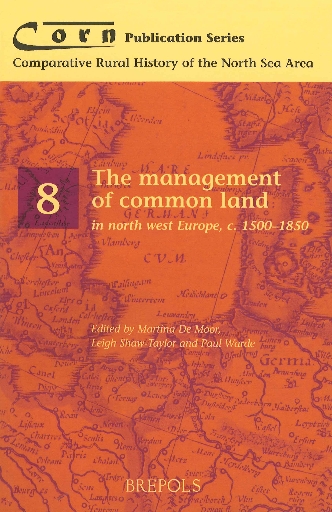
The management of common land in north west Europe, c. 1500-1850
show More to view fulltext, buy and share links for:The management of common land in north west Europe, c. 1500-1850 show Less to hide fulltext, buy and share links for: The management of common land in north west Europe, c. 1500-1850Until the 19th century very large areas of Western Europe were subject to some degree to common rights, where individual users collectively managed resources such as pasture and wood which were central to the agrarian economy. Much scholarship has focused on the dissolution of these rights and the effects of the enclosure of common land on society and agricultural productivity. In contrast, this volume seeks to assess in a comparative framework the long-term management of the common lands and the relative success of strategies in providing the resources sought by the rural population. Chapters covering northern and southern England, France, the Netherlands, Flanders, Sweden and northern and southern Germany examine the institutional and legal framework of commoning, the resources available and their value, the sustainability of practices, and policies of inclusion and exclusion among the group of commoners. Building on the theoretical insights of recent works on commonly managed resources, this volume, the result of an international collaboration in the CORN network, provides a series of detailed historical studies and is the first major work to address this central aspect of the agrarian economy in a comparative European context.
-
-
-
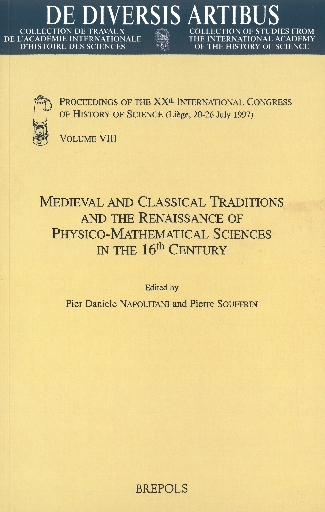
Medieval and Classical Traditions and the Renaissance of Physico-Mathematical Sciences in the 16th Century
show More to view fulltext, buy and share links for:Medieval and Classical Traditions and the Renaissance of Physico-Mathematical Sciences in the 16th Century show Less to hide fulltext, buy and share links for: Medieval and Classical Traditions and the Renaissance of Physico-Mathematical Sciences in the 16th CenturyCe volume est une contribution à l'histoire de la transition entre la science médiévale et la science moderne, en ce qui concerne les mathématiques et la science du mouvement. Le processus de cette transformation a été relativement peu étudié: les études historiques se sont concentrées de façon dominante sur la description de la phase finale de ce processus; le travail historique a établi une description très documentée et structurée de la situation de la philosophie naturelle à l'aube de la science classique. Au cours des dernières décennies des travaux sur des auteurs et des oeuvres du XVIe siècle peu étudié font cependant apparaître que cette description est altérée structurellement par des interprétations anachroniques de certains concepts qui y occupent manifestement une place centrale. Les études présentées dans ce volume sont un reflet des travaux effectués récemment dans ce sens sur deux aspects singuliers d'un tel programme: l'oeuvre scientifique de MAurolico d'une part, et l'émergence de la science galiléenne du mouvement d'autre part.
-
-
-
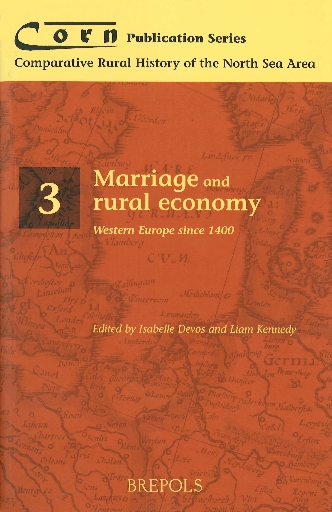
Marriage and Rural Economy. Western Europe since 1400
show More to view fulltext, buy and share links for:Marriage and Rural Economy. Western Europe since 1400 show Less to hide fulltext, buy and share links for: Marriage and Rural Economy. Western Europe since 1400The history of marriage in Western Europe, because of its peculiarities when viewed in a global setting, compels attention. This volume examines rural marriage patterns in the long run, relating these to changing economic conditions in the North Sea area, from c. 1400 to the present. More than thirty years after Hajnal's path-breaking publication it presents a state of the art as regards the study of the European Marriage Pattern in Ireland, Scotland, England, Belgium, the Netherlands, Germany and Scandinavia. By examining different forms of rural economy such as peasant farming, capitalist farming, prot-industry and other systems of production with differing implications for marriage and family formation, demographic and economic mechanisms emerge more clearly. Turning from description to explanation, a complex of interacting factors which regulate the formation of new households is identified and new directions into the research of this phenomenon are promoted. This volume comprises 11 article-chapters and introduction and conclusion and is the result of international collaboration from members of the CORN network. It is a work of richness, subtlety and historical depth, which makes essential reading for those interested in the evolution of marriage patterns, in the distant past and in more recent times.
-