Brepols Online Books Other Miscellanea Archive v2016 - bobar16miot

Collection Contents
1 - 20 of 98 results
-
-
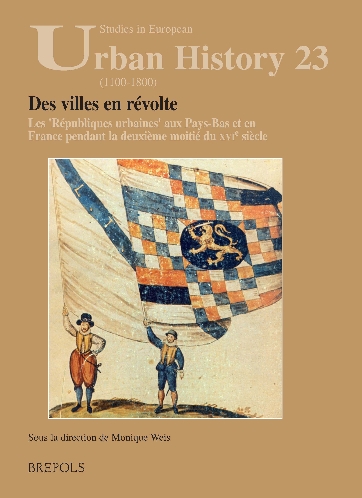
Des villes en révolte
show More to view fulltext, buy and share links for:Des villes en révolte show Less to hide fulltext, buy and share links for: Des villes en révolteEntre 1577 et 1585, plusieurs villes de Flandre et du Brabant s’instituent en des régimes insurrectionnels que les historiens désignent par le terme de ‘Républiques calvinistes’. Les anciens magistrats sont écartés des rouages du pouvoir, au profit de nouveaux conseils épris d’autonomie urbaine et proches des milieux réformés. Ces structures originales se figent peu à peu en de véritables bastions calvinistes, allant jusqu’à interdire l’exercice du culte catholique. Les assises politiques et religieuses des villes en question s’en trouvent bouleversées. Les répercussions sur la vie socio-économique et sur la production culturelle sont elles aussi multiples et profondes. La parenthèse des Républiques calvinistes se ferme en 1584/85 avec la reconquête par Alexandre Farnèse de ces avant-postes de la résistance au roi d’Espagne.
Cet ouvrage comble une lacune importante dans la recherche historique. Il met en évidence les liens étroits entre revendications religieuses, enjeux politiques et tensions sociales qui caractérisent les troubles du 16e siècle. Il replace aussi les Républiques calvinistes de Flandre et du Brabant dans une longue tradition de révoltes urbaines et d’idées républicaines. Enfin, il étend l’analyse au contexte européen plus large, en établissant des corrélations avec la France des Guerres de religion.
Monique Weis est chercheure qualifiée du Fonds national de la Recherche scientifique auprès de l’Université Libre de Bruxelles. Ses recherches et son enseignement portent sur l’histoire religieuse et l'histoire des idées en Europe du 16e au 18e siècles.
-
-
-
Fußnoten zu Augustinus: Gesammelte Schriften Wilhelm Geerlings
show More to view fulltext, buy and share links for:Fußnoten zu Augustinus: Gesammelte Schriften Wilhelm Geerlings show Less to hide fulltext, buy and share links for: Fußnoten zu Augustinus: Gesammelte Schriften Wilhelm Geerlings“The English mathematician and philosopher A. N. Whitehead described the Western tradition as follows: ‘The safest general characterization of the European philosophical tradition is that it consists of a series of footnotes to Plato.’ By way of analogy, one could state without difficulty: The history of theology in the West consists of a series of footnotes to Augustine.”
This is how Wilhelm Geerlings describes the significance of Augustine in his pithy and short book on the theologian. Just as Whitehead’s statement was not meant to diminish the achievement of later philosophers, but rather aimed at underlining the fundamental significance of Plato, Geerlings did not intend to minimize the significance of post-Augustinian theology.
Likewise, the title given to the collection of the most important articles of Wilhelm Geerlings (1941-2008), Footnotes to Augustine, is not meant to lessen the author’s contribution. It rather highlights the crucial significance of Augustine for the thought and scholarship of the theologian and historian Wilhelm Geerlings. To the general public, he is mainly known as the founder and editor of the Fontes Christiani, a series of new bilingual editions of ancient and medieval Christian sources, which, by the time of his death, comprised one hundred volumes. Furthermore, he was one of two editors of the “Lexikon der antiken christlichen Literatur”.
Georg Röwekamp, Dr. phil., is the manager and theological director of Biblische Reisen GmbH, Stuttgart.
-
-
-
La rhétorique de la prière dans l'Antiquité grecque
show More to view fulltext, buy and share links for:La rhétorique de la prière dans l'Antiquité grecque show Less to hide fulltext, buy and share links for: La rhétorique de la prière dans l'Antiquité grecqueThis volume presents a collection of papers given at the 16th Conference of the International Society for the History of Rhetoric (Strasbourg, 24-28 July 2007), two sessions of which were dedicated to Ancient Greek prayer. As a discourse addressed to the divinity, prayer raises the question of approaching gods whose presence and action cannot be guaranteed. Such a situation implies the use of oratorical strategies, as in the supplication addressed to a human being. The specifically rhetorical approach of the prayer constitutes a field which as yet has not been widely researched. These contributions form a coherent collection which testifies to the fecundity of this approach. The large palette of authors discussed in this volume range from Homer to the Church Fathers, via the tragic authors, the historians, without forgetting poets of Hellenistic and Roman times.
Johann Goeken, specialist of Greek language and literature, is associate professor at the University of Strasbourg.
-
-
-
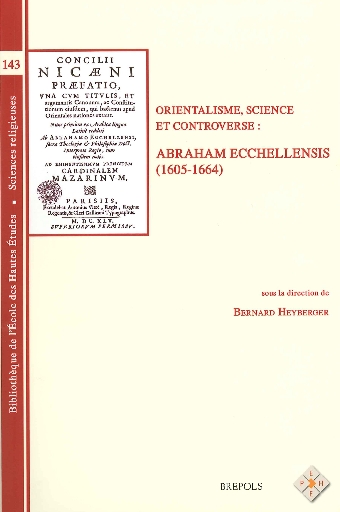
Orientalisme, science et controverse : Abraham Ecchellensis (1605-1664)
show More to view fulltext, buy and share links for:Orientalisme, science et controverse : Abraham Ecchellensis (1605-1664) show Less to hide fulltext, buy and share links for: Orientalisme, science et controverse : Abraham Ecchellensis (1605-1664)Abraham Ecchellensis (Ibrahîm Al-Hâqilânî) est sans doute le plus représentatif des chrétiens orientaux qui contribuèrent à la formation de l’orientalisme européen au xvii e siècle. Après une première éducation dans un couvent libanais, il arriva au collège maronite de Rome en 1620, où il fut très jeune reconnu pour ses talents dans l’enseignement de l’arabe et du syriaque, et dans l’expertise des questions orientales. Ses études achevées, il mena quelques aventures militaires et commerciales au service de l’emir libanais Fakhraddîn et de la croisade, en se plongeant brièvement dans les trafics méditerranéens liés à la course et au rachat des captifs. Il tenta aussi d’ouvrir un collège au Liban.
Mais c’est surtout par une carrière d’érudit qu’il se fit connaître. Ce volume s’attache moins à la biographie d’Abraham; Ecchellensis qu’à la place qu’il occupa dans la République des Lettres du xvii e siècle, entre Pise, Rome et Paris (où il enseigna au Collège Royal). Il sut bénéficier d’un réseau de protecteurs, qui estimaient sa capacité à cataloguer et publier des manuscrits, enseigner les langues, ou servir d’expert et d’interprète : Les Médicis, les Barberini, Richelieu, Mazarin et le chancelier Séguier veillèrent successivement sur sa carrière. Il fut l’ami et le collaborateur de savants de son temps, comme Jean Morin, Marin Mersenne, Lucas Holsten ou Athanase Kircher.
Il contribua aux grands chantiers intellectuels du xvii e siècle, comme la bible polyglotte de Paris et la bible arabe de Rome. Il composa des outils pour l’apprentissage de l’arabe et du syriaque. Mais il fut surtout un traducteur d’ouvrages en langues orientales. Chez lui, la controverse et l’apologétique ne se distinguaient guère de l’érudition, et il entendait mettre sa science au service de la foi catholique, contre les protestants. Mais ses origines orientales et arabophones l’amenèrent aussi à défendre la dignité des Orientaux et à valoriser leur culture face aux milieux savants européens. Il contribua à l’élaboration du « récit national » maronite et libanais. Il voulut faire connaître la « sagesse arabe » et l’intégrer dans la science européenne, en la distinguant de l’islam, qu’il ne pouvait accepter. Il collabora avec le professeur «galiléen» de Pise Giovanni Alfonso Borelli, pour traduire à partir de manuscrits arabes le traité d’Apollonius de Perga sur le Coniques.
Ses travaux érudits furent utilisés dans les controverses théologiques du second xvii e siècle. Mais, au début du xviii e siècle, la connaissance des langues orientales était suffisamment avancée en Europe pour qu’on pût se passer des « médiateurs » issus du Collège de Rome.
Bernard Heyberger, directeur d’études à l’École Pratique des Hautes Études, est professeur à l’université François-Rabelais de Tours et membre de l’Institut Universitaire de France. Ses travaux portent sur le christianisme de langue arabe et sur les relations entre le christianisme et l’islam. Il a notamment publié Les chrétiens du Proche-Orient au temps de la Réforme catholique (1994) et Hindiyya, mystique et criminelle (2001).
-
-
-
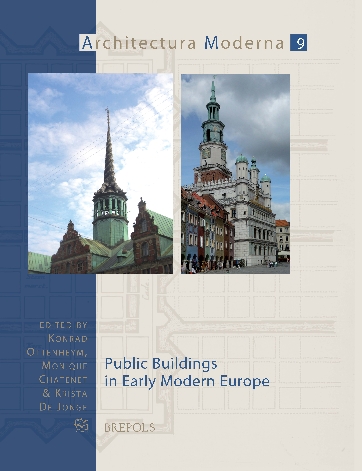
Public Buildings in Early Modern Europe
show More to view fulltext, buy and share links for:Public Buildings in Early Modern Europe show Less to hide fulltext, buy and share links for: Public Buildings in Early Modern EuropeIn the early modern European city, public buildings were the main pillars of the political, mercantile and social infrastructure. In a first attempt to create a preliminary overview of current knowledge in various European countries, the IIIe and Ve Rencontres d’Architecture Européenne, held in 2006 and 2008 at Utrecht University, The Netherlands, in cooperation with the Centre André Chastel, Paris, were dedicated to this subject. In these two meetings, architectural historians from all over Europe discussed the results of their research on the development of various types of public building in the various European regions between the late fifteenth and mid-eighteenth century. This publication brings together most of the contributions to these two conferences, subdivided into three categories:
buildings erected for government and justice
buildings serving mercantile functions
buildings for education, health and social care.
Konrad Ottenheym is professor of Architectural History at Utrecht University.
Monique Chatenet is senior researcher at the Centre André Chastel/Sorbonne Paris-IV, Paris.
Krista De Jonge is professor of Architectural History at the Catholic University Leuven.
-
-
-
Quintilien ancien et moderne
show More to view fulltext, buy and share links for:Quintilien ancien et moderne show Less to hide fulltext, buy and share links for: Quintilien ancien et moderneQuintilien (Ier s.) a souvent souffert d’être comparé à l’un de ses grands modèles, Cicéron. On ne voit fréquemment dans l’Institution oratoire qu’une pâle reprise des réflexions et des préceptes du grand philosophe et orateur de la République romaine. Pourtant, le bienveillant maître de rhétorique, dont l’èthos de père, de professeur et de citoyen a souvent séduit la postérité plus que celui de Cicéron (dont la correspondance privée avait déçu maints humanistes), a exercé à sa manière une influence très importante et trop sous-estimée dans de très nombreux domaines de notre culture : rhétorique, poétique, pédagogie, morale, histoire de l’art, théâtre … C’est ce rayonnement fécond à travers les âges que les auteurs du présent volume ont tâché de faire ressortir. La première partie de l’ouvrage, consacrée à l’Antiquité, fait le point sur les dettes de Quintilien lui-même à l’égard de ses prédécesseurs grecs, de Cicéron, et sur certains aspects fondamentaux de sa doctrine qui seront retenus en priorité : la nécessité pour l’orateur d’être un vir bonus (conviction héritée et réinterprétée par Pline le Jeune, par exemple), l’extrême pragmatisme de sa méthode d’enseignement et l’importance, pour lui, des liens entre écriture et vision. La seconde partie du volume, qui s’étend au Moyen Âge (XIIe siècle) et à la Renaissance, aborde la manière dont le rhéteur a été considéré par Jean de Salisbury et Alain de Lille (XIIe s.), puis par Pétrarque, puis a influencé les pédagogues du Quattrocento, le « grammaticus » Lorenzo Valla, a intéressé l’important imprimeur parisien Josse Bade qui l’a édité en France, a servi de modèle aux arts poétiques latins de la Renaissance, avant d’être condamné pour sa théorie des affects par Pierre de la Ramée et réinterprété au début du XVIIe s. par Pierre de Deimier pour une redéfinition « moderne » de l’inventio. La dernière partie du volume étudie la présence de Quintilien à l’Âge classique, son impact sur la définition du « classicisme » et de la clarté, sur la construction du discours, comme sur l’expression des passions en peinture, ainsi que sa récupération par les rhétoriques post-tridentines.
les auteurs / Giovanni Baffetti, Emmanuel Bury, Gualtiero Calboli, Jean Ceard, Maria Silvana Celentano, Pierre Chiron, Sophie Conte, Perrine Galand, Christophe Gutbub, Francis Goyet, Fernand Hallyn, Laure Hermand-Schebat, Volker Kapp, Jean Lecointe, Virginie Leroux, Carlos Lévy, Ida Gilda Mastrorosa, Gabriella Moretti, John Nassichuk, Mariangela Regoliosi, Alexander Roose, Florent Rouillé, Marc van der Poel, Wim Verbaal.
-
-
-
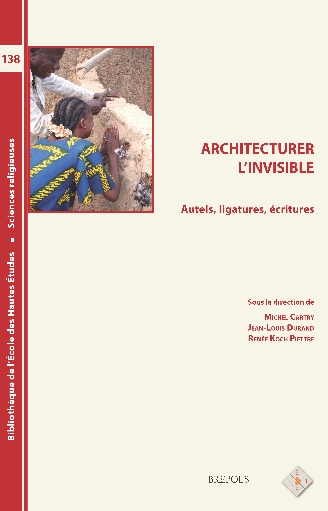
Architecturer l'invisible
show More to view fulltext, buy and share links for:Architecturer l'invisible show Less to hide fulltext, buy and share links for: Architecturer l'invisibleDes ethnologues, des hellénistes, un assyriologue, une médiéviste, conscients du risque d'ethnocentrisme que fait peser l'utilisation de la catégorie de la «présence» dans le champ du religieux, ont cependant placé cette abstraction au centre de leurs travaux : ils ont fait de la «présence» un dénominateur commun dans un large spectre de catégories comparatives que l'on a coutume d'étudier séparément, comme la divination, le sacrifice, la possession. La simple approche concrète de ce que l'on pourrait appeler «autel» dans les cultures particulières, a démontré que cet artefact rituel pouvait se réaliser indépendamment de toute procédure spécifique d'aménagement ou de construction, mais plus directement dans la gestuelle de présentation de l'offrande, animée ou inanimée ; et l'instance pouvait elle-même se réaliser sous la forme d'un autel. Simultanément, des corrélations nouvelles, rarement repérées, ont pu émerger entre des composantes du rite, faisant apparaître ici, une articulation étroite entre parole, écriture et ligature, là la récurrence de «bouches» pour faire taire, ingérer, proférer, révéler, maudire, ailleurs encore la grammaire complexe et les gestes à suivre pour les formes variées du dépôt. Les contributions se distribuent entre trois verbes d'action : ouvrir, parce que toute instauration et toute «reprise» d'un culte requièrent l'invention et la mise en place d'un commencement; œuvrer, parce que le rite fait feu de tout bois dans les manipulations qui, par métaphore ou par métonymie, construisent des lieux de mise en présence des acteurs et des instances ; écrire, parce qu'en toute performance rituelle, y compris dans les sociétés réputées sans écriture, surgissent un temps d'inscription et un temps de déchiffrement du signe, sur un support rendu efficace tant par ses qualités propres que par cette inscription même.
Michel Cartry, ethnologue de l'Afrique Noire (École Pratique des Hautes Études), Jean-Louis Durand, helléniste et anthropologue (CNRS, Centre Louis Gernet), Renée Koch Piettre, helléniste et comparatiste (École Pratique des Hautes Études), animent ensemble à Paris un groupe de travail sur les pratiques des polythéismes, en s'inspirant des travaux de Marcel Detienne. Leurs travaux croisés ont exploré les aires sacrificielles, avant de s'orienter vers la question de la «présence» des puissances de l'au-delà.
-
-
-
Art Auctions and Dealers
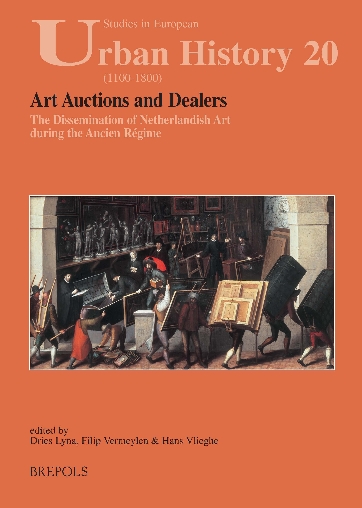
show More to view fulltext, buy and share links for:Art Auctions and Dealers show Less to hide fulltext, buy and share links for: Art Auctions and DealersThis collection of essays presents a status quaestionis concerning the dissemination of Flemish and Dutch art during the period 1500-1800, and highlights the role art auctions and dealers have played in this process. Auctions emerged as the primary channel for art sales at the end of the seventeenth century in the Low Countries and started a trent whereby countless local art collections were broken up and sold to the highest bidder. Especially (old master) paintings exchanged hands in great numbers at these public sales, and the finest pieces frequently ended up in foreign holdings.
The activities of the professional art dealer form the focus of several essays. These intermediaries played an instrumental role in the commercialization and expansion of the art trade in early modern Europe. They had a profound impact on the history of collecting as they mediated and even influenced taste. Naturally, the role of art dealers changed over time. Therefore, the historians, art historians and economists who contributed to this volume have approached this phenomenon in an interdisciplinary fashion in order to properly understand how art markets functioned. In doing so, these essays explore the various ways in which art dealers helped shape markets for art, and how they facilitated the increasing volume of exports of Netherlandish art from the sixteenth century onwards.
Hans Vlieghe is professor emeritus at the University of Leuven. He has published extensively on Flemish art of the 17th century, especially on Rubens and his circle.
Filip Vermeylen is assistant professor of Cultural Economics at the Erasmus University in Rotterdam. His current research focuses on the history of art markets.
Dries Lyna works at the Center for Urban History (University of Antwerp), where he is currently preparing a Ph.D. thesis on art auctions in eighteenth-century Antwerp and Brussels.
-
-
-
Art, Architecture and Religion Along the Silk Roads
show More to view fulltext, buy and share links for:Art, Architecture and Religion Along the Silk Roads show Less to hide fulltext, buy and share links for: Art, Architecture and Religion Along the Silk RoadsArt, Architecture and Religion Along the Silk Roads will be volume 12 in the Silk Road Studies series. It has been produced by the Ancient History Documentary Research Centre at Macquarie University, Australia and edited by Ken Parry, Senior Research Fellow, Department of Ancient History, Macquarie University. It consists of selected papers from the 2004 conference of the Australasian Society for Inner Asian Studies. The volume contains 14 articles of 350 pages with 40 illustrations and covers topics relating to Ancient Chorasmia, Sogdia and China, Buddhist and Manichaean art, Middle Iranian manuscripts and Buddhist manuscripts from Afghanistan, Nestorian Christianity and contemporary Islam, Silk Road clowns and headcoverings of Central Asia. The collection highlights the range and depth of Australasian scholarship on Inner Asia and demonstrates that there are still many unexplored aspects of Silk Road Studies.
-
-
-

Credit and the rural economy in North-western Europe, c. 1200-c. 1850
show More to view fulltext, buy and share links for:Credit and the rural economy in North-western Europe, c. 1200-c. 1850 show Less to hide fulltext, buy and share links for: Credit and the rural economy in North-western Europe, c. 1200-c. 1850This book retraces the nature and role of credit in the pre-industrial European countryside. As part of an ongoing examination of credit and its provision in European past societies, the nine papers collected in this volume offer further insight into the ways in which credit was provided and managed, as well as the opportunities which credit may or may not have presented in effecting economic and social change between c. 1200 and c. 1850. In these respects, the papers in this volume add to a developing investigation of the history of credit and of indebtedness in northern Europe, which also coincides with a continued interest in the structures of credit evident in studies of southern European societies. The present volume also, for a broad North Sea region, develops a concentration upon the economic and social history of credit from the late medieval period to the early nineteenth century. The themes here are deliberately focused on the nature of credit, its form and structure, as well as upon the economic and social impact of credit and the changing availability of the same.
Phillipp Schofield is Professor of Medieval History at Aberystwyth University. He has published extensively on the social, economic and demographic history of late medieval peasant society in England.
Thijs Lambrecht is postdoctoral researcher with the Research Foundation Flanders and the Department of Early Modern History at Ghent University. His research focuses on rural markets in the Southern Netherlands during the early modern period.
-
-
-
Exploring the food chain. Food production and food processing in Western Europe, 1850-1990
show More to view fulltext, buy and share links for:Exploring the food chain. Food production and food processing in Western Europe, 1850-1990 show Less to hide fulltext, buy and share links for: Exploring the food chain. Food production and food processing in Western Europe, 1850-1990Until the late 19th century the food industry was restricted to a few activities, usually based on small scale industries. The links between agriculture and food processing were very tight. Due to increased purchasing power, population growth and urbanisation, the demand for food grew substantially. This was not only the case for basis products as corn and potatoes, but also and especially for more expensive, quality products as meat, fish and dairy produce. These developments generated, together with the essential technological innovations, the creation and development of modern food processing in specialized shops and factories. In only a few decades these industries transformed from an important complement to the primary agricultural production on the farms to a much comprising industrial business. At the end of the 20th century food processing has evolved into a modern, high-tech industry, dominated by a few large enterprises, offering a wide range of products. This volume aims to turn the spotlight on this often neglected but important link in the food chain.
-
-
-
Fashioning Old and New. Changing Consumer Patterns in Europe (1650-1900)
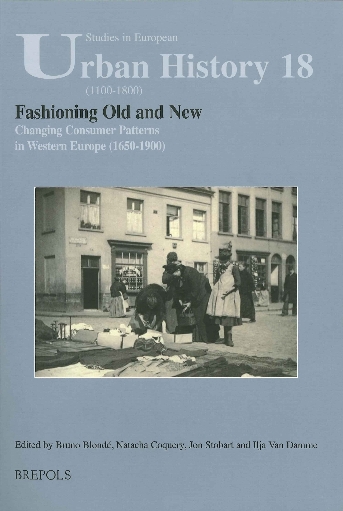
show More to view fulltext, buy and share links for:Fashioning Old and New. Changing Consumer Patterns in Europe (1650-1900) show Less to hide fulltext, buy and share links for: Fashioning Old and New. Changing Consumer Patterns in Europe (1650-1900)A continuing ‘cry for the new’, it is said, drives present-day consumerism. People are producing and buying new goods in ever-larger quantities. However, in the past, consumer choices for new products were paralleled and even overlapped by structurally embedded practices such as re-use, recycling and resale. Unfortunately far too little is known about these important practices. The ‘birth of a consumer society’ was grounded not only in the appearance of new products and new industries; a similar drive manifested itself in the handling, buying and selling of ‘second-hand’.
In this book then the editors confront and integrate historical research on the world of the new and the old. Papers focus on the relationship between material culture and novelty, fashion and innovation on the one hand; and/or patina, second-hand and re-cycling on the other. Differences existed in the use of old and new products according to time, place, social and gender groups. By paying close attention to this historical diversity, this book explores the changing meanings and motivations of consumption. The geographical coverage will be an urban one. The studied time frame will be ‘the long eighteenth-century’ (from circa 1650 until 1900). It was only then that rapid fashion changes, new imports and spreading industrialization changed the existing material culture dramatically. However, comparisons crossing time and place do place sweeping ‘modern’ assumptions in perspective. After all: who can decipher how the concepts old and new are changing today, with the current popularity of more responsible (social and ecological) forms of consumption and recycling, and with vintage-clothing and antique furniture back en vogue?
Bruno Blondé is Research Professor at the Center for Urban History (University of Antwerp). His research interest includes urban networks, transport history and the history of consumption.
Natacha Coquery is appointed Professor at the University of Nantes. She has written extensively on the shopping and consumer habits of the French elites.
Jon Stobart is appointed professor at the University of Northampton. He has worked on urban networks and consumption in spatial perspective.
Ilja Van Damme is Postdoctoral Fellow of the Fund for Scientific Research. He has written a PhD on the interrelationships between consumer changes and retail evolutions.
-
-
-
Le shīʿisme imāmite Quarante ans après
show More to view fulltext, buy and share links for:Le shīʿisme imāmite Quarante ans après show Less to hide fulltext, buy and share links for: Le shīʿisme imāmite Quarante ans aprèsAu printemps 1968, lorsque la France et bon nombre d’endroits dans le monde étaient secoués par des mouvements de protestations socio- politiques importants, quelques grands savants se réunissaient à la vieille et prestigieuse université de Strasbourg et allaient déclencher un véritable tournant dans les études islamologiques en Occident. En eff et, pour la première fois, des chercheurs d’envergure mondiale se rencontraient dans un colloque exclusivement consacré au shī'isme imāmite. Les conférences et les discussions aboutirent à la publication d’un excellent recueil d’articles : Le shî 'isme imâmite : Colloque de Strasbourg (6-9 mai 1968), Presses Universitaires de France, Paris 1970.
Si nous avons souhaité associer le 40e anniversaire de cet événement à l’hommage que nous voulions rendre à Etan Kohlberg, c’est pour souligner le rôle majeur de ce dernier dans l’enrichissement et l’approfondissement des études consacrées au shī'isme imāmite. En eff et, l’ampleur de ses connaissances, la rigueur radicale de son érudition et ses grandes qualités humaines ont été des facteurs décisifs dans la diff usion des études shī'ites et leur transmission à travers la formation de générations entières de chercheurs.
Ainsi, ce volume d’hommage se veut un témoignage de l’essor grandissant des études shī'ites imāmites et de la dette indéniable de celles-ci aux savants réunis, il y a quarante ans, à Strasbourg, ainsi qu’à l’œuvre immense d’Etan Kohlberg.
-
-
-

Les cérémoniaux catholiques en France à l’époque moderne
show More to view fulltext, buy and share links for:Les cérémoniaux catholiques en France à l’époque moderne show Less to hide fulltext, buy and share links for: Les cérémoniaux catholiques en France à l’époque moderneOuvrage post-tridentin par excellence, le Caeremoniale episcoporum publié par Clément VIII en 1600 a engendré une importante production de cérémoniaux à usage romain, diocésain et monastique, qui s’est développée durant l’époque moderne et au-delà. Cette littérature encore non explorée systématiquement jusqu’à présent constitue une source de premier ordre pour l’histoire du culte catholique, l’histoire des pratiques et normes culturelles et, plus généralement, pour examiner l’ensemble des rapports entre Église et société. Traitant du déroulement extérieur de la liturgie, le cérémonial est censé décrire, régenter et fixer les usages d’une assemblée religieuse plus ou moins vaste ; il permet d’observer la diversité ou la régularité des pratiques, de même que les enjeux identitaires, hiérarchiques ou politiques qui se dessinent en arrière-plan. Objet riche et complexe, il offre une multitude de niveaux de lecture qui en font une source exemplaire, tant pour l’étude des diverses réalités sonores et visuelles mises en œuvre dans les sanctuaires, que pour l’approche des systèmes de représentation d’Ancien Régime. Par son caractère interdisciplinaire (sont rassemblées ici les contributions d’historiens, d’historiens du livre, de musicologues et de liturgistes), par l’expérimentation des approches et des méthodes qu’il propose, le présent ouvrage collectif ambitionne de constituer à la fois un premier bilan à partir du corpus des cérémoniaux publiés en France entre 1600 et 1800 et une introduction aux études historiques des sources liturgiques en France et en Europe.
Ouvrage dirigé par : Cécile Davy-Rigaux, chargée de recherche au CNRS à l’Institut de recherche sur le patrimoine musical en France (Centre National de la Recherche Scientifique / Bibliothèque nationale de France / Ministère de la Culture); Bernard Dompnier, professeur d’histoire moderne (Université de Clermont-Ferrand) et membre senior de l’Institut universitaire de France; Daniel-Odon Hurel, directeur de recherche au CNRS, directeur du Centre Européen de Recherches sur les Congrégations et les Ordres Religieux (CERCOR-CNRS-UMR 8584).
-
-
-
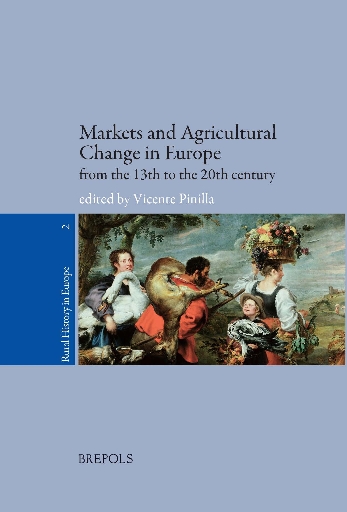
Markets and Agricultural Change in Europe from the 13th to the 20th century
show More to view fulltext, buy and share links for:Markets and Agricultural Change in Europe from the 13th to the 20th century show Less to hide fulltext, buy and share links for: Markets and Agricultural Change in Europe from the 13th to the 20th centuryThe main target of this book is to explore how the involvement of rural populations and communities in different kinds of markets (mainly for agricultural commodities) has influenced the management of rural land in Europe. Most of the papers focus on precisely what were the forces driving agricultural change in rural Europe. Although the importance of these changes were very different from the Middle Ages until the present days, a common approach that emerged was to stress the importance of urban and external markets in order to give incentives to changes in the management of rural land. The transition of agriculture and its producers, respectively, into a highly market-integrated sector and strongly market-oriented peasants formed the driving force and prima causa of European agricultural revolutions during early modern times. Expansion of market allowed for an intense process of specialization, with clear competitive advantages with respect to earlier land uses.
Vicente Pinilla, professor of Economic History at the University of Zaragoza, has published widely in the field of economic history, notably of nineteenth- and twentieth -century Spanish agriculture and international trade in agricultural products.
-
-
-
Pensée grecque et sagesse d'Orient
show More to view fulltext, buy and share links for:Pensée grecque et sagesse d'Orient show Less to hide fulltext, buy and share links for: Pensée grecque et sagesse d'OrientÀ l’occasion du 70e anniversaire de Michel Tardieu, un certain nombre d’amis et de collègues ont voulu manifester un hommage particulier à celui qui fut un maître, un ami, un professeur estimé. Cet anniversaire correspond aussi à son départ à la retraite du Collège de France. La diversité des contributions de ce volume illustre le genre de domaines qu’il s’est plu à fréquenter, tout autour du Bassin méditerranéen et dans les contrées plus lointaines de l’Orient et de l’Extrême-Orient.
Ce volume d’hommage à Michel Tardieu s’adresse aux spécialistes de l’Antiquité et du Proche-Orient ancien, aux historiens des religions ; il intéressera les historiens de la philosophie, les spécialistes des papyri magiques, des mouvements gnostiques, du manichéisme, de l’islam, du monde iranien, de l’Asie centrale, des christianismes orientaux.
Philosophe et historien des religions, Michel Tardieu entra comme chercheur au CNRS en 1972. Il occupa la direction d’études « Gnose et manichéisme » à la Section des Sciences religieuses de l’Ecole pratique des hautes études, de 1976 à 1990, et la chaire « Histoire des syncrétismes de la fin de l’Antiquité » au Collège de France, de 1990 à 2008.
-
-
-
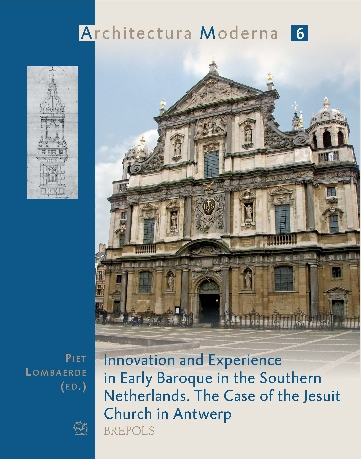
Innovation and Experience in Early Baroque in the Southern Netherlands. The Case of the Jesuit Church in Antwerp
show More to view fulltext, buy and share links for:Innovation and Experience in Early Baroque in the Southern Netherlands. The Case of the Jesuit Church in Antwerp show Less to hide fulltext, buy and share links for: Innovation and Experience in Early Baroque in the Southern Netherlands. The Case of the Jesuit Church in AntwerpDuring the sixteenth century Antwerp was at the forefront of the Renaissance north of the Alps. Not only a new architectural style flourished in the Antwerp metropolis, but at the end of the sixteenth century sciences such as mathematics, optics, geometry and perspective became more and more important. They helped to redefine architecture and the other fine arts on a more scientific base. Their introduction in the arts at the beginning of the seventeenth century lead to new experiences, applications and even innovations in architecture. The Jesuit Order played a very crucial rule in this process. The realization of their new church in the centre of the city of Antwerp became one of the first attempts to bring together the applications of all those new ideas in one total project. Paintings by Peter Paul Rubens and sculptures by Hieronymus Duquenoy, Artus Quellinus etc. were participating in one of the first Early Baroque architectural realizations in the Low Countries. The Jesuit Church of Antwerp, currently the St Carolus Borromeus Church, was designed by François d'Aguilón, a scientist and architect of the Jesuit Order. His publication Opticorum Libri sex on optics and on the reflection of light was edited by the Officina Plantiniana in 1613, the same year he started his project for the church. This scientific and theoretical work helps us to understand the new experiences with light and space he experimented with.
It is the aim of this publication to bring together researchers to confront the results of their studies about the interpretation of the façade of this Counter-Reformation church, the phenomenon of diffuse light created by reflection and refraction on marble statues, pillars and multiple ornaments, the combination of linear and parallel perspective applications, the sacral and social use of space, the signification of the façade and towers as parts of a perspective scene in the city landscape. Special attention is also devoted to the School of Mathematics, installed in Antwerp by the Jesuits at that time.
The central question will be whether we can conclude that at the beginning of the seventeenth century the innovative sense of creating a new architecture, so typical for the sixteenth century in Antwerp, still persisted in this city during the early seventeenth century, and even lead to a new interpretation of architectural space in European context.
-
-
-
L'étiologie dans la pensée antique
show More to view fulltext, buy and share links for:L'étiologie dans la pensée antique show Less to hide fulltext, buy and share links for: L'étiologie dans la pensée antiqueWhat did etiology mean to the ancients? A search for causes, an explanation, a history of origins. Greek and Roman authors thus created many sorts of narrations to explain the original meaning and value of various objects, be they institutions, rites, customs, monuments, toponyms, or even arts, such as that of rhetoric. Until now however, modern scholars have concentrated upon etiology in religion and poetry. An up-to-date synthesis of its role and function in ancient thought is lacking.
The present volume assembles the viewpoints of specialists of different genres and fields; it is meant to nourish debate by complementary contributions. Although etiology in religion and poetry maintains pride of place, it is also considered in new areas: historiography, the origin of names and the origins of rhetoric, praise, chorography and sophistic.
Over and above the diversity of the specific themes, there is convergence of method: precise source criticism, and attention to the political, intellectual, religious, and social contexts. The twenty-two studies which make up this volume throw light upon the complexity of the mechanisms of etiology and its essential role in ancient thought.
This volume results from a colloquium organized by the Center for the Analysis of the Religious Rhetorics of Antiquity (CARRA) of the University of Strasbourg, in collaboration with the Center for Ancient Studies of Laval University - Québec.
-
-
-
La société des amis à Rome et dans la littérature médiévale et humaniste
show More to view fulltext, buy and share links for:La société des amis à Rome et dans la littérature médiévale et humaniste show Less to hide fulltext, buy and share links for: La société des amis à Rome et dans la littérature médiévale et humanisteLe présent volume propose une réflexion diachronique et pluridisciplinaire sur la notion fondamentale d’amitié, amicitia, telle qu’elle a été théorisée et mise en pratique par les Romains, puis par leurs héritiers, au gré de l’évolution des mentalités et des institutions. Le livre que Cicéron a consacré à ce thème si important dans le fonctionnement de la société romaine, le Laelius ou De amicitia (44 av. J.-C.), fait d’abord l’objet d’études croisées, qui cherchent à définir sa structure et son aspect prescriptif, les référents d’autorité puisés dans la tradition romaine sur lesquels il s’appuie, les exemples qu’il invoque et aussi son lien avec les discours de Cicéron lui-même ou bien la manière dont un poète contemporain d’avant-garde comme Catulle a pu le lire. Une seconde partie étudie le rôle de l’« amitié » dans les codes sociaux et politiques qui régnaient à l’époque de Cicéron, puis dans l’Antiquité tardive, avant d’observer l’évolution de ces codes chez les humanistes. Une troisième partie envisage au contraire l’amicitia le cadre de la sphère privée, chez Catulle et les Élégiaques durant la République romaine et le début de l’Empire, puis à la Renaissance, entre de grands humanistes comme Politien, Budé, Lascaris, Macrin, Du Bellay et à travers le genre spécifique des Alba amicorum. La quatrième et dernière partie porte sur l’échange épistolaire conçu comme miroir de l’amitié, depuis Pline le Jeune jusqu’à l’humaniste Busbecq, en passant par Alcuin, Bernard de Clairvaux et Buchanan.
Les auteurs / Marie-Françoise André, Dominique Arrighi, Jacques-Emmanuel Bernard, Christiane Cosme, Marie-Dominique Couzinet, Blandine Cuny Le Callet, Marielle de Franchis, Évrard Delbey, Annie Dubourdieu, Carine Ferradou, Jean-Claude Julhe, Suzanne Laburthe-Guillet, Walther Ludwig, Frédéric Nau, François Prost, Luigi-Alberto Sanchi, Émilie Séris, Joëlle Soler, Ginette Vagenheim, Wim Verbaal, Étienne Wolff, Vincent Zarini
-