


Brepols Online Books Other Miscellanea Archive v2016 - bobar16miot

Collection Contents
10 results
-
-

The State and Rural Societies
show More to view fulltext, buy and share links for:The State and Rural Societies show Less to hide fulltext, buy and share links for: The State and Rural SocietiesRural societies are conventionally thought to be bound by tradition and resistant to change. But from the 18th century onwards many countries began to see the countryside as the basis of national prosperity, with a healthy and increasing population, and rising agricultural output fostering general economic growth. It became an objective of the State to encourage the trend, but also to exert social control on this major part of the population in order to civilize the rude peasantry and acquire their electoral support.
This book deals with the various aspects of rural life in which the State intervened: economic matters, such as property rights and market regulations; social questions, from moral concerns to demographic policy; and the key issue of rural education.
From Sweden to the Iberian Peninsula, the United Kingdom to Hungary, and from the eighteenth century to the twentieth, using both broad surveys and in-depth studies, with an extensive introduction written from a comparative perspective, an international group of historians (brought together by the COST network A35) for the first time examine the rural concerns of the state, both economic and social, in a comparative European context.
Nadine Vivier is professor of social and economic history at the University of Maine (France). She has worked extensively on rural societies from 1750 to 2000 in France and in Europe.
-
-
-
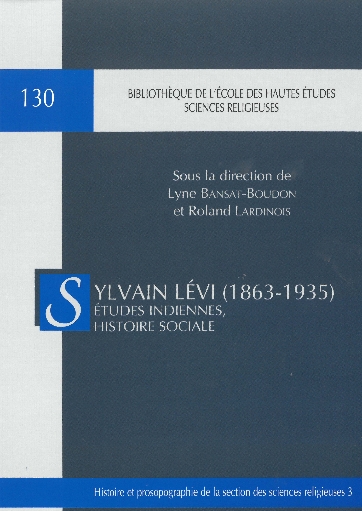
Sylvain Lévi (1863-1935). Études indiennes, histoire sociale
show More to view fulltext, buy and share links for:Sylvain Lévi (1863-1935). Études indiennes, histoire sociale show Less to hide fulltext, buy and share links for: Sylvain Lévi (1863-1935). Études indiennes, histoire socialeUn colloque international consacré à Sylvain Lévi s'est tenu à Paris, du 8 au 10 octobre 2003, sous l'égide de l'École Pratique des Hautes Études et de la Maison des Sciences de l'Homme. Le présent volume en constitue les Actes.
Directeur d'études à l'École Pratique des Hautes Études (de 1886 à 1935, à la IVe et à la Ve section) et professeur de langue et littérature sanskrites au Collège de France de 1894 à 1935, Sylvain Lévi (1863-1935) fut une haute figure de l'indianisme français, à une époque où la philologie sanskrite en était la discipline reine. Multipliant apprentissages et domaines de recherche afin d'appréhender de toutes parts la pensée indienne, il construisit une œuvre considérable, au rayonnement international. De même fut-il bâtisseur institutionnel, posant aussi bien les fondements de l'enseignement indianiste français que ceux de l'Institut de civilisation indienne, créé en 1927. Parallèlement, dans les années 1880, Sylvain Lévi rejoignit l'Alliance israélite universelle. Élu à sa présidence en 1920, il assuma cette fonction jusqu'à sa mort, en octobre 1935. Le nom de Sylvain Lévi est connu. Paradoxalement, pourtant, l'homme et l'œuvre sont aujourd'hui frappés d'un relatif oubli. Pour tenter d'y remédier, il était nécessaire d'adopter le double point de vue des études indiennes et de l'histoire sociale, tant il est vrai qu'en Sylvain Lévi se conjoignent exemplairement le savant adonné à sa recherche et l'intellectuel engagé, l'un et l'autre animés du même idéal d'humanisme et d'aspiration à l'universel.
Ainsi a-t-on relu l'œuvre indianiste et orientaliste de Sylvain Lévi, en s'efforçant d'en saisir la diversité (théâtre, littérature, études védiques, histoire des religions, bouddhisme, philologie, philosophie, histoire), et pris la mesure de son rayonnement international (Russie, Inde, Japon). On a également examiné la place qu'il occupa dans le monde intellectuel de la fin du XIXe siècle et du début du XXe, selon deux axes thématiques : les approches disciplinaires de l'orientalisme dans l'espace francophone à l'époque de Sylvain Lévi (philologie, histoire, anthropologie, sociologie); Sylvain Lévi et les milieux juifs en France, de l'Affaire Dreyfus à la Seconde Guerre mondiale.
Au terme de l'enquête, on se prend à penser qu'elle pourrait être l'effet différé de l'énergie militante que Sylvain Lévi a continûment insufflée dans ses travaux et dans sa vie. Comme on voit la roue du potier tournoyer quelque temps encore, après que la main a cessé d'en soutenir le mouvement.
-
-
-
Science and Technology in the Islamic World
show More to view fulltext, buy and share links for:Science and Technology in the Islamic World show Less to hide fulltext, buy and share links for: Science and Technology in the Islamic WorldThis volume provides a comprehensive overview of current researches on science in the Muslim-Arab world. The papers deal with the religious and institutional context, mathematics, optics, astronomy, mechanics, natural philosophy, and pharmacology.
The present volume also includes a general author index of the 21 volumes that make up the proceedings of the xxth International Congress of History of Science.
-
-
-
Science, Philosophy and Music
show More to view fulltext, buy and share links for:Science, Philosophy and Music show Less to hide fulltext, buy and share links for: Science, Philosophy and MusicThis volume illustrates the old and fruitful dialogue between historians of science and philosophers, as well as new collaborations with artists. It includes two symposia. The first one is on the history of scientific models, the seond is on science and music. It also contains papers on the philosophy of mathematics, physics, technology and politics, but also on Aristotle, Lucretius, Bacon, Le Bon, Spengler, Reichenbach, and Kuhn.
-
-
-
Scientific Instruments and Museums
show More to view fulltext, buy and share links for:Scientific Instruments and Museums show Less to hide fulltext, buy and share links for: Scientific Instruments and MuseumsThe present volume is organised around two symposia of the XXth International Congress of History of Science, respectively devoted to the history of sundials and to the national inventories of scientific instruments. Separate studies on outstanding instruments, instrument-makers, as well as unknown museums and collections in Spain, Italy, Estonia, and Latin-America were also included.
-
-
-
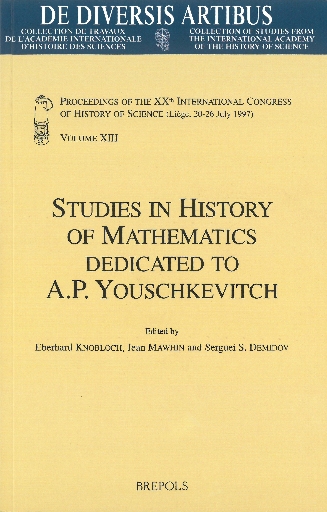
Studies in History of Mathematics Dedicated to A.P. Youschkevitch
show More to view fulltext, buy and share links for:Studies in History of Mathematics Dedicated to A.P. Youschkevitch show Less to hide fulltext, buy and share links for: Studies in History of Mathematics Dedicated to A.P. YouschkevitchIn the framework of the 20th International Congress of History of Science (Liège 1997), a symposium was devoted to the historical work of Adolph P. Youschkevitch (1906-1993). The present volume includes the papers read during the symposium as well as contributions on current issues in the history of mathematics : mathematics as a cultural strength, mathematics from antiquity to the classical period, probability theory and its applications, mathematics in the 19th and 20th centuries.
-
-
-
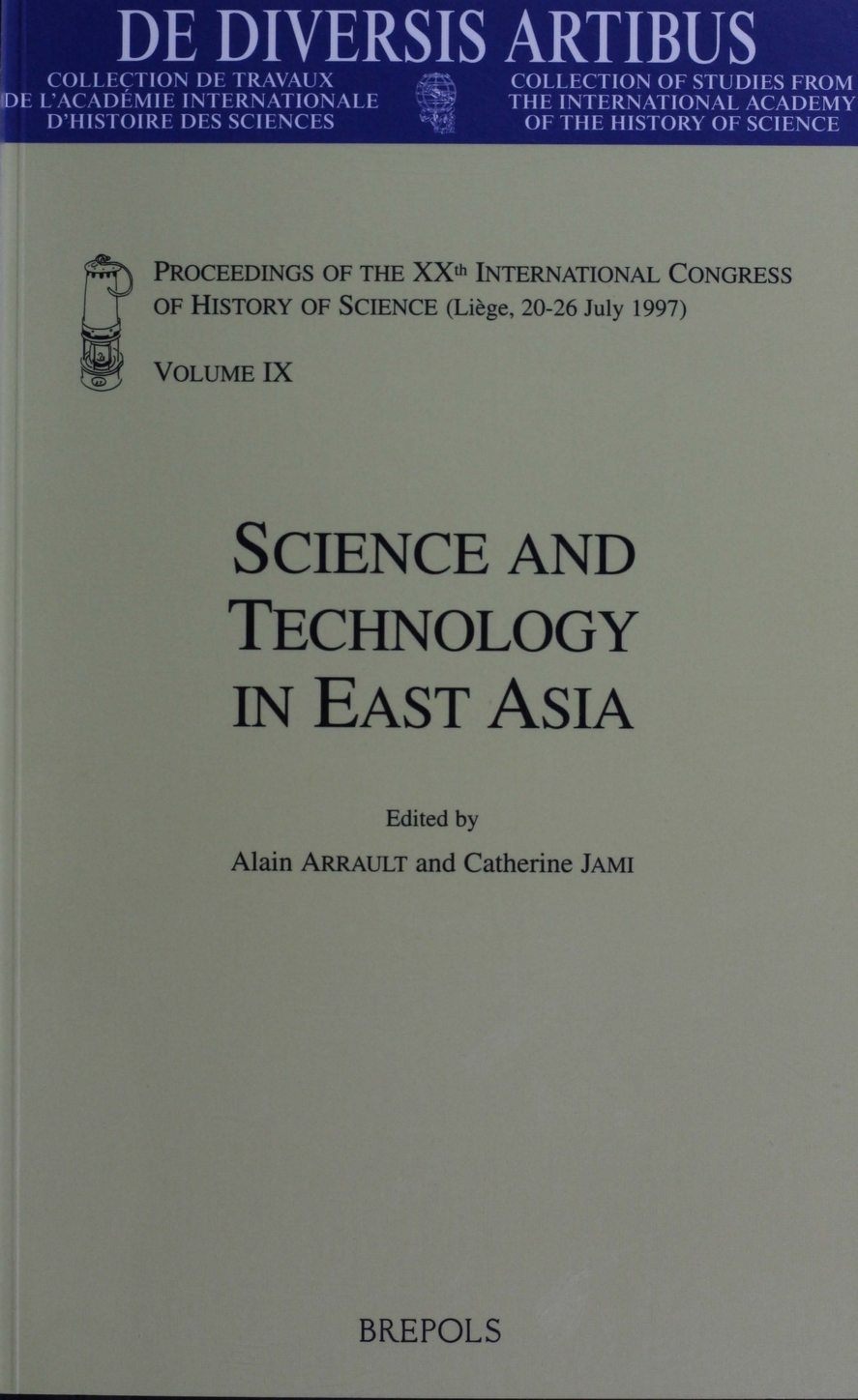
Science and Technology in East Asia. The Legacy of Joseph Needham
show More to view fulltext, buy and share links for:Science and Technology in East Asia. The Legacy of Joseph Needham show Less to hide fulltext, buy and share links for: Science and Technology in East Asia. The Legacy of Joseph NeedhamThe xx th International Congress of History of Science (Liège, July 1997) was the first to be held after Joseph Needham (1900-1995) passed away. During the Congress the symposium entitled “Global history of science” was dedicated to this scholar usually recognised as the founder of the study of East Asian science. The symposium aimed at highlighting the significance of his research, which has influenced historians of science in their study of all civilisations. The papers presented there and included in this volume focus on various historiographical and methodological issues raised by Needham’s work and on questions which he has opened to investigation. These issues and questions are relevant not only to the history of East Asian science and technology, but also to the history of science at large, once one envisions it in a global perspective. This volume is rounded off by four further papers that are representative of current research in the history of East Asian science.
-
-
-
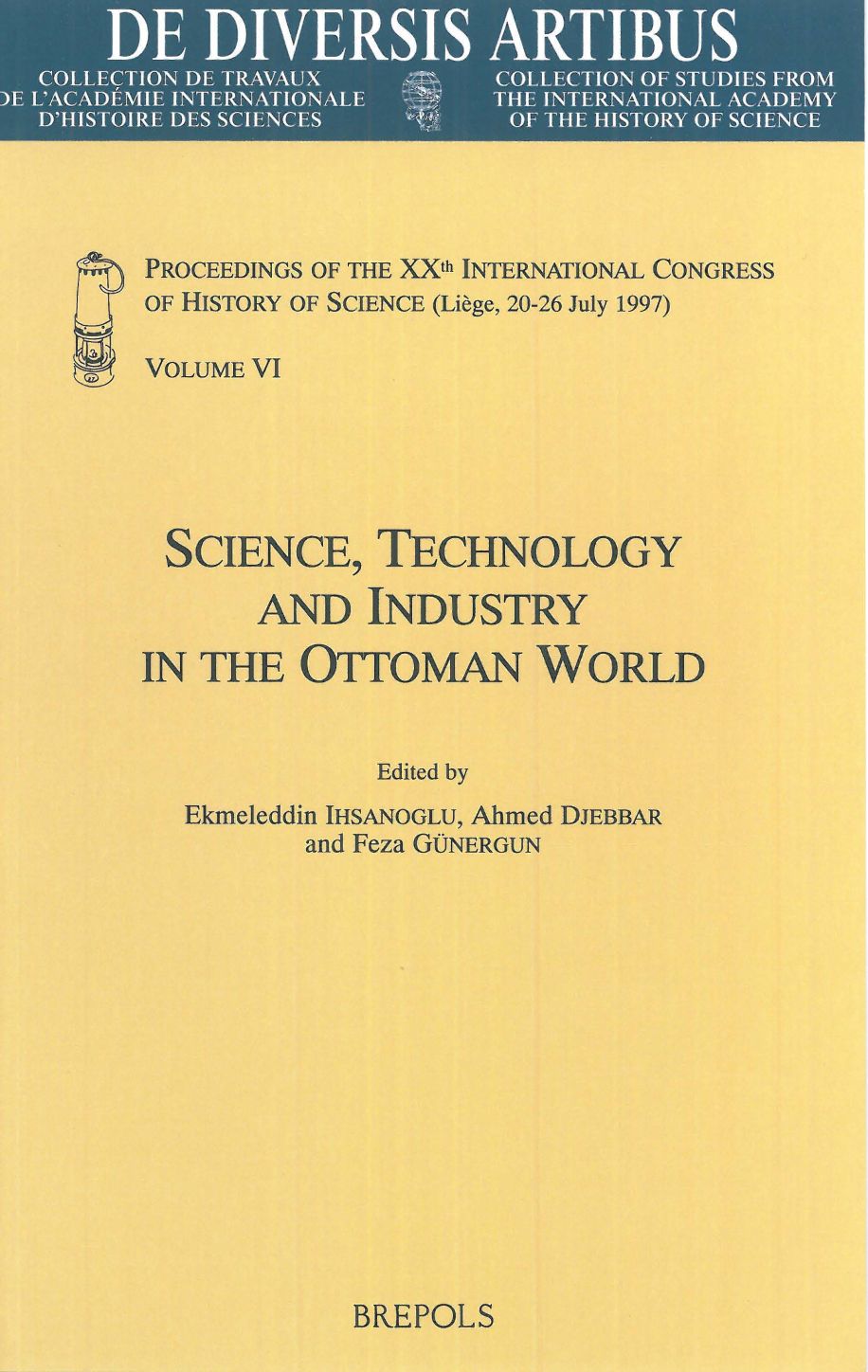
Science, Technology and Industry in the Ottoman World
show More to view fulltext, buy and share links for:Science, Technology and Industry in the Ottoman World show Less to hide fulltext, buy and share links for: Science, Technology and Industry in the Ottoman WorldThis volume gathers together the papers of the Symposium on Science, Technology and Industry in the Ottoman World which was organized within the XXth International Congress of History of Science held in Liège in July 1997. This symposium was the first to focus exclusively on the Ottoman World within the congresses convened by the International Union for the History and Philosophy of Science (IUHPS).
Scholarly interest in the scientific activities caried out in various geographical areas of the Ottoman Empire between the 14th and 20th century yielded a growing number of studies in recent years. The initial findings of these studies led scholars to question the view that Islamic science went into a decline after the 12th century, and to argue that Ottoman science constituted a new episode in Islamic science.
The present volume begins with a survey on the Ottomans' transition from the Islamic to the European scientific tradition. This survey is followed by research papers dealing with: the introduction of modern science and technology to Turkey in the 18th and 19th centuries as regards the military technical training, the first railway line in Asiatic Turkey and the teaching of modern botany; the introduction of modern medicine and Darwinism in Egypt; Bonaparte's expedition to Egypt from the viewpoint of history of science and technology; and the mathematical activities in the Maghreb in both pre-Ottoman and Ottoman periods.
-
-
-
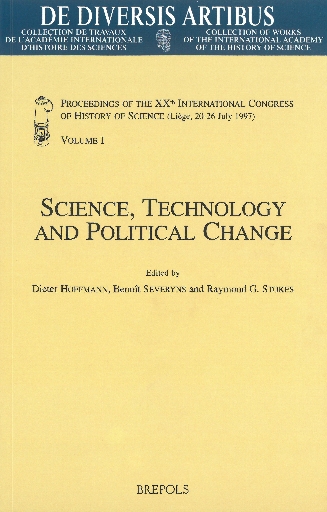
Science, Technology and Political Change
show More to view fulltext, buy and share links for:Science, Technology and Political Change show Less to hide fulltext, buy and share links for: Science, Technology and Political ChangeThis is the first of a series of thematic volumes consisting of a selection of papers from the 20th International Congress of History of Science, which was held in Liège in 1997, and organised by the International Union of History and Philosophy of Science (IUHPS), an organisation linked to UNESCO through the International Council for Science (ICSU).
The present volume deals with the relationship between science, technology and politics in the 20th century, with a special emphasis on some areas of the world that recently underwent serious political change including the German Democratic Republic and other countries from the former "Eastern bloc" such as Hungary, Ukraine, the Baltic countries, Russia, and countries in Central Asia. Individual contributions from Japan, Algeria and Portugal have also been included, since they should help initiate a transnational reflection on the subject.
-
-
-
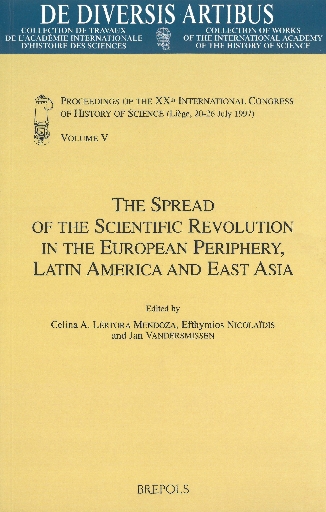
The Spread of the Scientific Revolution in the European Periphery, Latin America and East Asia
show More to view fulltext, buy and share links for:The Spread of the Scientific Revolution in the European Periphery, Latin America and East Asia show Less to hide fulltext, buy and share links for: The Spread of the Scientific Revolution in the European Periphery, Latin America and East AsiaThis volume includes papers presented during a symposium on the spreading of the scientific revolution outside Western European countries, which was held during the XXth International Congress of History of Science in Liège in 1997.
The contributions aim to answer some recent historiographical questions such as the modalities of the spreading of science in different countries, the reception of the new science by different cultures, the kind of changes this reception set in motion, the periodisation in adopting the new scientific knowledge, the structures set up for this adoption.
Three geographical areas are presented here: the European countries in the border of the "scientific center", Latin America countries and East Asian regions.
The volume constitutes the first attempt at making a synthesis at an international level on the important question of the spreading of the "new science" throughout the world.
-